
BuddhistCatholicContemplativeEvangelicalGeneral ChristianHinduJewishLatter-day SaintMuslimNew VisionsProgressive Christian
Beliefs
- Buddhist
- Catholic
- Contemplative
- Evangelical
- General Christian
- Hindu
- Jewish
- Latter-day Saint
- More Voices
- Muslim
- New Visions
- Pagan
- Progressive Christian
Topics
- Religion News
- Food and Religion
- Sports and Religion
- Religious Art
- Religious Music and Entertainment
- Religious Events
- History and Religion
- Style and Religion
- Politics and Religion
- Women in Religion
- Recreation Outdoors and Religion
- Business Finance and Religion
- Careers Workplace and Religion
- Education and Religion
- Family Parenting and Religion
- Health Fitness and Religion
- Home and Religion
- Relationships and Religion
- Technology and Religion
- Travel and Religion
Columnists
- Buddhist Columnists
- Business Finance and Religion Columnists
- Careers Workplace and Religion Columnists
- Catholic Columnists
- Contemplative Columnists
- Education and Religion Columnists
- Evangelists Columnists
- Family Parenting and Religion Columnists
- General Christian Columnists
- Health Fitness and Religion Columnists
- Hindu Columnists
- History and Religion Columnists
- Home and Religion Columnists
- Jewish Columnists
- More Voices Columnists
- Latter Day Columnists
- Muslim Columnists
- New Visions Columnists
- Nonreligious Columnists
- Pagan Columnists
- Politics and Religion Columnists
- Progressive Columnists
- Recreation Outdoors and Religion Columnists
- Relationships and Religion Columnists
- Religion News Columnists
- Religious Art Columnists
- Religious Events Columnists
- Religious Music and Entertainment Columnists
- Sports and Religion Columnists
- Style and Religion Columnists
- Technology and Religion Columnists
- Travel and Religion Columnists
- Women in Religion Columnists
Resource Library
- 2026 Calendar
- Library of World Religions
- The 100 Most Holy Places on Earth
- Patheos Answers
- Podcasts
- Videos
- Faith Leaders Database
- Anglican Episcopalian
- Bahai
- Baptist
- Buddhism
- Christianity
- Confucianism
- Eastern Orthodoxy
- Hinduism
- Holiness and Pentecostal
- ISKCON
- Islam
- Judaism
- Lutheran
- Methodist
- The Church of Jesus Christ of Latter-day Saints
- New Age
- Paganism
- Presbytarian and Reformed
- Protestantism
- Religion Behind the Scenes
- Roman Catholic
- Scientology
- Shia Islam
- Sikhism
- Sufism
- Sunni Islam
- Taoism
- Zen
- See all religions
Research Tools
 Ad-Free & Subscriber Log-In Subscription Support
Ad-Free & Subscriber Log-In Subscription Support
Follow Patheos 

- Trending:
- Forgiveness
- |
- Marriage
- |
- Consciousness
- |
- Death Penalty
- |
- Election
- |
- Halloween
 Eating Peaches
- Home
- Catholic
- Mary, Mother of God: The Theotokos
Mary, Mother of God: The Theotokos
Last updated on: December 31, 2018 at 8:38 pm by Marina S. Brungardt
Mary, Mother of God: The Theotokos 2018-12-31T20:38:43-07:00 Marina S. Brungardt
Patheos Explore the world's faith through different perspectives on religion and spirituality! Patheos has the views of the prevalent religions and spiritualities of the world.
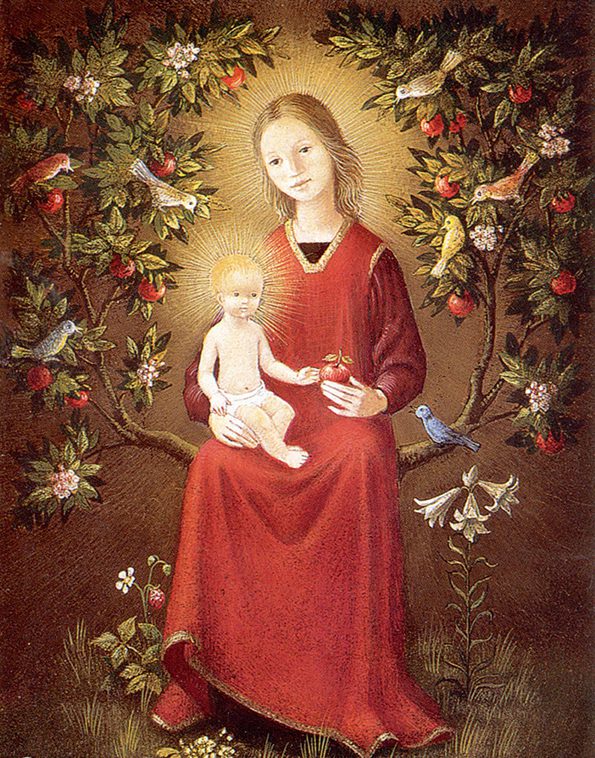
Image via Bradi-Barth.org
The Solemnity of Mary, Mother of God
Day Celebrated:
January 1, Holy Day of Obligation.
What Is the Feast About?
One of the most important dogmatic Marian teachings of our faith is that Mary is the Mother of God. This title of “Theotokos” or “God-Bearer” testifies to the fundamental reality of the Incarnation: the Person of the Son assumed to Himself a human nature; He is fully God and fully Man. The Catechism of the Catholic Church explains that:
Called in the Gospels “the mother of Jesus”, Mary is acclaimed by Elizabeth, at the prompting of the Spirit and even before the birth of her son, as “the mother of my Lord”. In fact, the One whom she conceived as man by the Holy Spirit, who truly became her Son according to the flesh, was none other than the Father’s eternal Son, the second person of the Holy Trinity. Hence the Church confesses that Mary is truly “Mother of God” (Theotokos).
Mary’s Divine motherhood follows from the fact that her son, Jesus, is truly God and truly Man, as the Gospel writers attest (c.f. Matthew 1:18-25, Luke 1:26-38, John 1: 1-18).
Nor were the earliest Church Fathers shy to recognize Mary as the Mother of God. St. Irenaeus, who lived during the second century, wrote in his work Against Heresies that the “Virgin Mary, being obedient to His word, received glad tidings that she should bear God” (5:19:1). Later, St. Ambrose invited his readers to consider the life of Mary by asking themselves “What is greater than the Mother of God? What is more glorious than she whom Glory Itself chose?” (Concerning Virgins II.ii.7) In his Letter to Cledonius the Priest, St. Gregory Nazianzen explicitly ties the truth of the hypostatic union of Christ’s divinity and humanity to the truth of Mary’s motherhood, writing “If anyone does not believe that Holy Mary is the Mother of God, he is severed from the Godhead.”
The Council of Ephesus in 431 A.D. explicitly takes up the question of Mary as the Theotokos. In this Council the Church addressed the Nestorian heresy by proclaiming that Mary’s Divine motherhood directly follows from the truth of the Incarnation. In short, the Nestorian heresy overemphasized the distinction between Christ’s Divine and Human Natures, leading those who held this position to claim that while Mary might be the “Christ-Bearer” in that she bore Christ with regards to his Humanity, she was not the “God-Bearer” or Mother of God. In refuting this claim, it is worth paying attention to three key proclamations the Council Fathers make:
- We too ought to follow these words and these teachings and consider what is meant by saying that the Word from God took flesh and became man. For we do not say that the nature of the Word was changed and became flesh, nor that he was turned into a whole man made of body and soul. Rather do we claim that the Word in an unspeakable, inconceivable manner united to himself hypostatically flesh enlivened by a rational soul, and so became man and was called son of man, not by God’s will alone or good pleasure, nor by the assumption of a person alone. Rather did two different natures come together to form a unity, and from both arose one Christ, one Son. It was not as though the distinctness of the natures was destroyed by the union, but divinity and humanity together made perfect for us one Lord and one Christ, together marvelously and mysteriously combining to form a unity. So he who existed and was begotten of the Father before all ages is also said to have been begotten according to the flesh of a woman…The Word is said to have been begotten according to the flesh, because for us and for our salvation he united what was human to himself hypostatically and came forth from a woman.
- Therefore, because the holy virgin bore in the flesh God who was united hypostatically with the flesh, for that reason we call her mother of God, not as though the nature of the Word had the beginning of its existence from the flesh (for “the Word was in the beginning and the Word was God and the Word was with God”, and he made the ages and is coeternal with the Father and craftsman of all things), but because, as we have said, he united to himself hypostatically the human and underwent a birth according to the flesh from her womb.
- If anyone does not confess that Emmanuel is God in truth, and therefore that the holy virgin is the mother of God (for she bore in a fleshly way the Word of God become flesh), let him be anathema.
There are some today who deny that Mary is the Mother of God, for example our Protestant brothers and sisters, who do so out of fear that calling her mother of God preempts God the Father’s role as generator of the Son. It is helpful to note as the Council Fathers do, that Mary is not the one who generates the Son insofar as He is the Second Person of the Trinity. Rather, Mary’s Divine motherhood is in fact consequent on the Incarnation of the Son: because the Son, Who assumed to His Person a Human Nature such that He is fully God and fully Man, became flesh, the mother of Him according to the flesh is not some partial mother, but rather mother of the whole, who is God and Man. Thus, Mary is truly called the Mother of God, not as if she generated the Trinity, but because she gave birth to the Son Who is fully God and fully Man. This is why the Council Fathers are so insistent on Mary being understood as the Theotokos: because to deny her Divine motherhood is to deny the full reality of the Incarnation.
Once again we see the beauty of the image of Mary as the moon, for like the moon which reflects the light of the sun, so Mary constantly reflects and points back to her Son. When we honor Mary in feasts and titles, when we meditate on her role in salvation history, she constantly draws us beyond herself to her Son. To honor Mary does not take away from Christ, rather, it opens up a vista from which we can better understand the wondrous love which led Him to come and unite us to Himself.
When Did the Church Begin Celebrating It?
This feast is the oldest Marian feast in the Church, and has traditionally been celebrated within the octave of Christ’s birth. The Eastern Church, around 500 AD, began to celebrate a “Day of the Theotokos” around the time of Christmas. This celebration ultimately became a Marian feast celebrated on December 26th (in the Byzantine Church) and on January 16th (in the Coptic Church).
While the Roman Church had strongly emphasized marking the octave day of Christmas for Mary since ~600 A.D., it wasn’t until much later, in Portugal that an initiative began seeking to proclaim a specific feast of Mary’s Divine Maternity. This led to Pope Benedict XIV decreeing in 1751 that Mary’s Divine Maternity would be celebrated the first Sunday of May.
As the years passed, more countries and congregations sought and were granted approval to celebrate this feast in their own liturgical calendars. In 1914, the celebration of this feast had shifted to October 11, and in 1931 Mary’s Divine Maternity was declared a universal feast. Finally, the feast was moved back to the octave of Christmas thanks to the Second Vatican Council, and has been celebrated on January 1 since 1969. As Pope Paul VI wrote about the shift,
In the revised ordering of the Christmas period it seems to us that the attention of all should be directed towards the restored Solemnity of Mary the holy Mother of God. This celebration, placed on January 1 in conformity with the ancient indication of the liturgy of the City of Rome, is meant to commemorate the part played by Mary in this mystery of salvation. It is meant also to exalt the singular dignity which this mystery brings to the “holy Mother…through whom we were found worthy to receive the Author of life.”(17) It is likewise a fitting occasion for renewing adoration of the newborn Prince of Peace, for listening once more to the glad tidings of the angels (cf. Lk. 2:14), and for imploring from God, through the Queen of Peace, the supreme gift of peace. It is for this reason that, in the happy concurrence of the Octave of Christmas and the first day of the year, we have instituted the World Day of Peace, an occasion that is gaining increasing support and already bringing forth fruits of peace in the hearts of many.
Prayers for the Feast:
The Akathist Hymn to the Blessed Virgin Mary
It is becoming for you, O Mary, to be mindful of us, as you stand near Him who bestowed upon you all graces, for you are the Mother of God and our Queen. Come to our aid for the sake of the King, the Lord God and Master Who was born of you. For this reason you are called “full of grace.”
Be mindful of us, most holy Virgin, and bestow on us gifts from the riches of your graces, O Virgin, full of grace.
We honor you, O Mary,
Mother of God,
treasure of the universe,
inextinguishable flame,
crown of virginity,
scepter of the true faith,
indestructible temple,
tabernacle of the one whom
the world cannot contain,
and mother and virgin. …
In your virginal womb
you enclosed the immense and
incomprehensible One.
Through you the Trinity is glorified
and the cross is celebrated and adored
everywhere on earth.
Through you
the heavens exult with joy,
the angels and archangels are glad,
demons are put to flight,
the demon tempter is cast out of heaven,
and our fallen nature has again
been assumed into heaven. …
It is through you that the only-begotten Son of God,
who is the Light,
shone amid the nations
who were seated in darkness and the shadow of death.
What human voice can ever worthily celebrate
the ineffable greatness of Mary?
She is mother and virgin
at the same time.
Through her
peace has been restored to the world.
What peace?
Our Lord Jesus Christ,
whom Mary has brought forth!
Further Reading:
- Theotokos: Woman, Mother, Disciple- A Catechesis on Mary, Mother of God by Pope St. John Paul II
- The World’s First Love: Mary the Mother of God by Fulton Sheen
- Theotokos: A Theological Encyclopedia of the Blessed Virgin Mary by Fr. Michael O’Carroll, C.S.Sp.
- Rethinking Mary in the New Testament: What the Bible Tells Us about the Mother of the Messiah by Edward Sri
- Hail, Holy Queen by Scott Hahn
- Praying With Mary: An English-Latin Edition
- The Complete Ante-Nicene & Nicene and Post-Nicene Church Fathers Collection
- Canons of the Ecumenical Council of Ephesus; 431 AD
Resources:
- https://udayton.edu/imri/mary/archive.php?format=html&tags=Doctrine,%20Dogma,%20Theology%20and%20Tradition|
- https://udayton.edu/imri/mary/s/solemnity-of-marys-maternity-origins.php
- Mary+as+Mother+of+God%2FTheotokos
- http://www.newadvent.org/fathers/index.html
- http://www.newadvent.org/cathen/15464b.htm
- https://www.ewtn.com/library/councils/ephesus.htm
- https://www.catholicnewsagency.com/resources/mary/general-information/the-four-marian-dogmas
- https://www.osv.com/OSVNewsweekly/Story/TabId/2672/ArtMID/13567/ArticleID/6199/Theotokos.aspx

About Marina S. Brungardt
Writer, teacher, grad student, wife, mother. If you like what you are reading, please consider making a small contribution to my patron page: https://www.patreon.com/marinabrungardt. You can read more about the author here.
Previous Post
December 13, 2018
Saint Lucy of Syracuse: Looking to God
Browse Our Archives
Select a Category Body Problems Fatherhood Feast Day Friendship Grace Building on Nature Holy Days and Liturgy Living Life in Christ Love and Marriage and Other Responsibilities Mary Motherhood Philosophic Wanderings Podcasts Reality of Things Saint of the Day The Beautiful The Good The Habit of Being In The Polis The Reality Superelevating Things The True Transcendentals Transcendentals Trinity Uncategorized Virtue
Select a Month December 2018 June 2017 May 2017 April 2017 March 2017 February 2017 January 2017 December 2016 September 2016 August 2016 July 2016 June 2016 May 2016
Follow Us!
TAKE THE
Religious Wisdom Quiz
How many times did Peter deny Jesus?
Select your answer to see how you score.
4 2 5 3
Related posts from Eating Peaches

Saint Lucy of Syracuse: Looking to God
Our Lady of Guadalupe: Empress of the Americas

Pope Saint Gregory III: Against the Iconoclasts
Saint Juan Diego: The First Indigenous American Saint
TRENDING AT PATHEOS Catholic

Rejecting Doom: Christian Hope And Human Action
Christianity is a religion of hope. We are to have hope and...

It’s What Comes From Within Which Matters
One of the most difficult things for us to understand is why...

Why I Choose the Eucharist Over the Sermon
Choose the Eucharist, Not the Sermon What are we supposed to get...

5 Design Elements Found in Spiritually Rooted Homes
Putting Spirituality Into Home Decor Our homes are more than our living...

Credo: A Story of God Told with the...
About 10 years ago, I began to imagine a personal "Credo" that...

The Anatomy of Divine Revelation in Catholic Thought
The claim that God has made Himself known to human beings is...
view all Catholic blogs
Ad-Free & Subscriber Log-In Subscription Support
- About Us
- 2026 Calendar
- Videos
- Podcasts
- Library of World Religions
- Faith In Media Tracker
- Advertise With Us
- Write for Us
- Privacy Policy
- Terms of Service
- Do Not Sell My Data
- Contact Us
- Radiant Digital
- Manage Newsletter Subscriptions
- Unsubscribe From Notifications
- Sitemap
Copyright 2008-2026, Patheos. All rights reserved.
Subscription Support Ad-Free & Subscriber Log-In
Follow Patheos