
BuddhistCatholicContemplativeEvangelicalGeneral ChristianHinduJewishLatter-day SaintMuslimNew VisionsProgressive Christian
Beliefs
- Buddhist
- Catholic
- Contemplative
- Evangelical
- General Christian
- Hindu
- Jewish
- Latter-day Saint
- More Voices
- Muslim
- New Visions
- Pagan
- Progressive Christian
Topics
- Religion News
- Food and Religion
- Sports and Religion
- Religious Art
- Religious Music and Entertainment
- Religious Events
- History and Religion
- Style and Religion
- Politics and Religion
- Women in Religion
- Recreation Outdoors and Religion
- Business Finance and Religion
- Careers Workplace and Religion
- Education and Religion
- Family Parenting and Religion
- Health Fitness and Religion
- Home and Religion
- Relationships and Religion
- Technology and Religion
- Travel and Religion
Columnists
- Buddhist Columnists
- Business Finance and Religion Columnists
- Careers Workplace and Religion Columnists
- Catholic Columnists
- Contemplative Columnists
- Education and Religion Columnists
- Evangelists Columnists
- Family Parenting and Religion Columnists
- General Christian Columnists
- Health Fitness and Religion Columnists
- Hindu Columnists
- History and Religion Columnists
- Home and Religion Columnists
- Jewish Columnists
- More Voices Columnists
- Latter Day Columnists
- Muslim Columnists
- New Visions Columnists
- Nonreligious Columnists
- Pagan Columnists
- Politics and Religion Columnists
- Progressive Columnists
- Recreation Outdoors and Religion Columnists
- Relationships and Religion Columnists
- Religion News Columnists
- Religious Art Columnists
- Religious Events Columnists
- Religious Music and Entertainment Columnists
- Sports and Religion Columnists
- Style and Religion Columnists
- Technology and Religion Columnists
- Travel and Religion Columnists
- Women in Religion Columnists
Resource Library
- 2026 Calendar
- Library of World Religions
- The 100 Most Holy Places on Earth
- Patheos Answers
- Podcasts
- Videos
- Faith Leaders Database
- Anglican Episcopalian
- Bahai
- Baptist
- Buddhism
- Christianity
- Confucianism
- Eastern Orthodoxy
- Hinduism
- Holiness and Pentecostal
- ISKCON
- Islam
- Judaism
- Lutheran
- Methodist
- The Church of Jesus Christ of Latter-day Saints
- New Age
- Paganism
- Presbytarian and Reformed
- Protestantism
- Religion Behind the Scenes
- Roman Catholic
- Scientology
- Shia Islam
- Sikhism
- Sufism
- Sunni Islam
- Taoism
- Zen
- See all religions
Research Tools
 Ad-Free & Subscriber Log-In Subscription Support
Ad-Free & Subscriber Log-In Subscription Support
Follow Patheos 

- Trending:
- Forgiveness
- |
- Marriage
- |
- Consciousness
- |
- Death Penalty
- |
- Election
- |
- Halloween
 Eating Peaches
- Home
- Catholic
- The Holy Spirit: Who is He?
The Holy Spirit: Who is He?
Last updated on: September 20, 2016 at 12:57 am by Marina S. Brungardt
The Holy Spirit: Who is He? 2016-09-20T00:57:08-07:00 Marina S. Brungardt
Patheos Explore the world's faith through different perspectives on religion and spirituality! Patheos has the views of the prevalent religions and spiritualities of the world.
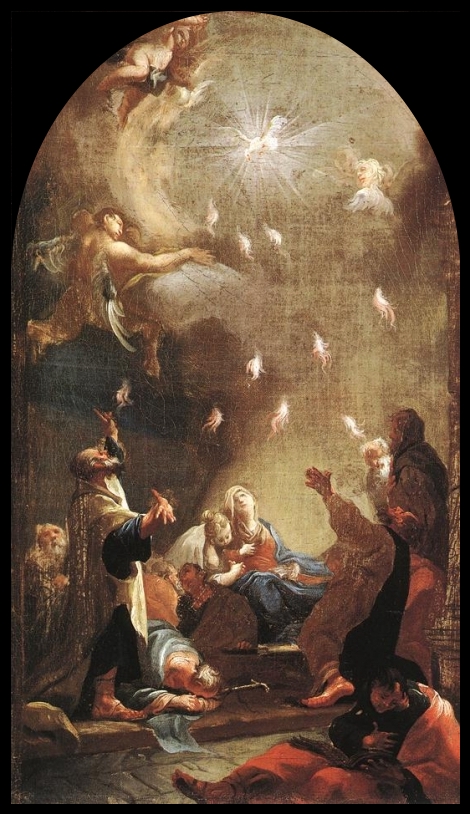
Image via Wikimedia Commons

***This is the first of a two part inquiry into the Person of the Holy Spirit. This post will explore our relationship with the Holy Spirit more in terms of Who He is, and tomorrow I will post a follow up considering our relationship with the Holy Spirit in more experiential terms of how He should be an essential Person in our spiritual lives.
There is a beautiful passage I was recently reading from On Cleaving to God, a text attributed to St. Albert the Great:
For love draws the lover out of himself (since love is strong as death), and establishes him in the beloved, causing him to cleave closely to him. For the soul is more where it loves than where it lives, since it is in what it loves in accordance with its very nature, understanding and will, while it is in where it lives only with regard to form, which is even true for animals as well…Nor can anyone attain the supreme beatitude unless summoned to it by love and yearning. Love after all is the life of the soul, the wedding garment and the soul’s perfection, containing all the law and the prophets and our Lord’s teaching. That is why Paul says to the Romans, Love is the fulfilling of the law, (Rom. 13.8) and in the first letter to Timothy, The end of the commandment is love. (1 Timothy 1.5).
Have you ever lived far from a friend? Or a significant other? I’ve done both, and let me tell you—it’s hard. My best friend lives across the country from me, and my sister lives at least a thousand miles away, and most of my closest friends are at least a three hour drive beyond where I live. When I’ve stayed up hours beyond midnight, when I’m on FaceTime at times inconvenient for all of us, when I’m involved in their lives and classes and friendships and know about people I have never met, I understand what St. Albert is talking about. My soul is confined to my body, because I am, after all, body and soul. But my soul does in a way share life with these ones I love, because I am made for communion, because I seek to know my friends more—to share in their days and weeks as I may, and I seek their good through prayer and conversation and anything I can do to bring it about.
Now, there is a side of this experience of being in that reveals our life in Christ; namely, we are called to love God with all our heart, soul, mind, and strength, but I’d like to take a different approach. Instead of considering how love is the principle by which we are in God, I think the far more neglected side of this thought is the following point St. Albert makes: love is the life of the soul. That is to say, while love draws us to God and brings us into Him, love is also the principle by which God is in us and dwells in our souls. In fact, God’s love by which He comes and dwells among us is in fact the reason we can love Him and desire to be with Him in the first place.
This began to make more sense to me when I realized that I don’t have to exist. I mean, obviously, I could have not been born. But it’s not just me. All of us, this whole world, none of it was necessary. God, in His Holy Trinity, was content. The Person of the Father originated the Word, Who differed only in that He was from the Father, and the mutual Love between them is the Holy Spirit (or the outpouring of the Love of the Father for the Son if you are feeling more Orthodox today). Yet, love does not remain static.
Think about it: when we love other people so much, in a romantic sense, we want to have a wedding and invite all our friends. The best weddings are those where the couple invites the guests to come in and share the joy and happiness they have found. In these instances, love is not static but dynamic—it reaches beyond itself simply because it desires others to find this joy and happiness encompassed in love. In fact, when that love aligns just right with biology, it becomes life-giving—love is the proper context through which new life was intended to enter the world. Love is like fresh-baked cookies: the scent diffuses everywhere, suggesting that the goodness of the cookie existing could make your life even better.*
The Holy Spirit, the Love of the Father and the Son, likewise is dynamic. As our highest Good, God is that which we most fundamentally and deeply desire, and yet we can only love Him in being loved by Him, for “this is love, not that we loved God but that he loved us” (1 John 4:10). God, loving us, gave us His Son, Who in turn calls us to union. In Christ, we are one with Him as He and the Father are One and we remain in Him. The gift of this call to love, sometimes called the call to holiness, in our lives is the action of the Holy Spirit coming to us. The Person Who is the Love between the Father and the Son, a Love so perfect it is personal and wholly God, reaches out to embrace us.
Christ gives us the Holy Spirit to dwell in us as members of His Church—He is giving us the Love the Father has for Him. This Love, by inclination to us (which God freely chooses), by knowing us fully, and by loving us so much as to give us all of Himself without reservation, can only be effected by the Third Person of the Blessed Trinity dwelling within our souls.
So what does this mean? We are baptized Christians, and the Holy Spirit dwells in us; in this Trinitarian Unity, Christ has revealed that the Father through the Son in that same Holy Spirit also dwell within us. It means that God loves us so radically that He seeks us out with the ardor of a lover who will do anything to awaken desire within us. Once he is in us, God the Holy Spirit penetrates our soul, knowing us “fully.” This is rather terrifying to consider—to be stripped bare before one who loves us. And yet, it is not without reason that St. Albert also calls Love the “wedding garment and the soul’s perfection.” In that knowledge, He also captures us in His Love which is Himself.
We are imperfect. We are all wounded, whether by the scars or the festering blisters of sin—the problem of evil and the problem of us doing bad things. And yet. God wants to be in us, not to condemn us, but to draw us ever nearer to Him in love. God wants to clothe us with himself, to heal our scars and cauterize our wounds with flame of love. St. Bernard recognizes this healing offered in the Spirit when he prayed:
O Wisdom, sweetly powerful and powerfully sweet, with what skill of healing in wine and oil do you restore my soul’s health. Powerfully for me and sweet to me. You deploy your strength from one end of the earth to the other, ordering all things sweetly, driving off all hostile powers and cherishing the weak. Heal me, Lord, and I shall really be healed, I shall sing praise to your name.
The wounds, the sins, the shames, the fears we all carry with us are not all we are. We are loved, so profoundly that God Himself seeks out those secret memories we fear to uncover, in order to heal us if we desire it. God is jealous: He will let nothing separate us from His love, except our own refusal to receive that love.
For love is strong as death, jealousy is cruel as the grave. Its flashes are flashes of fire, a most vehement flame.
Pray to the Holy Spirit. Talk to Him, particularly from your wounded and sinful state, because He wants to embrace you and draw you to Himself in His Trinity through the gift of the Sacraments. The Holy Spirit, Love, brings God to us and brings us into union with God in His Most Holy Trinity. He seeks to perfect us, to make us holy, to make us lovable, through loving us. If He still seems to remote, consider beginning by inviting Him to dwell in your soul with the Church’s ancient prayer:
Come, Holy Spirit, fill the hearts of Thy faithful and enkindle in them the fire of Thy love.
*In truth the Holy Spirit is nothing like cookies, but then God is in many ways nothing like us, so we use images and analogies and the way of negation (i.e. “God is not human) because revelation gives us some basis to say things (like how St. Athanasius unpacks St. John’s profession that those who have the Spirit are “the sweet savor of Christ” to show the Holy Spirit is Breath of the Son Who anoints us and impresses Christ into our souls as a seal).
The Reality Superelevating Things
Previous Post

September 14, 2016
ThisCatholicGirl: A Shadow Play for the Internet Age
Next Post

September 22, 2016 The Holy Spirit, Part II: Who is He to Me?
Browse Our Archives
Select a Category Body Problems Fatherhood Feast Day Friendship Grace Building on Nature Holy Days and Liturgy Living Life in Christ Love and Marriage and Other Responsibilities Mary Motherhood Philosophic Wanderings Podcasts Reality of Things Saint of the Day The Beautiful The Good The Habit of Being In The Polis The Reality Superelevating Things The True Transcendentals Transcendentals Trinity Uncategorized Virtue
Select a Month December 2018 June 2017 May 2017 April 2017 March 2017 February 2017 January 2017 December 2016 September 2016 August 2016 July 2016 June 2016 May 2016
Follow Us!
TAKE THE
Religious Wisdom Quiz
Who betrayed Jesus for thirty pieces of silver?
Select your answer to see how you score.
Peter James Saul Judas
Related posts from Eating Peaches

Saint Lucy of Syracuse: Looking to God

Pope Saint Gregory III: Against the Iconoclasts
Saint Mary Josepha Rossello: Surprised by Vocation

Advent and the Incarnation When Words Fail
TRENDING AT PATHEOS Catholic

The Parable Of The Sower And The Word...
One of Christ’s most famous parables is that of the sower who...

Rejecting Doom: Christian Hope And Human Action
Christianity is a religion of hope. We are to have hope and...

Why I Choose the Eucharist Over the Sermon
Choose the Eucharist, Not the Sermon What are we supposed to get...

5 Design Elements Found in Spiritually Rooted Homes
Putting Spirituality Into Home Decor Our homes are more than our living...

Credo: A Story of God Told with the...
About 10 years ago, I began to imagine a personal "Credo" that...

The Anatomy of Divine Revelation in Catholic Thought
The claim that God has made Himself known to human beings is...
view all Catholic blogs
Ad-Free & Subscriber Log-In Subscription Support
- About Us
- 2026 Calendar
- Videos
- Podcasts
- Library of World Religions
- Faith In Media Tracker
- Advertise With Us
- Write for Us
- Privacy Policy
- Terms of Service
- Do Not Sell My Data
- Contact Us
- Radiant Digital
- Manage Newsletter Subscriptions
- Unsubscribe From Notifications
- Sitemap
Copyright 2008-2026, Patheos. All rights reserved.
Subscription Support Ad-Free & Subscriber Log-In
Follow Patheos