
BuddhistCatholicContemplativeEvangelicalGeneral ChristianHinduJewishLatter-day SaintMuslimNew VisionsProgressive Christian
Beliefs
- Buddhist
- Catholic
- Contemplative
- Evangelical
- General Christian
- Hindu
- Jewish
- Latter-day Saint
- More Voices
- Muslim
- New Visions
- Pagan
- Progressive Christian
Topics
- Religion News
- Food and Religion
- Sports and Religion
- Religious Art
- Religious Music and Entertainment
- Religious Events
- History and Religion
- Style and Religion
- Politics and Religion
- Women in Religion
- Recreation Outdoors and Religion
- Business Finance and Religion
- Careers Workplace and Religion
- Education and Religion
- Family Parenting and Religion
- Health Fitness and Religion
- Home and Religion
- Relationships and Religion
- Technology and Religion
- Travel and Religion
Columnists
- Buddhist Columnists
- Business Finance and Religion Columnists
- Careers Workplace and Religion Columnists
- Catholic Columnists
- Contemplative Columnists
- Education and Religion Columnists
- Evangelists Columnists
- Family Parenting and Religion Columnists
- General Christian Columnists
- Health Fitness and Religion Columnists
- Hindu Columnists
- History and Religion Columnists
- Home and Religion Columnists
- Jewish Columnists
- More Voices Columnists
- Latter Day Columnists
- Muslim Columnists
- New Visions Columnists
- Nonreligious Columnists
- Pagan Columnists
- Politics and Religion Columnists
- Progressive Columnists
- Recreation Outdoors and Religion Columnists
- Relationships and Religion Columnists
- Religion News Columnists
- Religious Art Columnists
- Religious Events Columnists
- Religious Music and Entertainment Columnists
- Sports and Religion Columnists
- Style and Religion Columnists
- Technology and Religion Columnists
- Travel and Religion Columnists
- Women in Religion Columnists
Resource Library
- 2026 Calendar
- Library of World Religions
- The 100 Most Holy Places on Earth
- Patheos Answers
- Podcasts
- Videos
- Faith Leaders Database
- Anglican Episcopalian
- Bahai
- Baptist
- Buddhism
- Christianity
- Confucianism
- Eastern Orthodoxy
- Hinduism
- Holiness and Pentecostal
- ISKCON
- Islam
- Judaism
- Lutheran
- Methodist
- The Church of Jesus Christ of Latter-day Saints
- New Age
- Paganism
- Presbytarian and Reformed
- Protestantism
- Religion Behind the Scenes
- Roman Catholic
- Scientology
- Shia Islam
- Sikhism
- Sufism
- Sunni Islam
- Taoism
- Zen
- See all religions
Research Tools
 Ad-Free & Subscriber Log-In Subscription Support
Ad-Free & Subscriber Log-In Subscription Support
Follow Patheos 

- Trending:
- Forgiveness
- |
- Marriage
- |
- Consciousness
- |
- Death Penalty
- |
- Election
- |
- Halloween
 Eating Peaches
- Home
- Catholic
- Mary’s Fiat: Refuge of Persistent Sinners
Mary’s Fiat: Refuge of Persistent Sinners
Last updated on: August 15, 2016 at 12:00 am by Marina S. Brungardt
Mary’s Fiat: Refuge of Persistent Sinners 2016-08-15T00:00:27-07:00 Marina S. Brungardt
Patheos Explore the world's faith through different perspectives on religion and spirituality! Patheos has the views of the prevalent religions and spiritualities of the world.
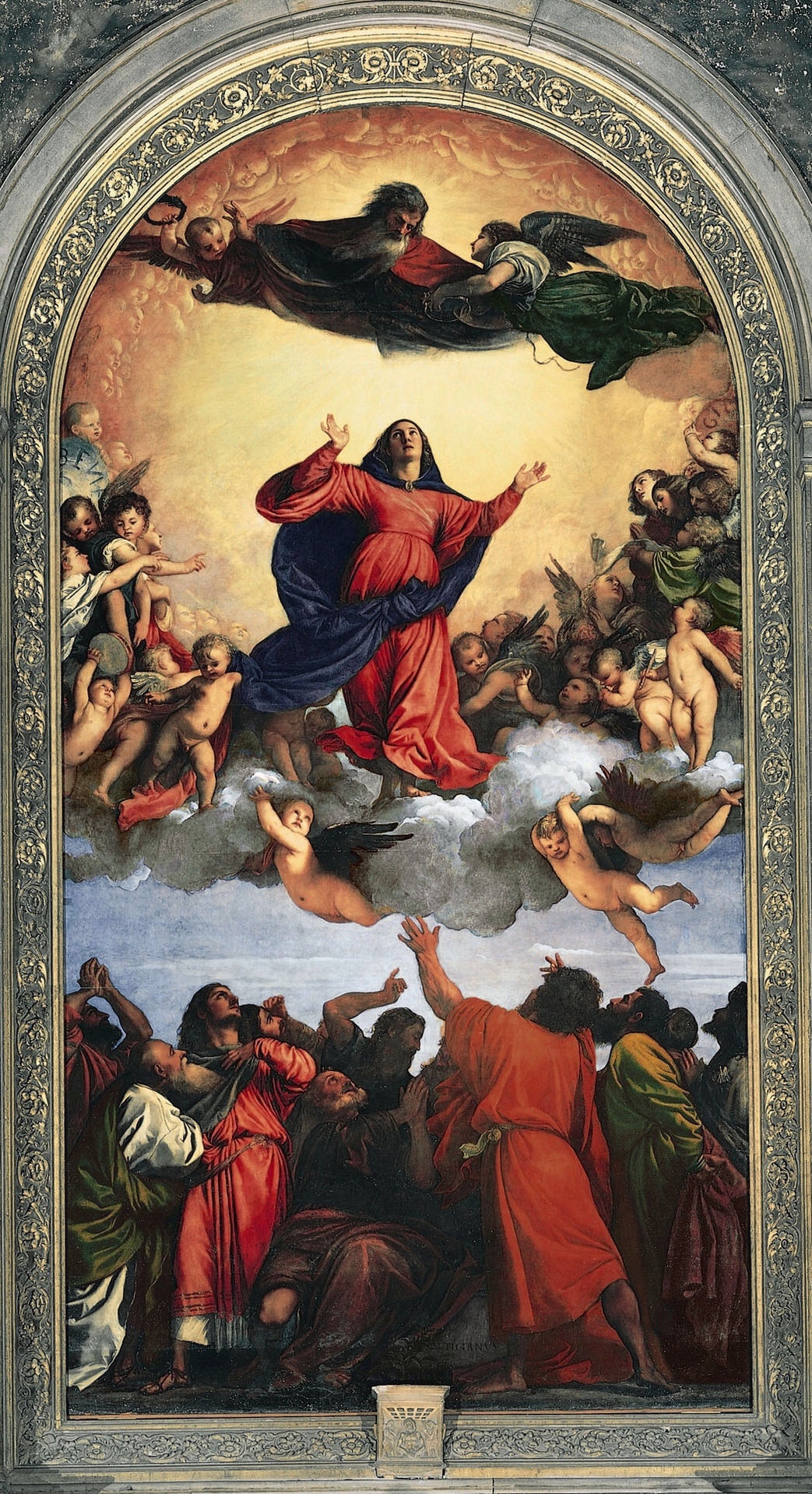
Titan’s Assumption of Mary via Wikimedia Commons, public domain
Today is the feast of the Assumption. Yesterday was the day that I fell into a sin (among, unfortunately, other sins) that I hadn’t fallen into since I was a teenager. In fact, this particularly troublesome sin was one I hadn’t even thought to be on guard for, it had been so long since I had been tempted to it. And then, bam!, there I went falling into it without even realizing. It really sucked.
I was texting a good friend of mine about it, and he told me that when we fall back into sins like this,
It gives us some small glimpse of what life would be like if we completely abandoned God…because as bad as I am, I would be so unspeakably worse without grace.
This is not unlike the reality of Mary. See, before there was Mary, the world wasn’t just getting a small glimpse of what life was like if we completely abandoned God. In the words of St. Athanasius, humans, post-Fall, were “in the process of becoming corrupted entirely, and death had them completely under its dominion.” We were getting the home run equivalent to seeing life without God. Yet, despite the darkness that our hearts can hold, we also have Mary of whom, alone out of all human persons, we can proclaim et macula non est inte—there is no blemish in you.
In her fiat, our Blessed Mother is the cause of our hope: she is the cause of our hope as the Theotokos, the Mother of God, and she is the cause of our hope because she is the first fruit of Christ’s salvific mission. Turning to the second of these, the Church reiterates and reaffirms the title St. Gabriel addresses the Blessed Virgin by: “full of grace.” In exploring this title, then-Cardinal Josef Ratzinger (a.k.a Pope Emeritus Benedict XVI) wrote that
Grace in the proper and deepest sense of the word is not something that comes from God, it is God himself. Redemption means that God, acting as God truly does, gives us nothing less than himself… ‘Full of grace’ therefore means, once again, that Mary is a wholly open human being, one who has opened herself entirely, one who has placed herself in God’s hands boldly, limitless, and without fear for her own fate. It means she lives wholly by and in relation to God.
In this, Mary is wholly and radically embraced by divine love. Her fiat, her Yes is, as Ratzinger says later, “wholly grace” all the while remaining no less wholly hers. The grace Mary received “does not cancel freedom; it creates it.” This is the hope we have in Mary as the first fruit of Christ’s mission: Mary was given the grace not merely to obey the word of God, Mary was given the grace to carry within her own flesh the very Incarnate Word of the Father.
This sounds an awful long way from falling into/throwing ourselves into sin. Yet, the impossibility of Mary is what gives us hope. That any human should be graced to offer such a profound Yes to conformity with God, that any human should be without stain, is astonishing. This is, perhaps, a small part of why so many of Our Lady’s feast days are holy days of obligation: without Christ, Mary could not have had the freedom found in grace to be most fully herself. If God can preserve Mary from all sin, it seems that it is possible that He will one day overwhelm me with His love, preserving me from all sin.
If any human can say Yes to God in the profound way that Mary could, there is hope that I could say Yes to God sufficiently that I might become a saint. Mary is the Mother of God, and how easy and hard that is. Easy for God and hard for her. But if she can be humble enough to be immaculate, perhaps even when I sin, I can be humble enough to reach out and touch the hem of the garment of my God.
I’m not saying habitual sin doesn’t suck. I’m not saying that revisiting sins you know you’ve overcome, only to find that you haven’t so much overcome them as that they’ve been dormant like cicadas, isn’t a rather day ruining realization. And, I’m not saying that we will never sin again, because we have those inclinations and we likely will. We might even feel all the guilt and shame that come from failing at something we desperately want to do well.
But what I am saying is that Mary is without sin. Mary is the Mother of God. Mary said and continues to say the most profound Yes and profound acceptance of God’s will that any human person ever has, a Yes that gave her a child, a Yes that pierced her heart, a Yes that saw her watch her Child die a horrific death. Yet, she did not suffer the grave. She was Assumed, body and soul, into Heaven to be with the Son who suffered that horrific death for her sake. He also suffered that horrific death for our sake, so that we might die to the world and rise in Him. Mary’s life manifests the profound love of God: the world was in darkness and one of our own was called to bear forth the Light.
When our own lives become dark with sin, I have realized that I need to turn to God and pray that He with send forth His Light into my life. After all, the Virgin birth/earthly mission/dying/rising from the dead/sending forth of the disciples part was the hard part, and that already happened.
The world collectively was at least as bad as I am in my worst moments, and God loved us enough all together to do so many impossible things. How much more ought I to hold on to hope that, no matter how dark it seems, He can still love me, He can still forgive me, and He can still redeem me. Mary received the grace to be conceived without sin and assumed into Heaven. I simply need the grace to confess my sins and return to Him. If He can do such wondrously difficult things for Mary, I can pray with confidence and hope even when I have fallen that He will be able to love me anyway.
The Reality Superelevating Things
Previous Post

August 10, 2016
Masturbation and Despair: A Podcast Follow Up with Mountain Catholic
Next Post

August 23, 2016 The Catholic Church is Not Your Sports Team
Browse Our Archives
Select a Category Body Problems Fatherhood Feast Day Friendship Grace Building on Nature Holy Days and Liturgy Living Life in Christ Love and Marriage and Other Responsibilities Mary Motherhood Philosophic Wanderings Podcasts Reality of Things Saint of the Day The Beautiful The Good The Habit of Being In The Polis The Reality Superelevating Things The True Transcendentals Transcendentals Trinity Uncategorized Virtue
Select a Month December 2018 June 2017 May 2017 April 2017 March 2017 February 2017 January 2017 December 2016 September 2016 August 2016 July 2016 June 2016 May 2016
Follow Us!
TAKE THE
Religious Wisdom Quiz
Who killed Goliath with a stone and sling?
Select your answer to see how you score.
Jonathan Saul Samson David
Related posts from Eating Peaches
Mary, Mother of God: The Theotokos

Saint Lucy of Syracuse: Looking to God
Our Lady of Guadalupe: Empress of the Americas

Pope Saint Gregory III: Against the Iconoclasts
TRENDING AT PATHEOS Catholic

Creation, Preservation, and Teleology in Catholic Theology
As I write this, it is very early Monday morning. Like millions...

The Parable Of The Sower And The Word...
One of Christ’s most famous parables is that of the sower who...

Rejecting Doom: Christian Hope And Human Action
Christianity is a religion of hope. We are to have hope and...

Why I Choose the Eucharist Over the Sermon
Choose the Eucharist, Not the Sermon What are we supposed to get...

5 Design Elements Found in Spiritually Rooted Homes
Putting Spirituality Into Home Decor Our homes are more than our living...

Credo: A Story of God Told with the...
About 10 years ago, I began to imagine a personal "Credo" that...
view all Catholic blogs
Ad-Free & Subscriber Log-In Subscription Support
- About Us
- 2026 Calendar
- Videos
- Podcasts
- Library of World Religions
- Faith In Media Tracker
- Advertise With Us
- Write for Us
- Privacy Policy
- Terms of Service
- Do Not Sell My Data
- Contact Us
- Radiant Digital
- Manage Newsletter Subscriptions
- Unsubscribe From Notifications
- Sitemap
Copyright 2008-2026, Patheos. All rights reserved.
Subscription Support Ad-Free & Subscriber Log-In
Follow Patheos