
BuddhistCatholicContemplativeEvangelicalGeneral ChristianHinduJewishLatter-day SaintMuslimNew VisionsProgressive Christian
Beliefs
- Buddhist
- Catholic
- Contemplative
- Evangelical
- General Christian
- Hindu
- Jewish
- Latter-day Saint
- More Voices
- Muslim
- New Visions
- Pagan
- Progressive Christian
Topics
- Religion News
- Food and Religion
- Sports and Religion
- Religious Art
- Religious Music and Entertainment
- Religious Events
- History and Religion
- Style and Religion
- Politics and Religion
- Women in Religion
- Recreation Outdoors and Religion
- Business Finance and Religion
- Careers Workplace and Religion
- Education and Religion
- Family Parenting and Religion
- Health Fitness and Religion
- Home and Religion
- Relationships and Religion
- Technology and Religion
- Travel and Religion
Columnists
- Buddhist Columnists
- Business Finance and Religion Columnists
- Careers Workplace and Religion Columnists
- Catholic Columnists
- Contemplative Columnists
- Education and Religion Columnists
- Evangelists Columnists
- Family Parenting and Religion Columnists
- General Christian Columnists
- Health Fitness and Religion Columnists
- Hindu Columnists
- History and Religion Columnists
- Home and Religion Columnists
- Jewish Columnists
- More Voices Columnists
- Latter Day Columnists
- Muslim Columnists
- New Visions Columnists
- Nonreligious Columnists
- Pagan Columnists
- Politics and Religion Columnists
- Progressive Columnists
- Recreation Outdoors and Religion Columnists
- Relationships and Religion Columnists
- Religion News Columnists
- Religious Art Columnists
- Religious Events Columnists
- Religious Music and Entertainment Columnists
- Sports and Religion Columnists
- Style and Religion Columnists
- Technology and Religion Columnists
- Travel and Religion Columnists
- Women in Religion Columnists
Resource Library
- 2026 Calendar
- Library of World Religions
- The 100 Most Holy Places on Earth
- Patheos Answers
- Podcasts
- Videos
- Faith Leaders Database
- Anglican Episcopalian
- Bahai
- Baptist
- Buddhism
- Christianity
- Confucianism
- Eastern Orthodoxy
- Hinduism
- Holiness and Pentecostal
- ISKCON
- Islam
- Judaism
- Lutheran
- Methodist
- The Church of Jesus Christ of Latter-day Saints
- New Age
- Paganism
- Presbytarian and Reformed
- Protestantism
- Religion Behind the Scenes
- Roman Catholic
- Scientology
- Shia Islam
- Sikhism
- Sufism
- Sunni Islam
- Taoism
- Zen
- See all religions
Research Tools
 Ad-Free & Subscriber Log-In Subscription Support
Ad-Free & Subscriber Log-In Subscription Support
Follow Patheos 

- Trending:
- Forgiveness
- |
- Marriage
- |
- Consciousness
- |
- Death Penalty
- |
- Election
- |
- Halloween
 Eating Peaches
- Home
- Catholic
- Father Jacques Hamel’s Day of Triumph
Father Jacques Hamel’s Day of Triumph
Last updated on: July 27, 2016 at 10:45 am by Marina S. Brungardt
Father Jacques Hamel’s Day of Triumph 2016-07-27T10:45:02-07:00 Marina S. Brungardt
Patheos Explore the world's faith through different perspectives on religion and spirituality! Patheos has the views of the prevalent religions and spiritualities of the world.
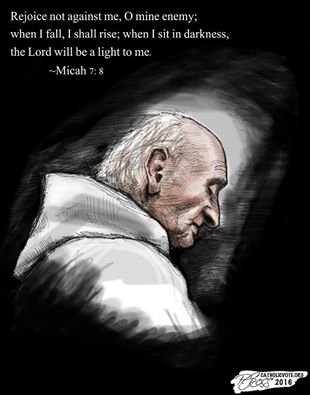
Image Credit: Patrick Cross via Catholic Vote
Back in my freshman year of college, one of my friends was in the process of entering the Church. While doing so, she told me that one of the things she had learned about being Catholic is that it “the only thing that gives meaning to suffering.” The phrase stuck with me, as it did with her. In particular, I often remember this when I hear about atrocious acts of violence committed against Catholics and Christians worldwide. Yesterday, I had reason to remember it again with the murder of Father Jacques Hamel, when we are confronted, as Pope Francis was with the news of “the barbaric murder of a priest,” responding, as our Holy Father did, with what Vatican spokesman Rev. Federico Lombardi described as the “pain and horror of this absurd violence.”
In the face of such evil, of knowing that in 2016 a priest in ostensibly liberal, civilized France could be murdered, could have his throat cut by ISIS sympathizers after finishing his celebration of Mass, it is hard not to emphasize the tragedy of such a death. Even those calling for his sainthood, like former Italian Interior Minister Roberto Maroni did on Twitter, cannot help but emphasize the horror. And yet, though pain and horror are rightly our first reactions, particularly in a society where death has become exiled from our conscious minds through “civilization,” it is not sufficient to only see pain and horror in Father Hamel’s death. It is not merely pain and suffering, it is not simply death that we recognize when a man or woman dies for the faith—the liturgy teaches us, looking to the older “common for one martyr,” that in the death of a man like Father Hamel we also celebrate “the day of his triumph.”
How can we look at such senseless evil and call it triumph? Because being Catholic gives meaning to suffering. When Scripture teaches is us that the words of the first martyr, St. Stephen, at his death were “Behold, I see the heavens opened and the Son of Man standing at the right hand of God,” we must see the evil and name it so, without losing sight of God’s providence and the joy that follows on consummated love. To remain faithful to the end, well, that is to bear the Cross of Our Lord Himself, who became “obedient to death, even death on a cross.” According to Sister Danielle, who witnessed the scene, Father Jacques had just finished saying mass, when the ISIS sympathizers forced him to kneel, and slit the throat of the priest, who had this past Easter preached that Christ
“Gave us everything, to live in his love. Jesus…went to the end of love. ‘There is no greater love than to give his life for those we love.’ And so much love could be lost. God, his Father and our Father, raised him. And ‘in this mystery of faith, each of us has already risen.’”
Yesterday, Father Hamel found himself also called to go to the end of love. Not only did Father Hamel give his life for Christ, Who became Man and calls us friends, but in his death he gave perhaps his most powerful testament to that love. Though he could not have known what God would ask of him that morning, in the indelible mark set on his soul at his ordination, Father Hamel chose that “Christ will be magnified in my body, whether by life or by death.” In taking Holy Orders, Father Hamel witnessed the truth that “life is Christ,” and in his death, on the same altar where he, acting in persona Christi, had just made re-present Christ’s passion, Father Hamel further witnessed that “death is gain.” How truly did he show us that “the ministers of Christ must be in conformity with Him” (SCG 4, 74).
Being Catholic gives meaning to suffering, because it is a suffering we undertake in union with Christ for the sake of His Body. We can unite our sufferings to Christ, and through union with Him, our sufferings are transformed from a consequence of sin and evil, from an irrational consequence of someone’s failing to chose the highest good, into a living out of the Passion in our own lives. Our suffering, united to the suffering of Our Lord Jesus Christ, is subsumed into His salvific and redemptive mission. As Tertullian wrote so many years ago of the early Christians, “we spring up in greater numbers the more we are mown down by you: the blood of the Christians is the seed of a new life.”
Though we mourn the loss of a priest today, and though we are rightly outraged at the violence of his murder, we cannot forget that in his martyrdom, there is joy that underlies the tragedy and horrific death of Father Jacques Hamel. At his ordination, the bishop was told that the then young man had “been found worthy.” In his death 58 years later, how well has Father Hamel lived up to that judgment and to his vocation as a priest. God has brought good from what men intended for evil, for now depth of that judgment has been shown to the world in its full truth: Father Hamel was indeed worthy, for he followed his Lord where he would not have gone, uniting with him one final time in this life. As David Russell Mosley wrote so well yesterday,
“Somehow the death of priest in a church named after no ordinary martyr, but the first, excepting our Lord, is grotesque and beautiful. What is more, that his blood was poured out as he celebrated the pouring out of Christ’s blood, this too is grotesque and macabre and yet beautiful.”
In what was intended as an act of terror, God has instead allowed Father Hamel to once more present the reality of Christ to both his congregation and the whole world. How grateful I am to say today #JeSuisCatholique. Today, I hope all of us will have the courage to, like Father Hamel, pledge to support the Church “until my last breath.” After 58 years of service to the Church, the good Father gave the Church far more than “until” his last breath; he gave to the Church his last breath and his own life blood. I hope that I can say #JeSuisJacquesHamel, because in his life, as in his death, it was not Jacques Hamel, but “Christ who lives” in him. So let us mourn, but let us remember that one day, our tears will transform into joy as Father Hamel’s have, for “as we have shared much in the suffering of Christ, so through Christ do we share abundantly in his consolation.”
The Reality Superelevating Things
Previous Post

July 26, 2016
When Good Catholic Women Take Birth Control
Next Post

July 29, 2016 Theology of the Body, Topless Picnics, and the Message Our Body Sends
Browse Our Archives
Select a Category Body Problems Fatherhood Feast Day Friendship Grace Building on Nature Holy Days and Liturgy Living Life in Christ Love and Marriage and Other Responsibilities Mary Motherhood Philosophic Wanderings Podcasts Reality of Things Saint of the Day The Beautiful The Good The Habit of Being In The Polis The Reality Superelevating Things The True Transcendentals Transcendentals Trinity Uncategorized Virtue
Select a Month December 2018 June 2017 May 2017 April 2017 March 2017 February 2017 January 2017 December 2016 September 2016 August 2016 July 2016 June 2016 May 2016
Follow Us!
TAKE THE
Religious Wisdom Quiz
What does "Capernaum" mean?
Select your answer to see how you score.
City of trade Port of peace Village of comfort Place of water
Related posts from Eating Peaches

Saint Lucy of Syracuse: Looking to God

Pope Saint Gregory III: Against the Iconoclasts
Saint Mary Josepha Rossello: Surprised by Vocation
Advent and the Incarnation When Words Fail
TRENDING AT PATHEOS Catholic

The Parable Of The Sower And The Word...
One of Christ’s most famous parables is that of the sower who...

Rejecting Doom: Christian Hope And Human Action
Christianity is a religion of hope. We are to have hope and...

Why I Choose the Eucharist Over the Sermon
Choose the Eucharist, Not the Sermon What are we supposed to get...

5 Design Elements Found in Spiritually Rooted Homes
Putting Spirituality Into Home Decor Our homes are more than our living...

Credo: A Story of God Told with the...
About 10 years ago, I began to imagine a personal "Credo" that...

The Anatomy of Divine Revelation in Catholic Thought
The claim that God has made Himself known to human beings is...
view all Catholic blogs
Ad-Free & Subscriber Log-In Subscription Support
- About Us
- 2026 Calendar
- Videos
- Podcasts
- Library of World Religions
- Faith In Media Tracker
- Advertise With Us
- Write for Us
- Privacy Policy
- Terms of Service
- Do Not Sell My Data
- Contact Us
- Radiant Digital
- Manage Newsletter Subscriptions
- Unsubscribe From Notifications
- Sitemap
Copyright 2008-2026, Patheos. All rights reserved.
Subscription Support Ad-Free & Subscriber Log-In
Follow Patheos