
BuddhistCatholicContemplativeEvangelicalGeneral ChristianHinduJewishLatter-day SaintMuslimNew VisionsProgressive Christian
Beliefs
- Buddhist
- Catholic
- Contemplative
- Evangelical
- General Christian
- Hindu
- Jewish
- Latter-day Saint
- More Voices
- Muslim
- New Visions
- Pagan
- Progressive Christian
Topics
- Religion News
- Food and Religion
- Sports and Religion
- Religious Art
- Religious Music and Entertainment
- Religious Events
- History and Religion
- Style and Religion
- Politics and Religion
- Women in Religion
- Recreation Outdoors and Religion
- Business Finance and Religion
- Careers Workplace and Religion
- Education and Religion
- Family Parenting and Religion
- Health Fitness and Religion
- Home and Religion
- Relationships and Religion
- Technology and Religion
- Travel and Religion
Columnists
- Buddhist Columnists
- Business Finance and Religion Columnists
- Careers Workplace and Religion Columnists
- Catholic Columnists
- Contemplative Columnists
- Education and Religion Columnists
- Evangelists Columnists
- Family Parenting and Religion Columnists
- General Christian Columnists
- Health Fitness and Religion Columnists
- Hindu Columnists
- History and Religion Columnists
- Home and Religion Columnists
- Jewish Columnists
- More Voices Columnists
- Latter Day Columnists
- Muslim Columnists
- New Visions Columnists
- Nonreligious Columnists
- Pagan Columnists
- Politics and Religion Columnists
- Progressive Columnists
- Recreation Outdoors and Religion Columnists
- Relationships and Religion Columnists
- Religion News Columnists
- Religious Art Columnists
- Religious Events Columnists
- Religious Music and Entertainment Columnists
- Sports and Religion Columnists
- Style and Religion Columnists
- Technology and Religion Columnists
- Travel and Religion Columnists
- Women in Religion Columnists
Resource Library
- 2026 Calendar
- Library of World Religions
- The 100 Most Holy Places on Earth
- Patheos Answers
- Podcasts
- Videos
- Faith Leaders Database
- Anglican Episcopalian
- Bahai
- Baptist
- Buddhism
- Christianity
- Confucianism
- Eastern Orthodoxy
- Hinduism
- Holiness and Pentecostal
- ISKCON
- Islam
- Judaism
- Lutheran
- Methodist
- The Church of Jesus Christ of Latter-day Saints
- New Age
- Paganism
- Presbytarian and Reformed
- Protestantism
- Religion Behind the Scenes
- Roman Catholic
- Scientology
- Shia Islam
- Sikhism
- Sufism
- Sunni Islam
- Taoism
- Zen
- See all religions
Research Tools
 Ad-Free & Subscriber Log-In Subscription Support
Ad-Free & Subscriber Log-In Subscription Support
Follow Patheos 

- Trending:
- Forgiveness
- |
- Marriage
- |
- Consciousness
- |
- Death Penalty
- |
- Election
- |
- Halloween
 Christian Podcast Central
- Home
- Evangelical - Sponsored
- 5 Minutes in Church History: The Ten Theses of Berne
5 Minutes in Church History: The Ten Theses of Berne
Last updated on: February 2, 2017 at 7:00 am by Christian Podcast Central
5 Minutes in Church History: The Ten Theses of Berne 2017-02-01T14:51:56-08:00 Christian Podcast Central
Patheos Explore the world's faith through different perspectives on religion and spirituality! Patheos has the views of the prevalent religions and spiritualities of the world.

The city of Berne is in northern Germany, toward the west, not too far from the border with the Netherlands. In 1520, Berchtold Haller came to the church at St. Vincent in the city. Haller had been influenced by Philip Melanchthon and Huldrych Zwingli. Later, especially after 1521, Haller and Zwingli would correspond often and would consider themselves allies.
Haller was interested in Reformation ideas and was leaning toward the Reformation, but the city was not. In 1523, the city affirmed Roman Catholic doctrines. In fact, it explicitly forbade the preaching of Protestantism and of Luther’s ideas. But one thing that the city allowed—and this is fascinating—was the preaching of biblical themes, and that’s exactly what Haller set out to do from the pulpit at St. Vincent. And guess what happened? In 1525, the sermons started replacing the Mass at St. Vincent. Haller put an end to the ritual of the Mass, and by 1527, Reformed ideas basically had the run of the city.
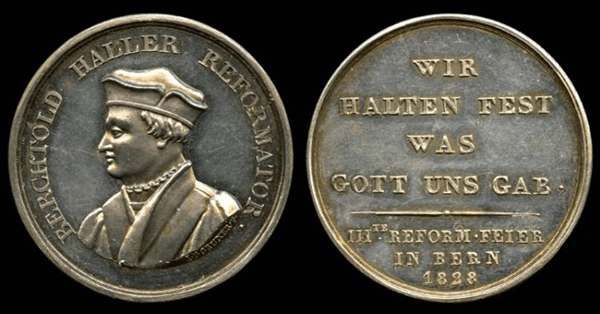
Berchtold Haller Coin, Translation: “We Hold Firmly What God Gave Us”, Image: VHobbies
On January 6, 1528, the city council called for a dispute, and the Ten Theses of Berne were presented. They were roundly affirmed. There were only a few dissenting ministers in the city at that time, but they quickly departed, and the city of Berne became staunchly and firmly a Reformation city. There was quite a ripple effect from the Ten Theses at Berne. The effect was felt at Basel, at Saalhausen, at Lausanne, at Geneva, and even in the Netherlands and as far away as England.
Let’s take a look at some of these theses. The first one simply says,
“The holy Christian Church, whose only Head is Christ, is born of the Word of God, abides in the same, and does not listen to the voice of a stranger.”
You get there the sense of how short these theses are, and in fact, all ten of them are fairly short. You also get there the emphasis on the Word of God, and of course, it’s obvious what the implication is of “the voice of a stranger” that has crowded in and was preaching a false gospel.
The second thesis states,
“The Church of Christ makes no laws or commandments without God’s Word. Hence, all human traditions,” which are called ecclesiastical commandments, “are binding upon us only insofar as they are based on and commanded by God’s Word.”
There we have a clear articulation of the Reformation plank of sola Scriptura: that the Scriptures alone are the church’s authority and that the church is not to rely on an extrabiblical source for its regulations, its commandments, and its guides.
We find in thesis number three that,
“Christ is our only wisdom, righteousness, redemption, and payment for the sins of the whole world. Hence, it is a denial of Christ when we acknowledge another merit for salvation and satisfaction of sin.”
And here we’re touching upon other Reformation planks: sola fide, sola gratia, and solus Christus.
Thesis six says,
“As Christ alone died for us, He is to be worshiped as the only Mediator and Advocate between God the Father and us believers; therefore, to propose the invoking of other mediators and advocates beyond this life is contrary to Scripture.”
The Ten Theses of Berne thus provide a concise statement of the Reformation and the doctrines of sola Scriptura, sola fide, sola gratia, and solus Christus.
Stay connected with 5 Minutes in Church History by getting the weekly podcast on iTunes, SoundCloud, or via RSS. You can also subscribe to the blog via RSS and follow us on Twitter and Facebook.
(This podcast is by Ligonier Ministries. Discovered by e2 media network and our community — copyright is owned by the publisher, not e2 media network, and audio is streamed directly from their servers.)
Previous Post
February 2, 2017
Reasonable Faith Podcast: Dr. Craig Visits an Amazing Laboratory!
Next Post
February 3, 2017 Jesus in HD 190: Jesus' One Worry Concerning YOU (and Me)
Browse Our Archives
Select a Category Brad Stine Has Issues Christian Podcast Central Classic Podcast Experience God Life Grounded Ouxano Parent Like You Mean It The Protest Show with Thor Ramsey The Summit Lecture Series Uncategorized What You’ve Been Searching For
Select a Month July 2022 June 2022 May 2022 April 2022 March 2022 February 2022 January 2022 December 2021 November 2021 September 2021 August 2021 July 2021 June 2021 May 2021 April 2021 March 2021 February 2021 January 2021 December 2020 November 2020 October 2020 October 2019 September 2019 August 2019 July 2019 June 2019 May 2019 April 2019 March 2019 June 2018 April 2018 March 2018 February 2018 January 2018 December 2017 November 2017 October 2017 September 2017 August 2017 July 2017 June 2017 May 2017 April 2017 March 2017 February 2017 January 2017 December 2016 November 2016 October 2016 September 2016 August 2016 July 2016 June 2016 May 2016 April 2016 March 2016 February 2016 January 2016 December 2015 November 2015 October 2015 September 2015 August 2015 July 2015 June 2015 May 2015 April 2015 March 2015 February 2015 January 2015 December 2014 November 2014 October 2014 September 2014 August 2014 July 2014 June 2014 May 2014 April 2014 March 2014 February 2014
Follow Us!
TAKE THE
Religious Wisdom Quiz
How did Moses' mother save him as a baby?
Select your answer to see how you score.
Placed him in a basket on the river Dressed him as a girl Hid him in a cave Sent him to another city
Related posts from Christian Podcast Central
Peter in HD 6: The Glorious Gift of...
Peter in HD 4: The Most Important Person...
5 Minutes in Church History: Esther Edwards Burr
5 Minutes in Church History: Just War
TRENDING AT PATHEOS Evangelical - Sponsored

The REST of Your Life: A Creative Wrestles...
This week I had a conversation with a good friend from church....

How the author of the world's best hymn...
I've been working with John Newton for a while now. This makes...

Long before this Lectio Divina, Psalm 130 - the song - started...

What About the Trees? Another Living Parable
After I finished writing the last article about falling leaves as a...

Why Classical Education Is a Conversation, Not a...
Come and Read: Joy in Classical Education When I was a little...

Cornell University has received a great deal of negative publicity and intense...
view all Evangelical - Sponsored blogs
Ad-Free & Subscriber Log-In Subscription Support
- About Us
- 2026 Calendar
- Videos
- Podcasts
- Library of World Religions
- Faith In Media Tracker
- Advertise With Us
- Write for Us
- Privacy Policy
- Terms of Service
- Do Not Sell My Data
- Contact Us
- Radiant Digital
- Manage Newsletter Subscriptions
- Unsubscribe From Notifications
- Sitemap
Copyright 2008-2026, Patheos. All rights reserved.
Subscription Support Ad-Free & Subscriber Log-In
Follow Patheos