
BuddhistCatholicContemplativeEvangelicalGeneral ChristianHinduJewishLatter-day SaintMuslimNew VisionsProgressive Christian
Beliefs
- Buddhist
- Catholic
- Contemplative
- Evangelical
- General Christian
- Hindu
- Jewish
- Latter-day Saint
- More Voices
- Muslim
- New Visions
- Pagan
- Progressive Christian
Topics
- Religion News
- Food and Religion
- Sports and Religion
- Religious Art
- Religious Music and Entertainment
- Religious Events
- History and Religion
- Style and Religion
- Politics and Religion
- Women in Religion
- Recreation Outdoors and Religion
- Business Finance and Religion
- Careers Workplace and Religion
- Education and Religion
- Family Parenting and Religion
- Health Fitness and Religion
- Home and Religion
- Relationships and Religion
- Technology and Religion
- Travel and Religion
Columnists
- Buddhist Columnists
- Business Finance and Religion Columnists
- Careers Workplace and Religion Columnists
- Catholic Columnists
- Contemplative Columnists
- Education and Religion Columnists
- Evangelists Columnists
- Family Parenting and Religion Columnists
- General Christian Columnists
- Health Fitness and Religion Columnists
- Hindu Columnists
- History and Religion Columnists
- Home and Religion Columnists
- Jewish Columnists
- More Voices Columnists
- Latter Day Columnists
- Muslim Columnists
- New Visions Columnists
- Nonreligious Columnists
- Pagan Columnists
- Politics and Religion Columnists
- Progressive Columnists
- Recreation Outdoors and Religion Columnists
- Relationships and Religion Columnists
- Religion News Columnists
- Religious Art Columnists
- Religious Events Columnists
- Religious Music and Entertainment Columnists
- Sports and Religion Columnists
- Style and Religion Columnists
- Technology and Religion Columnists
- Travel and Religion Columnists
- Women in Religion Columnists
Resource Library
- 2026 Calendar
- Library of World Religions
- The 100 Most Holy Places on Earth
- Patheos Answers
- Podcasts
- Videos
- Faith Leaders Database
- Anglican Episcopalian
- Bahai
- Baptist
- Buddhism
- Christianity
- Confucianism
- Eastern Orthodoxy
- Hinduism
- Holiness and Pentecostal
- ISKCON
- Islam
- Judaism
- Lutheran
- Methodist
- The Church of Jesus Christ of Latter-day Saints
- New Age
- Paganism
- Presbytarian and Reformed
- Protestantism
- Religion Behind the Scenes
- Roman Catholic
- Scientology
- Shia Islam
- Sikhism
- Sufism
- Sunni Islam
- Taoism
- Zen
- See all religions
Research Tools
 Ad-Free & Subscriber Log-In Subscription Support
Ad-Free & Subscriber Log-In Subscription Support
Follow Patheos 

- Trending:
- Forgiveness
- |
- Marriage
- |
- Consciousness
- |
- Death Penalty
- |
- Election
- |
- Halloween

- Home
- Progressive Christian
- Bells, Smells, and Liturgy – A Backwards Step?
Bells, Smells, and Liturgy – A Backwards Step?
Last updated on: May 6, 2024 at 4:53 pm by Duncan Edward Pile
Bells, Smells, and Liturgy – A Backwards Step? 2024-05-06T16:53:39+01:00 Duncan Edward Pile
Patheos Explore the world's faith through different perspectives on religion and spirituality! Patheos has the views of the prevalent religions and spiritualities of the world.
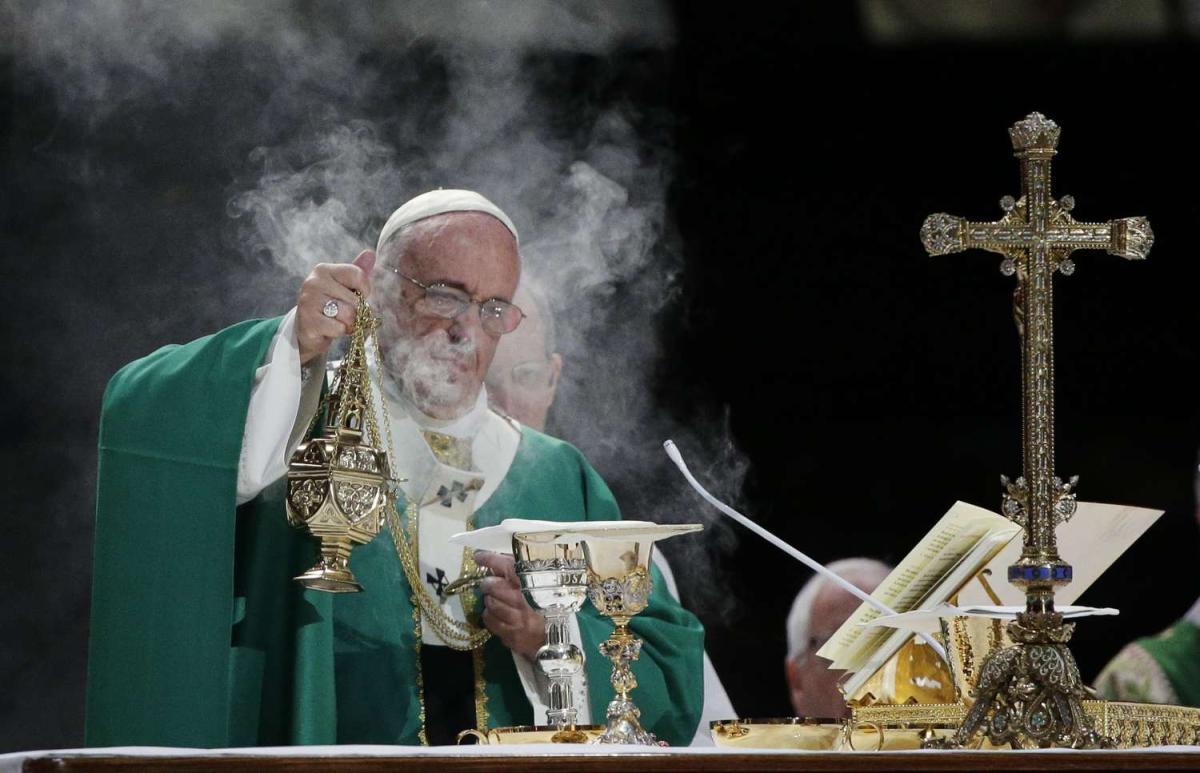
In the wake of scandals around large, informal churches and their worship juggernauts, there has been much debate about what services should look like, with many pushing for greater formality, relying on ritual and liturgy rather than organic expressions of praise. I’ve written about the worship issue before, but today I want to argue that formality (both structural and devotional) is a poor solution to the problem of performative worship, creating a maze of nooks and crannies for hidden harm. I’ll get on to liturgy and ritual in a bit, but want to start with the dangers of formal church hierarchies.
Hierarchies are fundamentally problematic
For me, hierarchies have within them a set of inbuilt flaws that will inevitably express themselves over time:
Lack of transparency
Whenever we establish a pecking order, we make it harder to hold people to account. Complaints about abuse of power have to inch their way up the chain instead of being heard in the most efficient way for the person who is suffering. The only way a multi-layered religious hierarchy can function for the wellbeing of all is if every level of that structure is populated by people of the utmost integrity, which is a statistical and moral improbability. In essence, we’re talking about cumbersome bureaucracy interfering with the natural rhythms of growth. The fewer levels of hierarchy, the better!
Abdication of thought
I sometimes get into theological discussions with a Catholic friend of mine, but as he doesn’t permit himself to question what he’s been told by someone higher up in his religious hierarchy, it never goes anywhere useful. He won’t permit ‘personal interpretation of scripture’, relying on those he thinks God has appointed to tell him how to understand the Bible. I’ve literally shown him the words of Jesus to counter a poor argument, but they carry no weight unless interpreted to him by someone else. In this case, theological hierarchy has made my friend deaf to the teachings of Jesus.
This isn’t unique to Catholicism, but Catholicism is a clear example of the pitfalls of multi-layered church hierarchies. Another person told me that, after converting to Catholicism, he was glad he didn’t have to work stuff out anymore and would accept the authority and teaching of the Pope instead. For me, this is a woeful abdication of the responsibility to think for ourselves. Hebrews 8:10-11 offers insight into what God wants each of us to understand:
This is the covenant I will establish with the people of Israel
after that time, declares the Lord.
I will put my laws in their minds
and write them on their hearts.
I will be their God,
and they will be my people.
No longer will they teach their neighbour,
or say to one another, ‘Know the Lord,’
because they will all know me,
from the least of them to the greatest.
The surrender of this freedom is perhaps the most cringeworthy consequence of formality and church hierarchies, and should be challenged at every opportunity. Believers should empower rather than disempower each other.
Discouraging openness
Once a person has been given a formal rank, they have something to lose besides their reputation if they make a poor moral choice. The higher the rank and the more generous its benefits, the harder it is to come clean.
I had a friend called John, whose father was a vicar in an Anglican church on the south coast of England. For all the world, he and his family looked like they had it all together, but behind the formality, the rituals, and the performance lay a dark secret that tormented my friend. One day, he told me the tale he’d kept hidden from almost everyone in his life – his father was involved in something church-related in the far East, and while he was out there, had conducted an affair with a local man.
To be clear, homosexuality is not the issue here; I’m fully inclusive of the LGBTQ+ community – the issue was the betrayal of his wife and family. Wracked by guilt, he gathered his family and told them the truth, but they could never speak about it to anyone else, because the father would have lost his job and the family would have been kicked out of the comfortable vicarage they lived in. From that time onwards they lived a lie, smiling and keeping up the pretence on Sundays, which had a devastating effect on my friend John, undermining his resilience and making him painfully fragile.
Now I’m not saying the Anglican church shouldn’t have vicars, but this serves as an example of the kind of secrecy that hierarchical structures incubate. The more layers in that structure, and the more people have to lose if their position is removed, the greater the temptation to hide your sins instead of live openly and with courage.
Formality hinders organic expression
Returning to the subject of worship, I’ve read many articles from Patheos writers who want to return to liturgy and dismantle the worship band entirely. Personally, I believe that informality is a far better vehicle for human expression than formality. If we add rigidity to our church services, we are making extra room for performance, even if it is performance of a religious rite rather than a musical performance. It is much easier to hide behind repetition and ceremony than it is behind organic worship.
In our happiest moments, we are likely to smile, laugh, move, embrace, and even dance. In our most intimate moments we abandon formality altogether. In our most protective moments, we gather our children in our arms, speaking sincere, soothing words.
For me, the love of God is tangible, and as his child, I respond to that love without formality or ritual. The imposition of religious rites would hinder rather than help my authentic engagement with the divine, and I am not convinced this is merely a matter of preference. For sure, contemplative elements add value to services, but not at the expense of organic expression. This is not a binary choice, and contemplation is not at odds with heartfelt singing.
I do not accept that rituals such as liturgy are a remedy for performative worship, as they introduce a form of reverence that is even more easily faked. Rather than shut down emotion, we ought to find ways to discourage performance and encourage sincerity. Nobody needs to pretend anything at all! Relationships with God and each other are the key, and healthy, organic relationships can never be hemmed in by formality.
Readers interested in my previous articles on the worship debate can find them here:
- The real problem with contemporary worship
- The Importance of emotion in worship
- The Importance of collective emotion in worship
- A racist element in the contemporary worship debate.
Evangelical
Previous Post

April 25, 2024
Releasing Ourselves From Ego
Next Post

May 13, 2024 Separation From God is an Illusion
Recent Comments
"As I see it, the values espoused by self-described Christian nationalists (which really requires the ..."
The Rise of Cultural Christianity
"Most people when considering cultural Christianity view it merely as left-wing. Primarily because "cultural Christians" ..."
The Rise of Cultural Christianity
"A Good Follower of "The Way" of Yahushua , and a Good Person should go ..."
Is It More Important To Be ..."
"Dear Duncan — This is my conclusion about the Christianity of the Trump administration. Trump ..."
When Politics and Values Clash
Browse Our Archives
Select a Category A time for war and Sheol Authentic Faith Being in Christ Christian marriage Christian Mysticism Christian Nationalism Christian Parenting Christianity and politics Church and State De/reconstruction Discipleship Divine Healing Divine judgement Don't throw the baby out with the bathwater Effective Prayer Embracing the LGBTQ+ Community Embracing the LGBTQIA+ community End-Times Fellowship with his sufferings Gehenna Glorifying God Hades Healthy Debate Heaven and Earth Hell Honouring Christian Women I still believe inter-faith dialogue Interpreting Scripture Keep the faith Knowing the peace of God Living in Abundance Loving Each Other Loving God Loving Ourselves Mental Health Mental Health and Faith Old and New Covenants Practice Peace Prophecy Prophesy Re-thinking Christian Concepts Resist the Devil Revival Salvation Seeking God Sex and love sin and sinfulness Sound theology Spiritual Authority Spiritual discipline Spiritual effectiveness Spiritual Gifts Spiritual growth Spiritual Mentorship The Christmas story The Cross of Christ The divine feminine The Fear of the Lord The Holy Spirit The importance of kindness The importance of theology The MAGA Cult The Ministry of Jesus The risen Christ The service of Jesus the sin of judgement The spirit-filled life The Virgin Birth True worship Uncategorized Understanding God Understanding Old Testament prophecy Understanding Self-Worth Understanding the Bible Union with God War and Peace
Select a Month September 2026 August 2026 September 2025 March 2025 February 2025 January 2025 December 2024 November 2024 October 2024 September 2024 August 2024 July 2024 June 2024 May 2024 April 2024 March 2024 February 2024 January 2024 December 2023 November 2023 October 2023 September 2023 August 2023 July 2023 June 2023 May 2023 April 2023 March 2023 February 2023 January 2023 December 2022 November 2022 October 2022 September 2022 August 2022 July 2022 June 2022 May 2022 April 2022 March 2022 February 2022 January 2022 December 2021 November 2021 October 2021 September 2021 August 2021 July 2021
TAKE THE
Religious Wisdom Quiz
Who was the Roman centurion who converted to Christianity in Acts 10?
Select your answer to see how you score.
Herod Nicodemus Felix Cornelius
Related posts from Duncan Edward Pile
What Does God Get Out of Worship?

God is Everywhere, and Whirling!

I’ve Changed My Mind About Contemporary Worship
TRENDING AT PATHEOS Progressive Christian

What Being a Modern-Day Apostle Means to Me
In my last column, I discussed the ins and outs of modern-day...

Did Ancient China Once Worship the God of...
Across human history, a common thread weaves through the origins of the...

Love Your Neighbor – Including Earth-Kin: Lev. 19,...
God’s command to love your neighbor means acting in an ethical and...

Lead a Church Study of “Jesus and Lao...
Guest writer Jack Thomas (The Irreverent Reverend) reflects on leading his church...

Pastoral Wisdom for Responding to Sermon Pushback
Getting sermon pushback on your social justice sermon? Learn practical, Proverbs-based strategies...

Principles for Understanding the Apostolic Ministry Today
Whenever people discover that my formal ministry title is "apostle," as in...
view all Progressive Christian blogs
What Are Your Thoughts?leave a comment
Ad-Free & Subscriber Log-In Subscription Support
- About Us
- 2026 Calendar
- Videos
- Podcasts
- Library of World Religions
- Faith In Media Tracker
- Advertise With Us
- Write for Us
- Privacy Policy
- Terms of Service
- Do Not Sell My Data
- Contact Us
- Radiant Digital
- Manage Newsletter Subscriptions
- Unsubscribe From Notifications
- Sitemap
Copyright 2008-2026, Patheos. All rights reserved.
Subscription Support Ad-Free & Subscriber Log-In
Follow Patheos