
BuddhistCatholicContemplativeEvangelicalGeneral ChristianHinduJewishLatter-day SaintMuslimNew VisionsProgressive Christian
Beliefs
- Buddhist
- Catholic
- Contemplative
- Evangelical
- General Christian
- Hindu
- Jewish
- Latter-day Saint
- More Voices
- Muslim
- New Visions
- Pagan
- Progressive Christian
Topics
- Religion News
- Food and Religion
- Sports and Religion
- Religious Art
- Religious Music and Entertainment
- Religious Events
- History and Religion
- Style and Religion
- Politics and Religion
- Women in Religion
- Recreation Outdoors and Religion
- Business Finance and Religion
- Careers Workplace and Religion
- Education and Religion
- Family Parenting and Religion
- Health Fitness and Religion
- Home and Religion
- Relationships and Religion
- Technology and Religion
- Travel and Religion
Columnists
- Buddhist Columnists
- Business Finance and Religion Columnists
- Careers Workplace and Religion Columnists
- Catholic Columnists
- Contemplative Columnists
- Education and Religion Columnists
- Evangelists Columnists
- Family Parenting and Religion Columnists
- General Christian Columnists
- Health Fitness and Religion Columnists
- Hindu Columnists
- History and Religion Columnists
- Home and Religion Columnists
- Jewish Columnists
- More Voices Columnists
- Latter Day Columnists
- Muslim Columnists
- New Visions Columnists
- Nonreligious Columnists
- Pagan Columnists
- Politics and Religion Columnists
- Progressive Columnists
- Recreation Outdoors and Religion Columnists
- Relationships and Religion Columnists
- Religion News Columnists
- Religious Art Columnists
- Religious Events Columnists
- Religious Music and Entertainment Columnists
- Sports and Religion Columnists
- Style and Religion Columnists
- Technology and Religion Columnists
- Travel and Religion Columnists
- Women in Religion Columnists
Resource Library
- 2026 Calendar
- Library of World Religions
- The 100 Most Holy Places on Earth
- Patheos Answers
- Podcasts
- Videos
- Faith Leaders Database
- Anglican Episcopalian
- Bahai
- Baptist
- Buddhism
- Christianity
- Confucianism
- Eastern Orthodoxy
- Hinduism
- Holiness and Pentecostal
- ISKCON
- Islam
- Judaism
- Lutheran
- Methodist
- The Church of Jesus Christ of Latter-day Saints
- New Age
- Paganism
- Presbytarian and Reformed
- Protestantism
- Religion Behind the Scenes
- Roman Catholic
- Scientology
- Shia Islam
- Sikhism
- Sufism
- Sunni Islam
- Taoism
- Zen
- See all religions
Research Tools
 Ad-Free & Subscriber Log-In Subscription Support
Ad-Free & Subscriber Log-In Subscription Support
Follow Patheos 

- Trending:
- Forgiveness
- |
- Marriage
- |
- Consciousness
- |
- Death Penalty
- |
- Election
- |
- Halloween

- Home
- Progressive Christian
- Which Mountain Do You Stand Upon?
Which Mountain Do You Stand Upon?
Last updated on: March 12, 2023 at 6:46 pm by Duncan Edward Pile
Which Mountain Do You Stand Upon? 2023-03-12T18:46:52+00:00 Duncan Edward Pile
Patheos Explore the world's faith through different perspectives on religion and spirituality! Patheos has the views of the prevalent religions and spiritualities of the world.
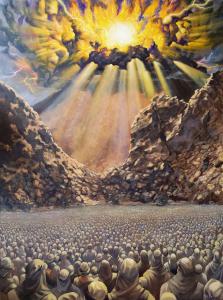
It’s all too easy to confuse covenants, mixing Law with grace – so much so that Paul dedicated a considerable proportion of his writings to the topic, trying to clarify the crucial distinctions between the Old and New Covenants.
In his second letter to Timothy, Paul uses a helpful phrase to describe the theological process of sound Bible teachers. 2 Tim 2:15
Be diligent to present yourself approved to God, a worker who does not need to be ashamed, rightly dividing the word of truth.
Rightly dividing the word of truth – seeing the distinct and often contrasting approaches to human/divine relationships under the different covenants. To be clear, there are many covenants in the Bible, but I am referring to the two which Jesus (and later Paul) identified as old and new – the Covenant of Sinai and the Covenant of Christ.
The purpose of the Law
Prior to Sinai, there was no law, and when it was given at Sinai, the Law brought death. Paul incisively explains the purpose and effect of the Law in Romans 7: 7-13
What shall we say, then? Is the law sinful? Certainly not! Nevertheless, I would not have known what sin was had it not been for the law. For I would not have known what coveting really was if the law had not said, ‘You shall not covet.’ But sin, seizing the opportunity afforded by the commandment, produced in me every kind of coveting. For apart from the law, sin was dead. Once I was alive apart from the law; but when the commandment came, sin sprang to life and I died. I found that the very commandment that was intended to bring life actually brought death. For sin, seizing the opportunity afforded by the commandment, deceived me, and through the commandment put me to death. So then, the law is holy, and the commandment is holy, righteous and good.
Did that which is good, then, become death to me? By no means! Nevertheless, in order that sin might be recognised as sin, it used what is good to bring about my death, so that through the commandment sin might become utterly sinful.
I’ll expound. The Law created a perception of right and wrong – do this, don’t do that – which in and of itself brings human beings to measure themselves against a standard. That standard, and the failure to meet it, brings death – the judgement that we are incapable of righteousness.
This form of death is the very purpose of the Law – to lead us to recognise sin (human brokenness) as sin, or as Paul neatly sums up, to make sin utterly sinful. What this really does is make us aware that in our own efforts, we cannot live up to an established standard of righteousness. In turn, that should prompt us to embrace grace – the gift of righteousness through Christ.
The purpose of the Law is to stop us relying on our own perfection, and point us in the direction of grace. To give up striving and to receive instead the free gift of God. The Law is a warning against self-righteousness, the dead end of personal perfection, and a signpost towards grace.
Biblical teachings about Law versus grace
Confusion between the Sinai Covenant and the New Covenant was one of the main areas of misunderstanding Paul and other New Testament writers sought to address. I could pick dozens upon dozens of passages, but will limit it to a few for the sake of brevity:
Grace does what the Law could not, setting us free from habits and behaviours that harm ourselves and other people (also known as sin). Romans 6:14
For sin will have no dominion over you, since you are not under law but under grace.
Receiving grace should be the end of any reliance on the written code. Romans 10:4
For Christ is the end of the law for righteousness to everyone who believes.
Grace leads us to a new way of serving God through the love and power of the Spirit. Romans 7:6
But now we are released from the law, having died to that which held us captive, so that we serve in the new way of the Spirit and not in the old way of the written code.
Grace is accessed through a relationship with the Holy Spirit, rather than adherence to a written code. Galatians 5:18
But if you are led by the Spirit, you are not under the law.
The Law is reliant on human effort, but grace relies on divine effort. Ephesians 2:8
For by grace you have been saved through faith. And this is not your own doing; it is the gift of God.
Trying to be righteous by attaining to a written standard is a living nightmare. Galatians 3:10
For all who rely on works of the law are under a curse; for it is written, “Cursed be everyone who does not abide by all things written in the Book of the Law, and do them.”
Grace enables us to bear fruit for God – the natural, easy rhythms of grace give life. Romans 7:4
Likewise, my brothers, you also have died to the law through the body of Christ, so that you may belong to another, to him who has been raised from the dead, in order that we may bear fruit for God.
Grace frees us from all condemnation, whatever its source, including our own thoughts and judgement. Romans 8:1-4
There is therefore now no condemnation for those who are in Christ Jesus. For the law of the Spirit of life has set you free in Christ Jesus from the law of sin and death. For God has done what the law, weakened by the flesh, could not do. By sending his own Son in the likeness of sinful flesh and for sin, he condemned sin in the flesh, in order that the righteous requirement of the law might be fulfilled in us, who walk not according to the flesh but according to the Spirit.
We cannot mix Law and grace, basing our opinion of ourselves or others on successful adherence to a written code while claiming to be saved by grace. The Bible is clear – if we step back into Law, we can no longer access grace and are alienated from Christ. The two are completely incompatible. Galatians 4:5
You who are trying to be justified by the law have been alienated from Christ; you have fallen away from grace.
Despite the abundant Biblical instruction on Law and grace, believers are as confused about this today as they were in the early church, meaning that teaching on grace is just as important today as it has ever been.
Heed the Warnings
There are various signs which tell me a person is still living under law:
- An obsession with their own sin
- Judging others for their failures
- Lack of joy
- Fear of making mistakes
- Begging for forgiveness from God instead of approaching the throne with confidence
- Lack of compassion
- A tendency towards self-criticism and judgement
- Lack of curiosity
- A preference for dwelling on the bone-shaking, terrifying encounters with God seen in the Old Testament, rather than the empowerment of the Holy Spirit and the compassion of Jesus seen in the New Testament.
For me, this is all rather simple. The Law (trying to live up to a code to be acceptable) leads to failure to overcome sin, self-judgement, judgement of others, frustration, and ultimately to spiritual death. Grace leads to overcoming sin, freedom from judgement and condemnation, including self-judgement and self-condemnation, empowerment through the Holy Spirit, righteousness, peace, and joy. Grace manifests itself in the bearing of fruit, the fulfilling of callings and destinies, a heart full of hope, the receiving of comfort and compassion in times of pain, in personal growth, good relationships, and every other blessing under Heaven.
The choice is yours
The writer of Hebrews laid out the boundaries of Law and Grace under the two covenants with impeccable clarity. Hebrew 12:18-24
You have not come to a mountain that can be touched and that is burning with fire; to darkness, gloom and storm; to a trumpet blast or to such a voice speaking words that those who heard it begged that no further word be spoken to them, because they could not bear what was commanded: ‘If even an animal touches the mountain, it must be stoned to death.’ The sight was so terrifying that Moses said, ‘I am trembling with fear.’
But you have come to Mount Zion, to the city of the living God, the heavenly Jerusalem. You have come to thousands upon thousands of angels in joyful assembly, to the church of the firstborn, whose names are written in heaven. You have come to God, the Judge of all, to the spirits of the righteous made perfect, to Jesus the mediator of a new covenant, and to the sprinkled blood that speaks a better word than the blood of Abel.
Which mountain have you come to? The fear and condemnation of living under Law, or to the city of the Living God? The cringing terror of striving and self-righteousness or to thousands upon thousands of angels in joyful assembly and to Jesus, the mediator of a new covenant? If we want to walk with Jesus, he cannot be found on Sinai; he can only be found in Zion.
For readers who want to delve into other teachings of mine, I’ve written four spiritual books under the pseudonym James Bewley (to avoid cross-pollination of my fantasy/sci-fi and spiritual readerships), linked below.
Who Am I to Judge examines the nature of judgement and its pivotal role in ‘the fall’. I examine the nature of judgement, including divine judgement, and lay out strategies for personal freedom.
How to Know God is the story of my own journey from spiritual emptiness to the experience of daily divine encounters, before addressing what I believe are the keys to spiritual abundance.
Job: A Story of Salvation goes through the book of Job chapter by chapter, demonstrating that the Church has made a colossally consequential error in its interpretation of Job. I examine the results of that error, the poor theology that stems from it, and the joy and peace found when we shed this deception and move into freedom.
How to Meet God is a short work written for those who are yet to know God. It’s essentially a tract that I know has resulted in salvation for some.
I trust you will get what you need from these writings, and am always happy to discuss any questions arising from them.
General Christian
rightly divide the word of truth
Previous Post

March 8, 2023
Where the Spirit of the Lord is, there is Freedom
Next Post

March 18, 2023 The Sin of Exclusion
Recent Comments
"As I see it, the values espoused by self-described Christian nationalists (which really requires the ..."
The Rise of Cultural Christianity
"Most people when considering cultural Christianity view it merely as left-wing. Primarily because "cultural Christians" ..."
The Rise of Cultural Christianity
"A Good Follower of "The Way" of Yahushua , and a Good Person should go ..."
Is It More Important To Be ..."
"Dear Duncan — This is my conclusion about the Christianity of the Trump administration. Trump ..."
When Politics and Values Clash
Browse Our Archives
Select a Category A time for war and Sheol Authentic Faith Being in Christ Christian marriage Christian Mysticism Christian Nationalism Christian Parenting Christianity and politics Church and State De/reconstruction Discipleship Divine Healing Divine judgement Don't throw the baby out with the bathwater Effective Prayer Embracing the LGBTQ+ Community Embracing the LGBTQIA+ community End-Times Fellowship with his sufferings Gehenna Glorifying God Hades Healthy Debate Heaven and Earth Hell Honouring Christian Women I still believe inter-faith dialogue Interpreting Scripture Keep the faith Knowing the peace of God Living in Abundance Loving Each Other Loving God Loving Ourselves Mental Health Mental Health and Faith Old and New Covenants Practice Peace Prophecy Prophesy Re-thinking Christian Concepts Resist the Devil Revival Salvation Seeking God Sex and love sin and sinfulness Sound theology Spiritual Authority Spiritual discipline Spiritual effectiveness Spiritual Gifts Spiritual growth Spiritual Mentorship The Christmas story The Cross of Christ The divine feminine The Fear of the Lord The Holy Spirit The importance of kindness The importance of theology The MAGA Cult The Ministry of Jesus The risen Christ The service of Jesus the sin of judgement The spirit-filled life The Virgin Birth True worship Uncategorized Understanding God Understanding Old Testament prophecy Understanding Self-Worth Understanding the Bible Union with God War and Peace
Select a Month September 2026 August 2026 September 2025 March 2025 February 2025 January 2025 December 2024 November 2024 October 2024 September 2024 August 2024 July 2024 June 2024 May 2024 April 2024 March 2024 February 2024 January 2024 December 2023 November 2023 October 2023 September 2023 August 2023 July 2023 June 2023 May 2023 April 2023 March 2023 February 2023 January 2023 December 2022 November 2022 October 2022 September 2022 August 2022 July 2022 June 2022 May 2022 April 2022 March 2022 February 2022 January 2022 December 2021 November 2021 October 2021 September 2021 August 2021 July 2021
TAKE THE
Religious Wisdom Quiz
What was the purpose of the Ark of the Covenant?
Select your answer to see how you score.
To be carried in battle To hold the Ten Commandments To serve as a throne for Moses To store sacrifices
Related posts from Duncan Edward Pile


What Does God Get Out of Worship?
TRENDING AT PATHEOS Progressive Christian

What Being a Modern-Day Apostle Means to Me
In my last column, I discussed the ins and outs of modern-day...

Did Ancient China Once Worship the God of...
Across human history, a common thread weaves through the origins of the...

Love Your Neighbor – Including Earth-Kin: Lev. 19,...
God’s command to love your neighbor means acting in an ethical and...

Lead a Church Study of “Jesus and Lao...
Guest writer Jack Thomas (The Irreverent Reverend) reflects on leading his church...

Pastoral Wisdom for Responding to Sermon Pushback
Getting sermon pushback on your social justice sermon? Learn practical, Proverbs-based strategies...

Principles for Understanding the Apostolic Ministry Today
Whenever people discover that my formal ministry title is "apostle," as in...
view all Progressive Christian blogs
What Are Your Thoughts?leave a comment
Ad-Free & Subscriber Log-In Subscription Support
- About Us
- 2026 Calendar
- Videos
- Podcasts
- Library of World Religions
- Faith In Media Tracker
- Advertise With Us
- Write for Us
- Privacy Policy
- Terms of Service
- Do Not Sell My Data
- Contact Us
- Radiant Digital
- Manage Newsletter Subscriptions
- Unsubscribe From Notifications
- Sitemap
Copyright 2008-2026, Patheos. All rights reserved.
Subscription Support Ad-Free & Subscriber Log-In
Follow Patheos