
BuddhistCatholicContemplativeEvangelicalGeneral ChristianHinduJewishLatter-day SaintMuslimNew VisionsProgressive Christian
Beliefs
- Buddhist
- Catholic
- Contemplative
- Evangelical
- General Christian
- Hindu
- Jewish
- Latter-day Saint
- More Voices
- Muslim
- New Visions
- Pagan
- Progressive Christian
Topics
- Religion News
- Food and Religion
- Sports and Religion
- Religious Art
- Religious Music and Entertainment
- Religious Events
- History and Religion
- Style and Religion
- Politics and Religion
- Women in Religion
- Recreation Outdoors and Religion
- Business Finance and Religion
- Careers Workplace and Religion
- Education and Religion
- Family Parenting and Religion
- Health Fitness and Religion
- Home and Religion
- Relationships and Religion
- Technology and Religion
- Travel and Religion
Columnists
- Buddhist Columnists
- Business Finance and Religion Columnists
- Careers Workplace and Religion Columnists
- Catholic Columnists
- Contemplative Columnists
- Education and Religion Columnists
- Evangelists Columnists
- Family Parenting and Religion Columnists
- General Christian Columnists
- Health Fitness and Religion Columnists
- Hindu Columnists
- History and Religion Columnists
- Home and Religion Columnists
- Jewish Columnists
- More Voices Columnists
- Latter Day Columnists
- Muslim Columnists
- New Visions Columnists
- Nonreligious Columnists
- Pagan Columnists
- Politics and Religion Columnists
- Progressive Columnists
- Recreation Outdoors and Religion Columnists
- Relationships and Religion Columnists
- Religion News Columnists
- Religious Art Columnists
- Religious Events Columnists
- Religious Music and Entertainment Columnists
- Sports and Religion Columnists
- Style and Religion Columnists
- Technology and Religion Columnists
- Travel and Religion Columnists
- Women in Religion Columnists
Resource Library
- 2026 Calendar
- Library of World Religions
- The 100 Most Holy Places on Earth
- Patheos Answers
- Podcasts
- Videos
- Faith Leaders Database
- Anglican Episcopalian
- Bahai
- Baptist
- Buddhism
- Christianity
- Confucianism
- Eastern Orthodoxy
- Hinduism
- Holiness and Pentecostal
- ISKCON
- Islam
- Judaism
- Lutheran
- Methodist
- The Church of Jesus Christ of Latter-day Saints
- New Age
- Paganism
- Presbytarian and Reformed
- Protestantism
- Religion Behind the Scenes
- Roman Catholic
- Scientology
- Shia Islam
- Sikhism
- Sufism
- Sunni Islam
- Taoism
- Zen
- See all religions
Research Tools
 Ad-Free & Subscriber Log-In Subscription Support
Ad-Free & Subscriber Log-In Subscription Support
Follow Patheos 

- Trending:
- Forgiveness
- |
- Marriage
- |
- Consciousness
- |
- Death Penalty
- |
- Election
- |
- Halloween

- Home
- Progressive Christian
- Understanding Progressive Christianity, Part 1 – The Necessity of Deconstruction
Understanding Progressive Christianity, Part 1 – The Necessity of Deconstruction
Last updated on: December 7, 2021 at 5:24 pm by Duncan Edward Pile
Understanding Progressive Christianity, Part 1 – The Necessity of Deconstruction 2021-12-07T17:24:42+00:00 Duncan Edward Pile
Patheos Explore the world's faith through different perspectives on religion and spirituality! Patheos has the views of the prevalent religions and spiritualities of the world.

Many of my posts challenge the assumptions of Evangelicalism, but in this series, I’ll be examining Progressive Christianity, exploring its tenets and principles, and whether it is a step towards or away from Jesus. The heart of Progressive Christianity is not a commonly-held set of beliefs; it is a shared process – the deconstruction and reconstruction of faith. For me, this journey was embarked upon as a necessity, because the faith of my youth no longer provided me with satisfying answers, and to hold to it regardless would have been dishonest, leading to significant cognitive dissonance. Cognitive dissonance is too tortuous to live with, making deconstruction inevitable, for many.
The first brick to tumble, for me, was the doctrine of Hell, as I’d received it. I’d lived quite comfortably with the idea since childhood, and had somehow never paused to consider it in real terms until my brain switched on, sometime in my mid-twenties. All of a sudden, I could no longer contemplate Hell without courting madness. The idea of even one person burning forever was more than I could cope with, and despite years of internal wrestling with the issue, during which time I attended a residential healing retreat for deliverance from my ‘problem’, my discomfort only grew until it could no longer be borne. It felt as if my mind would snap, if I continued to hold to that belief.
Thus began a process of deconstruction that lasted for five or more years, during which I asked even the most fundamental questions, starting with whether or not I believed in God anymore, and being open to any internal response – this is crucial; questioning is unproductive if certain responses are off-limits. To my immense relief, my heart cried ‘YES!’; the roar of my soul was joyful and fierce, and on the basis of that assurance I began to work through the detail of inherited doctrine, interrogating whether or not it was even Biblical, as well as asking difficult questions of the Bible itself.
Deconstruction leaves everything that was once well-ordered in a mess on the floor. It requires rigour and honesty to rebuild from the ground up, but that is what people have to do, when they have carried untested ideas for too long.
In my youth, I was told that doubt was an enemy, but I’ve learned that all thinking people see the world in shades of grey; doubt is fundamentally human, as well as an important part of finding answers. Rather than flee from doubt, I faced it head on, and asked the questions that needed to be asked.
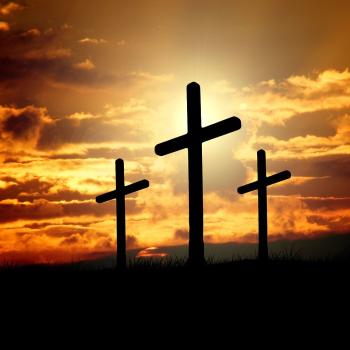
To cut a long story short, deconstruction led to reconstruction (as it ought to, or deconstruction is just destruction), and much of my original faith was restored. Jesus became even more central, and the cross remained the pivotal moment of human history, now and forever. Added to that, I grasped that mercy fully triumphs over justice, and that the Gospel is far more inclusive than I’d understood. I love the Bible as deeply as ever, perhaps even more so, and spend plenty of time meditating in it, harnessing the power God has invested in his word, but there are a few key differences in how I see it:
There is only one Word of God, and that is Jesus himself. John 1:1-14,
‘In the beginning was the Word, and the Word was with God, and the Word was God. He was with God in the beginning. Through him all things were made; without him nothing was made that has been made. In him was life, and that life was the light of all mankind. The light shines in the darkness, and the darkness has not overcome it…The Word became flesh and made his dwelling among us. We have seen his glory, the glory of the one and only Son, who came from the Father, full of grace and truth.’
While brimming with inspiration, the Bible is not a divine entity, and as such is the word of God, but not the Word of God. It must, therefore, be subject to rigorous questioning and analysis. God could have chosen to reveal himself in a single, unquestionable download, as Muslims believe he did with the Quran, but according to the Christian tradition, he chose two other methods.
Firstly, through numerous and varied documents, written by people living in different cultures and under diverse pressures, carrying their own assumptions. Secondly, and perfectly, he revealed himself through his son, Jesus. Hebrews 1:1-3,
‘In the past God spoke to our ancestors through the prophets at many times and in various ways, but in these last days he has spoken to us by his Son, whom he appointed heir of all things, and through whom also he made the universe. The Son is the radiance of God’s glory and the exact representation of his being, sustaining all things by his powerful word.’
For me, Jesus is the heart of all things, and the Bible serves to point to him, rather than to itself. As such, I permit myself to see the perspectives, flaws and limitations of its writers, while examining each book in context. Given the long and complex process involved in the Bible’s writing and compilation, I am confident this is the approach God always intended we take.
I no longer accept a simplistic version of inerrancy, which argues that each word of every book is unquestionably perfect. For example, it is well understood that many psalms attributed to David were not written by him – a thought that would have frightened me, twenty years ago: ‘If the Bible says a psalm is ‘of David’, but it wasn’t written by David, does that mean the Bible contains error?’
At university, a friend pointed out that in one place, the Bible asserts Jesus was buried for ‘three days and three nights’, while the Gospel stories show he only spent two nights in the grave. He was just winding me up, and didn’t anticipate the paroxysms his words span me into, until I’d found a way to explain this ‘error’. That is a hard way to believe – always nervous of the discoveries of science, archaeology and psychology, in case they contradict Biblical statements.
And what of Ecclesiastes? When Solomon wrote ‘Meaningless, meaningless, everything is meaningless,’ we are not meant to take that as either doctrine or instruction. He was surely ‘in error’, to reach such a conclusion, in the sense that it is not a statement of absolute truth, such as ‘God is love,’ but perhaps that’s the wrong way to look at it.
Alternatively, we could see that Solomon was expressing the truth as it appeared to him in that moment. Can we agree that he was right to express and be unashamed of his humanity, and that sharing his vulnerability with us was a helpful thing to do? Can we take truth from the passage without needing every word to be perfect? The truth of such a passage might be that it’s okay to be in the moment and accept your own emotions. Life is far from easy, at times, as we all know. Confusion, wrestling, and hope are all part of the process of seeking the truth, and finding one’s path.
For me, the fact that Solomon’s writing contains theological short-sightedness does not mean it is erroneous, in the sense that frightens those whose ideas are rigid. I give myself the permission I believe God always intended – to see in the Bible the heights of human wisdom, when inspired by love, and the depths of human folly, when driven by fear; the joy and pain of the personal journey. There is much else in the scriptures, including cascades of pure, doctrinal truth, but we can’t take human frailty out of the equation.
This approach to understanding scripture can frighten the rigid thinker, because we have been taught to see the Bible as a flat, two-dimensional download, each sentence of which must be a perfect expression of truth. In reality, nobody reads the Bible that way. I’m yet to meet the Evangelical who puts John 3:16 on the same footing as 1 Tim 2:15:
‘But women will be saved through childbearing – if they continue in faith, love and holiness with propriety.’
Or how about John 4:3?
‘So he left Judea and went back once more to Galilee.’
What is a verse without a passage? A passage without a chapter? A chapter without a book? A book without the other texts it relies upon, or which balance it out? Even with the Bible…no… especially with the Bible, context is everything, if wisdom is to be found.
What happens when we are honest with ourselves, and admit we already read the Bible in a more nuanced way than we claim? Do we come loose from our moorings, and drift into destruction? Not at all. After releasing ourselves from rigid thinking, we rediscover joy and touch base with humanity. We find ourselves in the company of the Holy Spirit, who leads us into all truth. The Holy Spirit is God; the Bible is not, and cannot be understood without his help. He interprets its many, diverse truths to us, as he leads us into increasing revelation, throughout the course of our lives.
I’ve come to believe that Evangelicalism has made a false god of the Bible. We must not forget that Jesus himself is the Word of God, and that the Bible points us to him, or we have misunderstood it. This is why a relationship with the Holy Spirit is essential. Without his guiding, all-knowing presence, we end up in all kinds of knots; deluded, self-justifying, and confused. That’s why (I believe) Evangelicalism in general is so keen on emphasising the Bible above all, including God himself – because within the movement’s confines, a relationship with the Holy Spirit is so often, and so tragically under-emphasised.
We should all be mystics, diving deep into the river of God, but many are only occasional visitors, dipping their feet into the shallows without ever surrendering control.
Having (I hope) established an argument for the necessity of deconstruction, the next instalment in the series will look at when deconstruction goes wrong (in my view), and how to avoid its pitfalls.
Re-thinking Christian Concepts
deconstruction and reconstruction
Previous Post

November 26, 2021
The Most Important Lesson My Father Taught Me
Next Post
December 7, 2021 Understanding Progressive Christianity, Part 2 – Sexual Integrity
Browse Our Archives
Select a Category A time for war and Sheol Authentic Faith Being in Christ Christian marriage Christian Mysticism Christian Nationalism Christian Parenting Christianity and politics Church and State De/reconstruction Discipleship Divine Healing Divine judgement Don't throw the baby out with the bathwater Effective Prayer Embracing the LGBTQ+ Community Embracing the LGBTQIA+ community End-Times Fellowship with his sufferings Gehenna Glorifying God Hades Healthy Debate Heaven and Earth Hell Honouring Christian Women I still believe inter-faith dialogue Interpreting Scripture Keep the faith Knowing the peace of God Living in Abundance Loving Each Other Loving God Loving Ourselves Mental Health Mental Health and Faith Old and New Covenants Practice Peace Prophecy Prophesy Re-thinking Christian Concepts Resist the Devil Revival Salvation Seeking God Sex and love sin and sinfulness Sound theology Spiritual Authority Spiritual discipline Spiritual effectiveness Spiritual Gifts Spiritual growth Spiritual Mentorship The Christmas story The Cross of Christ The divine feminine The Fear of the Lord The Holy Spirit The importance of kindness The importance of theology The MAGA Cult The Ministry of Jesus The risen Christ The service of Jesus the sin of judgement The spirit-filled life The Virgin Birth True worship Uncategorized Understanding God Understanding Old Testament prophecy Understanding Self-Worth Understanding the Bible Union with God War and Peace
Select a Month September 2026 August 2026 September 2025 March 2025 February 2025 January 2025 December 2024 November 2024 October 2024 September 2024 August 2024 July 2024 June 2024 May 2024 April 2024 March 2024 February 2024 January 2024 December 2023 November 2023 October 2023 September 2023 August 2023 July 2023 June 2023 May 2023 April 2023 March 2023 February 2023 January 2023 December 2022 November 2022 October 2022 September 2022 August 2022 July 2022 June 2022 May 2022 April 2022 March 2022 February 2022 January 2022 December 2021 November 2021 October 2021 September 2021 August 2021 July 2021
TAKE THE
Religious Wisdom Quiz
Who said, "The Lord will fight for you; you need only to be still"?
Select your answer to see how you score.
Solomon Joshua Moses David
Related posts from Duncan Edward Pile


What Does God Get Out of Worship?

Separation From God is an Illusion
TRENDING AT PATHEOS Progressive Christian

What Being a Modern-Day Apostle Means to Me
In my last column, I discussed the ins and outs of modern-day...

Did Ancient China Once Worship the God of...
Across human history, a common thread weaves through the origins of the...

Love Your Neighbor – Including Earth-Kin: Lev. 19,...
God’s command to love your neighbor means acting in an ethical and...

Lead a Church Study of “Jesus and Lao...
Guest writer Jack Thomas (The Irreverent Reverend) reflects on leading his church...

Pastoral Wisdom for Responding to Sermon Pushback
Getting sermon pushback on your social justice sermon? Learn practical, Proverbs-based strategies...

Principles for Understanding the Apostolic Ministry Today
Whenever people discover that my formal ministry title is "apostle," as in...
view all Progressive Christian blogs
Ad-Free & Subscriber Log-In Subscription Support
- About Us
- 2026 Calendar
- Videos
- Podcasts
- Library of World Religions
- Faith In Media Tracker
- Advertise With Us
- Write for Us
- Privacy Policy
- Terms of Service
- Do Not Sell My Data
- Contact Us
- Radiant Digital
- Manage Newsletter Subscriptions
- Unsubscribe From Notifications
- Sitemap
Copyright 2008-2026, Patheos. All rights reserved.
Subscription Support Ad-Free & Subscriber Log-In
Follow Patheos