
BuddhistCatholicContemplativeEvangelicalGeneral ChristianHinduJewishLatter-day SaintMuslimNew VisionsProgressive Christian
Beliefs
- Buddhist
- Catholic
- Contemplative
- Evangelical
- General Christian
- Hindu
- Jewish
- Latter-day Saint
- More Voices
- Muslim
- New Visions
- Pagan
- Progressive Christian
Topics
- Religion News
- Food and Religion
- Sports and Religion
- Religious Art
- Religious Music and Entertainment
- Religious Events
- History and Religion
- Style and Religion
- Politics and Religion
- Women in Religion
- Recreation Outdoors and Religion
- Business Finance and Religion
- Careers Workplace and Religion
- Education and Religion
- Family Parenting and Religion
- Health Fitness and Religion
- Home and Religion
- Relationships and Religion
- Technology and Religion
- Travel and Religion
Columnists
- Buddhist Columnists
- Business Finance and Religion Columnists
- Careers Workplace and Religion Columnists
- Catholic Columnists
- Contemplative Columnists
- Education and Religion Columnists
- Evangelists Columnists
- Family Parenting and Religion Columnists
- General Christian Columnists
- Health Fitness and Religion Columnists
- Hindu Columnists
- History and Religion Columnists
- Home and Religion Columnists
- Jewish Columnists
- More Voices Columnists
- Latter Day Columnists
- Muslim Columnists
- New Visions Columnists
- Nonreligious Columnists
- Pagan Columnists
- Politics and Religion Columnists
- Progressive Columnists
- Recreation Outdoors and Religion Columnists
- Relationships and Religion Columnists
- Religion News Columnists
- Religious Art Columnists
- Religious Events Columnists
- Religious Music and Entertainment Columnists
- Sports and Religion Columnists
- Style and Religion Columnists
- Technology and Religion Columnists
- Travel and Religion Columnists
- Women in Religion Columnists
Resource Library
- 2026 Calendar
- Library of World Religions
- The 100 Most Holy Places on Earth
- Patheos Answers
- Podcasts
- Videos
- Faith Leaders Database
- Anglican Episcopalian
- Bahai
- Baptist
- Buddhism
- Christianity
- Confucianism
- Eastern Orthodoxy
- Hinduism
- Holiness and Pentecostal
- ISKCON
- Islam
- Judaism
- Lutheran
- Methodist
- The Church of Jesus Christ of Latter-day Saints
- New Age
- Paganism
- Presbytarian and Reformed
- Protestantism
- Religion Behind the Scenes
- Roman Catholic
- Scientology
- Shia Islam
- Sikhism
- Sufism
- Sunni Islam
- Taoism
- Zen
- See all religions
Research Tools
 Ad-Free & Subscriber Log-In Subscription Support
Ad-Free & Subscriber Log-In Subscription Support
Follow Patheos 

- Trending:
- Forgiveness
- |
- Marriage
- |
- Consciousness
- |
- Death Penalty
- |
- Election
- |
- Halloween

- Home
- Progressive Christian
- Will the Real Jehovah Please Stand Up? Part 3
Will the Real Jehovah Please Stand Up? Part 3
Last updated on: August 11, 2021 at 5:54 pm by Duncan Edward Pile
Will the Real Jehovah Please Stand Up? Part 3 2021-08-11T17:54:28+01:00 Duncan Edward Pile
Patheos Explore the world's faith through different perspectives on religion and spirituality! Patheos has the views of the prevalent religions and spiritualities of the world.
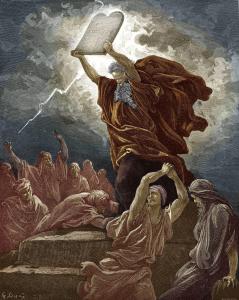
Hebrew Law.
In parts one and two of this series, I’ve examined the interaction and nature of God as seen in Eden and the time of Noah – whether historic or allegorical stories, the message is the same. It would take half the post to recap what was discussed, so I’ll leave a couple of links here and here, for parts 1 and 2, and move on into the interaction between God and his people in the time of Hebrew Law.
The giving of the Hebrew Law was heralded by threat and fear. Exodus 20, 18-21:
‘Now all the people witnessed the thunderings, the lightning flashes, the sound of the trumpet, and the mountain smoking; and when the people saw it, they trembled and stood afar off. Then they said to Moses, “You speak with us, and we will hear; but let not God speak with us, lest we die.”
And Moses said to the people, “Do not fear; for God has come to test you, and that His fear may be before you, so that you may not sin.” So the people stood afar off, but Moses drew near the thick darkness where God was.’
As intimated in parts one and two, the God we see in the time of the Mosaic Law has little in common with the God we saw in Eden, and the God we know in Jesus. So why the disconnect?
The Mosaic covenant is one of laws, strictures, right and wrong, black and white. It contains the Lex Talionis – an eye for an eye and a tooth for a tooth – and holds to unflinching notions of crime and punishment. In contrast to the mercy shown in Eden, God was no longer slow to anger, rushing straight to judgement. Numbers 15, 32-36:
‘While the Israelites were in the wilderness, a man was found gathering wood on the Sabbath day. Those who found him gathering wood brought him to Moses and Aaron and the whole assembly, and they kept him in custody, because it was not clear what should be done to him. Then the Lord said to Moses, ‘The man must die. The whole assembly must stone him outside the camp.’ So the assembly took him outside the camp and stoned him to death, as the Lord commanded Moses.’
How can this law have been just, or kind, or compassionate? How could the same God who did everything he could to rescue the human race by sending his own son to die, enforce a rule like this? What was the purpose of the Hebrew Law, when under it, God is hardly recognisable to the Christian believer?
The Apostle Paul understood Hebrew Law intimately, having spent the earlier portion of his adult life as a pharisee, struggling to achieve righteousness through perfect obedience to its wide-ranging rules. In the book of Romans, he exposes what it felt like to live that way. Romans 7, 18-20:
‘For the good that I will to do, I do not do; but the evil I will not to do, that I practice. Now if I do what I will not to do, it is no longer I who do it, but sin that dwells in me.’
Under the Law, Paul became painfully aware of the impossibility of personal perfection, but in Christ, he came to understand a divine purpose in the Law that was far above rule-keeping and personal righteousness. Romans 7, 7-13:
‘What shall we say, then? Is the law sinful? Certainly not! Nevertheless, I would not have known what sin was had it not been for the law. For I would not have known what coveting really was if the law had not said, ‘You shall not covet.’ But sin, seizing the opportunity afforded by the commandment, produced in me every kind of coveting…Did that which is good, then, become death to me? By no means! Nevertheless, in order that sin might be recognised as sin, it used what is good to bring about my death, so that through the commandment sin might become utterly sinful.’
Prior to the commandment (the Law), sin was not seen for what it was. A commandment requires a response – shall I obey it or not? The forbidding of activities awakens the desire to do the opposite. Telling a child not to touch a specific object, for example, is a guarantee that the object will be touched. Neither can the commandment bring true internal change. Colossians 2, 20-23:
‘Therefore, if you died with Christ from the basic principles of the world, why, as though living in the world, do you subject yourselves to regulations— “Do not touch, do not taste, do not handle,” which all concern things which perish with the using—according to the commandments and doctrines of men? These things indeed have an appearance of wisdom in self-imposed religion, false humility, and neglect of the body, but are of no value against the indulgence of the flesh.’
Outward measures of obedience, such as the Hebrew Law, have an appearance of wisdom, but no power to change us. The Law then, was no path to true righteousness, failing to deal with the human heart.
After all his striving under the Law, Paul came to understand its true message – that we can only receive righteousness through faith in Christ. Romans 7, 24-25:
‘What a wretched man I am! Who will rescue me from this body that is subject to death? Thanks be to God, who delivers me through Jesus Christ our Lord!’
This was Paul’s conclusion, which he doubles down on in Romans 8, 3a:
‘For what the law was powerless to do because it was weakened by the flesh, God did by sending his own Son…’
For what the law was powerless to do (make us right with God), God did by sending his own son. We receive righteousness as a gift, through Jesus. The purpose of the Hebrew Law then was not to establish a route to righteousness, but to reveal to human hearts that they need grace.
The period under Hebrew Law, then, is atypical of God’s relationship with humanity. He was not harsh in Eden, and even in the time of Noah, he sought mercy at every opportunity. When Jesus was confronted by an angry crowd of zealots, dragging a woman caught in adultery before him, he found a way to overturn the judgement of the Law, which would have seen her stoned to death. Jesus chose mercy, instead of the hard justice of the Law.
Every believer needs to understand this – in Jesus, we see the nature of God fully revealed. Jesus is not the anomaly; the Law is. Jesus is not an expression of a mere part of God’s nature; he is the Lord of All. The Great I am. John 19, 9b-10:
‘Anyone who has seen me has seen the Father. How can you say, “Show us the Father”? Don’t you believe that I am in the Father, and that the Father is in me? The words I say to you I do not speak on my own authority. Rather, it is the Father, living in me, who is doing his work.’
The law was a tool, exposing the root of our problem – since the days of Adam and Eve (whether literal or allegorical, the message is the same), we have been gorging on the fruit of the Tree of the Knowledge of Good and Evil. We are obsessed with judgement – of ourselves and others – and with standards to measure ourselves against. Human judgement is the enemy of fellowship with God, and self-righteousness under the Law is the ultimate expression of that woeful tendency.
It is my belief that many Christians are confused about the God they worship, because of a lack of clarity about law and grace. It needs teaching with surgical precision, but instead many folk swerve from one dispensation to the other, without theological insight. Perhaps it seems too good to be true, or maybe too simple – that we receive righteousness as a gift, that we are free from the law. And yet this truth lies at the core of all Christian freedom, joy and growth. We are called to receive the love of God, to let it transform us inwardly, and to release its organic flow to those we encounter. If we even nod the head towards earning the favour of God, we abandon grace. Galatians 5, 4:
‘You who are trying to be justified by the law have been alienated from Christ; you have fallen away from grace.’
Contrary to popular belief, ‘falling from grace’ does not refer to slipping into sin. It has only one meaning in the New Testament, and that is returning to law. If our behaviour determines the confidence with which we approach the Throne of Grace, we have become reliant on ourselves and our righteousness, instead of his. We have fallen from grace.
A lifetime of experience of different denominational teachings around the world has taught me this – despite the many biblical teachings about law and grace, the Evangelical Church remains greatly confused about this foundational matter. We need to banish theological woolliness, and understand the word of God in all its complexity. Paul wrote to Timothy of this, in 2 Timothy 2, 15:
‘Be diligent to present yourself approved to God, a worker who does not need to be ashamed, rightly dividing the word of truth.’
To rightly divide the word of truth, we must understand the reasons behind the differing ways God interacted with humanity throughout scripture. The confusion we see in the Church is because we are yet to grasp the importance of these differing scriptural periods, across the denominational board. When believers don’t know if they are under law or grace, they cannot be confident in the God they serve. Is he wrathful, punitive, and harsh, or does he see us with soft eyes, as Jesus did? The writer of Hebrews addresses this problem head on, making it abundantly clear what the believer should expect from God. Hebrews 12, 18-21:
‘For you have not come to the mountain that may be touched and that burned with fire, and to blackness and darkness and tempest, and the sound of a trumpet and the voice of words, so that those who heard it begged that the word should not be spoken to them anymore. (For they could not endure what was commanded: “And if so much as a beast touches the mountain, it shall be stoned or shot with an arrow.” And so terrifying was the sight that Moses said, “I am exceedingly afraid and trembling.”)
But you have come to Mount Zion and to the city of the living God, the heavenly Jerusalem, to an innumerable company of angels, to the general assembly and church of the firstborn who are registered in heaven, to God the Judge of all, to the spirits of just men made perfect, to Jesus the Mediator of the new covenant, and to the blood of sprinkling that speaks better things than that of Abel.’
This first mountain is Sinai, where the Law was given; the second is Zion, where we are seated in Heavenly places in Christ, and fearlessly fellowship with God, face to face. The writer contrasts the two, making it clear that the first mountain, which signifies life under the Law, is not our destiny. We have not come to gloom, lightning and storm, to terror of an exacting God! We have come to Jesus, the mediator of the covenant of grace, to innumerable angels, and to the joyful assembly of the saints. This second mountain is the reality of our spiritual position in Christ.
In conclusion, the Hebrew Law was not a true expression of the nature of God. In that period of divine interaction with humanity, the Lord was harsh and swift to anger. He had confined himself to the ways of the Law, for the purposes of that Law – to bring us to a full realisation of our need for grace. In Christ the Law is fulfilled; we receive righteousness as a gift, and can approach the Lord with confidence.
In the final instalment of Will the Real Jehovah Please Stand Up, I’ll be focussing on the life of Jesus, where the Lord God Almighty is fully and finally seen for who he is.
Re-thinking Christian Concepts
Previous Post

August 9, 2021
Would the Real Jehovah Please Stand Up? Part 2 - The Time of Noah
Next Post
August 16, 2021 Would the Real Jehovah Please Stand Up? Part 4 - The Life of Jesus
Browse Our Archives
Select a Category A time for war and Sheol Authentic Faith Being in Christ Christian marriage Christian Mysticism Christian Nationalism Christian Parenting Christianity and politics Church and State De/reconstruction Discipleship Divine Healing Divine judgement Don't throw the baby out with the bathwater Effective Prayer Embracing the LGBTQ+ Community Embracing the LGBTQIA+ community End-Times Fellowship with his sufferings Gehenna Glorifying God Hades Healthy Debate Heaven and Earth Hell Honouring Christian Women I still believe inter-faith dialogue Interpreting Scripture Keep the faith Knowing the peace of God Living in Abundance Loving Each Other Loving God Loving Ourselves Mental Health Mental Health and Faith Old and New Covenants Practice Peace Prophecy Prophesy Re-thinking Christian Concepts Resist the Devil Revival Salvation Seeking God Sex and love sin and sinfulness Sound theology Spiritual Authority Spiritual discipline Spiritual effectiveness Spiritual Gifts Spiritual growth Spiritual Mentorship The Christmas story The Cross of Christ The divine feminine The Fear of the Lord The Holy Spirit The importance of kindness The importance of theology The MAGA Cult The Ministry of Jesus The risen Christ The service of Jesus the sin of judgement The spirit-filled life The Virgin Birth True worship Uncategorized Understanding God Understanding Old Testament prophecy Understanding Self-Worth Understanding the Bible Union with God War and Peace
Select a Month September 2026 August 2026 September 2025 March 2025 February 2025 January 2025 December 2024 November 2024 October 2024 September 2024 August 2024 July 2024 June 2024 May 2024 April 2024 March 2024 February 2024 January 2024 December 2023 November 2023 October 2023 September 2023 August 2023 July 2023 June 2023 May 2023 April 2023 March 2023 February 2023 January 2023 December 2022 November 2022 October 2022 September 2022 August 2022 July 2022 June 2022 May 2022 April 2022 March 2022 February 2022 January 2022 December 2021 November 2021 October 2021 September 2021 August 2021 July 2021
TAKE THE
Religious Wisdom Quiz
What animal was often used for sacrifice?
Select your answer to see how you score.
Goat Lamb Dove Ox
Related posts from Duncan Edward Pile


What Does God Get Out of Worship?

Separation From God is an Illusion
TRENDING AT PATHEOS Progressive Christian

What Being a Modern-Day Apostle Means to Me
In my last column, I discussed the ins and outs of modern-day...

Did Ancient China Once Worship the God of...
Across human history, a common thread weaves through the origins of the...

Love Your Neighbor – Including Earth-Kin: Lev. 19,...
God’s command to love your neighbor means acting in an ethical and...

Lead a Church Study of “Jesus and Lao...
Guest writer Jack Thomas (The Irreverent Reverend) reflects on leading his church...

Pastoral Wisdom for Responding to Sermon Pushback
Getting sermon pushback on your social justice sermon? Learn practical, Proverbs-based strategies...

Principles for Understanding the Apostolic Ministry Today
Whenever people discover that my formal ministry title is "apostle," as in...
view all Progressive Christian blogs
Ad-Free & Subscriber Log-In Subscription Support
- About Us
- 2026 Calendar
- Videos
- Podcasts
- Library of World Religions
- Faith In Media Tracker
- Advertise With Us
- Write for Us
- Privacy Policy
- Terms of Service
- Do Not Sell My Data
- Contact Us
- Radiant Digital
- Manage Newsletter Subscriptions
- Unsubscribe From Notifications
- Sitemap
Copyright 2008-2026, Patheos. All rights reserved.
Subscription Support Ad-Free & Subscriber Log-In
Follow Patheos