
BuddhistCatholicContemplativeEvangelicalGeneral ChristianHinduJewishLatter-day SaintMuslimNew VisionsProgressive Christian
Beliefs
- Buddhist
- Catholic
- Contemplative
- Evangelical
- General Christian
- Hindu
- Jewish
- Latter-day Saint
- More Voices
- Muslim
- New Visions
- Pagan
- Progressive Christian
Topics
- Religion News
- Food and Religion
- Sports and Religion
- Religious Art
- Religious Music and Entertainment
- Religious Events
- History and Religion
- Style and Religion
- Politics and Religion
- Women in Religion
- Recreation Outdoors and Religion
- Business Finance and Religion
- Careers Workplace and Religion
- Education and Religion
- Family Parenting and Religion
- Health Fitness and Religion
- Home and Religion
- Relationships and Religion
- Technology and Religion
- Travel and Religion
Columnists
- Buddhist Columnists
- Business Finance and Religion Columnists
- Careers Workplace and Religion Columnists
- Catholic Columnists
- Contemplative Columnists
- Education and Religion Columnists
- Evangelists Columnists
- Family Parenting and Religion Columnists
- General Christian Columnists
- Health Fitness and Religion Columnists
- Hindu Columnists
- History and Religion Columnists
- Home and Religion Columnists
- Jewish Columnists
- More Voices Columnists
- Latter Day Columnists
- Muslim Columnists
- New Visions Columnists
- Nonreligious Columnists
- Pagan Columnists
- Politics and Religion Columnists
- Progressive Columnists
- Recreation Outdoors and Religion Columnists
- Relationships and Religion Columnists
- Religion News Columnists
- Religious Art Columnists
- Religious Events Columnists
- Religious Music and Entertainment Columnists
- Sports and Religion Columnists
- Style and Religion Columnists
- Technology and Religion Columnists
- Travel and Religion Columnists
- Women in Religion Columnists
Resource Library
- 2026 Calendar
- Library of World Religions
- The 100 Most Holy Places on Earth
- Patheos Answers
- Podcasts
- Videos
- Faith Leaders Database
- Anglican Episcopalian
- Bahai
- Baptist
- Buddhism
- Christianity
- Confucianism
- Eastern Orthodoxy
- Hinduism
- Holiness and Pentecostal
- ISKCON
- Islam
- Judaism
- Lutheran
- Methodist
- The Church of Jesus Christ of Latter-day Saints
- New Age
- Paganism
- Presbytarian and Reformed
- Protestantism
- Religion Behind the Scenes
- Roman Catholic
- Scientology
- Shia Islam
- Sikhism
- Sufism
- Sunni Islam
- Taoism
- Zen
- See all religions
Research Tools
 Ad-Free & Subscriber Log-In Subscription Support
Ad-Free & Subscriber Log-In Subscription Support
Follow Patheos 

- Trending:
- Forgiveness
- |
- Marriage
- |
- Consciousness
- |
- Death Penalty
- |
- Election
- |
- Halloween

- Home
- General Christian
- History and Religion
- Generosity, from the Inside Out
Generosity, from the Inside Out
Last updated on: July 26, 2023 at 2:38 pm by Kathleen Mulhern
Generosity, from the Inside Out 2023-07-26T14:38:59-06:00 Kathleen Mulhern
Patheos Explore the world's faith through different perspectives on religion and spirituality! Patheos has the views of the prevalent religions and spiritualities of the world.

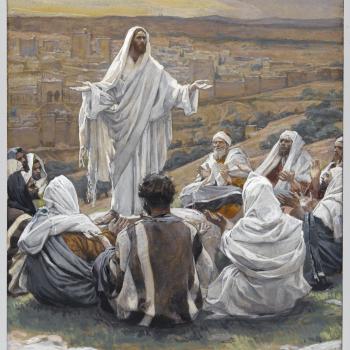
At this point in the Sermon on the Mount, Jesus gets very irksome. Until now, we can see the value of his counsel—control your anger, be faithful to your spouse, stay honest. Okay. All good points. But now he’s telling us, apparently, to do things that will really mess with the system: don’t resist an evil person, give to anyone who asks, love your enemies. None of these bits of advice settles well in this age of rights, hostilities, and violence.
Ludolph knows a little about all this. His century was not exactly Edenic. It included a Plague that makes Covid look like a head cold; papal corruption and conflict; numerous wars and political disasters; the dissolution of one economic order (feudalism) and the rise of a new one revolving around cities, markets, and businesses. The benefits and blessings of 21st century law, human rights, and social order that we enjoy (as tenuous as some of these seem), are bliss compared to life in European 14th century. And still, Ludolph takes Jesus’ words to heart. As should we.
Thus Ludolph moves with Jesus directly from treating our neighbors in life with integrity, in word and speech, to treating our non-neighbors with a similar integrity. Non-neighbors? Well, what would you call them, these evil persons, bullies, and enemies that Jesus describes? They’re the ones that assault you, steal from you, coerce you, persecute you.
After teaching that we should not injure others or show irreverence toward God, the Lord now goes on to teach how Christians should respond to those who injure them. In a few words, he forthrightly commends and encourages patience and generosity toward everyone, saying that this suffices for perfection.
So he introduces his hermeneutical theme for this section of the Sermon: patience and generosity. Once he has determined the overarching thrust of Jesus’ words, the various interpretations fall into place. Thus, he can bring reason to bear, even on these divinely breathed words: “It can even be wrong not to resist evil, if as a result wicked people oppress ordinary folk and can carry out their evil without fear of retribution.” Jesus isn’t giving us absolute laws, as though he’s replacing Law with Law, regulations with regulations. Rather he’s telling us how to be.
Be the kind of person who is humble enough to accept ill-treatment with a spirit of equanimity.
Be the kind of person who pursues justice for the correction of the neighbor and the welfare of the community rather than for your own bruised ego.
Be the kind of person who does not need to retaliate.
Ludolph proceeds to address each of the Sermon’s situations in these verses (5.38-47): vengeance, turning the cheek, giving the cloak, going the extra mile, praying for the persecutor. In each of these situations, the undergirding principle is a spirit of peace and a spirit of generosity. He tells us, “According to Augustine, the Lord is not telling you to walk a certain number of steps, but to be ready in spirit.” Ready to give generously, without fear for your own well-being or resentment about the ask. Ready to live without stinginess.
Jesus does not specify what to give, because you may not have the wherewithal to provide material assistance, but you are still obliged to give, even if it is only a word of encouragement. When those in need ask you for something material or spiritual, give a gift or a word. If their request is reasonable, you should give them what they ask for. … And if you are lacking in material means, give an affectionate and good disposition, a kind answer and prayer. If their request is unreasonable, talk with them and give a just cause for your refusal, explaining why what they ask is not feasible, so that you do not send them on their way as fools. Instruction of this kind is a work of justice and spiritual almsgiving. … Give to everyone that asks you; give something, even it if it is not what they asked. Christ said to give to everyone who asks, but not everything they ask; you should give what can be given honestly and justly.
Lest you think this gives us far too much wiggle room to avoid generosity, Ludolph is quick to follow this advice with Ambrose’s warning that “you should be aware that you unjustly possess many things when you do not share them.” Ahem.
The heart of the matter is, of course, the heart—not just ours, but those that reside in those very same evil persons, bullies, and enemies. “Every human being should be loved in charity because he or she is made in God’s image and has the capacity to know and love God.” This charitable love does not need to “lavish special affection,” as though we need to feel the same about these “non-neighbors.” Rather, the goal is “to become like God to the extent that our human nature allows”—i.e., granting others, even the nasty ones, acts of generosity, kindness, forgiveness, and patience, no matter how ill-treated we are. Just like Jesus.
Note: For a brief introduction to Ludolph of Saxony, a medieval “best-selling author,” read this.
Image by Jaroslav Smahel from Pixabay
History and Religion
Previous Post

July 11, 2023
The Sermon, Hair Color, and Swearing
Next Post

August 1, 2023 The Goodness Conundrum
Recent Comments
"It's too bad evangelicals dont have the same aversion for the Sinner's Prayer."
What Is the Prayer of Salvation?
"There is language that is clearly poetic symbolic in nature, and there is language that ..."
Jesus (and Only Jesus) Is the ..."
"This was a fantastic read! Thanks!"
The Sermon for the Summer: Beatitudes
"I'm glad that I have found and read this. This blog is practical. As for ..."
Unmoored Christianity: 12 “Anchor” Questions
Browse Our Archives
Select a Category Advent Ascetical Theology Book Reviews Children and Parenting Easter Epiphany Friends of God Lent Life in the Spirit Ludolph Pascalian Spirituality: a series Politics Prayers Six Neo-Christian Myths Spiritual Formation Tales from My Father Trinitarian Spirituality: a series Uncategorized
Select a Month October 2026 July 2024 June 2024 December 2023 August 2023 July 2023 June 2023 January 2023 October 2022 September 2022 August 2022 July 2022 April 2022 November 2021 October 2021 September 2021 August 2021 July 2021 June 2020 January 2020 December 2019 November 2019 October 2019 September 2019 June 2019 May 2019 April 2019 October 2018 August 2018 July 2018 June 2018 May 2018 April 2018 March 2018 February 2018 May 2017 April 2017 March 2017 February 2017 November 2016 June 2016 April 2016 February 2016 January 2016 December 2015 November 2015 October 2015 September 2015 August 2015 March 2015 October 2014 September 2014 August 2014 April 2014 March 2014 February 2014 September 2013 August 2013 July 2013 June 2013 May 2013 April 2013 March 2013 February 2013 January 2013 December 2012 November 2012 October 2012 September 2012 August 2012 July 2012 June 2012 May 2012 April 2012 March 2012 February 2012 October 2011 August 2011 July 2011 February 2011 October 2010 September 2010 July 2010 May 2010 April 2010 March 2010 February 2010 January 2010 November 2009 September 2009 August 2009 July 2009 June 2009
TAKE THE
Religious Wisdom Quiz
What city is the headquarters of the Roman Catholic Church?
Select your answer to see how you score.
Florence Rome Jerusalem Vatican City
Related posts from Dry Bones

What Is the Prayer of Salvation?


The Sermon, Hair Color, and Swearing
TRENDING AT PATHEOS General Christian

Seventy and Five Years Old: God Still Starts...
There is a small detail tucked into Genesis 12 that I skipped...

A Biblical Vision of Success in Christian Life...
The Concern and Quest Recent trends and tendencies I note around me...

Indigenous Peoples’ Day and the Church
Indigenous' Peoples Day or Columbus Day? Depending on where you live...

When Spiritual Growth Looks Like Losing Ground
Four Passive Spiritual Disciplines: An Introduction When I was a college freshman,...

Faith and Finding Your Current Season
“To everything there is a season,” Ecclesiastes tells us, “and a time...

Did Jesus Fear God's Wrath in Gethsemane?
That Time Jesus Was Terrified Before we begin, let me say at...
view all General Christian blogs
What Are Your Thoughts?leave a comment
Ad-Free & Subscriber Log-In Subscription Support
- About Us
- 2026 Calendar
- Videos
- Podcasts
- Library of World Religions
- Faith In Media Tracker
- Advertise With Us
- Write for Us
- Privacy Policy
- Terms of Service
- Do Not Sell My Data
- Contact Us
- Radiant Digital
- Manage Newsletter Subscriptions
- Unsubscribe From Notifications
- Sitemap
Copyright 2008-2026, Patheos. All rights reserved.
Subscription Support Ad-Free & Subscriber Log-In
Follow Patheos