
BuddhistCatholicContemplativeEvangelicalGeneral ChristianHinduJewishLatter-day SaintMuslimNew VisionsProgressive Christian
Beliefs
- Buddhist
- Catholic
- Contemplative
- Evangelical
- General Christian
- Hindu
- Jewish
- Latter-day Saint
- More Voices
- Muslim
- New Visions
- Pagan
- Progressive Christian
Topics
- Religion News
- Food and Religion
- Sports and Religion
- Religious Art
- Religious Music and Entertainment
- Religious Events
- History and Religion
- Style and Religion
- Politics and Religion
- Women in Religion
- Recreation Outdoors and Religion
- Business Finance and Religion
- Careers Workplace and Religion
- Education and Religion
- Family Parenting and Religion
- Health Fitness and Religion
- Home and Religion
- Relationships and Religion
- Technology and Religion
- Travel and Religion
Columnists
- Buddhist Columnists
- Business Finance and Religion Columnists
- Careers Workplace and Religion Columnists
- Catholic Columnists
- Contemplative Columnists
- Education and Religion Columnists
- Evangelists Columnists
- Family Parenting and Religion Columnists
- General Christian Columnists
- Health Fitness and Religion Columnists
- Hindu Columnists
- History and Religion Columnists
- Home and Religion Columnists
- Jewish Columnists
- More Voices Columnists
- Latter Day Columnists
- Muslim Columnists
- New Visions Columnists
- Nonreligious Columnists
- Pagan Columnists
- Politics and Religion Columnists
- Progressive Columnists
- Recreation Outdoors and Religion Columnists
- Relationships and Religion Columnists
- Religion News Columnists
- Religious Art Columnists
- Religious Events Columnists
- Religious Music and Entertainment Columnists
- Sports and Religion Columnists
- Style and Religion Columnists
- Technology and Religion Columnists
- Travel and Religion Columnists
- Women in Religion Columnists
Resource Library
- 2026 Calendar
- Library of World Religions
- The 100 Most Holy Places on Earth
- Patheos Answers
- Podcasts
- Videos
- Faith Leaders Database
- Anglican Episcopalian
- Bahai
- Baptist
- Buddhism
- Christianity
- Confucianism
- Eastern Orthodoxy
- Hinduism
- Holiness and Pentecostal
- ISKCON
- Islam
- Judaism
- Lutheran
- Methodist
- The Church of Jesus Christ of Latter-day Saints
- New Age
- Paganism
- Presbytarian and Reformed
- Protestantism
- Religion Behind the Scenes
- Roman Catholic
- Scientology
- Shia Islam
- Sikhism
- Sufism
- Sunni Islam
- Taoism
- Zen
- See all religions
Research Tools
 Ad-Free & Subscriber Log-In Subscription Support
Ad-Free & Subscriber Log-In Subscription Support
Follow Patheos 

- Trending:
- Forgiveness
- |
- Marriage
- |
- Consciousness
- |
- Death Penalty
- |
- Election
- |
- Halloween

- Home
- General Christian
- The Immeasurable Value of Ruins: Three Lessons in Appreciation
The Immeasurable Value of Ruins: Three Lessons in Appreciation
Last updated on: November 5, 2021 at 10:21 am by Kathleen Mulhern
The Immeasurable Value of Ruins: Three Lessons in Appreciation 2021-11-05T10:21:57-06:00 Kathleen Mulhern
Patheos Explore the world's faith through different perspectives on religion and spirituality! Patheos has the views of the prevalent religions and spiritualities of the world.
In my last post, I acknowledged the “falling apart” of our present version of American Christianity. “Fallings apart” are always painful, and this one is no different. We mourn the sense of chaos, the suffering of the faithful, the indifference of those who should know better, and, most of all, the befuddlement of those tearing down the walls all the while thinking they’re defending them. Peter Wehner sheds light on the real-time disintegration here. It’s the topic “du jour,” so there’s plenty of wise commentary out there. Timothy Keller begins a long analysis here.
I’m all about the ruins, though, not the reconstruction. That will be the responsibility of those far more creative and visionary than I am. I can, however, comment on ruins and their value.
The basest use of ruins is to deconstruct the building blocks and use them to construct something new, something, even, alien to their original use. This is not an act of appreciation, per se, merely of utility. It happens, and sometimes the outcome is beneficial to humanity, but we lose a great deal in this kind of exchange. An example: Saint Mark’s Basilica in Venice was constructed with pilfered stone and statues from Constantinople’s Hippodrome when the city was sacked in 1204—a sports venue converted into a house of worship.
There are, however, at least three ways to appreciate ruins, to benefit from them, to let them bless us. Three human ways, and one bonus divine way.
1) Ruins teach us the long view of human history: no power, no human achievement, no cultural privilege lasts forever. Stand for a moment in front of the Roman Forum, or maybe the Roman Colosseum in Italy. Or tour Versailles, France. Or ponder the Terracotta Army in Xi’an, China. It’s good for us to be reminded that these people and powers and principalities are all gone now. We may be in the throes of falling apart, but it has happened before and being human means accepting that. Being Christian, however, means seeing in these things Jesus’ warning: “Do you see all these great buildings? Not one stone here will be left on another; every one will be thrown down. … These are the beginning of birth pains. … The one who stands firm to the end will be saved.” Do not cling to human accomplishments, especially religious ones.
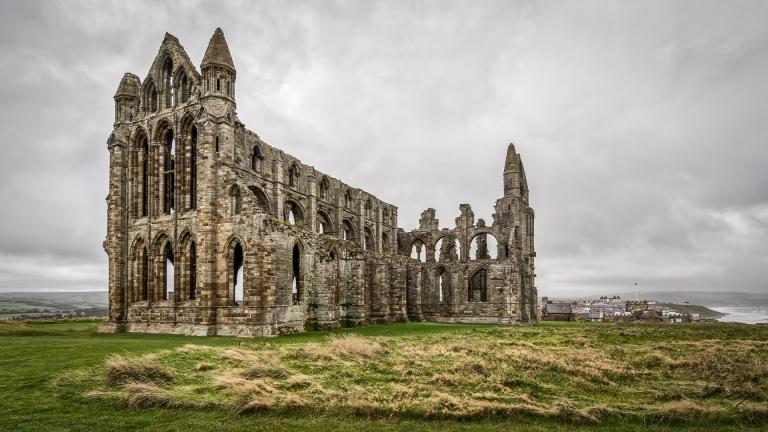
2) Ruins can serve as vessels of recollection: beauty and goodness are ephemeral, but their scent remains. Now we stand in front of Whitby Abbey, a 7th-century monastery that now stands open to wind and rain and bird life. Thanks to King Henry VIII’s Dissolution of the Monasteries, and multiple other disasters, the abbey no longer “functions.” What value, then, does it have? It remains as a witness to past faithfulness, past beauty, past seasons of goodness and effort. It echoes with centuries of night prayers and emanates a sensual radiance that stimulates our spiritual hunger. Ruins can draw us out of our techno-fever and the writhing rush of life, awakening us to the lingering fragrance of salvation as it was once celebrated, “the aroma of Christ among those who are being saved.” Ruins leave imprints on our souls, if we search for them. (If you have time, and like such things, check out these stunning pictures of ruined churches in Italy.)
3) Ruins can be severe warnings: “never again” has to be accompanied with keen questions and acts of will. Here we stand before the ruins of Theresienstadt, a Nazi labor camp that deported its residents to the killing camps. Cold, crumbling walls; a rusty maw-shaped crematorium; a “welcome” portal that declared “Works Frees.” Why do we not erase these ruined horrors from the earth? Because our “never again” means always remembering that we did these things. How did it come to that? What decisions were made that led to that? What choices and desires, banal in the beginning, could culminate in a holocaust? And what are we doing today to ensure that those things never happen again? Where are our choices and desires leading us? What must we say NO to in order to avert such gross travesties?
So, three ways to appreciate the ruins around us, even the ruins of American Christianity. Things fall apart, and no system or structure or network of power lasts forever. These disintegrations are merely the beginning of the deconstruction of what we cling to, and God will have us cling to nothing but him. Their demise does not mean that we cannot stand firm to the end.
But as we consider the ruins around us, let us remember the beauty and goodness they represent. Let us gather the godly zeal of the Puritans, the fervor of the revivalists, the stalwartness of the abolitionists, and the suffering passion of the slave churches. Let us breathe in the faithful labors of the Women’s Missionary Societies and the simple prayers of Children’s Church and the crammed note-taking of all the Bible studies and the monthly reception of the Lord’s Supper. And then, let us ask the hard questions: what choices have we made that have contributed to the ruination of these things? What choices must we now make to create something new, something life-giving? Where does the Spirit lead us today?
We look around with dismay, with a sense of profound loss and grief, even perhaps with a sense of hopelessness. What can be done with such ruins? This blog’s name is Dry Bones for a reason. We stand around and look at a valley of dry bones. Can these bones live? Ezekiel’s answer is the only one we have: “Sovereign Lord, you alone know.” And yet out of the ruins of a demolished Jerusalem, God anticipated city streets filled with boys and girls playing in them. “Even though it seems impossible to the remnant of this people in these days, should it also seem impossible to me, says the Lord of hosts?” (Zech 8.6)
And now, one final bonus divine way of appreciating these ruins. God says, let them become ruins! He is “removing what can be shaken—that is, created things, so that what cannot be shaken may remain. Therefore, since we are receiving a kingdom that cannot be shaken, let us be thankful, and so worship God acceptably with reverence and awe” (Heb 12.27-28). We are receiving an unshakeable kingdom, and all the constructions and deconstructions are just so many “frontier outposts.” They rise, they fall, but at its heart, King Jesus reigns in undaunted, fearless joy. As Charles Williams wrote: “The Centre cannot be touched; all that can possibly be done there has been done, outside Jerusalem, under Tiberius.”
Previous Post

October 26, 2021
The Ruins of Formation
Next Post

April 5, 2022 Johannes Vermeer and His Allegory of Faith: a Lenten Tableaux
Browse Our Archives
Select a Category Advent Ascetical Theology Book Reviews Children and Parenting Easter Epiphany Friends of God Lent Life in the Spirit Ludolph Pascalian Spirituality: a series Politics Prayers Six Neo-Christian Myths Spiritual Formation Tales from My Father Trinitarian Spirituality: a series Uncategorized
Select a Month October 2026 July 2024 June 2024 December 2023 August 2023 July 2023 June 2023 January 2023 October 2022 September 2022 August 2022 July 2022 April 2022 November 2021 October 2021 September 2021 August 2021 July 2021 June 2020 January 2020 December 2019 November 2019 October 2019 September 2019 June 2019 May 2019 April 2019 October 2018 August 2018 July 2018 June 2018 May 2018 April 2018 March 2018 February 2018 May 2017 April 2017 March 2017 February 2017 November 2016 June 2016 April 2016 February 2016 January 2016 December 2015 November 2015 October 2015 September 2015 August 2015 March 2015 October 2014 September 2014 August 2014 April 2014 March 2014 February 2014 September 2013 August 2013 July 2013 June 2013 May 2013 April 2013 March 2013 February 2013 January 2013 December 2012 November 2012 October 2012 September 2012 August 2012 July 2012 June 2012 May 2012 April 2012 March 2012 February 2012 October 2011 August 2011 July 2011 February 2011 October 2010 September 2010 July 2010 May 2010 April 2010 March 2010 February 2010 January 2010 November 2009 September 2009 August 2009 July 2009 June 2009
TAKE THE
Religious Wisdom Quiz
What Christian denomination is the largest in the United States?
Select your answer to see how you score.
Catholic Methodist Pentecostal Baptist
Related posts from Dry Bones
When Spiritual Growth Looks Like Losing Ground
From Virtue Signaling to Virtue
The Three Gifts and Their Meaning: a Ludolph...

The Sermon on the Mount for the New...
TRENDING AT PATHEOS General Christian

Seventy and Five Years Old: God Still Starts...
There is a small detail tucked into Genesis 12 that I skipped...

A Biblical Vision of Success in Christian Life...
The Concern and Quest Recent trends and tendencies I note around me...

Indigenous Peoples’ Day and the Church
Indigenous' Peoples Day or Columbus Day? Depending on where you live...

When Spiritual Growth Looks Like Losing Ground
Four Passive Spiritual Disciplines: An Introduction When I was a college freshman,...

Faith and Finding Your Current Season
“To everything there is a season,” Ecclesiastes tells us, “and a time...

Did Jesus Fear God's Wrath in Gethsemane?
That Time Jesus Was Terrified Before we begin, let me say at...
view all General Christian blogs
Ad-Free & Subscriber Log-In Subscription Support
- About Us
- 2026 Calendar
- Videos
- Podcasts
- Library of World Religions
- Faith In Media Tracker
- Advertise With Us
- Write for Us
- Privacy Policy
- Terms of Service
- Do Not Sell My Data
- Contact Us
- Radiant Digital
- Manage Newsletter Subscriptions
- Unsubscribe From Notifications
- Sitemap
Copyright 2008-2026, Patheos. All rights reserved.
Subscription Support Ad-Free & Subscriber Log-In
Follow Patheos