
BuddhistCatholicContemplativeEvangelicalGeneral ChristianHinduJewishLatter-day SaintMuslimNew VisionsProgressive Christian
Beliefs
- Buddhist
- Catholic
- Contemplative
- Evangelical
- General Christian
- Hindu
- Jewish
- Latter-day Saint
- More Voices
- Muslim
- New Visions
- Pagan
- Progressive Christian
Topics
- Religion News
- Food and Religion
- Sports and Religion
- Religious Art
- Religious Music and Entertainment
- Religious Events
- History and Religion
- Style and Religion
- Politics and Religion
- Women in Religion
- Recreation Outdoors and Religion
- Business Finance and Religion
- Careers Workplace and Religion
- Education and Religion
- Family Parenting and Religion
- Health Fitness and Religion
- Home and Religion
- Relationships and Religion
- Technology and Religion
- Travel and Religion
Columnists
- Buddhist Columnists
- Business Finance and Religion Columnists
- Careers Workplace and Religion Columnists
- Catholic Columnists
- Contemplative Columnists
- Education and Religion Columnists
- Evangelists Columnists
- Family Parenting and Religion Columnists
- General Christian Columnists
- Health Fitness and Religion Columnists
- Hindu Columnists
- History and Religion Columnists
- Home and Religion Columnists
- Jewish Columnists
- More Voices Columnists
- Latter Day Columnists
- Muslim Columnists
- New Visions Columnists
- Nonreligious Columnists
- Pagan Columnists
- Politics and Religion Columnists
- Progressive Columnists
- Recreation Outdoors and Religion Columnists
- Relationships and Religion Columnists
- Religion News Columnists
- Religious Art Columnists
- Religious Events Columnists
- Religious Music and Entertainment Columnists
- Sports and Religion Columnists
- Style and Religion Columnists
- Technology and Religion Columnists
- Travel and Religion Columnists
- Women in Religion Columnists
Resource Library
- 2026 Calendar
- Library of World Religions
- The 100 Most Holy Places on Earth
- Patheos Answers
- Podcasts
- Videos
- Faith Leaders Database
- Anglican Episcopalian
- Bahai
- Baptist
- Buddhism
- Christianity
- Confucianism
- Eastern Orthodoxy
- Hinduism
- Holiness and Pentecostal
- ISKCON
- Islam
- Judaism
- Lutheran
- Methodist
- The Church of Jesus Christ of Latter-day Saints
- New Age
- Paganism
- Presbytarian and Reformed
- Protestantism
- Religion Behind the Scenes
- Roman Catholic
- Scientology
- Shia Islam
- Sikhism
- Sufism
- Sunni Islam
- Taoism
- Zen
- See all religions
Research Tools
 Ad-Free & Subscriber Log-In Subscription Support
Ad-Free & Subscriber Log-In Subscription Support
Follow Patheos 

- Trending:
- Forgiveness
- |
- Marriage
- |
- Consciousness
- |
- Death Penalty
- |
- Election
- |
- Halloween

- Home
- General Christian
- The Adoration of the Magi: Our Impoverishment
The Adoration of the Magi: Our Impoverishment
Last updated on: January 3, 2020 at 8:30 am by Kathleen Mulhern
The Adoration of the Magi: Our Impoverishment 2019-12-10T12:34:35-07:00 Kathleen Mulhern
Patheos Explore the world's faith through different perspectives on religion and spirituality! Patheos has the views of the prevalent religions and spiritualities of the world.
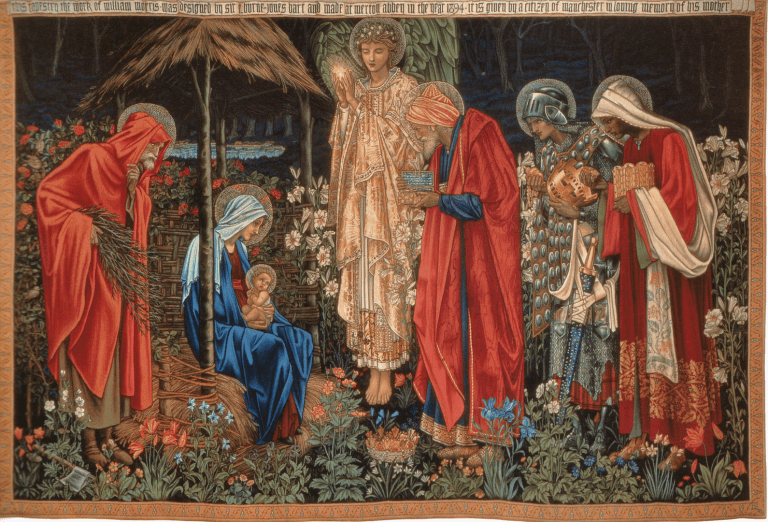 Adoration of the Magi, Edward Burne Jones, 19th c.
Shall we adore Our Lord Jesus Christ? Is he worthy?
“Behold, wise men from the east came to Jerusalem, saying, ‘Where is he who has been born king of the Jews? For we saw his star when it rose and have come to worship him.’ … They saw the child with Mary his mother, and they fell down and worshiped him. Then, opening their treasures, they offered him gifts, gold and frankincense and myrrh.”
Edward Burne Jones’ visual reflection on these verses from the Gospel of Matthew demonstrates the power of the imagination in understanding scripture. At one level, from a strictly biblical perspective, he gets the whole scene wrong. Mary and Joseph received them in a house, according to Matthew, not in a stable. No one knows how many wise men there were, and Jones portrays them as kings, which is also speculative. Joseph is portrayed as an old man, which comes from a post-biblical legend about the Holy Family. And Jesus was most certainly not blonde. It would be wrong, however, to get hung up on the inaccuracies of a portrayal like this and miss the deeper truths in the picture.
The power of prayerful imagination is such that Jones also gets it all right. It’s almost as though the whole scene is taking place in his heart, each detail reflecting some part of the artist’s own experience of the event: Joseph’s humble service, quietly taking the lesser part in the scene; Mary’s serene acceptance of yet another unexpected episode in this crazy year of her life; the wise men’s longing love and generous adoration; the gazebo serving as an altar; the lush, verdant garden of paradise surrounding them, replete with lilies of purity and holiness and roses surrounding the mother; the gifts, so irrelevant to an infant and yet so indicative of his true identity and so very useful in the night flight and long journey to come; the crowns thrown down in worship; the night everywhere outside of the scene; the attending angel who holds the star of revelation in his hands.
While the scene flows with life and energy, it is the baby’s glance that steals the scene. Jesus, God-with-us, looks at the three wise men, receiving them like the King that he is. Their eyes are locked on him, his on them. At that moment, the only moment in their lives when they are in his presence, the Great Exchange is made. They offer him their devotion; he offers them a place in his kingdom.
“Being warned in a dream not to return to Herod, they departed to their own country by another way.”
As we begin this new year, we have had the opportunity to experience this Great Exchange in our own hearts. Somewhere beneath and behind all the twinkling lights, Christmas trees, relentless carols, piles of wrapping paper, and tables of rich foods—all the incongruities of a season supposedly about an obscure young woman in a sleepy corner of a remote Roman province—we have been invited to come to the newborn King and worship. We have offered him our devotion; he has offered us a place in his kingdom.
We will know it was a true experience if indeed we do not return to Herod—the king of this world with his greedy, hate-filled, deceitful, and corrupt order of things—but take a new way into the country ahead. We move into these new ways poorer, for we have left our crowns and our gifts behind, and perhaps we move into them with some trepidation because the paths are unfamiliar. We are stripped and impoverished, and we have a long journey ahead sustained only by that Child’s loving acceptance of us.
Nevertheless, he is worthy, he is worthy, he is worthy.
“While him I love, in him I live, and cannot live amiss. …
His birth our joy, his life our light, his death our end of thrall.”
~ St. Robert Southwell (1561-95)
Previous Post

December 6, 2019
Advent Darkness: It's Not the New Normal
Next Post
June 1, 2020 A Letter to My Beloved White Friends
Browse Our Archives
Select a Category Advent Ascetical Theology Book Reviews Children and Parenting Easter Epiphany Friends of God Lent Life in the Spirit Ludolph Pascalian Spirituality: a series Politics Prayers Six Neo-Christian Myths Spiritual Formation Tales from My Father Trinitarian Spirituality: a series Uncategorized
Select a Month October 2026 July 2024 June 2024 December 2023 August 2023 July 2023 June 2023 January 2023 October 2022 September 2022 August 2022 July 2022 April 2022 November 2021 October 2021 September 2021 August 2021 July 2021 June 2020 January 2020 December 2019 November 2019 October 2019 September 2019 June 2019 May 2019 April 2019 October 2018 August 2018 July 2018 June 2018 May 2018 April 2018 March 2018 February 2018 May 2017 April 2017 March 2017 February 2017 November 2016 June 2016 April 2016 February 2016 January 2016 December 2015 November 2015 October 2015 September 2015 August 2015 March 2015 October 2014 September 2014 August 2014 April 2014 March 2014 February 2014 September 2013 August 2013 July 2013 June 2013 May 2013 April 2013 March 2013 February 2013 January 2013 December 2012 November 2012 October 2012 September 2012 August 2012 July 2012 June 2012 May 2012 April 2012 March 2012 February 2012 October 2011 August 2011 July 2011 February 2011 October 2010 September 2010 July 2010 May 2010 April 2010 March 2010 February 2010 January 2010 November 2009 September 2009 August 2009 July 2009 June 2009
TAKE THE
Religious Wisdom Quiz
True or False: The parable of the Good Samaritan is found in all four Gospels.
Select your answer to see how you score.
TRUE FALSE
Related posts from Dry Bones

When Spiritual Growth Looks Like Losing Ground
The Three Gifts and Their Meaning: a Ludolph...

The Immeasurable Value of Ruins: Three Lessons in...

TRENDING AT PATHEOS General Christian

Seventy and Five Years Old: God Still Starts...
There is a small detail tucked into Genesis 12 that I skipped...

A Biblical Vision of Success in Christian Life...
The Concern and Quest Recent trends and tendencies I note around me...

Indigenous Peoples’ Day and the Church
Indigenous' Peoples Day or Columbus Day? Depending on where you live...

When Spiritual Growth Looks Like Losing Ground
Four Passive Spiritual Disciplines: An Introduction When I was a college freshman,...

Faith and Finding Your Current Season
“To everything there is a season,” Ecclesiastes tells us, “and a time...

Did Jesus Fear God's Wrath in Gethsemane?
That Time Jesus Was Terrified Before we begin, let me say at...
view all General Christian blogs
Ad-Free & Subscriber Log-In Subscription Support
- About Us
- 2026 Calendar
- Videos
- Podcasts
- Library of World Religions
- Faith In Media Tracker
- Advertise With Us
- Write for Us
- Privacy Policy
- Terms of Service
- Do Not Sell My Data
- Contact Us
- Radiant Digital
- Manage Newsletter Subscriptions
- Unsubscribe From Notifications
- Sitemap
Copyright 2008-2026, Patheos. All rights reserved.
Subscription Support Ad-Free & Subscriber Log-In
Follow Patheos