
BuddhistCatholicContemplativeEvangelicalGeneral ChristianHinduJewishLatter-day SaintMuslimNew VisionsProgressive Christian
Beliefs
- Buddhist
- Catholic
- Contemplative
- Evangelical
- General Christian
- Hindu
- Jewish
- Latter-day Saint
- More Voices
- Muslim
- New Visions
- Pagan
- Progressive Christian
Topics
- Religion News
- Food and Religion
- Sports and Religion
- Religious Art
- Religious Music and Entertainment
- Religious Events
- History and Religion
- Style and Religion
- Politics and Religion
- Women in Religion
- Recreation Outdoors and Religion
- Business Finance and Religion
- Careers Workplace and Religion
- Education and Religion
- Family Parenting and Religion
- Health Fitness and Religion
- Home and Religion
- Relationships and Religion
- Technology and Religion
- Travel and Religion
Columnists
- Buddhist Columnists
- Business Finance and Religion Columnists
- Careers Workplace and Religion Columnists
- Catholic Columnists
- Contemplative Columnists
- Education and Religion Columnists
- Evangelists Columnists
- Family Parenting and Religion Columnists
- General Christian Columnists
- Health Fitness and Religion Columnists
- Hindu Columnists
- History and Religion Columnists
- Home and Religion Columnists
- Jewish Columnists
- More Voices Columnists
- Latter Day Columnists
- Muslim Columnists
- New Visions Columnists
- Nonreligious Columnists
- Pagan Columnists
- Politics and Religion Columnists
- Progressive Columnists
- Recreation Outdoors and Religion Columnists
- Relationships and Religion Columnists
- Religion News Columnists
- Religious Art Columnists
- Religious Events Columnists
- Religious Music and Entertainment Columnists
- Sports and Religion Columnists
- Style and Religion Columnists
- Technology and Religion Columnists
- Travel and Religion Columnists
- Women in Religion Columnists
Resource Library
- 2026 Calendar
- Library of World Religions
- The 100 Most Holy Places on Earth
- Patheos Answers
- Podcasts
- Videos
- Faith Leaders Database
- Anglican Episcopalian
- Bahai
- Baptist
- Buddhism
- Christianity
- Confucianism
- Eastern Orthodoxy
- Hinduism
- Holiness and Pentecostal
- ISKCON
- Islam
- Judaism
- Lutheran
- Methodist
- The Church of Jesus Christ of Latter-day Saints
- New Age
- Paganism
- Presbytarian and Reformed
- Protestantism
- Religion Behind the Scenes
- Roman Catholic
- Scientology
- Shia Islam
- Sikhism
- Sufism
- Sunni Islam
- Taoism
- Zen
- See all religions
Research Tools
 Ad-Free & Subscriber Log-In Subscription Support
Ad-Free & Subscriber Log-In Subscription Support
Follow Patheos 

- Trending:
- Forgiveness
- |
- Marriage
- |
- Consciousness
- |
- Death Penalty
- |
- Election
- |
- Halloween

- Home
- General Christian
- Life in the Spirit: The Guiding God, Part 2
Life in the Spirit: The Guiding God, Part 2
Last updated on: June 29, 2016 at 5:46 pm by K. Mulhern
Life in the Spirit: The Guiding God, Part 2 2016-06-29T17:46:06-06:00 K. Mulhern
Patheos Explore the world's faith through different perspectives on religion and spirituality! Patheos has the views of the prevalent religions and spiritualities of the world.
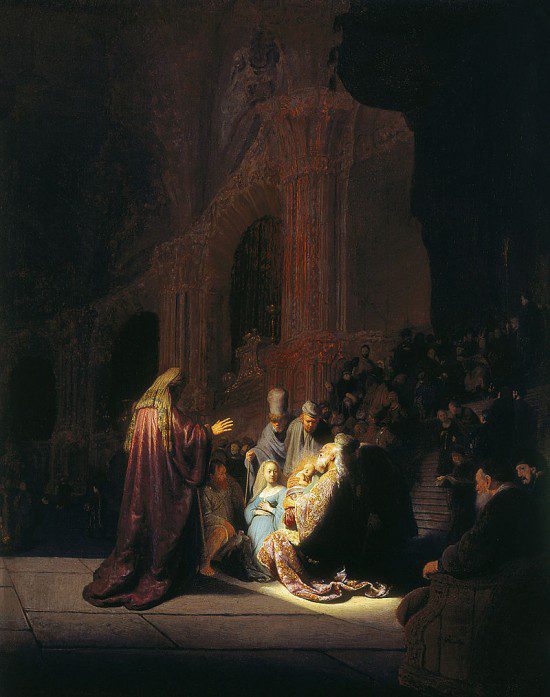
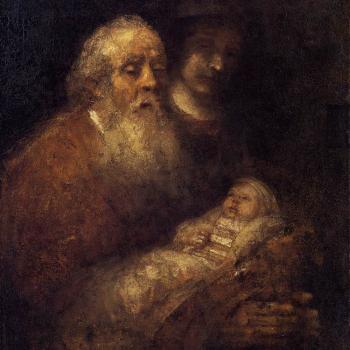
Rembrandt, 1631
“The mind and soul of a mature man of prayer have simplified their gaze, and deepened and broadened their correspondences with Reality… Such a soul knows existence, is aware of the mysterious movements and pressure of the Spirit, in a way others do not.” ~ Evelyn Underhill
Last week I wrote about the Spirit of God as a divine Sherpa, a trustworthy companion and guide in life. (Not “the spiritual life,” whatever that is, but life. All of life. House life and work life; marriage life and singleness life; laundry life; grocery store life; school life; office life; social life. “Spiritual but not religious” is one thing, and its own problem, but most religious people really practice “spiritual but not relevant,” which is another, perhaps more insidious, problem.)
There is one character in the Gospels that sums up for me exactly what I’m looking for in life in the Spirit. Despite our differences—he an elderly Jew of the first century who lived in an occupied city at the far edges of an Empire, me a 21st-century middle-aged woman who lives in the heartland of an Empire (that seems to be going further off the skids every day!)—I want to imitate him. The Gospel doesn’t tell us much about him—ten verses total—but I guess it tells us just enough.
“Now there was a man in Jerusalem called Simeon, who was righteous and devout. … the Holy Spirit was upon him … It had been revealed to him by the Holy Spirit … Moved by the Spirit, Simeon went…” (Luke 2.25-35)
The Church has referred to this man as Simeon “the God-receiver.” And with that nickname, we get images like this early 19th-century piece by Alexei Yegerov, “Simeon the Godreceiver”:
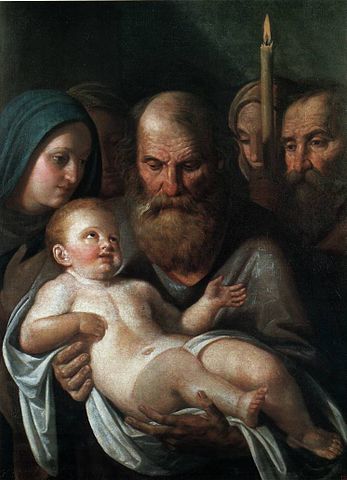
Alexey Yegorov, c. 1830s
As you can see, the artist interprets, as perhaps many have in history, that Simeon’s God-receiving took place when he scooped up the baby Jesus. And so it did, but it clearly also took place long, long, long before that.
Simeon is the epitome of timing. How can it be that he was in the right place at the right time to hold God in his arms? Sheer dumb luck? Mysterious coincidence? Divine appointment? No, nothing quite so serendipitous. Rather, Simeon was the kind of man who had lived a long life with the Spirit of God as his companion. He had lived life as a God-receiver. Thus, his whole being was attuned to life in the Spirit.
“Simeon was righteous and devout.” These words sound super pious and religious. We may imagine “righteous and devout” people today as spiritual prigs who need to get a life. Piety is an oddity in this world, and more a source of ridicule and pity than admiration. But these biblical terms merely tell us that Simeon was intimate with God.
“Righteous”: Simeon was in a face-to-face relationship with God, a relationship characterized by a true understanding of God and of himself. It does not mean that he was holier-than-thou, super religious, smarmy Bible-quoting, and smug. Pretty much the opposite of that. True righteousness means a deep knowledge of your own absolute need for and dependence on God.
“Devout”: Simeon practiced his righteousness. He cultivated rhythms of life that nurtured and fed his desire to be in relationship with God. He wasn’t passive in this relationship, but active, struggling, and persistent. For a long time. It’s hard to over emphasize in this world of the immediate that true devotion is indeed “a long obedience in the same direction” and that it involves a spiritual tenacity that refuses to get distracted by the lack of “results,” discouragements, failures, or dusty deaths of religious drudgery.
“Simeon was waiting for the consolation of Israel, and the Holy Spirit was upon him.” These aren’t two disconnected clauses. On the contrary, they’re tied together in ways that tell us a great deal about the business of being righteousness and devout. Simeon was waiting for the consolation of Israel, the expected act of God in history to bring new life to God’s people. The Old Testament is full of expectation, promise, hope, and these longings are all wrapped up in this idea of “consolation.” We read in Isaiah 40.1-2: “Comfort, comfort my people, says your God. Speak tenderly to Jerusalem and proclaim to her that her hard service has been completed, that her sin has been paid for, that she has received from the Lord’s hand double for all her sins.” Or, as one 19th-century rabbi cites it: “Comfort ye, comfort ye, my people, will say your God. Speak consolation unto the heart of Jerusalem; and call unto her…” (emphasis added)
To wait for the consolation of Israel is to be filled with holy desire as we long for the work of God in the world. The consolation of Israel is the fulfillment of God’s ancient promises, promises that include fullness of justice, human peace, the well-being of nature, the eradication of ignorance and degradation, and the death of death. A) Who doesn’t want that? And B) Who really thinks these things are going to come about through legislation, political strong-arming, or sheer “enlightenment”? This kind of consolation is a divine action, not a triumph of the human spirit. The Greek word for consolation is parakaleo, with the same root as Paraclete, Advocate.
The Spirit rested on Simeon; the Spirit made a home in Simeon. Simeon longed for the very things that the Spirit longed for. The inner attentiveness to the consolation, an echo of the Spirit, made it possible for him to receive the Spirit’s revelation. Revelations, you know, always take two.
“Guided by the Spirit, Simeon came into the temple…”
Simeon obeyed the prompting of the Spirit and came into the temple that day, at that time, just at the right moment to run into Mary and Joseph. And the Spirit guided him into truth about that peasant baby, told him what was to come, and made the meaning of Jesus known to him, enabling him to proclaim the Kingdom.
When I overlay Jesus’ teachings in John about the Spirit on this glimpse into Simeon’s world, this is what I see.
- Jesus taught his disciples that love and obedience are interdependent. You cannot have one without the other. Simeon was able to obey because he had spent a lifetime of loving; he had spent a lifetime of loving through daily obedience.
- When we attune our desires to the Spirit’s desire, we sync ourselves to the Spirit’s power and guidance. Simeon could testify to love because he, like a carved-out canyon, was a longtime conduit of the Spirit’s presence. This is obedience—not rule-keeping, but visible affection.
- The Spirit makes it all happen. Simeon simply moved with the Spirit, and the Spirit proclaimed the truth, gave a glimpse of the future, affirmed God’s presence.
These are all exact parallels of the three points about Jesus’ teaching in last week’s post. And so, these are the images of Simeon the God-receiver that I like the best, the ones where he is receiving God in his vision as well as in his arms. Like Mary, before we can carry Jesus, we must be filled with the Spirit.
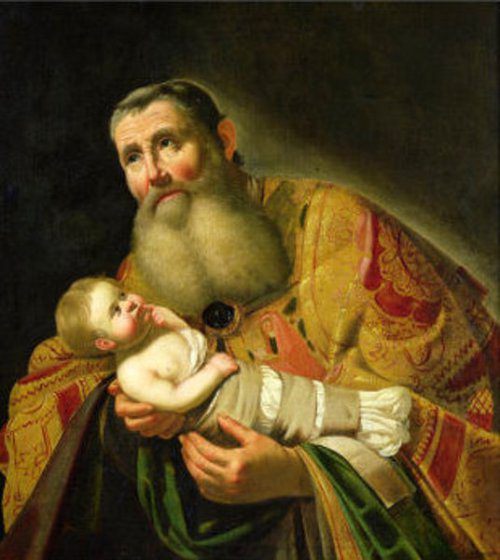
Jan van Bijlert, c. 1650
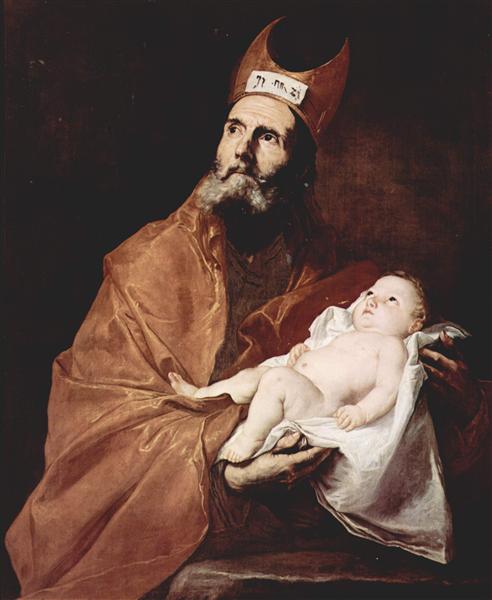
Jusepe de Ribera, 1647
Last week I addressed a small group of people, several of whom were the proverbial millennials, about life in Christ. One young man came up to me later and said something to the effect that 90 percent of people his age never, ever even give these things a moment’s thought. That may be a draconian estimate, but the impression itself is real. So, we can grab our bullhorns and stand on the sidewalk corner to proclaim the gospel—cajole, threaten, browbeat, and righteously warn—or we can deepen our lives in the Spirit and move with the work of God. I recommend the latter. As Evelyn Underhill continues, “Because of its humble and disciplined communion with that immanent Spirit, such a soul has achieved a flexibility which can move to and fro between the inward and the outward, finding in both in the most actual sense the presence of a living, acting God.”
Previous Post

June 23, 2016
Life in the Spirit: God Guiding, or, Spirit as Sherpa
Next Post
November 1, 2016 A Descent Into Darkness, but Never Alone
Browse Our Archives
Select a Category Advent Ascetical Theology Book Reviews Children and Parenting Easter Epiphany Friends of God Lent Life in the Spirit Ludolph Pascalian Spirituality: a series Politics Prayers Six Neo-Christian Myths Spiritual Formation Tales from My Father Trinitarian Spirituality: a series Uncategorized
Select a Month October 2026 July 2024 June 2024 December 2023 August 2023 July 2023 June 2023 January 2023 October 2022 September 2022 August 2022 July 2022 April 2022 November 2021 October 2021 September 2021 August 2021 July 2021 June 2020 January 2020 December 2019 November 2019 October 2019 September 2019 June 2019 May 2019 April 2019 October 2018 August 2018 July 2018 June 2018 May 2018 April 2018 March 2018 February 2018 May 2017 April 2017 March 2017 February 2017 November 2016 June 2016 April 2016 February 2016 January 2016 December 2015 November 2015 October 2015 September 2015 August 2015 March 2015 October 2014 September 2014 August 2014 April 2014 March 2014 February 2014 September 2013 August 2013 July 2013 June 2013 May 2013 April 2013 March 2013 February 2013 January 2013 December 2012 November 2012 October 2012 September 2012 August 2012 July 2012 June 2012 May 2012 April 2012 March 2012 February 2012 October 2011 August 2011 July 2011 February 2011 October 2010 September 2010 July 2010 May 2010 April 2010 March 2010 February 2010 January 2010 November 2009 September 2009 August 2009 July 2009 June 2009
TAKE THE
Religious Wisdom Quiz
What is the largest predominantly Catholic country in South America?
Select your answer to see how you score.
Argentina Mexico Brazil Peru
Related posts from Dry Bones
The Presentation: "Long for the Lord's coming" :...

Life in the Spirit: God Guiding, or, Spirit...

Life in the Spirit: God Tending

Life in the Spirit: God Birthing
TRENDING AT PATHEOS General Christian

Seventy and Five Years Old: God Still Starts...
There is a small detail tucked into Genesis 12 that I skipped...

A Biblical Vision of Success in Christian Life...
The Concern and Quest Recent trends and tendencies I note around me...

Indigenous Peoples’ Day and the Church
Indigenous' Peoples Day or Columbus Day? Depending on where you live...

When Spiritual Growth Looks Like Losing Ground
Four Passive Spiritual Disciplines: An Introduction When I was a college freshman,...

Faith and Finding Your Current Season
“To everything there is a season,” Ecclesiastes tells us, “and a time...

Did Jesus Fear God's Wrath in Gethsemane?
That Time Jesus Was Terrified Before we begin, let me say at...
view all General Christian blogs
Ad-Free & Subscriber Log-In Subscription Support
- About Us
- 2026 Calendar
- Videos
- Podcasts
- Library of World Religions
- Faith In Media Tracker
- Advertise With Us
- Write for Us
- Privacy Policy
- Terms of Service
- Do Not Sell My Data
- Contact Us
- Radiant Digital
- Manage Newsletter Subscriptions
- Unsubscribe From Notifications
- Sitemap
Copyright 2008-2026, Patheos. All rights reserved.
Subscription Support Ad-Free & Subscriber Log-In
Follow Patheos