
BuddhistCatholicContemplativeEvangelicalGeneral ChristianHinduJewishLatter-day SaintMuslimNew VisionsProgressive Christian
Beliefs
- Buddhist
- Catholic
- Contemplative
- Evangelical
- General Christian
- Hindu
- Jewish
- Latter-day Saint
- More Voices
- Muslim
- New Visions
- Pagan
- Progressive Christian
Topics
- Religion News
- Food and Religion
- Sports and Religion
- Religious Art
- Religious Music and Entertainment
- Religious Events
- History and Religion
- Style and Religion
- Politics and Religion
- Women in Religion
- Recreation Outdoors and Religion
- Business Finance and Religion
- Careers Workplace and Religion
- Education and Religion
- Family Parenting and Religion
- Health Fitness and Religion
- Home and Religion
- Relationships and Religion
- Technology and Religion
- Travel and Religion
Columnists
- Buddhist Columnists
- Business Finance and Religion Columnists
- Careers Workplace and Religion Columnists
- Catholic Columnists
- Contemplative Columnists
- Education and Religion Columnists
- Evangelists Columnists
- Family Parenting and Religion Columnists
- General Christian Columnists
- Health Fitness and Religion Columnists
- Hindu Columnists
- History and Religion Columnists
- Home and Religion Columnists
- Jewish Columnists
- More Voices Columnists
- Latter Day Columnists
- Muslim Columnists
- New Visions Columnists
- Nonreligious Columnists
- Pagan Columnists
- Politics and Religion Columnists
- Progressive Columnists
- Recreation Outdoors and Religion Columnists
- Relationships and Religion Columnists
- Religion News Columnists
- Religious Art Columnists
- Religious Events Columnists
- Religious Music and Entertainment Columnists
- Sports and Religion Columnists
- Style and Religion Columnists
- Technology and Religion Columnists
- Travel and Religion Columnists
- Women in Religion Columnists
Resource Library
- 2026 Calendar
- Library of World Religions
- The 100 Most Holy Places on Earth
- Patheos Answers
- Podcasts
- Videos
- Faith Leaders Database
- Anglican Episcopalian
- Bahai
- Baptist
- Buddhism
- Christianity
- Confucianism
- Eastern Orthodoxy
- Hinduism
- Holiness and Pentecostal
- ISKCON
- Islam
- Judaism
- Lutheran
- Methodist
- The Church of Jesus Christ of Latter-day Saints
- New Age
- Paganism
- Presbytarian and Reformed
- Protestantism
- Religion Behind the Scenes
- Roman Catholic
- Scientology
- Shia Islam
- Sikhism
- Sufism
- Sunni Islam
- Taoism
- Zen
- See all religions
Research Tools
 Ad-Free & Subscriber Log-In Subscription Support
Ad-Free & Subscriber Log-In Subscription Support
Follow Patheos 

- Trending:
- Forgiveness
- |
- Marriage
- |
- Consciousness
- |
- Death Penalty
- |
- Election
- |
- Halloween

- Home
- General Christian
- My House: God’s Favorite Place on Earth
My House: God’s Favorite Place on Earth
Last updated on: May 1, 2013 at 3:57 pm by K. Mulhern
My House: God’s Favorite Place on Earth 2013-05-01T15:57:56-06:00 K. Mulhern
Patheos Explore the world's faith through different perspectives on religion and spirituality! Patheos has the views of the prevalent religions and spiritualities of the world.
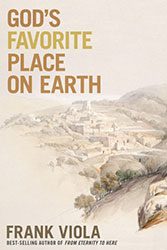 (A Book Review)
“Living after you have died is strange.”
So Lazarus tells us. An understatement, don’t you think? Living before you have died is sometimes very strange, so after you’ve died has to be far weirder. Not many people get to tell that story. In God’s Favorite Place on Earth, though, Lazarus (via Frank Viola) does. (No matter how many near-death experiences you’ve read about, they can’t compete with Lazarus’ four-day adventure.)
Lazarus’ death is one of many vignettes that Viola pulls out of the Gospel stories about Mary, Martha, and Lazarus in Bethany. Martha’s complaining, Mary’s listening; Mary’s messages, Lazarus’ illness; Martha’s declaration of faith, Jesus’ weeping; Mary’s recklessness, Jesus’ commendation. The heavy aroma of stewing lentils and garlic, the sweaty smell of many men, the exotic fragrance of nard; the sound of sweeping and weeping, sobbing and scolding; the image of Jesus stooping to come in the front door and relax with his friends after a long day cursing fig trees and whipping up a frenzy in the Temple; Jesus teaching, blessing, reminding, ascending. All these narratives are short stories told by Lazarus, interspersed with the author’s reflections.
Easy reading, yet thought provoking, Viola’s Bethany song is a prolonged and creative meditation on those earthy stories about Jesus’ friendship with a middle-class family in a small suburb of Jerusalem. The simple rhythm of storytelling and gentle application lead us into Jesus’ humanity while inviting us into his divinity.
Martin Luther likened humanity to a drunk man on a horse, slipping over to one side and being propped up only to slump over on the other. In some ways, Christian theology is not unlike this; we slip slide our spiritual way, sometimes relishing the historical Jesus (which usually means a natural man, first-century rabbi, son of a carpenter, and victim of the Roman Empire), and sometimes losing ourselves in the mystical, magical Lord in whom all things hold together. To hold the two in tension is always difficult, but that is the heart of the Christian mystery: revealed in the flesh, vindicated in spirit, seen by angels, proclaimed among Gentiles, believed in throughout the world, taken up in glory (1 Tim. 3.16).
I especially liked his inclusion of the Ascension as part of Lazarus’ story. All too often we Evangelicals fail to recognize that the Ascension is the completion of the Passion: the Trial-Crucifixion-Death-Burial-Resurrection Event. We jump around in joy at the Resurrection—as we should, of course—yet we often leave the story hanging. And then we quickly move on to the Pentecost (or not … sometimes that’s a little scary too, all that wild speaking in tongues … best to just remember that the Holy Spirit is somewhere nearby). But the Ascension is that culmination of the Passion, the very real—dare we even say, tangible?—glorification of Christ that takes humanity into the very throne room of God. The Ascension is our future.
God’s Favorite Place on Earth is a gentle and friendly book, never challenging in a scholarly sense, but inviting that reader who has seen one too many glittery Jesuses with halos to understand that a) this Man was someone who needed friends, who appreciated good meals, who got tired after a long day at work, and who would probably have loved potato chips, and that b) this Lord was One who can craft holiness and resurrection out of the common elements of my daily rhythms and greatest calamities.
I’m sure I’m not as good of a cook as Martha, nor as bold as Mary, nor quite as dead as Lazarus but I can hope that he would have liked my house, my cooking, and my family’s conversation, that he might think of Emerson Street as one of his favorite places on earth.
Book Club special offer for Patheos readers: Buy God’s Favorite Place on Earth between May 1-7, 2013, and receive 25 free books and audios from 15 different authors, such Leonard Sweet, Adrian Warnock, and Pete Briscoe.
For more on God’s Favorite Place on Earth*, visit the Patheos Book Club here.*
Previous Post

April 24, 2013
Becoming Neo-Pascalian: The Second Step Toward a Make-Believe Faith
Next Post
May 8, 2013 If I Hadn't Had Children...
Browse Our Archives
Select a Category Advent Ascetical Theology Book Reviews Children and Parenting Easter Epiphany Friends of God Lent Life in the Spirit Ludolph Pascalian Spirituality: a series Politics Prayers Six Neo-Christian Myths Spiritual Formation Tales from My Father Trinitarian Spirituality: a series Uncategorized
Select a Month October 2026 July 2024 June 2024 December 2023 August 2023 July 2023 June 2023 January 2023 October 2022 September 2022 August 2022 July 2022 April 2022 November 2021 October 2021 September 2021 August 2021 July 2021 June 2020 January 2020 December 2019 November 2019 October 2019 September 2019 June 2019 May 2019 April 2019 October 2018 August 2018 July 2018 June 2018 May 2018 April 2018 March 2018 February 2018 May 2017 April 2017 March 2017 February 2017 November 2016 June 2016 April 2016 February 2016 January 2016 December 2015 November 2015 October 2015 September 2015 August 2015 March 2015 October 2014 September 2014 August 2014 April 2014 March 2014 February 2014 September 2013 August 2013 July 2013 June 2013 May 2013 April 2013 March 2013 February 2013 January 2013 December 2012 November 2012 October 2012 September 2012 August 2012 July 2012 June 2012 May 2012 April 2012 March 2012 February 2012 October 2011 August 2011 July 2011 February 2011 October 2010 September 2010 July 2010 May 2010 April 2010 March 2010 February 2010 January 2010 November 2009 September 2009 August 2009 July 2009 June 2009
TAKE THE
Religious Wisdom Quiz
What did Moses do after breaking the tablets?
Select your answer to see how you score.
Fasted for 30 days Returned to Sinai for new tablets Left the camp Destroyed the calf
Related posts from Dry Bones

When Spiritual Growth Looks Like Losing Ground

The Immeasurable Value of Ruins: Three Lessons in...


Jesus (and Only Jesus) Is the Christ
TRENDING AT PATHEOS General Christian

Seventy and Five Years Old: God Still Starts...
There is a small detail tucked into Genesis 12 that I skipped...

A Biblical Vision of Success in Christian Life...
The Concern and Quest Recent trends and tendencies I note around me...

Indigenous Peoples’ Day and the Church
Indigenous' Peoples Day or Columbus Day? Depending on where you live...

When Spiritual Growth Looks Like Losing Ground
Four Passive Spiritual Disciplines: An Introduction When I was a college freshman,...

Faith and Finding Your Current Season
“To everything there is a season,” Ecclesiastes tells us, “and a time...

Did Jesus Fear God's Wrath in Gethsemane?
That Time Jesus Was Terrified Before we begin, let me say at...
view all General Christian blogs
Ad-Free & Subscriber Log-In Subscription Support
- About Us
- 2026 Calendar
- Videos
- Podcasts
- Library of World Religions
- Faith In Media Tracker
- Advertise With Us
- Write for Us
- Privacy Policy
- Terms of Service
- Do Not Sell My Data
- Contact Us
- Radiant Digital
- Manage Newsletter Subscriptions
- Unsubscribe From Notifications
- Sitemap
Copyright 2008-2026, Patheos. All rights reserved.
Subscription Support Ad-Free & Subscriber Log-In
Follow Patheos