
BuddhistCatholicContemplativeEvangelicalGeneral ChristianHinduJewishLatter-day SaintMuslimNew VisionsProgressive Christian
Beliefs
- Buddhist
- Catholic
- Contemplative
- Evangelical
- General Christian
- Hindu
- Jewish
- Latter-day Saint
- More Voices
- Muslim
- New Visions
- Pagan
- Progressive Christian
Topics
- Religion News
- Food and Religion
- Sports and Religion
- Religious Art
- Religious Music and Entertainment
- Religious Events
- History and Religion
- Style and Religion
- Politics and Religion
- Women in Religion
- Recreation Outdoors and Religion
- Business Finance and Religion
- Careers Workplace and Religion
- Education and Religion
- Family Parenting and Religion
- Health Fitness and Religion
- Home and Religion
- Relationships and Religion
- Technology and Religion
- Travel and Religion
Columnists
- Buddhist Columnists
- Business Finance and Religion Columnists
- Careers Workplace and Religion Columnists
- Catholic Columnists
- Contemplative Columnists
- Education and Religion Columnists
- Evangelists Columnists
- Family Parenting and Religion Columnists
- General Christian Columnists
- Health Fitness and Religion Columnists
- Hindu Columnists
- History and Religion Columnists
- Home and Religion Columnists
- Jewish Columnists
- More Voices Columnists
- Latter Day Columnists
- Muslim Columnists
- New Visions Columnists
- Nonreligious Columnists
- Pagan Columnists
- Politics and Religion Columnists
- Progressive Columnists
- Recreation Outdoors and Religion Columnists
- Relationships and Religion Columnists
- Religion News Columnists
- Religious Art Columnists
- Religious Events Columnists
- Religious Music and Entertainment Columnists
- Sports and Religion Columnists
- Style and Religion Columnists
- Technology and Religion Columnists
- Travel and Religion Columnists
- Women in Religion Columnists
Resource Library
- 2026 Calendar
- Library of World Religions
- The 100 Most Holy Places on Earth
- Patheos Answers
- Podcasts
- Videos
- Faith Leaders Database
- Anglican Episcopalian
- Bahai
- Baptist
- Buddhism
- Christianity
- Confucianism
- Eastern Orthodoxy
- Hinduism
- Holiness and Pentecostal
- ISKCON
- Islam
- Judaism
- Lutheran
- Methodist
- The Church of Jesus Christ of Latter-day Saints
- New Age
- Paganism
- Presbytarian and Reformed
- Protestantism
- Religion Behind the Scenes
- Roman Catholic
- Scientology
- Shia Islam
- Sikhism
- Sufism
- Sunni Islam
- Taoism
- Zen
- See all religions
Research Tools
 Ad-Free & Subscriber Log-In Subscription Support
Ad-Free & Subscriber Log-In Subscription Support
Follow Patheos 

- Trending:
- Forgiveness
- |
- Marriage
- |
- Consciousness
- |
- Death Penalty
- |
- Election
- |
- Halloween

- Home
- General Christian
- I Can Speak Whale: Interrupted by Moby-Dick
I Can Speak Whale: Interrupted by Moby-Dick
Last updated on: January 24, 2013 at 9:58 pm by K. Mulhern
I Can Speak Whale: Interrupted by Moby-Dick 2013-01-24T21:58:30-07:00 K. Mulhern
Patheos Explore the world's faith through different perspectives on religion and spirituality! Patheos has the views of the prevalent religions and spiritualities of the world.
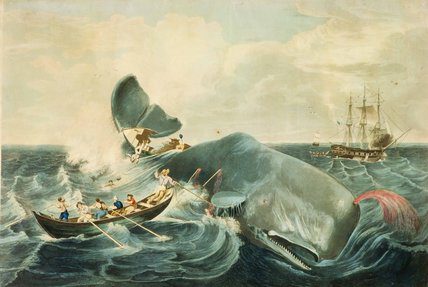 Pascal by day, but Melville by night. No wonder I can’t get a New Year’s letter out the door.
Last night I finished Moby-Dick, an enterprise I started, once, long ago, and found too mind-numbing even for me. My daughter, an English Lit major, warned me. “Read only if assigned. Then you can write a paper on it and get credit.” Unfortunately, it’s part of a Franklin books collection my parents gave me as a graduation gift from high school, and thus an unspoken mandate of sorts. And Moby-Dick has taunted me, all these many years, with my rebuff; I, in spurning it, had been conquered by it; the White Whale’s flukes slapped me silly. So I picked it up again (little knowing that my determination to succeed was, itself, Ahab-ian.)
But now? Done. Thinking more than once, “Die, stupid whale, die, so I can get on with something that tells me nothing about the dimensions of whale skeletons or the ambergris that comes from whale guts,” I come to end. And Moby-Dick survives. And I, with Ishmael, watch my weeks of reading circle the sucking vortex of the sinking Pequod.
Worth reading? Yes, I suppose so: for vanity’s sake; for the really transformational knowledge I’ve gleaned about whales; for the reassurance that my desire never to “go to sea” has some basis in reality.
But two take-aways, reminders for those of you who read the book, and spiritual “cheat sheets” for those who haven’t/won’t:
1) Ishmael. The book’s most famous line is its first: “Call me Ishmael.” And, then, a few chapters into the novel, Ishmael pretty much disappears from view, though the entire narrative is his. And there he is in the end, the sole survivor. (Sorry if these comments are spoilers. You’ve had plenty of time to read it yourself.)
Ishmael looks like the center; in his own mind, he is the center, obviously, as the observer; and yet very little of the book, almost none of it, is about Ishmael.
I, too, am Ishmael. I am the observer, the world around me the observed; I begin my story, and there I will be at the end of my story. But very little of my story is really about me. I’m in the boat; I overhear the conversations. The heat of the great vats liquefying the whale blubber into oil sears my face; the long hours in the crow’s nest, watching an unchanging horizon in the face of a relentless sun, weary me. I am a part of the story, a narrator of the story, but not the center of the story.
2) Ahab. The crazed captain of the Pequod is obsessed. Yes, he wants revenge for the great injuries the monstrous white whale had inflicted on the last hunt. Every stumpy step the captain takes on his ivory-crafted leg calls him to retribution. And yet, of course, his mania is irrational. As Starbuck, his first mate, declares early in the novel, revenge is for intentional harm and Moby-Dick is not an intentional creature.
In truth, though, it is not revenge that drives Ahab, but that “je ne sais quoi” that compels each of us to behave in destructive ways, even when we know, know, that these choices lead to death.
Ahab: “What is it, what nameless, inscrutable, unearthly thing is it; what cozening, hidden lord and master, and cruel, remorseless emperor commands me; that against all natural lovings and longings, I so keep pushing, and crowding, and jamming myself on all the time; recklessly making me ready to do what in my own proper, natural heart, I durst not so much as dare?”
I’m neither a captain nor a novelist, but this, this I understand all too well.
Paul: “For I do not understand my own actions. For I do not do what I want, but I do the very thing I hate. Now if I do what I do not want, I agree with the law, that it is good. So now it is no longer I who do it, but sin that dwells within me. For I know that nothing good dwells in me, that is, in my flesh. For I have the desire to do what is right, but not the ability to carry it out. For I do not do the good I want, but the evil I do not want is what I keep on doing.” (Rom. 7)
Mulhern: “I imagine good, I pray for good, I hope for good, but when I come to stretch out my hand, I take what is less good, no good, ungood. What is this fatal weakness that cannot conjure into reality what I choose in my heart?”
Choose life! (Dt. 30)
And so, the weird thing is that Ishmael, beginning and ending the book but so seemingly inconsequential throughout the story, is the character I cling to, like the bobbing coffin-lifebuoy that saves Ishmael’s life. He chooses life. In fact, his very desire to serve on a whaling boat, described at the beginning of the novel, is a desire to escape the emptiness of his life and enter into vitality. “I thought I would sail about a little and see the watery part of the world. It is a way I have of driving off the spleen… Whenever I find myself growing grim about the mouth; whenever it is a damp, drizzly November in my soul; whenever I find myself involuntarily pausing before coffin warehouses, and bringing up the rear of every funeral I meet … I account it high time to get to sea as soon as I can…. I am in the habit of going to sea whenever I begin to grow hazy about the eyes…” And one odd glimpse, midway through the book, relates Ishmael’s post-Pequod experiences—“smoking upon the thick-gilt tiled piazza of the Golden Inn in Lima.”
And yet, he is a no one—the main character and a no one. There’s some comfort in that. That, and the fact that my Franklin edition of the novel contains sixteen lovely colored lithographs.
Previous Post

January 21, 2013
Becoming Neo-Pascalian: The Back Story
Next Post
January 29, 2013 Becoming Neo-Pascalian: The Augustinian Problem
Browse Our Archives
Select a Category Advent Ascetical Theology Book Reviews Children and Parenting Easter Epiphany Friends of God Lent Life in the Spirit Ludolph Pascalian Spirituality: a series Politics Prayers Six Neo-Christian Myths Spiritual Formation Tales from My Father Trinitarian Spirituality: a series Uncategorized
Select a Month October 2026 July 2024 June 2024 December 2023 August 2023 July 2023 June 2023 January 2023 October 2022 September 2022 August 2022 July 2022 April 2022 November 2021 October 2021 September 2021 August 2021 July 2021 June 2020 January 2020 December 2019 November 2019 October 2019 September 2019 June 2019 May 2019 April 2019 October 2018 August 2018 July 2018 June 2018 May 2018 April 2018 March 2018 February 2018 May 2017 April 2017 March 2017 February 2017 November 2016 June 2016 April 2016 February 2016 January 2016 December 2015 November 2015 October 2015 September 2015 August 2015 March 2015 October 2014 September 2014 August 2014 April 2014 March 2014 February 2014 September 2013 August 2013 July 2013 June 2013 May 2013 April 2013 March 2013 February 2013 January 2013 December 2012 November 2012 October 2012 September 2012 August 2012 July 2012 June 2012 May 2012 April 2012 March 2012 February 2012 October 2011 August 2011 July 2011 February 2011 October 2010 September 2010 July 2010 May 2010 April 2010 March 2010 February 2010 January 2010 November 2009 September 2009 August 2009 July 2009 June 2009
TAKE THE
Religious Wisdom Quiz
Which Psalm is a prayer of repentance after David's sin with Bathsheba?
Select your answer to see how you score.
Psalm 24 Psalm 7 Psalm 51 Psalm 23
Related posts from Dry Bones

I want to write a book and be...

Loving Mrs. Turpin, Loving the Grotesque

When Spiritual Growth Looks Like Losing Ground

Come On, God, This Isn’t Working
TRENDING AT PATHEOS General Christian

Seventy and Five Years Old: God Still Starts...
There is a small detail tucked into Genesis 12 that I skipped...

A Biblical Vision of Success in Christian Life...
The Concern and Quest Recent trends and tendencies I note around me...

Indigenous Peoples’ Day and the Church
Indigenous' Peoples Day or Columbus Day? Depending on where you live...

When Spiritual Growth Looks Like Losing Ground
Four Passive Spiritual Disciplines: An Introduction When I was a college freshman,...

Faith and Finding Your Current Season
“To everything there is a season,” Ecclesiastes tells us, “and a time...

Did Jesus Fear God's Wrath in Gethsemane?
That Time Jesus Was Terrified Before we begin, let me say at...
view all General Christian blogs
Ad-Free & Subscriber Log-In Subscription Support
- About Us
- 2026 Calendar
- Videos
- Podcasts
- Library of World Religions
- Faith In Media Tracker
- Advertise With Us
- Write for Us
- Privacy Policy
- Terms of Service
- Do Not Sell My Data
- Contact Us
- Radiant Digital
- Manage Newsletter Subscriptions
- Unsubscribe From Notifications
- Sitemap
Copyright 2008-2026, Patheos. All rights reserved.
Subscription Support Ad-Free & Subscriber Log-In
Follow Patheos