
BuddhistCatholicContemplativeEvangelicalGeneral ChristianHinduJewishLatter-day SaintMuslimNew VisionsProgressive Christian
Beliefs
- Buddhist
- Catholic
- Contemplative
- Evangelical
- General Christian
- Hindu
- Jewish
- Latter-day Saint
- More Voices
- Muslim
- New Visions
- Pagan
- Progressive Christian
Topics
- Religion News
- Food and Religion
- Sports and Religion
- Religious Art
- Religious Music and Entertainment
- Religious Events
- History and Religion
- Style and Religion
- Politics and Religion
- Women in Religion
- Recreation Outdoors and Religion
- Business Finance and Religion
- Careers Workplace and Religion
- Education and Religion
- Family Parenting and Religion
- Health Fitness and Religion
- Home and Religion
- Relationships and Religion
- Technology and Religion
- Travel and Religion
Columnists
- Buddhist Columnists
- Business Finance and Religion Columnists
- Careers Workplace and Religion Columnists
- Catholic Columnists
- Contemplative Columnists
- Education and Religion Columnists
- Evangelists Columnists
- Family Parenting and Religion Columnists
- General Christian Columnists
- Health Fitness and Religion Columnists
- Hindu Columnists
- History and Religion Columnists
- Home and Religion Columnists
- Jewish Columnists
- More Voices Columnists
- Latter Day Columnists
- Muslim Columnists
- New Visions Columnists
- Nonreligious Columnists
- Pagan Columnists
- Politics and Religion Columnists
- Progressive Columnists
- Recreation Outdoors and Religion Columnists
- Relationships and Religion Columnists
- Religion News Columnists
- Religious Art Columnists
- Religious Events Columnists
- Religious Music and Entertainment Columnists
- Sports and Religion Columnists
- Style and Religion Columnists
- Technology and Religion Columnists
- Travel and Religion Columnists
- Women in Religion Columnists
Resource Library
- 2026 Calendar
- Library of World Religions
- The 100 Most Holy Places on Earth
- Patheos Answers
- Podcasts
- Videos
- Faith Leaders Database
- Anglican Episcopalian
- Bahai
- Baptist
- Buddhism
- Christianity
- Confucianism
- Eastern Orthodoxy
- Hinduism
- Holiness and Pentecostal
- ISKCON
- Islam
- Judaism
- Lutheran
- Methodist
- The Church of Jesus Christ of Latter-day Saints
- New Age
- Paganism
- Presbytarian and Reformed
- Protestantism
- Religion Behind the Scenes
- Roman Catholic
- Scientology
- Shia Islam
- Sikhism
- Sufism
- Sunni Islam
- Taoism
- Zen
- See all religions
Research Tools
 Ad-Free & Subscriber Log-In Subscription Support
Ad-Free & Subscriber Log-In Subscription Support
Follow Patheos 

- Trending:
- Forgiveness
- |
- Marriage
- |
- Consciousness
- |
- Death Penalty
- |
- Election
- |
- Halloween
 Drishtikone
- Home
- Hindu
- Two Millennia of India's Economic Journey: 1st Century to 2000 AD
Two Millennia of India's Economic Journey: 1st Century to 2000 AD
Last updated on: May 13, 2007 at 8:23 pm by Desh Kapoor
Two Millennia of India's Economic Journey: 1st Century to 2000 AD 2007-05-13T20:23:33-05:00 Desh Kapoor
Patheos Explore the world's faith through different perspectives on religion and spirituality! Patheos has the views of the prevalent religions and spiritualities of the world.
India is a poor country today. But was it always like that? If you look at the GDP figures (courtesy: Wikipedia) of India vs the rest of the world – the journey is extremely interesting. For most part of the two millenia, India and China simply ruled the world.
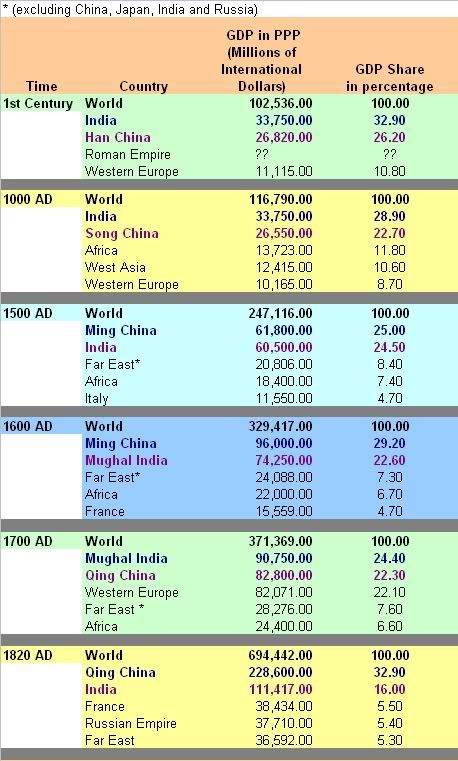 Until 1000 AD India was clearly well and truly the richest country. The share of the World’s GDP was around 30% for the first millenia. Then by 1500 AD the Islamic rulers had started making their raids from North, and the Hindu Kings had started becoming weak. From a country where spirituality and rule of law was paramount, India, suddenly was losing in its own web.
Then by 1600 AD, the Mughals were ruling India, and it went down further. The roles of China and India in the world’s economic dominance were now truly reversed. In 1000 AD, the shares were India – 28.90/China – 22.70; and in 1600 the shares had changed to India – 22.60/China – 29.20. Whereas the Ming dynasty had done wonders for China, Mughals had brought it down. It was the rule of Akbar and then Jahangir and Shahjahan, that India regained its numero uno position back, probably also helped by the Qing dynasty in China.
A country that was at the peak of science and technology edge was in 600-700 years of rule of Islam and self-serving Hindu rulers, had been slowly but gradually lost the urge to succeed and grow. This period – the Mughal period – is, in my personal view, the one time that broke the back of progressiveness in the Indian (Hindu) ethos – culturally and scientifically. We were to pay for such lack of urgency.
We had many invaders but none made India as poor as the British. They systematically took the wealth of the country out and replaced it with total dependence! All that was done in the name of "free-trade"… where the work was moved to a place where it was done best. So, our raw material was taken out and we got expensive finished goods back. We paid for lack of preparation.
Law of Personal and Societal Growth
No one – a person in his/her career or life or a society – grows in linear manner constantly. Everything grows up and down in curves interspersed with plateaus. These plateaus are the times that the preparation for the next level should be made. Decisions taken in life of a person and an organization ultimately decide which way the curve will move.. up .. or down. In India’s case, religion had clouded the normal life. We were forgetting to live in harmony with science and nature.. but were adamant to use religion to define what nature was. True Science will always be at odds with Religion, and always be in harmony with spirituality. For spirituality, like science is an exploration. Honest and clear and no-nonsense. It does not and should not define a result before it is achieved. There are no conjectures, or strict laws on how the final result of a step forward should be. In anticipation is the salvation of the exploration.
 If that was all, it would have been fine, worst was the money from treasury was usurped back to England or to fund more and more wars for colonization. The money was slowly but surely taken out. Bengal famine and many other such horrendous events resulted.
Once the richest country was brought to its knees. If India is resurgent today, it is because of its inherent strength of character.. its Civilizational character. It takes a certain set of characteristics to create a nation. But it takes a whole lot of different characteristics to create a civilization. A Civilization has an inherent strength of creating and re-creating itself while remaining the same. Most other civilizations – like Greek, Roman, and Chinese have lost their basic character, but India still retains its 5000 years old (I personally believe it to be at least 10,000 years but I did not write the history, the British did) ethos while becoming modern.
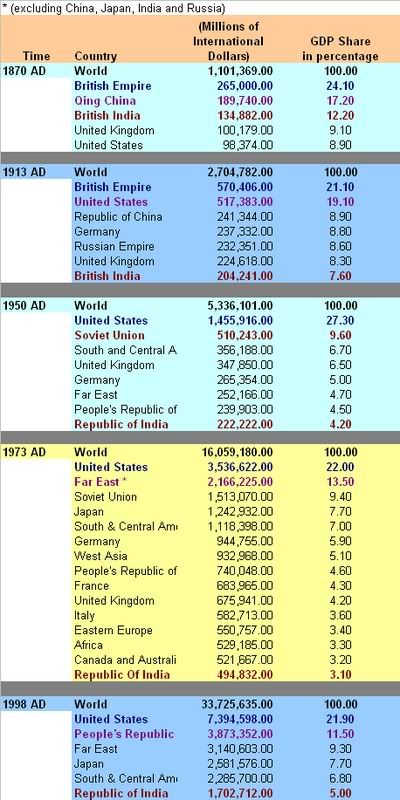
These things have been said by many people, but I will provide here the economic data to show how it was to demonstrate the strength and fall of India as an economic power.(pointed to me by my friend, Sanjay Goel)
Within a period of 90-odd years, the British virtually drained India’s economy dry! From the top economic power in 1820 with a share of 16% of the World’s GDP, India came down to just 7.6% in 1913.
It was not as if the misery of India was gone with the Brits. The first generation of free Indians left a lot to be desired. That generation collectively set India on a terrible downward turn.
There were two main issues, in my personal opinion, that contributed to the downward trend.
Idealism without adequate Practicality: Personal Idealism should be translated into rule of law not just generally felt self-aggrandisement. But that is what really happened! Right from Gandhi downward, every person was Idealist not because they wanted to set Rule of Law, but they would often flout those very laws. Dictatorship of Idealists though subtle was unmistakeable!
Vision abandoned for Rejoicing of the Moment: What that generation lack was simply vision. That generation was consumed in the occasion of the time. Meanwhile, the population increased by leaps and bounds. Suddenly, in 50 years time, a population that was "manageable" had turned monumental, while the infrastructural growth was inadequate to handle any growth.
It wasn’t until the Indian mind – that was responsible for India’s original economic peak, started the reverse journey. As the economy was unfettered, the Indian techies, under the radar of the Government bureaucracy performed a miracle. It used the common talent from the NIIT’s and Aptech’s to use Y2K to the most telling effect. The GDP share had risen from a miserable 3.10% to 5.00% amidst great competition in the World Economy.
Powered by Qumana
Previous Post

May 13, 2007
Calls from India to US/Canada at Rs. 1.99 per min!!
Next Post
May 14, 2007 Root and Branches of the World
Browse Our Archives
Select a Category Aarti Achievement and Leadership AfPak Africa Annual and Year-end Asia Audio Australia Behavioural Sciences Bhagwad Gita Bhagwad Gita Blogging Blogs Business Business Intelligence Business Strategy Cannes Careers Chanakya China Conservation Corruption Creative Daily Links Desh Poems Development & Welfare Devotional Audio Devotional Songs Drama Earth Economics Education Entertainment Environment Europe Everyday Quotes Featured Articles Featured Songs Finance Flickr Pictures Food Geo-Political Global Warming Globalization Health & Medicine Hinduism Historic History Humour India Indian Culture Indian music Indian Weddings Israel Issues Legal Link Love Minorities Misc Motivation and Personal Development Movie Lists Movie Reviews Movies Mumbai terror attacks Natural Disasters Nature News Outsourcing Pakistan Parenting Personal Philosophy Poetry Politics Poverty Quotes Recipe Regular Blog Post Relationships Religion Religious/Spiritual Audio Sciences Showcase Slideshow South Asia Special Stories Spiritual Quotes Spirituality Sports Stories Strategy Technology Technology Terrorism Travel Uncategorized US Video Women Women_s Rights Worship Yoga
Select a Month December 2015 November 2015 October 2015 September 2015 August 2015 June 2015 April 2015 March 2015 February 2015 September 2014 August 2014 January 2014 November 2013 October 2013 September 2013 August 2013 July 2013 June 2013 April 2013 March 2013 February 2013 January 2013 December 2012 November 2012 October 2012 September 2012 August 2012 July 2012 June 2012 May 2012 April 2012 March 2012 February 2012 January 2012 December 2011 November 2011 October 2011 September 2011 August 2011 July 2011 June 2011 May 2011 April 2011 March 2011 February 2011 January 2011 December 2010 November 2010 October 2010 September 2010 August 2010 July 2010 June 2010 May 2010 April 2010 March 2010 February 2010 January 2010 December 2009 November 2009 October 2009 September 2009 August 2009 July 2009 June 2009 May 2009 April 2009 March 2009 February 2009 January 2009 December 2008 November 2008 October 2008 September 2008 August 2008 July 2008 June 2008 May 2008 April 2008 March 2008 February 2008 January 2008 December 2007 November 2007 October 2007 September 2007 August 2007 July 2007 June 2007 May 2007 April 2007 March 2007 February 2007 January 2007 December 2006 November 2006 October 2006 September 2006 August 2006 July 2006 June 2006 May 2006 April 2006 March 2006 February 2006 January 2006 December 2005 November 2005 October 2005 September 2005 August 2005
Follow Us!
TAKE THE
Religious Wisdom Quiz
What does "Immanuel" mean, as in Isaiah's prophecy?
Select your answer to see how you score.
Prince of peace God will save God with us God reigns
Related posts from Drishtikone

Delhi: A City That Connects the Diverse

How the Historically Intolerant forces are now Preaching...

Detailed Historical Context to India-Pakistan Kashmir Issue, Recent...

E-Governance and Modi Government's Ambitious "Digital India" Program
TRENDING AT PATHEOS Hindu

Indian Hindu pilot’s valor in line of duty...
There is a hoary maritime tradition that the captain of the...

Movie on Neem Karoli Baba’s life is a...
Neem Karoli Baba’s life (1900-1973) is associated with miracles he made in...

20 Questions to Ask Before an Interfaith Marriage,...
Four questions every interfaith couple should discuss before marriage: Conversion. Will either...

Avadhānam: The Art of Concentration and Intellectual Mastery
What is Avadhānam? In the summer of 2015, during a three-day Sanskrit...

Jesus in the Dharma: Where Christ Fits in...
Where Does Jesus Fit in Hinduism? That’s a question I get often...

Hormuz: A Shared Hindu and Zoroastrian Heritage
Every evening, somewhere in the world, a newsreader utters the words: "The...
view all Hindu blogs
Ad-Free & Subscriber Log-In Subscription Support
- About Us
- 2026 Calendar
- Videos
- Podcasts
- Library of World Religions
- Faith In Media Tracker
- Advertise With Us
- Write for Us
- Privacy Policy
- Terms of Service
- Do Not Sell My Data
- Contact Us
- Radiant Digital
- Manage Newsletter Subscriptions
- Unsubscribe From Notifications
- Sitemap
Copyright 2008-2026, Patheos. All rights reserved.
Subscription Support Ad-Free & Subscriber Log-In
Follow Patheos