
BuddhistCatholicContemplativeEvangelicalGeneral ChristianHinduJewishLatter-day SaintMuslimNew VisionsProgressive Christian
Beliefs
- Buddhist
- Catholic
- Contemplative
- Evangelical
- General Christian
- Hindu
- Jewish
- Latter-day Saint
- More Voices
- Muslim
- New Visions
- Pagan
- Progressive Christian
Topics
- Religion News
- Food and Religion
- Sports and Religion
- Religious Art
- Religious Music and Entertainment
- Religious Events
- History and Religion
- Style and Religion
- Politics and Religion
- Women in Religion
- Recreation Outdoors and Religion
- Business Finance and Religion
- Careers Workplace and Religion
- Education and Religion
- Family Parenting and Religion
- Health Fitness and Religion
- Home and Religion
- Relationships and Religion
- Technology and Religion
- Travel and Religion
Columnists
- Buddhist Columnists
- Business Finance and Religion Columnists
- Careers Workplace and Religion Columnists
- Catholic Columnists
- Contemplative Columnists
- Education and Religion Columnists
- Evangelists Columnists
- Family Parenting and Religion Columnists
- General Christian Columnists
- Health Fitness and Religion Columnists
- Hindu Columnists
- History and Religion Columnists
- Home and Religion Columnists
- Jewish Columnists
- More Voices Columnists
- Latter Day Columnists
- Muslim Columnists
- New Visions Columnists
- Nonreligious Columnists
- Pagan Columnists
- Politics and Religion Columnists
- Progressive Columnists
- Recreation Outdoors and Religion Columnists
- Relationships and Religion Columnists
- Religion News Columnists
- Religious Art Columnists
- Religious Events Columnists
- Religious Music and Entertainment Columnists
- Sports and Religion Columnists
- Style and Religion Columnists
- Technology and Religion Columnists
- Travel and Religion Columnists
- Women in Religion Columnists
Resource Library
- 2026 Calendar
- Library of World Religions
- The 100 Most Holy Places on Earth
- Patheos Answers
- Podcasts
- Videos
- Faith Leaders Database
- Anglican Episcopalian
- Bahai
- Baptist
- Buddhism
- Christianity
- Confucianism
- Eastern Orthodoxy
- Hinduism
- Holiness and Pentecostal
- ISKCON
- Islam
- Judaism
- Lutheran
- Methodist
- The Church of Jesus Christ of Latter-day Saints
- New Age
- Paganism
- Presbytarian and Reformed
- Protestantism
- Religion Behind the Scenes
- Roman Catholic
- Scientology
- Shia Islam
- Sikhism
- Sufism
- Sunni Islam
- Taoism
- Zen
- See all religions
Research Tools
 Ad-Free & Subscriber Log-In Subscription Support
Ad-Free & Subscriber Log-In Subscription Support
Follow Patheos 

- Trending:
- Forgiveness
- |
- Marriage
- |
- Consciousness
- |
- Death Penalty
- |
- Election
- |
- Halloween
 Drishtikone
- Home
- Hindu
- Surya Sidhant and its measure of history: Restoring its claim of accuracy
Surya Sidhant and its measure of history: Restoring its claim of accuracy
Last updated on: February 5, 2015 at 8:28 pm by Desh Kapoor
Surya Sidhant and its measure of history: Restoring its claim of accuracy 2015-02-05T20:28:25-06:00 Desh Kapoor
Patheos Explore the world's faith through different perspectives on religion and spirituality! Patheos has the views of the prevalent religions and spiritualities of the world.
By Ramesh Panchwagh, Woodstock MD
The Surya Sidhant is the most ancient literature after the Vedas, in India and the World. It is written about the Astronomical Science and mathematics. It is based on the calculations of the Kalpa and Manvantar Math. Its year of writing is given in the book itself, which is 19,729,492nd year, at the end of the Satya or Krita Yuga. For those who are unfamiliar of this era, Krita Yuga (17,28,000 years) was the first era, followed by the Treta Yuga (12,96,000 years), which is followed by the Dwapar Yuga (864,000 years), and lastly the Kali Yuga (432,000 years), which is the present Era. The total of all four eras is 43,032,000 years according to the Hindu scriptures. Many believe this number of years as imaginary and based on mythology. This article is written to investigate these claims.
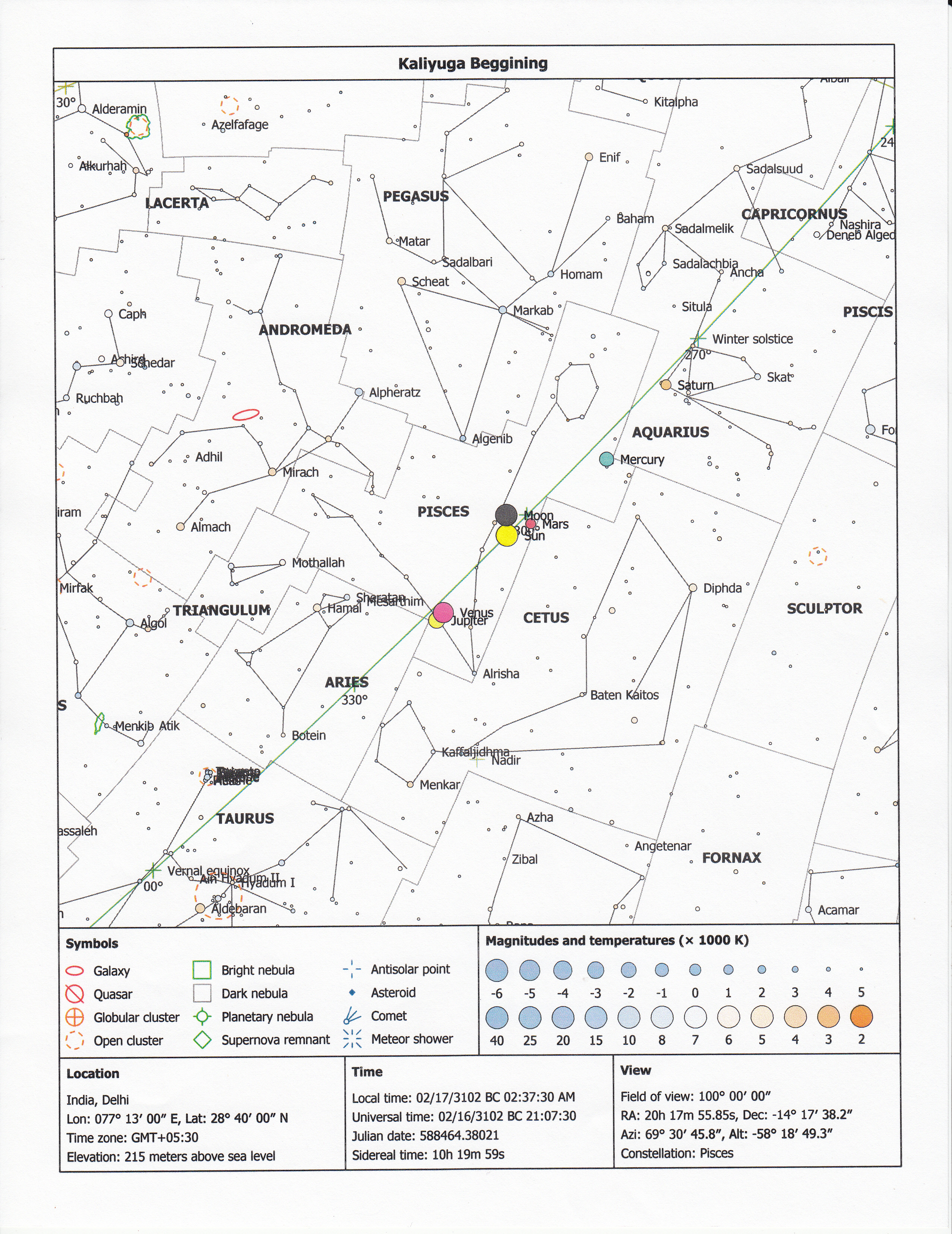
Ramayana was written at the end of the Treta Yuga and the Mahabharata was written at the end of the Dwapar Yuga. Kali Yuga started in 3102 BC and presently 5112 years have passed in it. Surya Sidhant provides the planetary positions and dates of the beginning of each of these eras. However, because of the very ancient dates, the only date of the Kaliyuga beginning could be verified with calculations. The book provides the date of the Kaliyuga beginning as 17th February, 3102 BC after midnight and states that it would be an Amavasya or new moon and that 7 planets would line up in conjunction in one sign. Further, it stated that there would be a solar eclipse at that time. The book is written in Sanskrit and the day, month and year are all given in the Indian astronomical system, which have been translated in the present system for the benefit of the readers. The book mentions that revisions be made in each era to correct the astronomical phenomena suitable to the changed time. The book originally may have been written on tree bark, or branches medium, but over the long period of close to two million years, it is mostly carried on by reciting in the Sanskrit Shloka (stanza) form and orally rote memorizing them and passing on to the next generations. Most of the Indian scriptures have been preserved in this manner over the millions of years, which so much amazes people, that most disbelieve it in the present age of printing and digital world.
In 1839, an American missionary named Rev. Ebenezer Burgess was posted in Pune in Maharashtra. It was the British Empire period. Mr. Burgess was curious about the new country and the many Brahmins assembled in Pune in the Peshawa rule at that time. The peshawas were Brahmins and used to reward generously to the Brahmins who had memorized the scriptures by heart. Mr. Burgess was amazed at this system and was curious about the scriptures. When he was told about the Surya Sidhant and that it is a treatise on astronomy, he wanted to translate it in English with the help of the Pune Brahmins. He accomplished his goal in 1856 and published the book on the Shila (stone) press, which was the old type of printing press. He not only translated the book, but not believing the contents as written by the natives, he consulted the prominent British and German Indologists, named Bailey, Bentley, Whitney and the famous Maxmuller, and sought their opinions. Needless to say, all agreed that the natives could not have written this most scientific book, Also reading the story of how the book was written, they concluded this in unison. The story given in the book is that a Danav (a lower caste) named Maya, was worshiping the Sun God to obtain the knowledge of the Time. The Sun God was pleased with his austerities and appeared to him in his dream. The Sun God told him that he was pleased with his devotion and that he will give him the knowledge of Time as he only possessed it in the Universe. However, because of his heat and light, he would not give Maya that knowledge in person. Instead he said he is designating a Yavan (another caste), from the City of Romyak Nagar. He asked Maya to go there and obtain the knowledge and spread it for the benefit of the world.
After reading this story, Mr. Burgess and all of his Indologist friends concluded that Romyak was Rome and Yavan was Greek, and that this knowledge is only obtained from the Greeks. They all wrote this opinion in the several books they all wrote and our people believed it completely even to date. Now, the number of years and other astronomical data did not matter, as it was all the imagination and Mythology of the Indian people according to them. Mr. Burgess’s translation with comments and opinions was published in 1856. It is now out of print and is not available. However, a copy from the Harvard University library was scanned and republished recently. In 1856 only, a Bapu Deo Shastri from Calcutta also translated the Surya sidhant from Sanskrit to English. In 1890, another person from Calcutta, a Swami Bhakti sidhant (the Guru of the Hare Krishna Swami Prabhupada), translated the Surya sidhant at the age of 15 from Sanskrit in to Bengali. All of these books are currently out of print and are unavailable. However, I obtained a copy of each for my personal library.
Mr. Burgess’s translation contains a chart of the planetary positions of the Kaliyuga beginning date mentioned in the Surya sidhant book, for February 17 after midnight, 3102 BC at Ujjain. His chart gives the planetary longitudes calculated by the American Nautical Almanac and the Royal British Ephemeris, which mentioned the Conjunction mentioned in the Surya sidhant book could not have happened. This provided support to the opinions of Burgess and company, and our learned people accepted this without any question. However, in 2011, while working on a book, “Astronomical Proof of Mahabharata”, I used the NASA JPL software, which gave accurate planetary positions. That chart basically, disproved the opinions in the Burgess book and confirmed that the Surya sidhant calculations to be very accurate. The Burgess chart and the NASA chart are both given on the next page. The right hand side numbers in the chart are from the NASA software. Now, in 1856, even the American and British navy could not use accurate calculation, but how the Indian Astronomers could give accurate results two million years back, is a mystery.
According to the Surya sidhant, the Time is divided in two types, 1) One which is continuous and has no beginning or end, and 2) One which has definite beginning and end. This second type is also divided in two parts; one is Measurable and the other in Immeasurable. The measurable time is based on human breathing time, 4 seconds. This time is used to calculate the day and year etc. The Immeasurable time is based on an atom which is 1/3,37000th seconds. This time is used only in calculations of scriptures. The Surya sidhant has used the measurable time for the calculation in the Arithmetic, Algebra, Trigonometry and Calculus etc. The sidhant has used it to calculate the planetary motions, orbits, diameters, weights, distances and sizes. It has calculated the Eclipses, star positions, universe expanse and distances. The annual position of the Sun is only 8.5 minutes faster in the Sidhant. However, it may also be the result of the Earths’ slowing motion in two million years. Surya Sidhant was the basis of Aryabhatt (477 AD), who proved that the Earth revolves on its own axis and forms the day and night. In the next Century, Varahmihir wrote Panchsidhant and confirmed the same. In the next century, Brahmagupta confirmed it. Then Aryabhatta2 and Bhaskar1 wrote Karan granthas (Corrections) in subsequent centuries. Finally Bhaskaracharya2 wrote the Sidhant Shiromani in 1174 which included the quadratic and indeterminate equations. He invented that the Ecliptic and Equator have a 23.5 degrees angle, which makes the seasons; and that a stone thrown up comes down because of the Earth density. This was centuries before Newton. On February 2, 2014, Famous Indian Mathematician and Astronomer Dr. Jayanta Naralikar have confirmed all this in an article in daily Sakal. The Surya sidhant based Almanacs are used even today in India. However, due to the help of Computers and the accuracy, the hand calculations are no more useful. Also, after the Islamic rule from 12th century onwards, the Indian Astronomy could not progress. The British rule and the 19th century comments have also helped our experts in believing the western opinions and have put a stop to further research. We hope, with this article, the debt of the Surya sidhant is acknowledged now with the history of the Indian scriptures.
Resources:
Surya Sidhant in English – Rev. Ebenezer Burgess
Same _ Bapu Deo Shastri
Same in Bengali _ Bhaktisidhant Swami
Same in Sanskrit _ Kamlakar Bhatt
Aryabhatiya _ Aryabhatt
Karan Grantha (corrections) _ Bhaskar 1
Brahmasphuta Sidhant _ Brahmagupta
Karan Grantha _ Aryabhatt 2
Sidhant Shiromani _ Bhaskaracharya 2
Karan Grantha — Lagadhacharya
Note: I have all of these granthas in my personal library, although they are all not in print, and are mostly unavailable.
Please check the chart from the Burgess book and the chart from NASA/JPL software below.
Scanned page from Surya Sidhant translation by Burgess
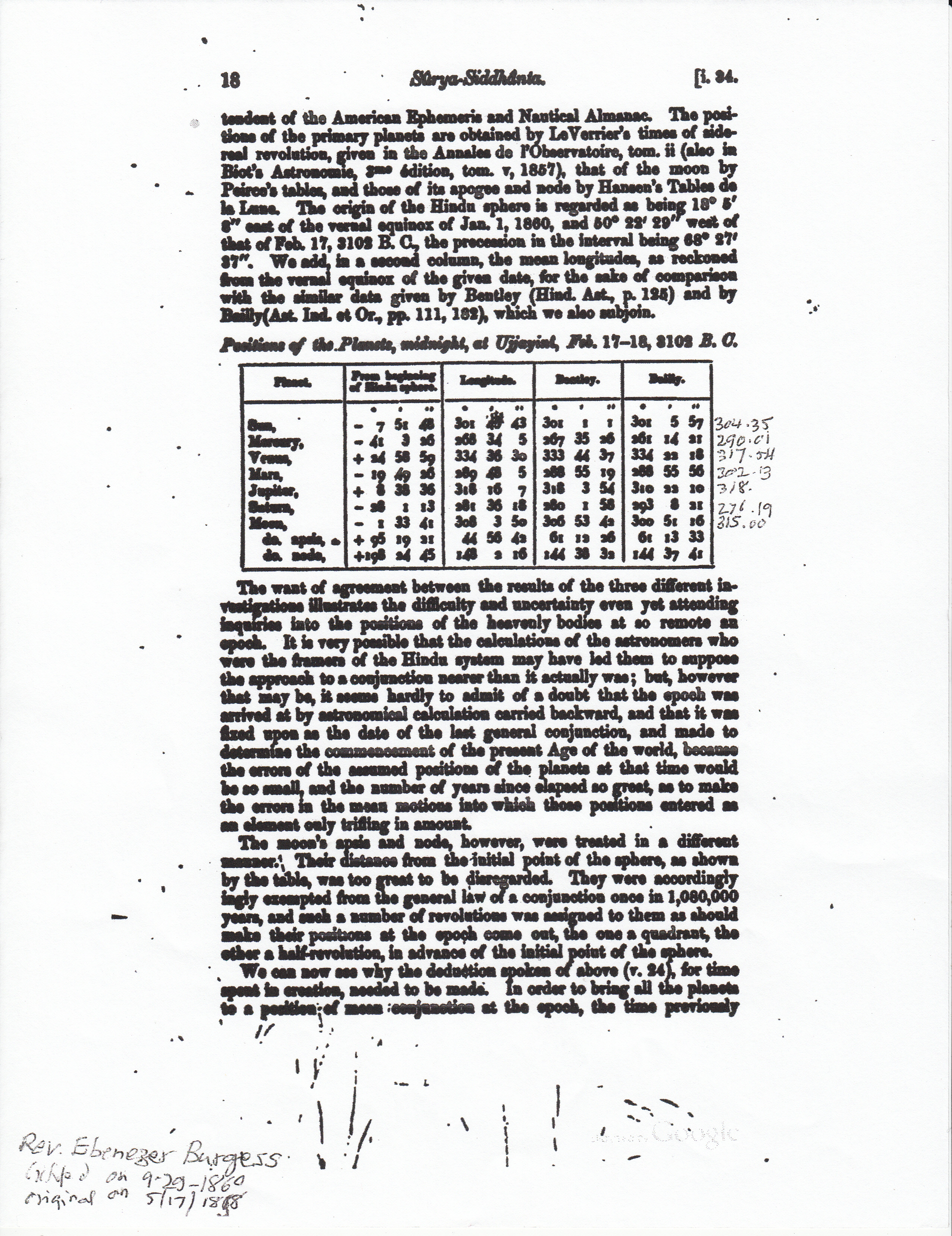
CHART FROM NASA/ JPL SOFTWARE
Featured Image Source: Flickr
Previous Post

September 1, 2014
How Delhi's heart mocks Secular ideals in India
Browse Our Archives
Select a Category Aarti Achievement and Leadership AfPak Africa Annual and Year-end Asia Audio Australia Behavioural Sciences Bhagwad Gita Bhagwad Gita Blogging Blogs Business Business Intelligence Business Strategy Cannes Careers Chanakya China Conservation Corruption Creative Daily Links Desh Poems Development & Welfare Devotional Audio Devotional Songs Drama Earth Economics Education Entertainment Environment Europe Everyday Quotes Featured Articles Featured Songs Finance Flickr Pictures Food Geo-Political Global Warming Globalization Health & Medicine Hinduism Historic History Humour India Indian Culture Indian music Indian Weddings Israel Issues Legal Link Love Minorities Misc Motivation and Personal Development Movie Lists Movie Reviews Movies Mumbai terror attacks Natural Disasters Nature News Outsourcing Pakistan Parenting Personal Philosophy Poetry Politics Poverty Quotes Recipe Regular Blog Post Relationships Religion Religious/Spiritual Audio Sciences Showcase Slideshow South Asia Special Stories Spiritual Quotes Spirituality Sports Stories Strategy Technology Technology Terrorism Travel Uncategorized US Video Women Women_s Rights Worship Yoga
Select a Month December 2015 November 2015 October 2015 September 2015 August 2015 June 2015 April 2015 March 2015 February 2015 September 2014 August 2014 January 2014 November 2013 October 2013 September 2013 August 2013 July 2013 June 2013 April 2013 March 2013 February 2013 January 2013 December 2012 November 2012 October 2012 September 2012 August 2012 July 2012 June 2012 May 2012 April 2012 March 2012 February 2012 January 2012 December 2011 November 2011 October 2011 September 2011 August 2011 July 2011 June 2011 May 2011 April 2011 March 2011 February 2011 January 2011 December 2010 November 2010 October 2010 September 2010 August 2010 July 2010 June 2010 May 2010 April 2010 March 2010 February 2010 January 2010 December 2009 November 2009 October 2009 September 2009 August 2009 July 2009 June 2009 May 2009 April 2009 March 2009 February 2009 January 2009 December 2008 November 2008 October 2008 September 2008 August 2008 July 2008 June 2008 May 2008 April 2008 March 2008 February 2008 January 2008 December 2007 November 2007 October 2007 September 2007 August 2007 July 2007 June 2007 May 2007 April 2007 March 2007 February 2007 January 2007 December 2006 November 2006 October 2006 September 2006 August 2006 July 2006 June 2006 May 2006 April 2006 March 2006 February 2006 January 2006 December 2005 November 2005 October 2005 September 2005 August 2005
Follow Us!
TAKE THE
Religious Wisdom Quiz
I was rejected by God as king for offering an unauthorized sacrifice instead of waiting. Who am I?
Select your answer to see how you score.
David Solomon Saul Rehoboam
Related posts from Drishtikone

This Diwali Light a Lamp for Humanity's Future

Open Source Human Transformation: Hinduism's gift to mankind
Christian Anti-Hindu Bigot Nandy's new rant: India should...

India's Daughter: Ok, We are Outraged, Indian Men...
TRENDING AT PATHEOS Hindu

Indian Hindu pilot’s valor in line of duty...
There is a hoary maritime tradition that the captain of the...

Movie on Neem Karoli Baba’s life is a...
Neem Karoli Baba’s life (1900-1973) is associated with miracles he made in...

20 Questions to Ask Before an Interfaith Marriage,...
Four questions every interfaith couple should discuss before marriage: Conversion. Will either...

Avadhānam: The Art of Concentration and Intellectual Mastery
What is Avadhānam? In the summer of 2015, during a three-day Sanskrit...

Jesus in the Dharma: Where Christ Fits in...
Where Does Jesus Fit in Hinduism? That’s a question I get often...

Hormuz: A Shared Hindu and Zoroastrian Heritage
Every evening, somewhere in the world, a newsreader utters the words: "The...
view all Hindu blogs
Ad-Free & Subscriber Log-In Subscription Support
- About Us
- 2026 Calendar
- Videos
- Podcasts
- Library of World Religions
- Faith In Media Tracker
- Advertise With Us
- Write for Us
- Privacy Policy
- Terms of Service
- Do Not Sell My Data
- Contact Us
- Radiant Digital
- Manage Newsletter Subscriptions
- Unsubscribe From Notifications
- Sitemap
Copyright 2008-2026, Patheos. All rights reserved.
Subscription Support Ad-Free & Subscriber Log-In
Follow Patheos