
BuddhistCatholicContemplativeEvangelicalGeneral ChristianHinduJewishLatter-day SaintMuslimNew VisionsProgressive Christian
Beliefs
- Buddhist
- Catholic
- Contemplative
- Evangelical
- General Christian
- Hindu
- Jewish
- Latter-day Saint
- More Voices
- Muslim
- New Visions
- Pagan
- Progressive Christian
Topics
- Religion News
- Food and Religion
- Sports and Religion
- Religious Art
- Religious Music and Entertainment
- Religious Events
- History and Religion
- Style and Religion
- Politics and Religion
- Women in Religion
- Recreation Outdoors and Religion
- Business Finance and Religion
- Careers Workplace and Religion
- Education and Religion
- Family Parenting and Religion
- Health Fitness and Religion
- Home and Religion
- Relationships and Religion
- Technology and Religion
- Travel and Religion
Columnists
- Buddhist Columnists
- Business Finance and Religion Columnists
- Careers Workplace and Religion Columnists
- Catholic Columnists
- Contemplative Columnists
- Education and Religion Columnists
- Evangelists Columnists
- Family Parenting and Religion Columnists
- General Christian Columnists
- Health Fitness and Religion Columnists
- Hindu Columnists
- History and Religion Columnists
- Home and Religion Columnists
- Jewish Columnists
- More Voices Columnists
- Latter Day Columnists
- Muslim Columnists
- New Visions Columnists
- Nonreligious Columnists
- Pagan Columnists
- Politics and Religion Columnists
- Progressive Columnists
- Recreation Outdoors and Religion Columnists
- Relationships and Religion Columnists
- Religion News Columnists
- Religious Art Columnists
- Religious Events Columnists
- Religious Music and Entertainment Columnists
- Sports and Religion Columnists
- Style and Religion Columnists
- Technology and Religion Columnists
- Travel and Religion Columnists
- Women in Religion Columnists
Resource Library
- 2026 Calendar
- Library of World Religions
- The 100 Most Holy Places on Earth
- Patheos Answers
- Podcasts
- Videos
- Faith Leaders Database
- Anglican Episcopalian
- Bahai
- Baptist
- Buddhism
- Christianity
- Confucianism
- Eastern Orthodoxy
- Hinduism
- Holiness and Pentecostal
- ISKCON
- Islam
- Judaism
- Lutheran
- Methodist
- The Church of Jesus Christ of Latter-day Saints
- New Age
- Paganism
- Presbytarian and Reformed
- Protestantism
- Religion Behind the Scenes
- Roman Catholic
- Scientology
- Shia Islam
- Sikhism
- Sufism
- Sunni Islam
- Taoism
- Zen
- See all religions
Research Tools
 Ad-Free & Subscriber Log-In Subscription Support
Ad-Free & Subscriber Log-In Subscription Support
Follow Patheos 

- Trending:
- Forgiveness
- |
- Marriage
- |
- Consciousness
- |
- Death Penalty
- |
- Election
- |
- Halloween
 Drishtikone
- Home
- Hindu
- Popedom finery is fine, but what does Christ have to do with Christianity?
Popedom finery is fine, but what does Christ have to do with Christianity?
Last updated on: March 19, 2013 at 2:58 pm by Desh Kapoor
Popedom finery is fine, but what does Christ have to do with Christianity? 2013-03-19T14:58:19-05:00 Desh Kapoor
Patheos Explore the world's faith through different perspectives on religion and spirituality! Patheos has the views of the prevalent religions and spiritualities of the world.
In Gautama Buddha’s own lifetime, he was able to help transcend around 30,000 people to realizing their own self. That many Enlightened people were developed by just one man in his lifetime. It so happened once that one of his disciples had transcended to an Enlightened self. Yet he kept at the normal chores and following Buddha in his journeys wherever he went. A year later Buddha happened to notice him and his realized self and asked him to stop following him around and “go walk his own path”.
Realized beings and Spiritual seekers do not conform. Buddhism developed in many different ways in different societies. It has many forms in India, China, Japan and South East Asia. Because, every being developed his own method to his real self after transcending his limited being.
But Buddhism is not just mysticism of the Realized Masters, or Buddhas. It is also the dogmatic belief system of the many in India as well as those in other countries. It is true that Buddhists in Sri Lanka have unleashed massacres of Tamils of their own land.
This dichotomy and tensions – as well as often a symbiotic relationship – between Spiritual Mystics vs Dogmatic Religious is true of most Religious faiths in the world today. It is true of Hinduism and true of Buddhism as much as it is true of Sikhism and Judaism. But it is ONLY in Christianity and Islam – the two “Fastest Growing Religions”, that one finds the strangest of phenomenons. The Dogmatic Religious have not just targeted and persecuted the Mystical but almost annihilated them.
Sufis in Islam represented that streak. Now, in the face of strong persecution, one often finds that very very few Sufis could hold their own with their Spiritual mysticism intact. Most became fronts for conversion and “smiling but ruthless” persecution.
The Mystics in Christianity had, alas, no such luck.
Gnosticism, which had articulation of the spiritual pursuit very similar to that in Hinduism and Buddhism – where the Monism and Dualism not just coexist, but interchange depending on the stage of a person’s journey – was exterminated from the face of the Earth almost completely.
Gnostics pre-dated Christ. But out of all the people around him, these were the ones who most clearly understood Jesus’ work. His mystical and spiritual work was carried on by the Gnostics in a useful way. However, they were outnumbered by the dogmatic religious “followers of Christ” – the Pistic Christians. These Pistics competed with the Romans initially and then joined hands – in persecuting and annihilating the Gnostics and all mystic strains that came from Jesus.
While the Gnostics focused on perfecting this secret inner knowledge of the divine, as a means of finding salvation, individuals of every station were questioning the incredible emotional strength of the Pistics. Captivated by this new religion, “the arena made converts by the droves, and it was Pistic Christians that they sought out to learn more about this powerful religion.” The Pistics grew in numbers and in strength despite persecution – or because of it – and easily outnumbered the Gnostics. The foundation of the Catholic Church settled the debate, as that declared Pistic Christianity to be the only orthodox beliefs. Gnosticism became heresy and thus grounds for excommunication, and the orthodox authorities quickly destroyed Gnostic libraries and texts. It was not truly until the discovery of the codices at Nag Hammadi that it was possible to study Gnostic writing and philosophy from first hand sources.
When one talks of Jesus, one has to understand that in that entire region, he was a Freak Accident. Just a handful of sermons from him were enough to revile the powerful of his land to kill him. Because no one understood him. Gnostics and their work was also persecuted in that land in a similar way and for the same reasons. But this fervor of persecution was especially high during the time after Jesus death. Both, by the dogmatic religious Pistics and the Romans.
Today’s Christianity and its Father
Christianity today is the product of Pistics – the dogmatic religious Christians. Specifically its origin is in the series of Nicene Councils called together by Constantine to craft a religious and theological dogma that has been passed on – often as an instrument of persecution – mostly as a means to “bring the flock together”.
All the denominations of Christianity today are DIRECT descendants of Pistics and Constantine’s crafted Christian Dogma. Christianity of today is actually Nicene Christianity! It has been shaped by and in the articulation of the Nicene Creed (see at the end of the post).
The Nicene Creed has been normative for the Catholic Church, the Eastern Orthodox Church, the Church of the East, the Oriental Orthodox churches, the Anglican Communion, and many Protestant denominations, forming the eponymous mainstream definition of Christianity itself in Nicene Christianity.
Every Church of today uses a version or an interpretation of Nicene Creed, the product of primarily the First Nicene Council.
The First Council of Nicaea (/naɪ’si:ə/; Greek: Νίκαια /’ni:kaɪja/) was a council of Christian bishops convened in Nicaea in Bithynia (present-day İznik in Turkey) by the Roman Emperor Constantine I in AD 325. This first ecumenical council was the first effort to attain consensus in the church through an assembly representing all of Christendom.[5][6]
Its main accomplishments were settlement of the Christological issue of the nature of The Son and his relationship to God the Father,[3] the construction of the first part of the Creed of Nicaea, settling the calculation of the date of Easter,[2] and promulgation of early canon law.
The articulation of Christianity today is not the outcome of a Spiritual or Mystical work of Jesus, but a product of a dogma that has a foundation in the worst persecution machinery that mankind has known – the Roman Empire – and its adaptions to make it more contemporary. Its Father is NOT Jesus, but Constantine!
Unlike Buddha, or other Realized Masters, who would “let the Realized amongst them go on their way”; the Christian (and Islamic) dogmatic machineries – have instead tried to “build numbers”. While doing so, they have also made sure that those who followed the Mystic traditions – from Pagans of Germany to Druids of Ireland – were annihilated, just as the Gnostics were.
They have killed the Spiritual Jesus to keep the dogma of Christ alive. Alas, Jesus has been no more than a useful Mascot for the Churches over the ages.
Constantine, the new convert to the Pistic Christian religion was a rather fanatic Christian to begin with. It is said that Constantine burned, along with Christian writings that did not fit his ideas for the new religion, the records of 300 years of Greek philosophy.
Initial Christian History and Popedom
The initial Christian history is full of anarchy, diabolical leaders, Popes and suppression.
- Circa AD 366, It was Damasus who invented the name “pope”, derived from a Greek word for father: “pappas”, in violation of Christ’s commandments. He also invented the doctrine of the pope being the successor to St. Peter, never mind Peter was never a bishop in Rome, nor anywhere else, and it is doubtful he was ever in Rome. Meanwhile, Peter was one of the founders of the Church of Antioch, which had ceceeded from the Catholic Church.
- In AD 378, Emperor Theodosius ordered large numbers of historical documents burned.
- Circa AD 390, Cyril, Bishop of Alexandria, incited a mob to burn the Library of Alexandria and brutally murder Hypatia, its female curator and librarian. For these crimes he was sainted. The Library of Alexandria had been the largest, most comprehensive library of the ancient world. Part of it survived to be burned by Pistic Arab Muslims about two centuries later.
- In AD 750, a document surfaced entitled: “The Donation of Constantine” claiming to have been written by Emperor Constantine giving deed of the entire Roman Empire to the Church. Such a greed for power grew out of the acceptance of this story as fact, that there would be as many as four popes take power in a day, each after having his predecessor murdered. It was exposed as a forgery on both linguistic and historical grounds independently by Nicholas of Cues in 1433, and Lorenzo Valla in 1440.
- In AD 1030, Pope Gregory the Great took power, declared himself a saint, and created a staff of forgers to create documents supporting any new policy as already existing. Gregory was later excommunicated by a group of Italian Bishops for “preferring licentiousness to honorable marriage”. Many “celibate” popes were actually shameless philanderers and womanizers, but Gregory, in reinstating the doctrine of priestly celibacy, had exiled the wives and children of Roman priests, leaving them helpless, while doing nothing about the prostitutes and concubines kept by the clergy. Many wives committed suicide.
It was only later that the whole machinery was crafted into a world domination force, thanks to the colonial era and Nazism.
Popedom is fine; But Jesus has nothing to do with it
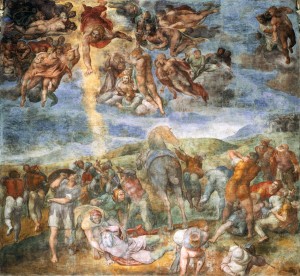
Jesus’ disciple Paul (Saul) was a critic of gnostic trends in the early church. “Conversion of Saul,” Michelangelo, 1542-1545, Cappella Paolina, Palazzi Pontifici, Vatican
Jesus was anything but survival. His life is a message of flowering of an individual. However, he wasn’t understood even by his own disciples.
From the time of the early church, Christians criticized Gnostic teachings. The apostles who wrote the New Testament condemned the Gnostic teachings. In his letter to a fledging church in Colossians Paul warned about some who said that they had a superior knowledge based on secret teachings and denied the value of the body and the Christian doctrines of creation and resurrection. An early church father Irenaeus devoted part of his book Against the Heresies to the Gnostics. In control of the state the Romans, Christians, and Muslims often used their power to persecute Gnostics as heretics or political threats. Even today, militant Muslims target the Iraqi Mandeans, a remnant of ancient Gnostics. In their defense Suhaib Nash runs the Mandean Society of America in Morristown, New Jersey.
The dogmatic Christian religious history is, therefore, an articulation of an acute sense of survival, persecution and suppression.
Actually, from where I see, I find that – Roman Empire never collapsed. It just morphed into Roman Catholic Church. The outlook, the mindset, and the urge to persecute remained the same.
Asceticism is often associated with Mystics. And, in an attempt to usurp the “Spiritual Demeanor” which comes from the Ascetic lifestyle, many religious schools adopt it to gain legitimacy. Little realizing that Asceticism is NOT a Game. It is NOT a ploy. It is a need for a seeker when s/he is deep in the path. It is like when you are trying to become an Olympic level sprinter, your diet will be very special – completely geared to get your there. But for ordinary people to start following that diet is not just stupid but actually pretty risky!
And, that is how asceticism is used by the Dogmatic Religious schools in Christianity – who having fed with Nicene Christian dogma, have absolutely no foundation in real Mysticism, start using Asceticism, as if just living in a monastery and leading a strict life will get you there. If you are born to be a weight-lifter, but are put in the lifestyle of a Sprinter, you will mess your life up and those of others.
Under any Spiritual Master, no two people would follow the same path. Even under Buddha, disciples followed different ways to their Realization. That is dependent on the individual’s own Karmic and mental structure. It is not one size fits all.
This also may have been the reason why the Christians and others of that era found Gnostics to be contradictory as well as talking “nonsense”.
The result of this fetish with Ascetic Lifestyle sans any foundation in mysticism is that no other organization indulges in as much sexual abuse as the Churches and their priests do. Even the current Pope is now in the dock for his role in Sexual Abuse cases in Argentina when he was the Archbishop there.
Father Julio Cesar Grassi was a celebrity in the Archdiocese of Buenos Aires. The young, dynamic, media-savvy priest networked with wealthy Argentines to fund an array of schools, orphanages and job training programs for poor and abandoned youths, winning praise from Argentine politicians and his superior, Archbishop Jorge Mario Bergoglio.
Grassi called his foundation Felices los Niños, “Happy Children.”
Bergoglio not just kept quiet but was actually praising the Sex offender who doubled up as a priest. Many now suggest that his actions – rather non-actions – in the wake of Sex Abuse scandals in the Argentinian Church may be an indicator as to how he will behave in the future in face of similar incidents in the Churches world-wide.
Today, Grassi is a convicted sex offender who remains free on a conditional release after being sentenced to 15 years in prison in 2009 for molesting a prepubescent boy in his care.
Yet in the years after Grassi’s conviction, Bergoglio — now Pope Francis — has declined to meet with the victim of the priest’s crimes or the victims of other predations by clergy under his leadership. He did not offer personal apologies or financial restitution, even in cases in which the crimes were denounced by other members of the church and the offending priests were sent to jail.
In a nutshell
The Persecution, the conversions, the growth oriented “strategies”, the abuse, the money, the “Elections of Holy Father”, the killings – are an expression of an Exclusivist, Colonial, and Empire building mindset. It has nothing whatsoever to do with Spirituality.
Spirituality looks for inclusiveness. It looks for expression – unique and individual – of a flowered being. And in flowering of an unrealized individual.
When a dogmatic mind looks at Mysticism and Spirituality, it makes some very simplistic assumptions. It creates ploys. And strategies, tactics and ways. To “use” the facade of “Goodness” which brings its own dividends. Little realizing that the Goodness is not an act, but an expression of a flowered being. You cannot get one without the other.
You cannot kill Mystics and hope for Goodness to express itself. No Constantine can Spiritually kill Jesus and hope to promote his work. It just doesn’t work that way.
Constantine, therefore, is the Father of Christianity that we see now. Jesus has absolutely NOTHING to do with it. If the abuse and persecution doesn’t bring this obvious fact home, nothing will.
**************** ******************
The Nicene Creed
I believe in one God,
the Father almighty,
maker of heaven and earth,
of all things visible and invisible.
I believe in one Lord Jesus Christ,
the Only Begotten Son of God,
born of the Father before all ages.
God from God, Light from Light,
true God from true God,
begotten, not made, consubstantial with the Father;
through him all things were made.
For us men and for our salvation
he came down from heaven,
and by the Holy Spirit was incarnate of the Virgin Mary,
and became man.
For our sake he was crucified under Pontius Pilate,
he suffered death and was buried,
and rose again on the third day
in accordance with the Scriptures.
He ascended into heaven
and is seated at the right hand of the Father.
He will come again in glory
to judge the living and the dead
and his kingdom will have no end.
I believe in the Holy Spirit, the Lord, the giver of life,
who proceeds from the Father and the Son,
who with the Father and the Son is adored and glorified,
who has spoken through the prophets.
I believe in one, holy, catholic and apostolic Church.
I confess one Baptism for the forgiveness of sins
and I look forward to the resurrection of the dead
and the life of the world to come. Amen.

Previous Post

March 18, 2013
Is Pakistan, China's vassal state?
Browse Our Archives
Select a Category Aarti Achievement and Leadership AfPak Africa Annual and Year-end Asia Audio Australia Behavioural Sciences Bhagwad Gita Bhagwad Gita Blogging Blogs Business Business Intelligence Business Strategy Cannes Careers Chanakya China Conservation Corruption Creative Daily Links Desh Poems Development & Welfare Devotional Audio Devotional Songs Drama Earth Economics Education Entertainment Environment Europe Everyday Quotes Featured Articles Featured Songs Finance Flickr Pictures Food Geo-Political Global Warming Globalization Health & Medicine Hinduism Historic History Humour India Indian Culture Indian music Indian Weddings Israel Issues Legal Link Love Minorities Misc Motivation and Personal Development Movie Lists Movie Reviews Movies Mumbai terror attacks Natural Disasters Nature News Outsourcing Pakistan Parenting Personal Philosophy Poetry Politics Poverty Quotes Recipe Regular Blog Post Relationships Religion Religious/Spiritual Audio Sciences Showcase Slideshow South Asia Special Stories Spiritual Quotes Spirituality Sports Stories Strategy Technology Technology Terrorism Travel Uncategorized US Video Women Women_s Rights Worship Yoga
Select a Month December 2015 November 2015 October 2015 September 2015 August 2015 June 2015 April 2015 March 2015 February 2015 September 2014 August 2014 January 2014 November 2013 October 2013 September 2013 August 2013 July 2013 June 2013 April 2013 March 2013 February 2013 January 2013 December 2012 November 2012 October 2012 September 2012 August 2012 July 2012 June 2012 May 2012 April 2012 March 2012 February 2012 January 2012 December 2011 November 2011 October 2011 September 2011 August 2011 July 2011 June 2011 May 2011 April 2011 March 2011 February 2011 January 2011 December 2010 November 2010 October 2010 September 2010 August 2010 July 2010 June 2010 May 2010 April 2010 March 2010 February 2010 January 2010 December 2009 November 2009 October 2009 September 2009 August 2009 July 2009 June 2009 May 2009 April 2009 March 2009 February 2009 January 2009 December 2008 November 2008 October 2008 September 2008 August 2008 July 2008 June 2008 May 2008 April 2008 March 2008 February 2008 January 2008 December 2007 November 2007 October 2007 September 2007 August 2007 July 2007 June 2007 May 2007 April 2007 March 2007 February 2007 January 2007 December 2006 November 2006 October 2006 September 2006 August 2006 July 2006 June 2006 May 2006 April 2006 March 2006 February 2006 January 2006 December 2005 November 2005 October 2005 September 2005 August 2005
Follow Us!
TAKE THE
Religious Wisdom Quiz
Who was the first woman?
Select your answer to see how you score.
Eve Deborah Sarah Mary
Related posts from Drishtikone

How the Historically Intolerant forces are now Preaching...

Why does Republicans' Outrage on the Pope Reminds...

Republican Conundrum: The Only Benchmark of Belief is...

How Delhi's heart mocks Secular ideals in India
TRENDING AT PATHEOS Hindu

Indian Hindu pilot’s valor in line of duty...
There is a hoary maritime tradition that the captain of the...

Movie on Neem Karoli Baba’s life is a...
Neem Karoli Baba’s life (1900-1973) is associated with miracles he made in...

20 Questions to Ask Before an Interfaith Marriage,...
Four questions every interfaith couple should discuss before marriage: Conversion. Will either...

Avadhānam: The Art of Concentration and Intellectual Mastery
What is Avadhānam? In the summer of 2015, during a three-day Sanskrit...

Jesus in the Dharma: Where Christ Fits in...
Where Does Jesus Fit in Hinduism? That’s a question I get often...

Hormuz: A Shared Hindu and Zoroastrian Heritage
Every evening, somewhere in the world, a newsreader utters the words: "The...
view all Hindu blogs
Ad-Free & Subscriber Log-In Subscription Support
- About Us
- 2026 Calendar
- Videos
- Podcasts
- Library of World Religions
- Faith In Media Tracker
- Advertise With Us
- Write for Us
- Privacy Policy
- Terms of Service
- Do Not Sell My Data
- Contact Us
- Radiant Digital
- Manage Newsletter Subscriptions
- Unsubscribe From Notifications
- Sitemap
Copyright 2008-2026, Patheos. All rights reserved.
Subscription Support Ad-Free & Subscriber Log-In
Follow Patheos