
BuddhistCatholicContemplativeEvangelicalGeneral ChristianHinduJewishLatter-day SaintMuslimNew VisionsProgressive Christian
Beliefs
- Buddhist
- Catholic
- Contemplative
- Evangelical
- General Christian
- Hindu
- Jewish
- Latter-day Saint
- More Voices
- Muslim
- New Visions
- Pagan
- Progressive Christian
Topics
- Religion News
- Food and Religion
- Sports and Religion
- Religious Art
- Religious Music and Entertainment
- Religious Events
- History and Religion
- Style and Religion
- Politics and Religion
- Women in Religion
- Recreation Outdoors and Religion
- Business Finance and Religion
- Careers Workplace and Religion
- Education and Religion
- Family Parenting and Religion
- Health Fitness and Religion
- Home and Religion
- Relationships and Religion
- Technology and Religion
- Travel and Religion
Columnists
- Buddhist Columnists
- Business Finance and Religion Columnists
- Careers Workplace and Religion Columnists
- Catholic Columnists
- Contemplative Columnists
- Education and Religion Columnists
- Evangelists Columnists
- Family Parenting and Religion Columnists
- General Christian Columnists
- Health Fitness and Religion Columnists
- Hindu Columnists
- History and Religion Columnists
- Home and Religion Columnists
- Jewish Columnists
- More Voices Columnists
- Latter Day Columnists
- Muslim Columnists
- New Visions Columnists
- Nonreligious Columnists
- Pagan Columnists
- Politics and Religion Columnists
- Progressive Columnists
- Recreation Outdoors and Religion Columnists
- Relationships and Religion Columnists
- Religion News Columnists
- Religious Art Columnists
- Religious Events Columnists
- Religious Music and Entertainment Columnists
- Sports and Religion Columnists
- Style and Religion Columnists
- Technology and Religion Columnists
- Travel and Religion Columnists
- Women in Religion Columnists
Resource Library
- 2026 Calendar
- Library of World Religions
- The 100 Most Holy Places on Earth
- Patheos Answers
- Podcasts
- Videos
- Faith Leaders Database
- Anglican Episcopalian
- Bahai
- Baptist
- Buddhism
- Christianity
- Confucianism
- Eastern Orthodoxy
- Hinduism
- Holiness and Pentecostal
- ISKCON
- Islam
- Judaism
- Lutheran
- Methodist
- The Church of Jesus Christ of Latter-day Saints
- New Age
- Paganism
- Presbytarian and Reformed
- Protestantism
- Religion Behind the Scenes
- Roman Catholic
- Scientology
- Shia Islam
- Sikhism
- Sufism
- Sunni Islam
- Taoism
- Zen
- See all religions
Research Tools
 Ad-Free & Subscriber Log-In Subscription Support
Ad-Free & Subscriber Log-In Subscription Support
Follow Patheos 

- Trending:
- Forgiveness
- |
- Marriage
- |
- Consciousness
- |
- Death Penalty
- |
- Election
- |
- Halloween
 Drishtikone
- Home
- Hindu
- Religions of East and West: How it all took a different turn
Religions of East and West: How it all took a different turn
Last updated on: July 22, 2008 at 8:57 pm by Desh Kapoor
Religions of East and West: How it all took a different turn 2008-07-22T20:57:17-05:00 Desh Kapoor
Patheos Explore the world's faith through different perspectives on religion and spirituality! Patheos has the views of the prevalent religions and spiritualities of the world.
“As other discovered texts proved, the Hittite pantheon was in fact borrowed from (or through) the Hurrians.” A particular treaty, between the Hittite King Shuppilulima and Mattiwaza, king of the Hurrian kingdom of Mitanni circa 1350 BC, however, listed among the divine witnesses “Mitra-ash, Uruwana, Indra, and the Nashatiyanu gods, the very Mithra, Varuna, Indra, and the Nasatya gods of the Hindu pantheon!”
– Zecaharia Sitchin, The Wars of Gods and Men
“Zoroaster (628-551 BC?) was probably a priest of the old Aryan religion, for he calls himself a zaotar (Indian hotar) in the Gatas (Yasna 33.6)….He also retained the old poetic form, for the meter of his Gathas is similar to that of the Vedas. He further exalted the concept of asha, ‘truth’, the rta of India, and further used words in the same sense as in the Vedas.”
“The deity is like a partner in discourse with the prophet, and this is new with Zoroaster.”
“…The adherents of the old Aryan religion were more rites centered and the adherents of Zoroaster, perhaps to be designated as Aryan reformers, more belief centered.”
– Richard N. Frye, The Heritage of Persia
“The ethics taught by Zarathustra were based on the social life of the husbandman. The good man is one who looks after the cattle and tills the soil in peace and neighborliness. He is upright and has a burning regard for the truth. It is his duty to keep away from those who worship the daevas and to resist them with force if necessary. Angra Mainyu, the great evil spirit, threatens the farmer’s life.”
– Geoffrey Ashe, The Ancient Wisdom
“Zarathustra [Zoroaster] was the son of a priest of a pastoral tribe. As a boy he showed much concern for others and was deeply interested in finding the truth of religion. At the age of thirty, or a little older, he had a decisive religious experience in which he encountered the angel Vohu Manah (literally ‘Good Thought’), an aspect or emissary from God. The angel transported him in spiritual form to the great spirit ‘Ahura Mazda’, the ‘Wise Lord’ – henceforth Zarathustra’s name for God. This prophetic experience was followed by other revelations in the next decade of Zarathustra’s life. As a consequence, he felt called to preach a purified faith against the existing polytheism (which had some similarities to the related religion of the Aryans…)”
“The god whom he addressed as Ahura Mazda had attributes, both ethical and celestial, of the sky god Varuna, a focal figure of Vedic religion…But the indigenous religion of early Iran entertained belief in a host of other gods and spirits – Mithra, Vayu, Yima, the fravashi, and so on. Zarathustra….equated the gods with evil spirits, who seduced men from the true worship of the one Spirit….He often mentioned Druj, the ‘Lie’, which was an evil force waging a struggle against Ahura Mazda….The chief evil spirit in the service of Druj was Angra Mainyu.”
– Ninian Smart, “The Religious Experience of Mankind”
**************
Long back, in Egypt – before the beginning of any Abrahamic strand, and their predecessor Zoroastrianism, resided people with decidedly Vedic background. The similarities in words, Gods, names are too much to ignore. Their practices were very similar as well. The Zoroastrians took on many of those similarities as their religion developed.
In 1887, 380 tablets were found in Egypt by a village lady digging for fertilizer.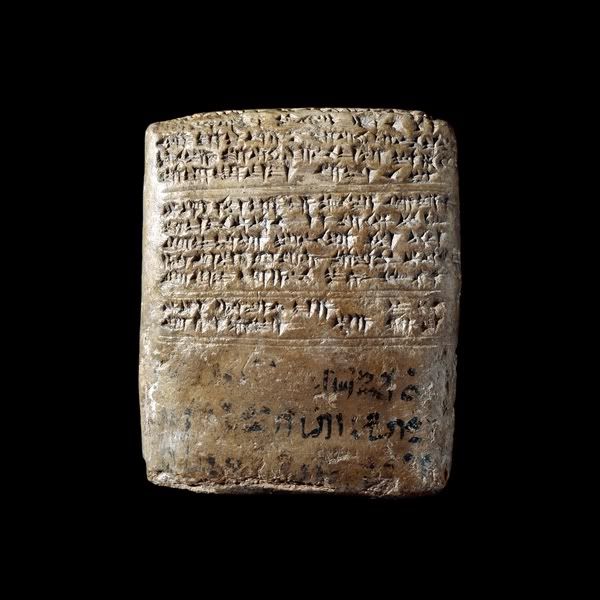 These letters were from notables of the Levant or Pharaoh’s record copies of replies – including letters to both Akhenaten and his Queen Nefertiti. These letters also provided a look into the missing link between the East and West.
One series are letters written by a Mittani king named Tushratta (meaning ” of splendid chariots”, similar to Dashratha meaning ” of ten chariots”) writes to his son-in-law, Amenhotep III, the king of Egypt ( the letter reads much like an Indian father-in-law’s letter will). Amenhotep married Tadukhepa, Tushratta’s daughter.
Tushrutta’s (was an Indo-Aryan king) ‘grandson’ (son of his son-in-law) became Akhenathen (ऐकःनाथें, 1352-1336 B.C) – who formed a new monotheistic religion (apart from Sanskrit, in current Hindi also, one God is एकनाथ). He was one of the first few kings who differentiated between his kingliness and the Godliness of Aten (The One). His chief wife was Nefertiti – who was given an important position – much against the male centred kingdoms and religions that were to follow. He founded the city of Akhetaten (The Horizon of the Aten), at the modern Amarna – where these tablets were found. His mother was Tiye. And the name of their eldest daughter – Sita (full name Sita-amen; Sitamen’s Name – amen after the Sun god Amen Ra).
In the centuries before the Mitanni texts, there was a Kassite dynasty in Mesopotamia, from the 18th to the 16th century BC. Linguistically assimilated, they preserved some purely Vedic names: Shuriash, Maruttash, Inda-Bugash, i.e. Surya, Marut, Indra-Bhaga (Bhaga meaning effectively god, cfr. Bhag-wAn, Slavic Bog). Subhash Kak also discusses the Vedic-Persian/Egyptian connection in two detailed papers (attached below): 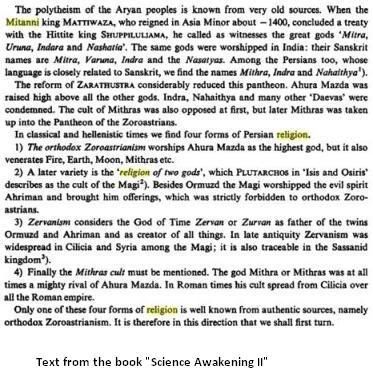
Like the Vedic tripartite division of society, the Zoroas-
trians have the classes priests (zaotar), warriors (nar), and pasturers (v¹astar).
It has been assumed for some time that the daevas of the Mazda faith are
the same as the Vedic devas and therefore Zarathushtra inverted the deva-
asura dichotomy of the Vedic period. In reality, the situation is more complex
and the Vedic and the Zarathushtrian systems are much less different than
is generally supposed.From Kashmir, which belongs square within the Vedic world, comes cru-
cial evidence regarding a three-way division consisting of devas, asuras, and
daevas. The scheme re°ects the three-way division that is basic to Vedic
thought. These three divisions in the outer realm are the earth, atmosphere,
and the sun; in the inner world they are the body, breath (pr¹an. a), and con-
sciousness or ¹atman. This tripartite classification is mirrored in the gunas of
Indian thought: sattva, rajas, and tamas.– Deva, or devata (heavens, sattva): power related to understanding
– Asura (atmosphere, rajas): power related to activity
– Daeva (earth, body, tamas): power related to acquisitiveness
From the discussion above and the text on the right, two major things happened that changed the polytheistic yet monistic beliefs of the Ancient Indo-Iranian/Egyptian people to take a turn to what went on the road to modern Abrahamic beliefs of Monotheism with an aversion (and condemnation) of polytheism:
- Akhenathen’s new religion which instead of monism-amidst-polytheism beliefs took on Monotheism as the preferred belief-system
- Zarathustra’s new religion which condemned the polytheism and started Zoroastrianism
Thereafter, there was no major change in the middle-east when it came to interpretation of belief-system in religions (Jewish to Islam). The names, the practices, the codes may have changed from one religion to another, but the core configuration of how “God” was perceived and interpreted not only was set in stone.. but worse was fanatically set in stone!
The only anti-dote to any questioning of the belief in Monotheism is a display of fanatic satisfaction and belief in one’s interpretation.
I have seen that within Hindu faith itself for example, I have interacted with many in Arya Samaj who cannot even bear to read highly profound and regarded texts as “Yoga Vasistha” on the argument that it is “wrong” – simply because it goes on to discuss monism and dismisses monotheism quite effectively. However, of the very little Upanishadic reading and interpretation that I have done, it is absolutely clear that Upanishads are replete with Monism as the ONLY interpretation of God. Now, since Upanishads are within the Vedic pantheon (and cannot be divorced from it), their philosophy is not completely in this system, but simply reinterpreted.
I have said before that a lot of what Krishna says in Gita shows his eagerness (in fact to me it is almost a frustration on his part at the utter cluelessness of Arjun when I read it carefully) to bring that society out of this separation of duality – that I am and He is… so I can kill Him and be sinned. Krishna effectively tries to explain to Arjun that this is nonsense when you look at the reality of the creation (of course, with enough scientific backing from major Quantum Physicists as regards the unity of creation being Matter-less and only Energy, it seems Krishna was indeed on the right path as were others before him). Not that Arjun or even Yudhishtra were convinced – because both were beset with depression of having committed sin after Mahabharata and went on penance. If THAT society itself could not understand or appreciate Krishna’s message of Unity of creation, then how can you expect the ones later on to understand or appreciate it?
In the Abrahamic pantheon of religions, only ONE attempt was made to bring the Monistic understanding of Unity of Creation prevalent in the East to bear upon that society – and that was by Jesus. I am convinced that his beliefs have a very relevant link to the Eastern thought. He was in the mould of Buddha and was as far ahead in compassion and intellect from the Brahmins of Benaras as he was from the Monotheistic believers of Middle-East and Europe. His real message never made it to the masses, as it was collated and taught by those who came after him. The message that did make it to all (interpretation rather) was a legacy of Akhenathen and Zarathustra – that there is One God, and He is the one that I have. Under this unashamed fanaticism (no amount of I-respect-you-but-its-my-belief can disguise the inherent fantacism, can it?), was buried the profound understanding of Jesus forever.
Now, an important question that always comes to my mind when I look at this scenario. Why did the belief-system take a decisive turn in Middle-East never to entertain any other option but was more inclusive and flexible in India? What was it that made those societies go through a one-way door but in India (despite many belief systems introduced which were similar in overall construction as the Abrahamic beliefs) Monism and Upanishadic/Vedanta thought system continued to somehow survive?
One answer could be that the people who created the new breed of belief-systems were very effective and successful in shutting off any other influence and create a more fanatical strain of a closed-monotheistic system. The other could be that the birthplace and the laboratory of different belief systems was India and they were merely implemented/used outside. Therefore the raw material of the different belief systems was never discarded but just stored for someone to discover later. The knowledge through books/verbal scholarship continued to survive for ever and thrive with other.. often completely different schools of religion.
The recipients of the innovation in thinking from this “laboratory”, therefore, did not completely get the benefit of the background of the logic/effort that went into coming up with that school of thought and so had an incomplete enculturation into the finer elements and nuances. This led to focusing on just the very superficial elements of that belief system.
This could well be true as you can clearly see the focus in Abrahamic scriptures is on things mundane. What I mean is that the discussion revolved more about how one should behave, eat, sleep, drink, pray given a God configuration (Monism/Monotheism and the strains and logic of it all).
The discussion in the East was hardly on the mundane but almost completely on God Configuration. That was the major area of spiritual realm where the emphasis of this laboratory of the spiritual minds centered around.
One way to understand is – It is like being on a ship, Middle-East was worried about how to set up the deck, the rooms, the furniture of the ship; while the East was more engaged in thinking through whether they were on the correct ship?
Sources: 2ndlook . Science Awakening II: The Birth of Astronomy . Subhash Kak’s articles (attached)
Technorati : Hindu, Upanishad, Vedas, Vedic, Zarathustra, Zoroastrianism
Attachment: Akhenaten, Surya, and the Rigveda.pdf
Attachment: Vedic Religion in Ancient Iran.pdf
Previous Post

July 22, 2008
Applying Knowledge to Action
Next Post
July 23, 2008 Aryan Invasion Theory: the myth cant die?
Browse Our Archives
Select a Category Aarti Achievement and Leadership AfPak Africa Annual and Year-end Asia Audio Australia Behavioural Sciences Bhagwad Gita Bhagwad Gita Blogging Blogs Business Business Intelligence Business Strategy Cannes Careers Chanakya China Conservation Corruption Creative Daily Links Desh Poems Development & Welfare Devotional Audio Devotional Songs Drama Earth Economics Education Entertainment Environment Europe Everyday Quotes Featured Articles Featured Songs Finance Flickr Pictures Food Geo-Political Global Warming Globalization Health & Medicine Hinduism Historic History Humour India Indian Culture Indian music Indian Weddings Israel Issues Legal Link Love Minorities Misc Motivation and Personal Development Movie Lists Movie Reviews Movies Mumbai terror attacks Natural Disasters Nature News Outsourcing Pakistan Parenting Personal Philosophy Poetry Politics Poverty Quotes Recipe Regular Blog Post Relationships Religion Religious/Spiritual Audio Sciences Showcase Slideshow South Asia Special Stories Spiritual Quotes Spirituality Sports Stories Strategy Technology Technology Terrorism Travel Uncategorized US Video Women Women_s Rights Worship Yoga
Select a Month December 2015 November 2015 October 2015 September 2015 August 2015 June 2015 April 2015 March 2015 February 2015 September 2014 August 2014 January 2014 November 2013 October 2013 September 2013 August 2013 July 2013 June 2013 April 2013 March 2013 February 2013 January 2013 December 2012 November 2012 October 2012 September 2012 August 2012 July 2012 June 2012 May 2012 April 2012 March 2012 February 2012 January 2012 December 2011 November 2011 October 2011 September 2011 August 2011 July 2011 June 2011 May 2011 April 2011 March 2011 February 2011 January 2011 December 2010 November 2010 October 2010 September 2010 August 2010 July 2010 June 2010 May 2010 April 2010 March 2010 February 2010 January 2010 December 2009 November 2009 October 2009 September 2009 August 2009 July 2009 June 2009 May 2009 April 2009 March 2009 February 2009 January 2009 December 2008 November 2008 October 2008 September 2008 August 2008 July 2008 June 2008 May 2008 April 2008 March 2008 February 2008 January 2008 December 2007 November 2007 October 2007 September 2007 August 2007 July 2007 June 2007 May 2007 April 2007 March 2007 February 2007 January 2007 December 2006 November 2006 October 2006 September 2006 August 2006 July 2006 June 2006 May 2006 April 2006 March 2006 February 2006 January 2006 December 2005 November 2005 October 2005 September 2005 August 2005
Follow Us!
TAKE THE
Religious Wisdom Quiz
Which prophet predicted that Gentiles would become God's people along with Israel?
Select your answer to see how you score.
Jonah Hosea Micah Ezekiel
Related posts from Drishtikone

Delhi: A City That Connects the Diverse

How the Historically Intolerant forces are now Preaching...

Why does Republicans' Outrage on the Pope Reminds...

Detailed Historical Context to India-Pakistan Kashmir Issue, Recent...
TRENDING AT PATHEOS Hindu

Indian Hindu pilot’s valor in line of duty...
There is a hoary maritime tradition that the captain of the...

Movie on Neem Karoli Baba’s life is a...
Neem Karoli Baba’s life (1900-1973) is associated with miracles he made in...

20 Questions to Ask Before an Interfaith Marriage,...
Four questions every interfaith couple should discuss before marriage: Conversion. Will either...

Avadhānam: The Art of Concentration and Intellectual Mastery
What is Avadhānam? In the summer of 2015, during a three-day Sanskrit...

Jesus in the Dharma: Where Christ Fits in...
Where Does Jesus Fit in Hinduism? That’s a question I get often...

Hormuz: A Shared Hindu and Zoroastrian Heritage
Every evening, somewhere in the world, a newsreader utters the words: "The...
view all Hindu blogs
Ad-Free & Subscriber Log-In Subscription Support
- About Us
- 2026 Calendar
- Videos
- Podcasts
- Library of World Religions
- Faith In Media Tracker
- Advertise With Us
- Write for Us
- Privacy Policy
- Terms of Service
- Do Not Sell My Data
- Contact Us
- Radiant Digital
- Manage Newsletter Subscriptions
- Unsubscribe From Notifications
- Sitemap
Copyright 2008-2026, Patheos. All rights reserved.
Subscription Support Ad-Free & Subscriber Log-In
Follow Patheos