
BuddhistCatholicContemplativeEvangelicalGeneral ChristianHinduJewishLatter-day SaintMuslimNew VisionsProgressive Christian
Beliefs
- Buddhist
- Catholic
- Contemplative
- Evangelical
- General Christian
- Hindu
- Jewish
- Latter-day Saint
- More Voices
- Muslim
- New Visions
- Pagan
- Progressive Christian
Topics
- Religion News
- Food and Religion
- Sports and Religion
- Religious Art
- Religious Music and Entertainment
- Religious Events
- History and Religion
- Style and Religion
- Politics and Religion
- Women in Religion
- Recreation Outdoors and Religion
- Business Finance and Religion
- Careers Workplace and Religion
- Education and Religion
- Family Parenting and Religion
- Health Fitness and Religion
- Home and Religion
- Relationships and Religion
- Technology and Religion
- Travel and Religion
Columnists
- Buddhist Columnists
- Business Finance and Religion Columnists
- Careers Workplace and Religion Columnists
- Catholic Columnists
- Contemplative Columnists
- Education and Religion Columnists
- Evangelists Columnists
- Family Parenting and Religion Columnists
- General Christian Columnists
- Health Fitness and Religion Columnists
- Hindu Columnists
- History and Religion Columnists
- Home and Religion Columnists
- Jewish Columnists
- More Voices Columnists
- Latter Day Columnists
- Muslim Columnists
- New Visions Columnists
- Nonreligious Columnists
- Pagan Columnists
- Politics and Religion Columnists
- Progressive Columnists
- Recreation Outdoors and Religion Columnists
- Relationships and Religion Columnists
- Religion News Columnists
- Religious Art Columnists
- Religious Events Columnists
- Religious Music and Entertainment Columnists
- Sports and Religion Columnists
- Style and Religion Columnists
- Technology and Religion Columnists
- Travel and Religion Columnists
- Women in Religion Columnists
Resource Library
- 2026 Calendar
- Library of World Religions
- The 100 Most Holy Places on Earth
- Patheos Answers
- Podcasts
- Videos
- Faith Leaders Database
- Anglican Episcopalian
- Bahai
- Baptist
- Buddhism
- Christianity
- Confucianism
- Eastern Orthodoxy
- Hinduism
- Holiness and Pentecostal
- ISKCON
- Islam
- Judaism
- Lutheran
- Methodist
- The Church of Jesus Christ of Latter-day Saints
- New Age
- Paganism
- Presbytarian and Reformed
- Protestantism
- Religion Behind the Scenes
- Roman Catholic
- Scientology
- Shia Islam
- Sikhism
- Sufism
- Sunni Islam
- Taoism
- Zen
- See all religions
Research Tools
 Ad-Free & Subscriber Log-In Subscription Support
Ad-Free & Subscriber Log-In Subscription Support
Follow Patheos 

- Trending:
- Forgiveness
- |
- Marriage
- |
- Consciousness
- |
- Death Penalty
- |
- Election
- |
- Halloween
 Drishtikone
- Home
- Hindu
- BlackStone and other Symbols of Islam and their Origins
BlackStone and other Symbols of Islam and their Origins
Last updated on: November 13, 2006 at 1:08 am by Desh Kapoor
BlackStone and other Symbols of Islam and their Origins 2006-11-13T01:08:53-06:00 Desh Kapoor
Patheos Explore the world's faith through different perspectives on religion and spirituality! Patheos has the views of the prevalent religions and spiritualities of the world.
There are many religious beliefs that either we do not go into detail or we just take what is told to us blindly. Here is an interesting account of how the pre-Islamic idols and symbols as well words formed the basis of some of the most important symbols within Islam itself. Some of them have been cleverly disguised but their origin seems pretty clear..
But before we go to the interpretation – lets go to the Wikipedia version:
Many Muslims regard the Stone as ‘just a stone’. When Umar ibn al-Khattab, the second Caliph, came to kiss the Stone, he said, in front of all assembled: “No doubt, I know that you are a stone and can neither harm anyone nor benefit anyone. Had I not seen Allah’s Messenger kissing you, I would not have kissed you.“[2] Many Muslims follow Umar: they pay their respects to the Black Stone in a spirit of trust in Muhammad, not with any belief in the Black Stone itself.
Some say that the Stone is best considered as a marker, useful in keeping count of the ritual circumambulations (tawaf) one has performed.[3]
Other Muslims are more willing to believe that the Stone itself has some supernatural powers. They believe that it fell from the sky during the time of Adam and Eve, and that it has the power to cleanse worshippers of their sins by absorbing them into itself. They say that the Black Stone was once a pure and dazzling white; it has turned black because of the sins it has absorbed over the years.[1]
Still others believe that the Stone can only erase the believer’s minor sins. On the Day of Judgement, the Stone will testify before God (Allah) in favor of those who kissed it.[citation needed]
The Stone was an object of veneration in pre-Islamic days. Early chroniclers say that the Kaaba was rebuilt during Muhammad’s youth, and that there was some contention among the Quraysh, Mecca’s ruling clan, as to who should have the honor of raising the Black Stone to its place in the new structure. Muhammad is said to have suggested that the Stone be placed on a cloak and that the various clan heads jointly lift the cloak and put the Stone into place.[4] Secular historians see this tale as a later glorification of Muhammad, but agree that it accurately represents the pre-Islamic status of the Black Stone.
So is it a “divine” stone or something else? Scientists say it is most probably a part of the meteorite but the Muslims would not let the Non-Muslims see it nor be taken out and tested
Just as there are various viewpoints regarding the religious significance of the Stone, there are also various opinions as to it’s history and nature.
Muslims say that the Stone was found by Abraham (Ibrahim) and his son Ishmael (Ismail) when they were searching for stones with which to build the Kaaba. They recognized its worth and made it one of the building’s cornerstones.
Secular historians point to the history of meteorite worship, in pre-Islamic Arabia, and say it is likely that the Stone is a meteorite or possibly impact glass, from the meteorite impact crater at Wabar, about 1100 km from Mecca.[5]. There is no way to test this hypothesis without removing and examining the Stone, which would not be permitted by its guardians.
Now here is the interpretation of this black stone and the other symbols/words in Islam:
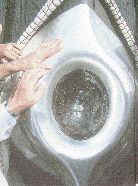
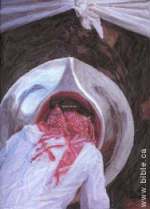
Perhaps the best-known Black Stone, and now by far the most revered, is the Ka’bah at Mecca. Ka’bah means ‘cube’ and this describes the shape of the black stone structure on a marble base which stands in the centre court of the Great Mosque, Masjidul Haram, at the centre of Mecca. It stands about 50 feet high by about 35 feet wide. Set into the eastern corner is the sacred stone, covered by an elaborately embroidered black drape. As any non-moslem in the temple would be slain on sight, and photography is generally prohibited, this stone is shrouded is mystery. However, Rufus Camphausen has succeeded in tracking down three accounts of the pilgrimage to Mecca, two of which do contain photographs [1-3]. What these reveal is a polished black stone of which less than two feet is visible, set in a large, solid silver mount. The whole resembles – quite deliberately, for reasons which will emerge – the vulva of the goddess. That moslems now refer to it as the Hand of Allah does not diminish the urge for all those who complete the pilgrimage to Mecca to touch or kiss this sacred object.
The Black Stone has long since been broken and the silver band holds together the fragments. Tradition holds that it was a meteorite and the stone was white in colour when it first landed and then blackened. The faithful attribute this change in colour to the belief that the stone absorbs the sins of the pilgrims, but it is consistent with known meteorites which are white at first but oxidise over a period of time.
‘A principal sacred object in Arabian religion was the stone. . . . Such stones were thought to be the residence of a god hence the term applied to them by Byzantine Christian writers of the fifth and sixth centuries: ‘baetyl’, from bet’el, ‘the house of god’.’ [4]
‘In north Arabian temples the image of the deity sometimes stood in the open air or could be sheltered in a qubbah, a vaulted niche. . . . Not to be confused with the qubbah is the word ka’bah, for a cube-shaped walled structure which . . . served as a shelter for the sacred stones.’ [5]
Camphausen, in his article [6], reveals that the misogynic moslem religion has its origins in goddess worship. Allah is a revamped version of the ancient goddess Al’Lat, and it was her shrine which has continued – little changed – as the Ka’bah. The known history of Mohammed reveals that he was born around 570 CE into a tribe of the Quraysh, who not only worshipped the goddess Q’re but were the sworn guardians of her shrine. By 622 Mohammed was preaching the ways of his god, Allah, and was driven out by his own tribe as a result.
The triple goddess
Pre-islamic worship of the goddess seems to be primarily associated with Al’Lat, which simply means ‘goddess’. She is a triple goddess, similar to the Greek lunar deity Kore/Demeter/Hecate. Each aspect of this trinity corresponds to a phase of the moon. In the same way Al’Lat has three names known to the initiate: Q’re, the crescent moon or the maiden; Al’Uzza, literally ‘the strong one’ who is the full moon and the mother aspect; then Al’Menat, the waning but wise goddess of fate, prophecy and divination. Islamic tradition continue to recognise these three but labels them ‘daughters of Allah’.
According to Edward Rice [7] Al’Uzza was especially worshipped at the Ka’bah where she was served by seven priestesses. Her worshippers circled the holy stone seven times – once for each of the ancient seven planets – and did so in total nudity. Near the Ka’bah is the ever-flowing well, Zamzam, which cools the throats of the countless millions of pilgrims.
In an oasis of always-flowing water, the Black Stone in its mount became an unmatched image of the goddess as giver of life. Only in the Indian continent do such physical symbols for the male and female generative powers – the lingam and yoni – continue to be worshipped with their original fervour.
It is easy to imagine that in pre-moslem times the goddess’s temple at Mecca was pre-eminent – whether to celebrate life, ask protection, pray for offspring. Legend tells how Abraham, unable to produce children by his wife Sarah, came here to make love to his slave Hagar. Later, when Hagar came back to give birth, she could find no water and Abraham created the holy well of Zamzam to save the life of his first son.
When Mohammed wanted to surplant Al’Lut with Allah, this was the one Temple he must conquer. Although Mohammed did conquer the Ka’bah, little else changed. The faithful still circle the Holy of Holies seven times (although, I hasten to add, now fully clothed). The priests of the sacred shrine are still known as Beni Shaybah or ‘Sons of the Old Woman’ – Shaybah being, of course, the famous Queen Sheeba of Solomon’s times.
Sheeba appears under the guise of Lilith in the Near East and as Hagar (‘the Egyptian’) in the Hebrew mythology of the Old Testament. So, rewriting the legend given above, Abraham begot his son, Ishmael – the ancestor of all Arab peoples – by the goddess on the Black Stone of the Ka’bah.
While we are tracing names, Q’re (or Qure), the maiden aspect of Al’Lut, seems certain to be the origin of the Greek Kore. Camphausen suggests that the holy Koran (qur’an in Arabic) is the ‘Word of Qure’. Even moslems admit that the work existed before the time of Mohammed. Legend said it was copied form a divine prototype that appeared in heaven at the beginning of time, or the Mother of the Book [8]. Al’Uzza, the mother aspect of Al’Lut, may give us the pre-dynastic Egyptian snake goddess Ua Zit, who develops into Isis.
Archaeo-astronomy<
Returning to the geomantic significance of the Ka’bah, Professor Hawkins has argued that it is exceedingly accurately aligned on two heavenly phenomena. These are the cycles of the moon and the rising of Canopus, the brightest star after Sirius. In a thirteenth-century Arabic manuscript by Mohammed ibn Abi Bakr Al Farisi it is stated that the alignment is set up for the setting crescent moon – an ancient symbol of the virgin-goddess which still appears in the national flags of many islamic nations. In some flags – Algeria, Mauritania, Tunisia and Turkey – the crescent is accompanied by a star, perhaps representing Canopus.
The Egyptian city known as Canopus seems also have been a goddess temple, as the Greek historian Strabo (63BCE-21CE) considered the place to be notorious for wild sexual activities. Such references typically refer to temples where sacred ‘prostitution’ or ritual promiscuity were part of the worship; invariably sacred objects depicting the genitals of either god and/or goddess were venerated. Such sacred promiscuity continued to be part of the Pilgrimage to Mecca, at least for some moslems. The Shi’ites from Persia were allowed to form temporary ‘marriages’ for the period of the pilgrimage. Any children born as a result were regarded as divine or as saints – a custom with worldwide parallels (English surnames such as Goodman, Jackson or Robinson perhaps derive from similar sacred unions with god in the form of Green Men characters such as Jack o’the Green or Robin Greenwood; I would also suggest that the original sense of ‘godparent’ and ‘godchild’ has similar origins.)
Aniconic black stone once venerated at the Temple of Aphrodite, near Paphos, Cyprus. From photograph by Bob Trubshaw.

Technorati : Black Stone Mohammad
Previous Post

November 12, 2006
He is Free
Next Post
November 13, 2006 He is above the Known and the Unknown
Browse Our Archives
Select a Category Aarti Achievement and Leadership AfPak Africa Annual and Year-end Asia Audio Australia Behavioural Sciences Bhagwad Gita Bhagwad Gita Blogging Blogs Business Business Intelligence Business Strategy Cannes Careers Chanakya China Conservation Corruption Creative Daily Links Desh Poems Development & Welfare Devotional Audio Devotional Songs Drama Earth Economics Education Entertainment Environment Europe Everyday Quotes Featured Articles Featured Songs Finance Flickr Pictures Food Geo-Political Global Warming Globalization Health & Medicine Hinduism Historic History Humour India Indian Culture Indian music Indian Weddings Israel Issues Legal Link Love Minorities Misc Motivation and Personal Development Movie Lists Movie Reviews Movies Mumbai terror attacks Natural Disasters Nature News Outsourcing Pakistan Parenting Personal Philosophy Poetry Politics Poverty Quotes Recipe Regular Blog Post Relationships Religion Religious/Spiritual Audio Sciences Showcase Slideshow South Asia Special Stories Spiritual Quotes Spirituality Sports Stories Strategy Technology Technology Terrorism Travel Uncategorized US Video Women Women_s Rights Worship Yoga
Select a Month December 2015 November 2015 October 2015 September 2015 August 2015 June 2015 April 2015 March 2015 February 2015 September 2014 August 2014 January 2014 November 2013 October 2013 September 2013 August 2013 July 2013 June 2013 April 2013 March 2013 February 2013 January 2013 December 2012 November 2012 October 2012 September 2012 August 2012 July 2012 June 2012 May 2012 April 2012 March 2012 February 2012 January 2012 December 2011 November 2011 October 2011 September 2011 August 2011 July 2011 June 2011 May 2011 April 2011 March 2011 February 2011 January 2011 December 2010 November 2010 October 2010 September 2010 August 2010 July 2010 June 2010 May 2010 April 2010 March 2010 February 2010 January 2010 December 2009 November 2009 October 2009 September 2009 August 2009 July 2009 June 2009 May 2009 April 2009 March 2009 February 2009 January 2009 December 2008 November 2008 October 2008 September 2008 August 2008 July 2008 June 2008 May 2008 April 2008 March 2008 February 2008 January 2008 December 2007 November 2007 October 2007 September 2007 August 2007 July 2007 June 2007 May 2007 April 2007 March 2007 February 2007 January 2007 December 2006 November 2006 October 2006 September 2006 August 2006 July 2006 June 2006 May 2006 April 2006 March 2006 February 2006 January 2006 December 2005 November 2005 October 2005 September 2005 August 2005
Follow Us!
TAKE THE
Religious Wisdom Quiz
True or False: God appeared to Moses in a burning bush on Mount Sinai.
Select your answer to see how you score.
FALSE TRUE
Related posts from Drishtikone

How the Historically Intolerant forces are now Preaching...

Why does Republicans' Outrage on the Pope Reminds...

Republican Conundrum: The Only Benchmark of Belief is...
How Delhi's heart mocks Secular ideals in India
TRENDING AT PATHEOS Hindu

Indian Hindu pilot’s valor in line of duty...
There is a hoary maritime tradition that the captain of the...

Movie on Neem Karoli Baba’s life is a...
Neem Karoli Baba’s life (1900-1973) is associated with miracles he made in...

20 Questions to Ask Before an Interfaith Marriage,...
Four questions every interfaith couple should discuss before marriage: Conversion. Will either...

Avadhānam: The Art of Concentration and Intellectual Mastery
What is Avadhānam? In the summer of 2015, during a three-day Sanskrit...

Jesus in the Dharma: Where Christ Fits in...
Where Does Jesus Fit in Hinduism? That’s a question I get often...

Hormuz: A Shared Hindu and Zoroastrian Heritage
Every evening, somewhere in the world, a newsreader utters the words: "The...
view all Hindu blogs
Ad-Free & Subscriber Log-In Subscription Support
- About Us
- 2026 Calendar
- Videos
- Podcasts
- Library of World Religions
- Faith In Media Tracker
- Advertise With Us
- Write for Us
- Privacy Policy
- Terms of Service
- Do Not Sell My Data
- Contact Us
- Radiant Digital
- Manage Newsletter Subscriptions
- Unsubscribe From Notifications
- Sitemap
Copyright 2008-2026, Patheos. All rights reserved.
Subscription Support Ad-Free & Subscriber Log-In
Follow Patheos