
BuddhistCatholicContemplativeEvangelicalGeneral ChristianHinduJewishLatter-day SaintMuslimNew VisionsProgressive Christian
Beliefs
- Buddhist
- Catholic
- Contemplative
- Evangelical
- General Christian
- Hindu
- Jewish
- Latter-day Saint
- More Voices
- Muslim
- New Visions
- Pagan
- Progressive Christian
Topics
- Religion News
- Food and Religion
- Sports and Religion
- Religious Art
- Religious Music and Entertainment
- Religious Events
- History and Religion
- Style and Religion
- Politics and Religion
- Women in Religion
- Recreation Outdoors and Religion
- Business Finance and Religion
- Careers Workplace and Religion
- Education and Religion
- Family Parenting and Religion
- Health Fitness and Religion
- Home and Religion
- Relationships and Religion
- Technology and Religion
- Travel and Religion
Columnists
- Buddhist Columnists
- Business Finance and Religion Columnists
- Careers Workplace and Religion Columnists
- Catholic Columnists
- Contemplative Columnists
- Education and Religion Columnists
- Evangelists Columnists
- Family Parenting and Religion Columnists
- General Christian Columnists
- Health Fitness and Religion Columnists
- Hindu Columnists
- History and Religion Columnists
- Home and Religion Columnists
- Jewish Columnists
- More Voices Columnists
- Latter Day Columnists
- Muslim Columnists
- New Visions Columnists
- Nonreligious Columnists
- Pagan Columnists
- Politics and Religion Columnists
- Progressive Columnists
- Recreation Outdoors and Religion Columnists
- Relationships and Religion Columnists
- Religion News Columnists
- Religious Art Columnists
- Religious Events Columnists
- Religious Music and Entertainment Columnists
- Sports and Religion Columnists
- Style and Religion Columnists
- Technology and Religion Columnists
- Travel and Religion Columnists
- Women in Religion Columnists
Resource Library
- 2026 Calendar
- Library of World Religions
- The 100 Most Holy Places on Earth
- Patheos Answers
- Podcasts
- Videos
- Faith Leaders Database
- Anglican Episcopalian
- Bahai
- Baptist
- Buddhism
- Christianity
- Confucianism
- Eastern Orthodoxy
- Hinduism
- Holiness and Pentecostal
- ISKCON
- Islam
- Judaism
- Lutheran
- Methodist
- The Church of Jesus Christ of Latter-day Saints
- New Age
- Paganism
- Presbytarian and Reformed
- Protestantism
- Religion Behind the Scenes
- Roman Catholic
- Scientology
- Shia Islam
- Sikhism
- Sufism
- Sunni Islam
- Taoism
- Zen
- See all religions
Research Tools
 Ad-Free & Subscriber Log-In Subscription Support
Follow Patheos 

- Trending:
- Advent
- |
- Forgiveness
- |
- Thanksgiving
- |
- Election
- |
- Seasonal Holidays
- |
- Marriage
 Doc Hollywood
- Home
- Religious Music & Entertainment
- The Fierce Urgency of BlacKkKlansman
The Fierce Urgency of BlacKkKlansman
Last updated on: August 12, 2018 at 11:41 pm by Craig Detweiler
The Fierce Urgency of BlacKkKlansman 2018-08-12T23:41:41-06:00 Craig Detweiler
Patheos Explore the world's faith through different perspectives on religion and spirituality! Patheos has the views of the prevalent religions and spiritualities of the world.

Last summer, Get Out took us inside the sunken place that paralyzes those caught in a spiral of racism. Now, BlacKkKlansman exposes the unholy marriage of white nationalism and Christianity which motivates cross burnings and lynchings, excuses police shootings and justifies racist dog whistles. BlacKkKlansman is an enormously entertaining mix—equal parts comedy and crime drama, cinematic valentine and potent agit-pop. It is a fierce exploration of the past that we need NOW.
BlacKkKlansman was originally slated to be directed by Jordan Peele following his Oscar nominated helming of Get Out. Instead, it became a chance for elder statesman, 61-year-old Spike Lee to show the rising young director how it is done. Lee draws upon thirty years of cinematic mastery [which includes Do the Right Thing (1989), Malcolm X (1992), and Bamboozled (2000)], to connect this strange but true 70s story to contemporary parallels. Denzel Washington’s son, John David Washington distinguishes himself as Ron Stallworth, the first African-American on the Colorado Springs’ police force. He stares through those who refuse to recognize his intelligence, uncovering racist cops and KKK members lurking in the Rocky Mountains.

The film works as a cracker jack police procedural about an undercover brother. Assigned to investigate Kwame Ture’s call for black power, Ron instead delves into the white hatred, fear and violence which predicates the need for black pride and self-determination. Spike Lee places Ron’s self-awakening amidst a sea of beatific black faces listening to Ture’s speech at Colorado College. Ron’s efforts to come alongside the passionate leader of the Black Student Union, Patrice (played by Laura Harrier with strong echoes of Angela Davis), leads to both dramatic and romantic complications.
BlacKkKlansman also provides plenty of comedic delights. The set-up echoes Cyrano de Bergerac, as Ron talks to the KKK on the phone but obviously needs another detective to portray him in person to the Klan. Flip Zimmerman (a compelling Adam Driver) is assigned to the investigation. Ron is so effective at speaking the king’s English that he eventually dupes Grand Wizard David Duke (an almost unrecognizable Topher Grace) into fast tracking his application to join ‘the organization.’ The same comedic exploration of code switching was employed earlier this summer in the even more subversive Sorry to Bother You. While we laugh at Ron’s ability to outsmart the Klan members, we also recognize the serious danger that his partner, Flip, encounters as he is initiated into the KKK. We realize that those who become allies also end up with skin in the game. Comedy can quickly turn toward tragedy.

This delicious mix of comedy, drama, romance, and even documentary is appropriate for the mixed-up world we’re all navigating. Spike Lee’s kitchen-sink surrealism aligns with our time when satire cannot possibly contain the costly foolishness and dangerous demagoguery dominating our political discourse. It is not subtle. It is appropriately strong. BlacKkKlansman turns back the clock to expose how we got to a present where blatant racism works as an effective campaign strategy. We may be tempted to laugh at the buffoonery of David Duke and his minions but they have infected significant sectors of our society (who will not be watching this movie). The grandiose score by Terence Blanchard underscores the gravity of the proceedings and how rooted they are in American history. This is who we were and tragically, who we still are.
BlacKkKlansman also explores how movies can motivate love or hate. It gets the swinging Soul Train seventies era so right—from the clothing, to the hairstyles, through the groovin’ tunes. It revels in blaxploitation movies and heroes like Richard Roundtree in Shaft and Pam Grier as Coffy. It lovingly evokes the era it portrays. But Spike Lee also critiques the role of media—specifically movies, in stirring up hatred. He demonstrates how the mythologizing scale of big screen spectacle in Gone With the Wind made the Old South look like the noble victim in “the War of Northern Aggression.” While the Klan members seek to cast themselves as the heroes in The Birth of a Nation, Spike Lee makes them the bug-eyed fools. In a brilliant sequence of cross cutting, Lee show’s how the educational (and/or indoctrination) works in two distinct settings. While the Klan don hoods and take up torches, black students respond by raising a fist and marching on behalf of lynching victims. Two tribes with two distinct initiation rituals.
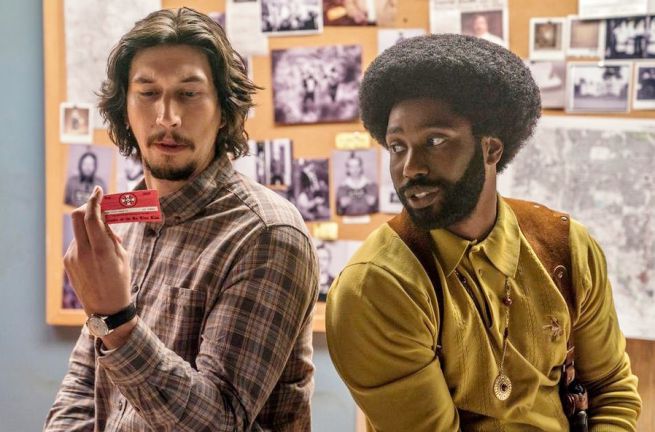
The understated third group explored in the film is the police force. BlacKkKlansman is a surprising affirmation of good cops doing their job. As Ron draws closer to Patrice, he also challenges her to not dismiss all officers as racists. He works inside a system that she dismisses as unredeemable. Can his undercover operation protect and serve a community that views the police with justifiable skepticism? BlacKkKlansman builds towards a nail-bitingly suspenseful climax. Will justice prevail or racism reign?
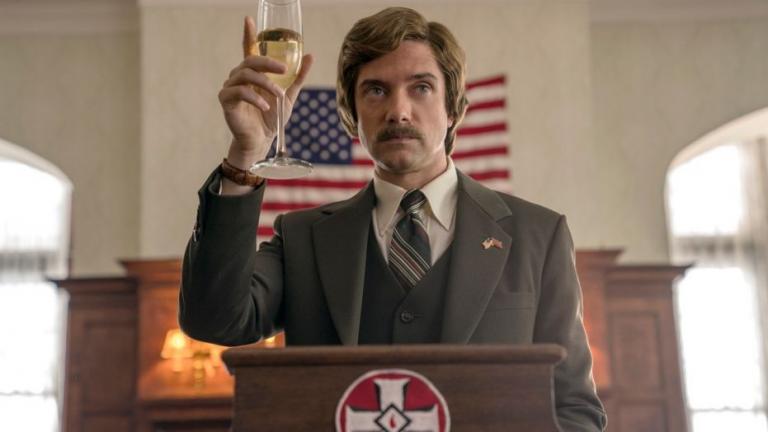
BlacKkKlansman offers devastating parallels for how we got here. It shows how the rise of black power is met by white fear, especially by those who view life as a zero-sum game. The Klan cannot imagine a world in which all prosper and live in peace. For white nationalists, “Your gain comes at my expense.” “America First” is a call to battle in which only one race can win. BlacKkKlansman traces how the dog whistles initiated in white supremacist groups led by David Duke have been mainstreamed and adopted by our current president to motivate far too much of his political base. The film arises from the same prophetic impulse that drove Martin Luther King to address “the fierce urgency of now.”
Why did BlacKkKlansman open this August weekend? Because one year ago, Heather Heyer’s blood spilled on the streets of Charlottesville called us all to some kind of activism. We must bemoan racism—so obvious in its ugliness. But we also must actively expose any attempt to wrap the cross in anything other than a common brokenness, an aching need for restoration that cuts across all races, cultures, languages, tribes. For those who have eyes to see and ears to hear, BlacKkKlansman is a bracing call to choose sides, to do the right thing, to join heroes like Ron Stallworth, to become allies like Flip Zimmerman. The twisted merging of Christian signs and symbols with white nationalism must be denounced at every juncture, especially NOW.
Previous Post

October 5, 2017
The Florida Project And The Ferocious Glory of Little Rascals
Next Post
September 7, 2018 Reconciling Cultural Tensions in Crazy Rich Asians
Browse Our Archives
Select a Category Books Movies Music Uncategorized Upcoming Videos
Select a Month February 2023 February 2022 March 2021 January 2020 December 2019 December 2018 September 2018 August 2018 October 2017 January 2017 December 2016 October 2016 March 2016 February 2016 November 2015 October 2015 February 2015 January 2015 December 2014 November 2014 October 2014 July 2014 April 2014 February 2014 January 2014 December 2013 November 2013 October 2013 August 2013 July 2013 June 2013 May 2013 April 2013 February 2013 January 2013 December 2012 November 2012 October 2012 September 2012 August 2012 July 2012 June 2012
TAKE THE
Religious Wisdom Quiz
How many chapters are in the book of Romans?
Select your answer to see how you score.
16 21 18 12
Related posts from Doc Hollywood
The Finest Films of 2022: Rise, Roar, and...

Ambiguity, Complexity, and the Finest Films of 2021
BEYOND NOSTALGIA: The Best Music Docs of 2021

Real to Reel: The Best Documentaries of 2020
TRENDING AT PATHEOS Religious Music & Entertainment

A Christian, a Narnia Fan, and a Filmmaker...
Watching The Narnia Trailer As A Fan And A Filmmaker Ever since...

Great Spiritual Horror Films of the 20th Century...
For the Christian, horror movies are often troubling—and many would say that...

"Les Diabolique" and Transgression
Alongside something like Arrival, Vertigo, or Charade, Les Diaboliques is a...

"The Plague Dogs" and Mortality
So, flashback to the late 70s, early 80s. Walt Disney Studios is...

With the recent and highly successful release of Christopher Nolan’s epic film,...

"L'avventura" and Human Weakness
Today's piece is going to be a little different for a few...
view all Religious Music & Entertainment blogs
Ad-Free & Subscriber Log-In Subscription Support
- About Us
- 2026 Calendar
- Videos
- Podcasts
- Library of World Religions
- Faith In Media Tracker
- Advertise With Us
- Write for Us
- Privacy Policy
- Terms of Service
- Do Not Sell My Data
- Contact Us
- Radiant Digital
- Manage Newsletter Subscriptions
- Unsubscribe From Notifications
- Sitemap
Copyright 2008-2026, Patheos, part of the Radiant Digital network of media brands. All rights reserved.
Subscription Support Ad-Free & Subscriber Log-In
Follow Patheos