
BuddhistCatholicContemplativeEvangelicalGeneral ChristianHinduJewishLatter-day SaintMuslimNew VisionsProgressive Christian
Beliefs
- Buddhist
- Catholic
- Contemplative
- Evangelical
- General Christian
- Hindu
- Jewish
- Latter-day Saint
- More Voices
- Muslim
- New Visions
- Pagan
- Progressive Christian
Topics
- Religion News
- Food and Religion
- Sports and Religion
- Religious Art
- Religious Music and Entertainment
- Religious Events
- History and Religion
- Style and Religion
- Politics and Religion
- Women in Religion
- Recreation Outdoors and Religion
- Business Finance and Religion
- Careers Workplace and Religion
- Education and Religion
- Family Parenting and Religion
- Health Fitness and Religion
- Home and Religion
- Relationships and Religion
- Technology and Religion
- Travel and Religion
Columnists
- Buddhist Columnists
- Business Finance and Religion Columnists
- Careers Workplace and Religion Columnists
- Catholic Columnists
- Contemplative Columnists
- Education and Religion Columnists
- Evangelists Columnists
- Family Parenting and Religion Columnists
- General Christian Columnists
- Health Fitness and Religion Columnists
- Hindu Columnists
- History and Religion Columnists
- Home and Religion Columnists
- Jewish Columnists
- More Voices Columnists
- Latter Day Columnists
- Muslim Columnists
- New Visions Columnists
- Nonreligious Columnists
- Pagan Columnists
- Politics and Religion Columnists
- Progressive Columnists
- Recreation Outdoors and Religion Columnists
- Relationships and Religion Columnists
- Religion News Columnists
- Religious Art Columnists
- Religious Events Columnists
- Religious Music and Entertainment Columnists
- Sports and Religion Columnists
- Style and Religion Columnists
- Technology and Religion Columnists
- Travel and Religion Columnists
- Women in Religion Columnists
Resource Library
- 2026 Calendar
- Library of World Religions
- The 100 Most Holy Places on Earth
- Patheos Answers
- Podcasts
- Videos
- Faith Leaders Database
- Anglican Episcopalian
- Bahai
- Baptist
- Buddhism
- Christianity
- Confucianism
- Eastern Orthodoxy
- Hinduism
- Holiness and Pentecostal
- ISKCON
- Islam
- Judaism
- Lutheran
- Methodist
- The Church of Jesus Christ of Latter-day Saints
- New Age
- Paganism
- Presbytarian and Reformed
- Protestantism
- Religion Behind the Scenes
- Roman Catholic
- Scientology
- Shia Islam
- Sikhism
- Sufism
- Sunni Islam
- Taoism
- Zen
- See all religions
Research Tools
 Ad-Free & Subscriber Log-In Subscription Support
Ad-Free & Subscriber Log-In Subscription Support
Follow Patheos 

- Trending:
- Forgiveness
- |
- Marriage
- |
- Consciousness
- |
- Death Penalty
- |
- Election
- |
- Halloween
 Doc Hollywood
- Home
- Religious Music & Entertainment
- Inside the Coen Brothers or Llewyn Davis Unclothed
Inside the Coen Brothers or Llewyn Davis Unclothed
Last updated on: January 13, 2014 at 1:03 pm by Craig Detweiler
Inside the Coen Brothers or Llewyn Davis Unclothed 2014-01-13T13:03:19-07:00 Craig Detweiler
Patheos Explore the world's faith through different perspectives on religion and spirituality! Patheos has the views of the prevalent religions and spiritualities of the world.

Despite what many critics have proclaimed, Inside Llewyn Davis is not the best film of the year. It is not the best film of the Coen Brothers’ career. It has remarkably melancholy music, but it doesn’t offer more than one recurring note. It is dark; really dark. Filmmakers (and especially cinematographers) love to get deep blacks on their images. Inside Llewyn Davis has great blacks. It makes evocative use of the dark shadows in the corners of every scene. They hang over the Gaslight Club, circa 1961 and the alleys off MacDougal Street. And a dark cloud looms over Llewyn Davis’s head in each and every scene. You see, Llewyn Davis is doomed to failure. He always chooses the wrong thing, says the wrong thing, does the wrong thing. He throws out things he should have kept. Spouts out thoughts he should have kept to himself. Drives past places he should have stopped. Like his decrepit father, Llewyn “shoulds” on himself.
Thankfully, Llewyn Davis is a good singer. Because otherwise, this trip Inside Llewyn Davis would only be horribly depressing. The soundtrack, produced by T-Bone Burnett, contains a fascinating mix of vintage folk songs and evocative originals composed for the film. It reminds us of the mournful aspects of folk music, the old sad songs of Ireland, Wales, and England. The multiple versions of the traditional ballad, “Fare Thee Well,” build a sublime power as we understand more of what’s haunting Llewyn.
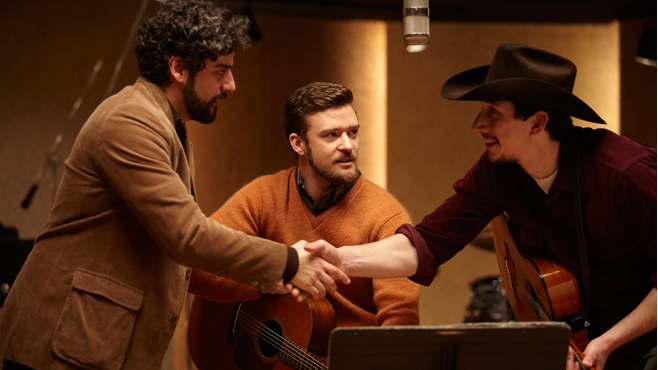
The songs also show what a dollop of American optimism did to the troubadour tradition. The absurd recording session of the space-age satire, “Please Mr. Kennedy” (featuring an earnest Justin Timberlake!) is the bright spot of the movie. But is this scene enough to endure all of Llewyn’s grief?
Making the best part of Llewyn Davis (the person and the movie) his music is evidently the point. Sad sacks can create great music; and maybe the sadder the sack; the greater the music. It is a cautionary tale for aspiring artists, musicians, and dreamers everywhere. “Don’t get your hopes up on being discovered or appreciated or having an audience because industry execs and agents are thieves who are only in it for the money.” Life is suffering. Prepare to suffer for your art (unless you’re Bob Dylan or the Coen Brothers).
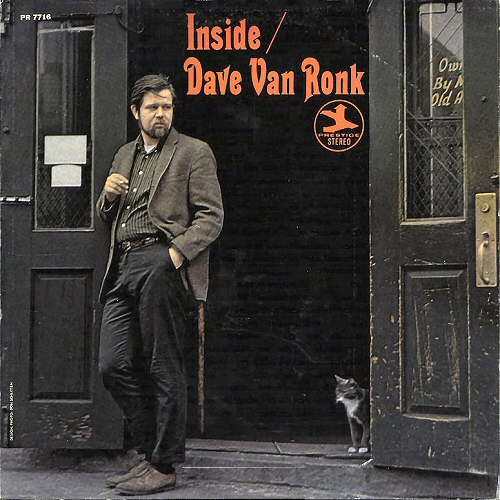
My quarrel with the Coen Brothers is that they don’t seem to have been true to the spirit of the age. It isn’t enough to get the cable sweaters of the Clancy Brothers just right. I understand that Inside Llewyn Davis is rooted in real singers like Dave Van Ronk who never crossed over into mainstream acceptance. It casts a cynical glow upon impresarios like Moe Asch of Folkways Records and Albert Grossman and his Gate of Horn in Chicago.
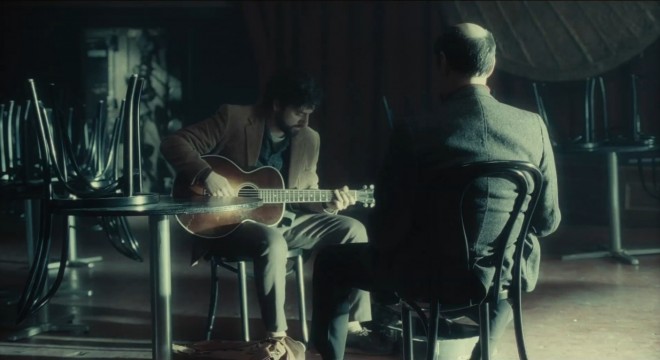
Standing in for Grossman, F. Murray Abraham provides the one laugh-out-loud line in the film with his stark appraisal of Llewyn’s music. The business savvy of Grossman undoubtedly made him millions. He made (wealthy) stars of Bob Dylan and Peter, Paul, and Mary and punished artists who didn’t comply with their wishes (probably pocketing their royalties). But what about the genuine advocacy and preservation work of Alan Lomax and Moe Asch and Folkways whose recordings formed the cornerstone for the Smithsonian’s collection? Such an essential treasure trove of the American musical experience was gathered thanks to their efforts. Inside Llewyn Davis never gets beyond the central truth that life is hard, hearts will be broken, and jazz musicians with a heroin habit will die tragically. The rapturous reviews for Inside Llewyn Davis reveal far more about the critics and their worldview than the film. Inside the Coen-friendly, hipster El Lay, Arclight theater where I saw it, the laughter was sparse in this bummer of a movie.

The Coen Brothers never get inside the motivations of the people who wrote songs of hope and change rooted in America’s lofty aspirations. (Read this telling interview from the Village Voice with Dave Van Ronk’s widow). They’ve crafted a paean to the folk scene before it turned into an enterprise. However, I’m not sure it is profound or true to suggest that Peter, Paul, or Mary were craven, empty, or stuffy. I’ve met and chatted with Peter Yarrow on several occasions and I’ve also found him remarkably personable, passionate, and generous. He still believes in what he sings even if the Coen Brothers don’t (or never did). Instead, they’ve chosen to pour their dour, dark view of humanity upon one the most progressive eras of pop music. It is almost like releasing Inside Santa Claus just in time for Christmas—how to drain the joy out of childlike wonder. (And don’t get me started on the one note portrait of the only significant woman in this pre-birth control era, the profane Jean. What a long way from the robust pregnant officer embodied by Francis McDormand in Fargo).
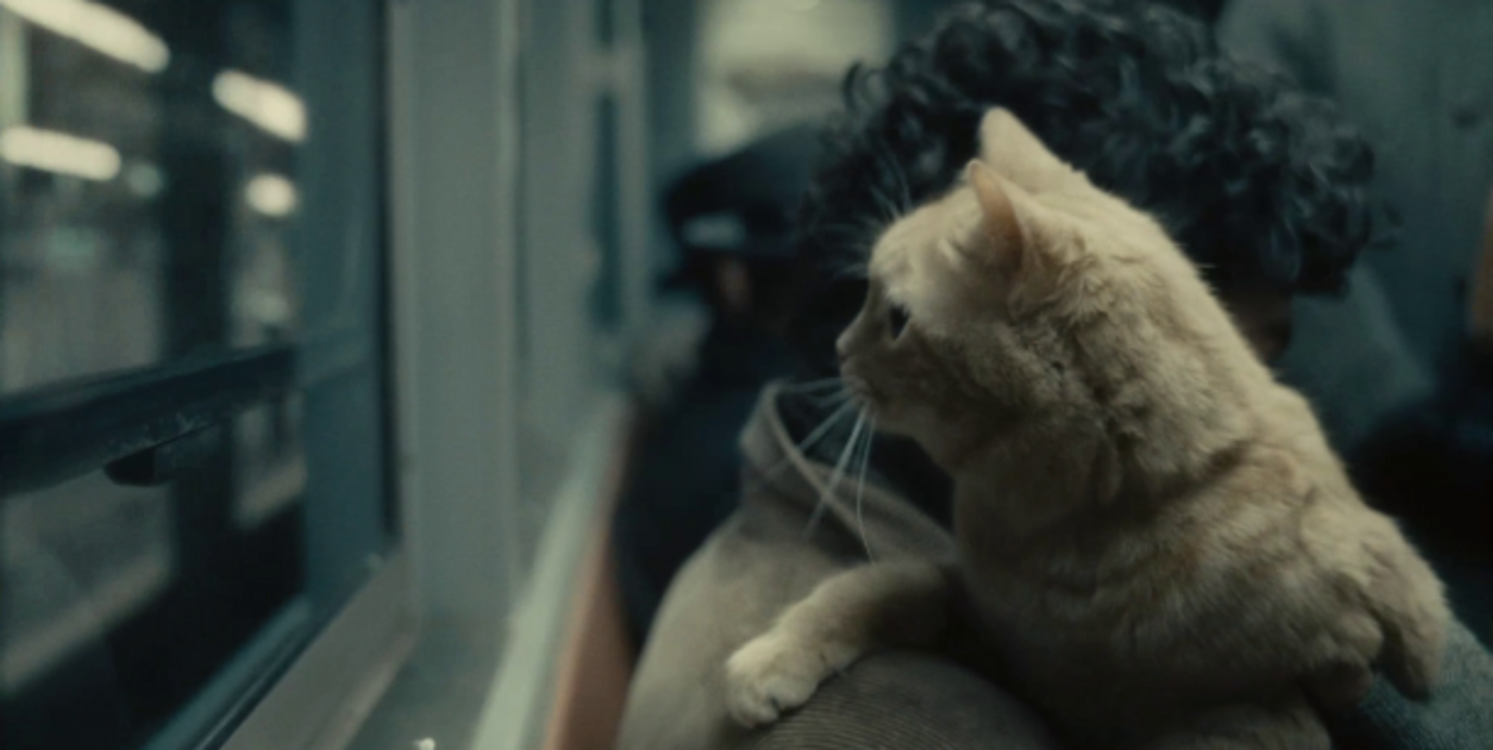
I get that like all their movies, Llewyn invites multiple viewings. They scatter a few clues to reading the film—“Llewyn as the cat, the cat as Ulysses, the film as a take on the James Joyce’s Ulysses which thereby links it back to their earlier musical take on the Odyssey, O Brother Where Art Thou?” But by the time I do all that, I am reading a thesis, rather than watching a movie. That’s not cinematic delight. That’s a puzzle box built for the creators’ enjoyment. Like in their earlier Barton Fink, I don’t feel invited into their private jokes. I’m on the outside, happy for them; sad for me, and the audience.
I have been a fan of the Coen Brothers since their debut feature, Blood Simple. I chortled through Raising Arizona, reveled in The Big Lebowski (in its original theatrical run!), and marveled at Fargo. I laughed a lot at Intolerable Cruelty while others scoffed. They deserved the Oscar for No Country for Old Men, for demonstrating where unmitigated greed will get you. It was the perfect film to arrive before the Wall Street crash/housing loan debacle. Yet I also recognize that they are fallible. Anyone who suffered through The Hudsucker Proxy realizes this. And while some thought Barton Fink worthy of winning the Cannes Film Festival, I found it to be a cruel joke on the audience. In my application to the University of Southern California’s film school, I skewered that “Barton Sinking Feeling.” While it was a risk to diverge from critical opinion, I couldn’t give the bleak nihilism in Barton Fink a pass. They didn’t give the audience much in exchange for our time and money (although I’m sure they enjoyed creating Barton Fink and found it satisfying to their own tastes/desires).
I admired A Serious Man because they took the story of Job to its logical conclusions. They updated what that twisted tale would look like played out with a college professor. It felt rooted in their own experience of the 60s as children of an academic. I understand that some people suffer more than their fair share. Or at least that life can be unfair. But I don’t feel like the Coen Brothers have told the whole truth in Llewyn Davis, or maybe they’re too content with a half-truth. Why haven’t they celebrated their own success in getting their stories onscreen? Does Llewyn’s story mirror their experience? I guess it takes courage after several Oscars and millions in moviemaking fees to still say, “The people who run the entertainment business are awful, greedy people with no taste.” Llewyn certainly has a talent for biting hands attempting to feed him. Maybe that’s the connection we’re supposed to make.

For all of my non-success as an artist, I don’t curse the business or consider everyone else a fraud. I don’t see how Llewyn’s disdain for humanity somehow fuels his compassion as a singer. I share the Coens misanthropic tendencies and also write with a satirical bite. I believe we are fallen, fallible, and prone to self-destruction. Yet, I can’t really make that my reason to create. Maybe I just missed the beauty of Llewyn carrying on in the face of losing a partner by couch surfing, impregnating women, and borrowing money to pay for abortions from friends that he never intends to repay. Perhaps we can’t expect the Coens or Llewyn to sing us a happy ending. Sometimes it is helpful to hear cold, hard truths. Do we really need to slather them upon one of the last times we all sang folk songs together?
Previous Post

December 17, 2013
MUSIC 2013: DANCING TO THE APOCALYPSE
Next Post
January 2, 2014 PHILOMENA: Sincerity Amidst Cynicism
Browse Our Archives
Select a Category Books Movies Music Uncategorized Upcoming Videos
Select a Month February 2023 February 2022 March 2021 January 2020 December 2019 December 2018 September 2018 August 2018 October 2017 January 2017 December 2016 October 2016 March 2016 February 2016 November 2015 October 2015 February 2015 January 2015 December 2014 November 2014 October 2014 July 2014 April 2014 February 2014 January 2014 December 2013 November 2013 October 2013 August 2013 July 2013 June 2013 May 2013 April 2013 February 2013 January 2013 December 2012 November 2012 October 2012 September 2012 August 2012 July 2012 June 2012
TAKE THE
Religious Wisdom Quiz
I am the root of all kinds of evil when loved. What am I?
Select your answer to see how you score.
Power Greed Money Pride
Related posts from Doc Hollywood
The Finest Films of 2022: Rise, Roar, and...

Ambiguity, Complexity, and the Finest Films of 2021
BEYOND NOSTALGIA: The Best Music Docs of 2021
Real to Reel: The Best Documentaries of 2020
TRENDING AT PATHEOS Religious Music & Entertainment

"Les Diabolique" and Transgression
Alongside something like Arrival, Vertigo, or Charade, Les Diaboliques is a...

"The Plague Dogs" and Mortality
So, flashback to the late 70s, early 80s. Walt Disney Studios is...

With the recent and highly successful release of Christopher Nolan’s epic film,...

"L'avventura" and Human Weakness
Today's piece is going to be a little different for a few...

I first want to apologize for not posting or writing anything. I'm...

I've engaged in the multi-year project of reading through the Church Fathers,...
view all Religious Music & Entertainment blogs
Ad-Free & Subscriber Log-In Subscription Support
- About Us
- 2026 Calendar
- Videos
- Podcasts
- Library of World Religions
- Faith In Media Tracker
- Advertise With Us
- Write for Us
- Privacy Policy
- Terms of Service
- Do Not Sell My Data
- Contact Us
- Radiant Digital
- Manage Newsletter Subscriptions
- Unsubscribe From Notifications
- Sitemap
Copyright 2008-2026, Patheos. All rights reserved.
Subscription Support Ad-Free & Subscriber Log-In
Follow Patheos