
BuddhistCatholicContemplativeEvangelicalGeneral ChristianHinduJewishLatter-day SaintMuslimNew VisionsProgressive Christian
Beliefs
- Buddhist
- Catholic
- Contemplative
- Evangelical
- General Christian
- Hindu
- Jewish
- Latter-day Saint
- More Voices
- Muslim
- New Visions
- Pagan
- Progressive Christian
Topics
- Religion News
- Food and Religion
- Sports and Religion
- Religious Art
- Religious Music and Entertainment
- Religious Events
- History and Religion
- Style and Religion
- Politics and Religion
- Women in Religion
- Recreation Outdoors and Religion
- Business Finance and Religion
- Careers Workplace and Religion
- Education and Religion
- Family Parenting and Religion
- Health Fitness and Religion
- Home and Religion
- Relationships and Religion
- Technology and Religion
- Travel and Religion
Columnists
- Buddhist Columnists
- Business Finance and Religion Columnists
- Careers Workplace and Religion Columnists
- Catholic Columnists
- Contemplative Columnists
- Education and Religion Columnists
- Evangelists Columnists
- Family Parenting and Religion Columnists
- General Christian Columnists
- Health Fitness and Religion Columnists
- Hindu Columnists
- History and Religion Columnists
- Home and Religion Columnists
- Jewish Columnists
- More Voices Columnists
- Latter Day Columnists
- Muslim Columnists
- New Visions Columnists
- Nonreligious Columnists
- Pagan Columnists
- Politics and Religion Columnists
- Progressive Columnists
- Recreation Outdoors and Religion Columnists
- Relationships and Religion Columnists
- Religion News Columnists
- Religious Art Columnists
- Religious Events Columnists
- Religious Music and Entertainment Columnists
- Sports and Religion Columnists
- Style and Religion Columnists
- Technology and Religion Columnists
- Travel and Religion Columnists
- Women in Religion Columnists
Resource Library
- 2026 Calendar
- Library of World Religions
- The 100 Most Holy Places on Earth
- Patheos Answers
- Podcasts
- Videos
- Faith Leaders Database
- Anglican Episcopalian
- Bahai
- Baptist
- Buddhism
- Christianity
- Confucianism
- Eastern Orthodoxy
- Hinduism
- Holiness and Pentecostal
- ISKCON
- Islam
- Judaism
- Lutheran
- Methodist
- The Church of Jesus Christ of Latter-day Saints
- New Age
- Paganism
- Presbytarian and Reformed
- Protestantism
- Religion Behind the Scenes
- Roman Catholic
- Scientology
- Shia Islam
- Sikhism
- Sufism
- Sunni Islam
- Taoism
- Zen
- See all religions
Research Tools
 Ad-Free & Subscriber Log-In Subscription Support
Ad-Free & Subscriber Log-In Subscription Support
Follow Patheos 

- Trending:
- Forgiveness
- |
- Marriage
- |
- Consciousness
- |
- Death Penalty
- |
- Election
- |
- Halloween
 The Divine Wedgie
- Home
- Catholic
- Reflections of a Saint of Nagasaki
Reflections of a Saint of Nagasaki
Last updated on: May 19, 2017 at 6:15 am by Matthew Tan
Reflections of a Saint of Nagasaki 2017-05-19T06:15:53+10:00 Matthew Tan
Patheos Explore the world's faith through different perspectives on religion and spirituality! Patheos has the views of the prevalent religions and spiritualities of the world.
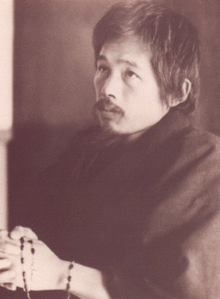
Source: Wikimedia Commons
On 9 August 1945 the Servant of God Takashi Nagai, a Japanese Catholic and academic radiologist, was working in the Nagasaki Medical College Hospital when the atomic bomb was dropped on that city. His wife, Maria Midori Moriyama, was killed in the attack. She was 37.
Nagasaki was also the largest centre of Japanese Catholics. 2 out of every 3 Catholics in Nagasaki were killed.
Already afflicted by radiation poisoning from his work in the nascent field of radiology, the blast would hasten his death, which would occur 6 years later. In those years following the bombing, Nagai collected a series of notes which were put together to form the book Leaving My Beloved Children Behind. It was first published in book form in 1956 and only got translated into English in 2008.
The thoughts in these notes are largely dedicated to the status of orphanhood, in particular the impending state of orphanhood that will soon greet his children, Makoto and Kayano. The pages are replete with expressions anxiety borne from this realisation and are often relentless and hard-rendering. In working through these anxieties, however, what also comes out are some of the most profound spiritual insights – on faith, providence, and the loyalties of a child – that are the fruit of his grappling with his experience of loss and death. Below is a sample of such reflections.
Of the day of the bombing: I saw the blinding flash of light from my radium lab. At that instant not only was my present blown away, but my past was destroyed and my future was ruined. In front of my very eyes, my beloved university, along with my beloved students, became one huge ball of fire. My wife, to whom I had entrusted our children after I should be gone, was reduced to a light bucketful of bones that I had to pick up from the ruins of our house. She had died in the kitchen.
Of his exposure to radiation and the new “atomic bomb disease”: Obviously I can’t see patients anymore. I don’t even have the strength to look through a microscope. The one saving grace has been that the very atomic bomb disease that I wanted to study was in my own body! This was very convenient because, with deep composure, I could observe and think about its daily development and the relationship between conscious symptoms and changes in the status of my disease…Since my blood samples contained all sorts of normal as well as diseased corpuscles, they become excellent study material for the students in those day did not have textbooks…In this way, I felt that I was making it up to my students for being bedridden and unable to deliver lectures.
Of his impending death and his daughters: So what if my spleen should burst, if my child enjoyed being loved by me as a father even for a few moments? But this was not permitted me. I have to live a month longer, a day longer, or even just an hour longer, in order to push farther into the future time when this child becomes an orphan. I must plead for an extension of my life by even a minute, even a second, so that the time this child will feel lonely will be shortened by that amount.
Of Divine Providence: … I must always praise and be grateful for, Divine Providence, because God created a person God loved, and that person is me. God created me because God wanted to love me; there is no malicious creation by God. God always loves me, and constantly wishes me to be happy. Just as God gives as an act of love, God takes as an act of love. Everything that takes place around me is an expression of God’s providential love. Therefore, I cannot help praising the name of the Lord, no matter what happens to me…We who survived…thought that the atomic bomb was not a divine punishment, but had to be the expression of a divine providence with some deep plan…The bomb had removed the obstacles that had hampered my walking down the right path, and I was able to experience true happiness.

Next Post

June 1, 2017 Insurance, Holiness and Hair
Browse Our Archives
Select a Category architecture art Augustine Belloc Benedict XVI bible blogs books bourgeois Christianity Campion College Chesterton Christianisation Church and Culture Church Fathers citizen conference conservative consumer culture cybernetics Desert Fathers discipleship distributism drinking ecclesiology economics education environment Evagrius of Pontus formation Foucault George Weigel Girard Graham Ward http://schemas.google.com/blogger/2008/kind#post interfaith Jacques Ellul John Chrysostom Julia Kristeva Latin liturgy mall marriage monasticism Music Narrative news philosophy polis politics pop culture postmodern city postsecular prayer prostestant quote Quotes Radical Orthodoxy resources Rome Rule of St. Benedict saint Saints secular sociology theological anthropology theology transcendance Uncategorized videos William Cavanaugh
Select a Month December 2018 November 2018 October 2018 September 2018 August 2018 July 2018 June 2018 May 2018 April 2018 March 2018 February 2018 January 2018 December 2017 November 2017 October 2017 September 2017 August 2017 July 2017 June 2017 May 2017 April 2017 March 2017 February 2017 January 2017 December 2016 November 2016 October 2016 September 2016 August 2016 July 2016 June 2016 May 2016 April 2016 March 2016 February 2016 January 2016 December 2015 November 2015 October 2015 September 2015 August 2015 July 2015 June 2015 May 2015 April 2015 March 2015 February 2015 January 2015 December 2014 November 2014 October 2014 September 2014 August 2014 July 2014 June 2014 May 2014 April 2014 March 2014 February 2014 January 2014 December 2013 November 2013 October 2013 September 2013 August 2013 July 2013 June 2013 May 2013 April 2013 March 2013 February 2013 January 2013 December 2012 November 2012 October 2012 September 2012 August 2012 July 2012 June 2012 May 2012 April 2012 March 2012 February 2012 January 2012 December 2011 November 2011 October 2011 September 2011 August 2011 July 2011 June 2011 May 2011 April 2011 October 2009 February 2008 December 2007 October 2007 September 2007 August 2007
Follow Us!
TAKE THE
Religious Wisdom Quiz
How many days did God take to create the world?
Select your answer to see how you score.
Ten Seven Six Five
Related posts from The Divine Wedgie

How a Train Ride Taught Me the Presence...

Images & Idolatry: What Christians Can Learn from...

The 3 Stages of Advent Waiting

Christ the King of My Disappointment
TRENDING AT PATHEOS Catholic

The Parable Of The Sower And The Word...
One of Christ’s most famous parables is that of the sower who...

Rejecting Doom: Christian Hope And Human Action
Christianity is a religion of hope. We are to have hope and...

Why I Choose the Eucharist Over the Sermon
Choose the Eucharist, Not the Sermon What are we supposed to get...

5 Design Elements Found in Spiritually Rooted Homes
Putting Spirituality Into Home Decor Our homes are more than our living...

Credo: A Story of God Told with the...
About 10 years ago, I began to imagine a personal "Credo" that...

The Anatomy of Divine Revelation in Catholic Thought
The claim that God has made Himself known to human beings is...
view all Catholic blogs
Ad-Free & Subscriber Log-In Subscription Support
- About Us
- 2026 Calendar
- Videos
- Podcasts
- Library of World Religions
- Faith In Media Tracker
- Advertise With Us
- Write for Us
- Privacy Policy
- Terms of Service
- Do Not Sell My Data
- Contact Us
- Radiant Digital
- Manage Newsletter Subscriptions
- Unsubscribe From Notifications
- Sitemap
Copyright 2008-2026, Patheos. All rights reserved.
Subscription Support Ad-Free & Subscriber Log-In
Follow Patheos