
BuddhistCatholicContemplativeEvangelicalGeneral ChristianHinduJewishLatter-day SaintMuslimNew VisionsProgressive Christian
Beliefs
- Buddhist
- Catholic
- Contemplative
- Evangelical
- General Christian
- Hindu
- Jewish
- Latter-day Saint
- More Voices
- Muslim
- New Visions
- Pagan
- Progressive Christian
Topics
- Religion News
- Food and Religion
- Sports and Religion
- Religious Art
- Religious Music and Entertainment
- Religious Events
- History and Religion
- Style and Religion
- Politics and Religion
- Women in Religion
- Recreation Outdoors and Religion
- Business Finance and Religion
- Careers Workplace and Religion
- Education and Religion
- Family Parenting and Religion
- Health Fitness and Religion
- Home and Religion
- Relationships and Religion
- Technology and Religion
- Travel and Religion
Columnists
- Buddhist Columnists
- Business Finance and Religion Columnists
- Careers Workplace and Religion Columnists
- Catholic Columnists
- Contemplative Columnists
- Education and Religion Columnists
- Evangelists Columnists
- Family Parenting and Religion Columnists
- General Christian Columnists
- Health Fitness and Religion Columnists
- Hindu Columnists
- History and Religion Columnists
- Home and Religion Columnists
- Jewish Columnists
- More Voices Columnists
- Latter Day Columnists
- Muslim Columnists
- New Visions Columnists
- Nonreligious Columnists
- Pagan Columnists
- Politics and Religion Columnists
- Progressive Columnists
- Recreation Outdoors and Religion Columnists
- Relationships and Religion Columnists
- Religion News Columnists
- Religious Art Columnists
- Religious Events Columnists
- Religious Music and Entertainment Columnists
- Sports and Religion Columnists
- Style and Religion Columnists
- Technology and Religion Columnists
- Travel and Religion Columnists
- Women in Religion Columnists
Resource Library
- 2026 Calendar
- Library of World Religions
- The 100 Most Holy Places on Earth
- Patheos Answers
- Podcasts
- Videos
- Faith Leaders Database
- Anglican Episcopalian
- Bahai
- Baptist
- Buddhism
- Christianity
- Confucianism
- Eastern Orthodoxy
- Hinduism
- Holiness and Pentecostal
- ISKCON
- Islam
- Judaism
- Lutheran
- Methodist
- The Church of Jesus Christ of Latter-day Saints
- New Age
- Paganism
- Presbytarian and Reformed
- Protestantism
- Religion Behind the Scenes
- Roman Catholic
- Scientology
- Shia Islam
- Sikhism
- Sufism
- Sunni Islam
- Taoism
- Zen
- See all religions
Research Tools
 Ad-Free & Subscriber Log-In Subscription Support
Ad-Free & Subscriber Log-In Subscription Support
Follow Patheos 

- Trending:
- Forgiveness
- |
- Marriage
- |
- Consciousness
- |
- Death Penalty
- |
- Election
- |
- Halloween
 The Divine Wedgie
- Home
- Catholic
- On Being Migrant and Catholic
On Being Migrant and Catholic
Last updated on: August 22, 2016 at 9:11 am by Matthew Tan
On Being Migrant and Catholic 2016-08-22T09:11:03+10:00 Matthew Tan
Patheos Explore the world's faith through different perspectives on religion and spirituality! Patheos has the views of the prevalent religions and spiritualities of the world.
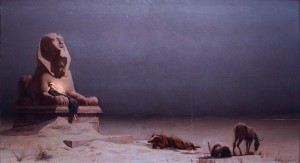
Luc-Olivier Merson, “Rest on the Flight Into Egypt”, 1879. Creative Commons
This post is a part of the Patheos Catholic Channel series, “Catholicity: Identity and Its Discontents.” Read more here.
To give some of the flavour of this symposium, Steel Magnificat has furnished a post about what the public face of Catholicism appears to be or should be (and just added another post on the normalcy of Catholic culture), while A Little Bit of Nothing has looked at the relationship between identity and gift. Jappers and Janglers, meanwhile, has provided a reflection on having Christian frenemies, Suspended in Her Jar looked at being Catholic and feminist, and Justin Tse of Eastern Catholic Person has framed a piece in the context of a prayer to the Theotokos.
The contribution made by this blog, largely for biographical reasons, concerns that often neglected interface between being Catholic and being a migrant, particularly being a non-western migrant to the anglosphere (saying “the West” becomes a bit awkward when one lives in Australia, although it is west of New Zealand).
From Pope Francis to Philip Jenkins, we are seeing analyses trickle in about the growing role that migrants will play in the Church. There is the numerical aspect of this phenomenon, where a small get growing proportion of congregations are hailing from other countries. From interactions with a good number of Catholic friends who are native born, there is this unarticulated sense that migrants are the new footsoldiers for the Church’s priorities set prior to their arrival, and in many ways they will be right. Migrants are now taking up roles in the Church left behind by dwindling numbers of native born Catholics, in reading rosters, choir lofts, soup kitchens and parish offices everywhere.
There is another sense, however, that leaves a smaller yet still significant number of native born Catholic friends, if not freaking out, at least feeling unsettled at the prospect of change in the character of the Church. The unease can be loosely described in this way: though the physical roles in the Church are being taken up, there are growing signs that migrants are not exactly “getting on with the program”, doing things the way things were done in the Church before their arrival, having the same priorities of the native born upon being naturalised, and most importantly, having the same conception of what being a Catholic means, with an exhausting array of diversely exhaustive laundry lists of the indispensable ingredients of being Catholic. There is a faint memory of one acquaintance who, after attending a Mass in another language in Australia, rhetorically asked why one cannot be satisfied with a “normal, neutral and western mass” and bring instead unnecessary foreign additions like another language into the realm of worship. Another once made the remark that Catholicism was being undermined by migrants because of their foreign ways. This is not in terms of their food or dress, but in terms of their thinking and concerns.
This second acquaintance will be right in one respect. As Jensen noted in The Next Christendom, the growth of migrants in the Church does mean that the borders of the concerns of the Church will shift, change, and perhaps expand. Implied in the book also is the idea that, for the migrant, what it means to be Catholic is very much tied to what it means to be a migrant. Being the composite of body and soul makes it hard to prise biography from soteriology, and so one should not be surprised that, as the numerical proportion of migrants relative to the rest of the Church grows, the social, political, cultural and linguistic concerns will gradually weave into a fabric of the “normal, neutral and western”.
By the same token, the migrant will also have struggles of their own in their living amongst their native born neighbours, for they too will have their preconceptions of what being Catholic means rightfully challenged. Whilst it may be difficult to prise biography from soteriology, being Catholic – being universal – also means being able to discern which aspects of their particular identity are improperly hooked onto the wagon of universality, as their love of their land of their birth blinds them to the love of the land of their final destination. Not their country of domicile, but the City of God.
Only this is not something that is unique to the migrant. The native born, insofar as they are of the “normal, neutral and western”, will also have to discern their own improper attachments of what it means to be Catholic. Sin is an equal opportunity employer, and so the loves that blind us to what is needed for our eternal end will equally afflict the native born and the migrant.
Indeed, in many respects, the migrant can act as the icon of one of the key struggles of being in a Church for whom the incarnation and sacramentality – the hypostasis of the divine and the material – is taken seriously. The migrant externalises for us what for many might think is purely spiritual and internal, and exposes to us our own propensity to love our own identity markers over and above our love of God, part of what Augustine called in City of God “the lust to dominate”. Whilst it is true that, in our finitude, our love of God has to be filtered through our love for the things that make up our identity, we must be vigilant that we do not let that love become the only way for anyone to love the lord, thereby turning that love into an occasion to dominate others. As the life of the migrant is a life of constant leaving behind and also integration, so is the life of all of us in the Church a life of purification through our being filtered by the Eucharistic Lord. We may stumble and fail to recognise the dividing line, for the simple reason that the dividing line can only be seen through a glass darkly, only coming clear in the life of the world to come.
Previous Post

August 15, 2016
Assumption: Personalising the Eschaton
Next Post

August 29, 2016 Guestpost by Kamila Soh: When Pokévalues Catch our Attention
Browse Our Archives
Select a Category architecture art Augustine Belloc Benedict XVI bible blogs books bourgeois Christianity Campion College Chesterton Christianisation Church and Culture Church Fathers citizen conference conservative consumer culture cybernetics Desert Fathers discipleship distributism drinking ecclesiology economics education environment Evagrius of Pontus formation Foucault George Weigel Girard Graham Ward http://schemas.google.com/blogger/2008/kind#post interfaith Jacques Ellul John Chrysostom Julia Kristeva Latin liturgy mall marriage monasticism Music Narrative news philosophy polis politics pop culture postmodern city postsecular prayer prostestant quote Quotes Radical Orthodoxy resources Rome Rule of St. Benedict saint Saints secular sociology theological anthropology theology transcendance Uncategorized videos William Cavanaugh
Select a Month December 2018 November 2018 October 2018 September 2018 August 2018 July 2018 June 2018 May 2018 April 2018 March 2018 February 2018 January 2018 December 2017 November 2017 October 2017 September 2017 August 2017 July 2017 June 2017 May 2017 April 2017 March 2017 February 2017 January 2017 December 2016 November 2016 October 2016 September 2016 August 2016 July 2016 June 2016 May 2016 April 2016 March 2016 February 2016 January 2016 December 2015 November 2015 October 2015 September 2015 August 2015 July 2015 June 2015 May 2015 April 2015 March 2015 February 2015 January 2015 December 2014 November 2014 October 2014 September 2014 August 2014 July 2014 June 2014 May 2014 April 2014 March 2014 February 2014 January 2014 December 2013 November 2013 October 2013 September 2013 August 2013 July 2013 June 2013 May 2013 April 2013 March 2013 February 2013 January 2013 December 2012 November 2012 October 2012 September 2012 August 2012 July 2012 June 2012 May 2012 April 2012 March 2012 February 2012 January 2012 December 2011 November 2011 October 2011 September 2011 August 2011 July 2011 June 2011 May 2011 April 2011 October 2009 February 2008 December 2007 October 2007 September 2007 August 2007
Follow Us!
TAKE THE
Religious Wisdom Quiz
What does the Hebrew word 'Shekinah' mean?
Select your answer to see how you score.
Everlasting Light God’s Glory Holy Fire Divine Presence
Related posts from The Divine Wedgie

How a Train Ride Taught Me the Presence...

Images & Idolatry: What Christians Can Learn from...

The 3 Stages of Advent Waiting

Christ the King of My Disappointment
TRENDING AT PATHEOS Catholic

Rejecting Doom: Christian Hope And Human Action
Christianity is a religion of hope. We are to have hope and...

It’s What Comes From Within Which Matters
One of the most difficult things for us to understand is why...

Why I Choose the Eucharist Over the Sermon
Choose the Eucharist, Not the Sermon What are we supposed to get...

5 Design Elements Found in Spiritually Rooted Homes
Putting Spirituality Into Home Decor Our homes are more than our living...

Credo: A Story of God Told with the...
About 10 years ago, I began to imagine a personal "Credo" that...

The Anatomy of Divine Revelation in Catholic Thought
The claim that God has made Himself known to human beings is...
view all Catholic blogs
Ad-Free & Subscriber Log-In Subscription Support
- About Us
- 2026 Calendar
- Videos
- Podcasts
- Library of World Religions
- Faith In Media Tracker
- Advertise With Us
- Write for Us
- Privacy Policy
- Terms of Service
- Do Not Sell My Data
- Contact Us
- Radiant Digital
- Manage Newsletter Subscriptions
- Unsubscribe From Notifications
- Sitemap
Copyright 2008-2026, Patheos. All rights reserved.
Subscription Support Ad-Free & Subscriber Log-In
Follow Patheos