
BuddhistCatholicContemplativeEvangelicalGeneral ChristianHinduJewishLatter-day SaintMuslimNew VisionsProgressive Christian
Beliefs
- Buddhist
- Catholic
- Contemplative
- Evangelical
- General Christian
- Hindu
- Jewish
- Latter-day Saint
- More Voices
- Muslim
- New Visions
- Pagan
- Progressive Christian
Topics
- Religion News
- Food and Religion
- Sports and Religion
- Religious Art
- Religious Music and Entertainment
- Religious Events
- History and Religion
- Style and Religion
- Politics and Religion
- Women in Religion
- Recreation Outdoors and Religion
- Business Finance and Religion
- Careers Workplace and Religion
- Education and Religion
- Family Parenting and Religion
- Health Fitness and Religion
- Home and Religion
- Relationships and Religion
- Technology and Religion
- Travel and Religion
Columnists
- Buddhist Columnists
- Business Finance and Religion Columnists
- Careers Workplace and Religion Columnists
- Catholic Columnists
- Contemplative Columnists
- Education and Religion Columnists
- Evangelists Columnists
- Family Parenting and Religion Columnists
- General Christian Columnists
- Health Fitness and Religion Columnists
- Hindu Columnists
- History and Religion Columnists
- Home and Religion Columnists
- Jewish Columnists
- More Voices Columnists
- Latter Day Columnists
- Muslim Columnists
- New Visions Columnists
- Nonreligious Columnists
- Pagan Columnists
- Politics and Religion Columnists
- Progressive Columnists
- Recreation Outdoors and Religion Columnists
- Relationships and Religion Columnists
- Religion News Columnists
- Religious Art Columnists
- Religious Events Columnists
- Religious Music and Entertainment Columnists
- Sports and Religion Columnists
- Style and Religion Columnists
- Technology and Religion Columnists
- Travel and Religion Columnists
- Women in Religion Columnists
Resource Library
- 2026 Calendar
- Library of World Religions
- The 100 Most Holy Places on Earth
- Patheos Answers
- Podcasts
- Videos
- Faith Leaders Database
- Anglican Episcopalian
- Bahai
- Baptist
- Buddhism
- Christianity
- Confucianism
- Eastern Orthodoxy
- Hinduism
- Holiness and Pentecostal
- ISKCON
- Islam
- Judaism
- Lutheran
- Methodist
- The Church of Jesus Christ of Latter-day Saints
- New Age
- Paganism
- Presbytarian and Reformed
- Protestantism
- Religion Behind the Scenes
- Roman Catholic
- Scientology
- Shia Islam
- Sikhism
- Sufism
- Sunni Islam
- Taoism
- Zen
- See all religions
Research Tools
 Ad-Free & Subscriber Log-In Subscription Support
Ad-Free & Subscriber Log-In Subscription Support
Follow Patheos 

- Trending:
- Forgiveness
- |
- Marriage
- |
- Consciousness
- |
- Death Penalty
- |
- Election
- |
- Halloween
 The Divine Wedgie
- Home
- Catholic
- Adam on Good Friday
Adam on Good Friday
Last updated on: April 13, 2017 at 9:00 am by Matthew Tan
Adam on Good Friday 2017-04-13T09:00:32+10:00 Matthew Tan
Patheos Explore the world's faith through different perspectives on religion and spirituality! Patheos has the views of the prevalent religions and spiritualities of the world.
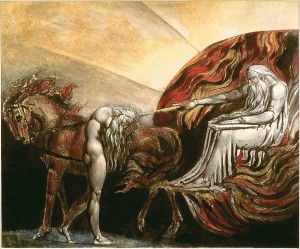
Image: “God Judging Adam” by William Blake. Source: Wikimedia Commons
At this time, the Church celebrates the passion of its founder, Jesus Christ. The events leading up to his death on Golgotha constitute the most brutal tragedy known to man. Yet the ancient theologians of the school of Alexandria, drawing heavily on the Gospel of John, describe this moment as the time of Jesus’ glorification. In what sense can we, reflecting on the brutality of the cross, at the same time become witnesses to the glorification of the man hanging on it?
A possible avenue would be a reflection on four tropes that are used to describe Jesus that converge in the event of the crucifixion: the Priest, the Lamb of God, the Bridegroom and the Second Adam. The Priest and Lamb motifs are obvious enough and often go together. Christ the True High Priest (using the author of the Letter to the Hebrews) offers Himself as the sacrificial Lamb and takes on the sins of many on the cross. Jesus, taking on that sin and experiencing the consequent separation from the Father, cries out in the words of Psalm 21: My God! My God! Why Have you forsaken me?
But what of the other two themes? How are they played out in the context of the Passion?
In chapter 9 of the Gospel of Matthew, Jesus portrays himself as a Bridegroom that will soon be taken away. Usually, we associate the being taken away with his being taken up into heaven, only marrying the Church at the wedding feast of the lamb at the conclusion Book of Revelation. But it makes no sense to have a bridegroom and not have a wedding on this side of the eschaton, until we remember that there was another, more intermediate and more terrestrial episode of the Bridegroom being taken away from his guests: namely the removal of Jesus from the company of his Disciples during the Passion. The eschatological wedding feast of the Lamb had already taken place within history in the form of the Last Supper. But where’s the wedding? And where’s the nuptial moment taking place? Scandal may probably set in at this point as the reader realises that this post hints at the crucifixion itself as the wedding and the consummation thereof. Is this association unjustified?
It is here that the third motif of Jesus as an Adamic figure – the Second Adam – comes into play. Paul’s first letter to the Corinthians makes a number of compelling parallels between Adam and Jesus, and these Adamic themes in the Scriptures have been continued on in the writings of Church Fathers like Justin Martyr, Irenaeus of Lyon and John Chrysostom. The Adamic theme in the Church Fathers is summarised in the fifth paragraph of Vatican II’s Constitution of the Sacred Liturgy Sacrosanctum Concilium. In the book of Genesis, as Adam slept, God created a woman out of his side who was to be his bride. In a new Genesical moment in John 19:34, as Jesus slept the sleep of death, God also caused a woman, the Church, to be created out of his side, a woman who is also to be the Bride of Christ.
But note also that in the Book of Genesis, the creation of the woman in 2:23 is immediately followed by a nuptial moment in 2:24, namely
For this reason a man will leave his father and mother and be united to his wife, and they will become one flesh.
The creation of the woman out of the side of Adam is at the same time a nuptial union between him with Eve. If Jesus the Second Adam was meant to complete in his humanity what was left incomplete in the first Adam, the only logical conclusion is that the crucifixion forms the privileged context in which the Second Adam marries the Church upon its creation from the side of the Bridegroom. Speaking of the Passion, John Chrysostom ended his Good Friday homily with the rhetorical question: Do you understand then, how Christ has united his Bride with Himself…?
The crucifixion is glorious because it is not only an execution, but also a wedding. It is glorious because Christ the Second Adam brings about on the cross a new Genesis, and it is glorious because it constitutes the starting point for the unfolding of a new Eden within history. It is glorious because the cross becomes the fulcrum by which the old order is overturned.
A blessed Pasch to all.
Previous Post

April 11, 2014
Sin, Multiplicity and Relation
Next Post
April 24, 2014 Syndicate: A New Forum for Theology
Browse Our Archives
Select a Category architecture art Augustine Belloc Benedict XVI bible blogs books bourgeois Christianity Campion College Chesterton Christianisation Church and Culture Church Fathers citizen conference conservative consumer culture cybernetics Desert Fathers discipleship distributism drinking ecclesiology economics education environment Evagrius of Pontus formation Foucault George Weigel Girard Graham Ward http://schemas.google.com/blogger/2008/kind#post interfaith Jacques Ellul John Chrysostom Julia Kristeva Latin liturgy mall marriage monasticism Music Narrative news philosophy polis politics pop culture postmodern city postsecular prayer prostestant quote Quotes Radical Orthodoxy resources Rome Rule of St. Benedict saint Saints secular sociology theological anthropology theology transcendance Uncategorized videos William Cavanaugh
Select a Month December 2018 November 2018 October 2018 September 2018 August 2018 July 2018 June 2018 May 2018 April 2018 March 2018 February 2018 January 2018 December 2017 November 2017 October 2017 September 2017 August 2017 July 2017 June 2017 May 2017 April 2017 March 2017 February 2017 January 2017 December 2016 November 2016 October 2016 September 2016 August 2016 July 2016 June 2016 May 2016 April 2016 March 2016 February 2016 January 2016 December 2015 November 2015 October 2015 September 2015 August 2015 July 2015 June 2015 May 2015 April 2015 March 2015 February 2015 January 2015 December 2014 November 2014 October 2014 September 2014 August 2014 July 2014 June 2014 May 2014 April 2014 March 2014 February 2014 January 2014 December 2013 November 2013 October 2013 September 2013 August 2013 July 2013 June 2013 May 2013 April 2013 March 2013 February 2013 January 2013 December 2012 November 2012 October 2012 September 2012 August 2012 July 2012 June 2012 May 2012 April 2012 March 2012 February 2012 January 2012 December 2011 November 2011 October 2011 September 2011 August 2011 July 2011 June 2011 May 2011 April 2011 October 2009 February 2008 December 2007 October 2007 September 2007 August 2007
Follow Us!
TAKE THE
Religious Wisdom Quiz
What is the book of songs and prayers in the Bible called?
Select your answer to see how you score.
Proverbs Genesis Psalms Matthew
Related posts from The Divine Wedgie

How a Train Ride Taught Me the Presence...

Images & Idolatry: What Christians Can Learn from...

The 3 Stages of Advent Waiting

Christ the King of My Disappointment
TRENDING AT PATHEOS Catholic

The Parable Of The Sower And The Word...
One of Christ’s most famous parables is that of the sower who...

Rejecting Doom: Christian Hope And Human Action
Christianity is a religion of hope. We are to have hope and...

Why I Choose the Eucharist Over the Sermon
Choose the Eucharist, Not the Sermon What are we supposed to get...

5 Design Elements Found in Spiritually Rooted Homes
Putting Spirituality Into Home Decor Our homes are more than our living...

Credo: A Story of God Told with the...
About 10 years ago, I began to imagine a personal "Credo" that...

The Anatomy of Divine Revelation in Catholic Thought
The claim that God has made Himself known to human beings is...
view all Catholic blogs
Ad-Free & Subscriber Log-In Subscription Support
- About Us
- 2026 Calendar
- Videos
- Podcasts
- Library of World Religions
- Faith In Media Tracker
- Advertise With Us
- Write for Us
- Privacy Policy
- Terms of Service
- Do Not Sell My Data
- Contact Us
- Radiant Digital
- Manage Newsletter Subscriptions
- Unsubscribe From Notifications
- Sitemap
Copyright 2008-2026, Patheos. All rights reserved.
Subscription Support Ad-Free & Subscriber Log-In
Follow Patheos