
BuddhistCatholicContemplativeEvangelicalGeneral ChristianHinduJewishLatter-day SaintMuslimNew VisionsProgressive Christian
Beliefs
- Buddhist
- Catholic
- Contemplative
- Evangelical
- General Christian
- Hindu
- Jewish
- Latter-day Saint
- More Voices
- Muslim
- New Visions
- Pagan
- Progressive Christian
Topics
- Religion News
- Food and Religion
- Sports and Religion
- Religious Art
- Religious Music and Entertainment
- Religious Events
- History and Religion
- Style and Religion
- Politics and Religion
- Women in Religion
- Recreation Outdoors and Religion
- Business Finance and Religion
- Careers Workplace and Religion
- Education and Religion
- Family Parenting and Religion
- Health Fitness and Religion
- Home and Religion
- Relationships and Religion
- Technology and Religion
- Travel and Religion
Columnists
- Buddhist Columnists
- Business Finance and Religion Columnists
- Careers Workplace and Religion Columnists
- Catholic Columnists
- Contemplative Columnists
- Education and Religion Columnists
- Evangelists Columnists
- Family Parenting and Religion Columnists
- General Christian Columnists
- Health Fitness and Religion Columnists
- Hindu Columnists
- History and Religion Columnists
- Home and Religion Columnists
- Jewish Columnists
- More Voices Columnists
- Latter Day Columnists
- Muslim Columnists
- New Visions Columnists
- Nonreligious Columnists
- Pagan Columnists
- Politics and Religion Columnists
- Progressive Columnists
- Recreation Outdoors and Religion Columnists
- Relationships and Religion Columnists
- Religion News Columnists
- Religious Art Columnists
- Religious Events Columnists
- Religious Music and Entertainment Columnists
- Sports and Religion Columnists
- Style and Religion Columnists
- Technology and Religion Columnists
- Travel and Religion Columnists
- Women in Religion Columnists
Resource Library
- 2026 Calendar
- Library of World Religions
- The 100 Most Holy Places on Earth
- Patheos Answers
- Podcasts
- Videos
- Faith Leaders Database
- Anglican Episcopalian
- Bahai
- Baptist
- Buddhism
- Christianity
- Confucianism
- Eastern Orthodoxy
- Hinduism
- Holiness and Pentecostal
- ISKCON
- Islam
- Judaism
- Lutheran
- Methodist
- The Church of Jesus Christ of Latter-day Saints
- New Age
- Paganism
- Presbytarian and Reformed
- Protestantism
- Religion Behind the Scenes
- Roman Catholic
- Scientology
- Shia Islam
- Sikhism
- Sufism
- Sunni Islam
- Taoism
- Zen
- See all religions
Research Tools
 Ad-Free & Subscriber Log-In Subscription Support
Follow Patheos 

- Trending:
- Advent
- |
- Forgiveness
- |
- Thanksgiving
- |
- Election
- |
- Seasonal Holidays
- |
- Marriage
 Dispatches From the End of the World
- Home
- Latter-day Saint
- Technology and Religion
- Technological Salvation
Technological Salvation
Last updated on: August 2, 2023 at 7:33 am by R. W. Richey
Technological Salvation 2023-08-02T07:33:38-06:00 R. W. Richey
Patheos Explore the world's faith through different perspectives on religion and spirituality! Patheos has the views of the prevalent religions and spiritualities of the world.
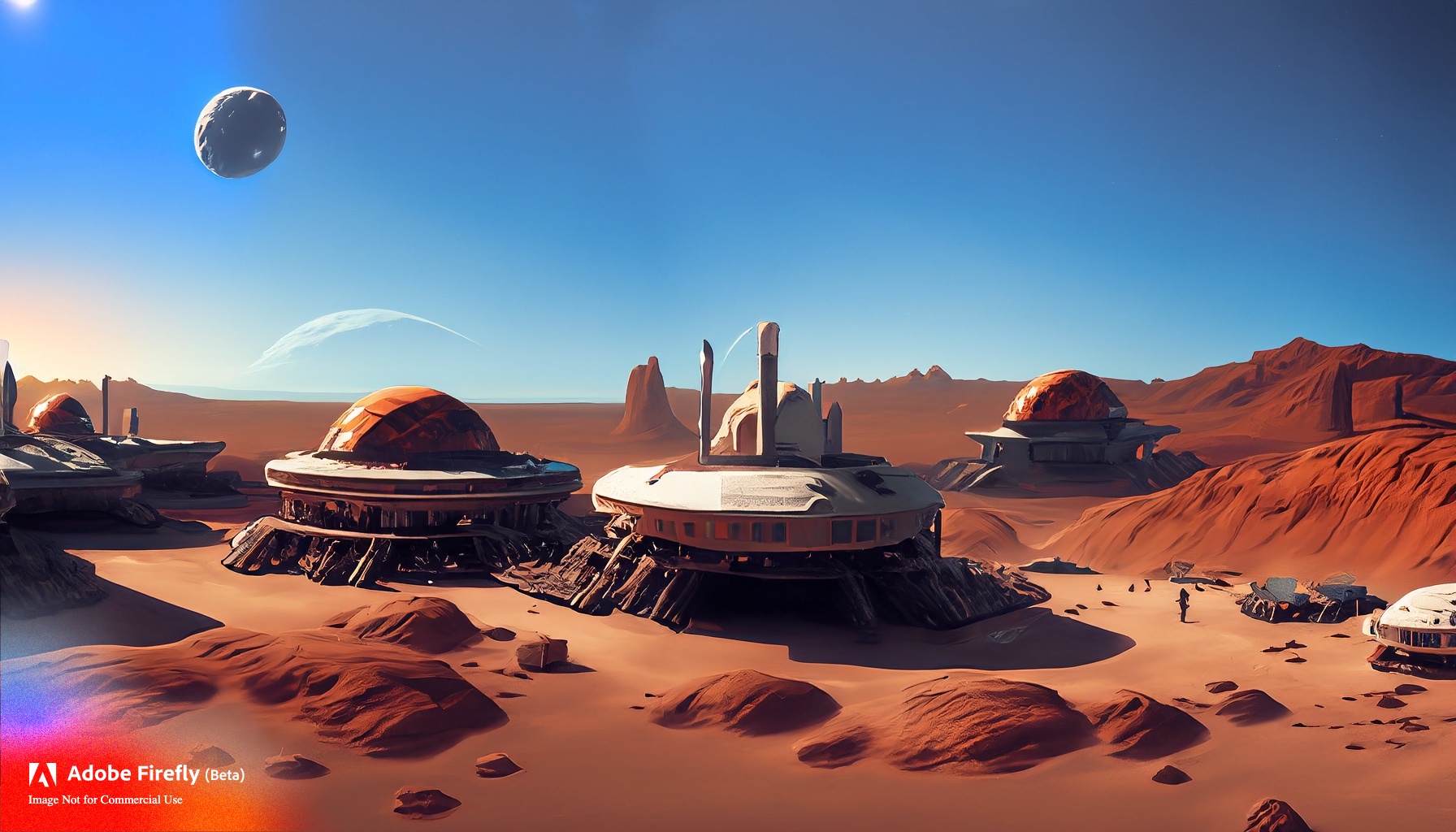
A Mars colony in the far, perhaps the impossible future. Generated by Firefly Beta.
I- Two Kinds of Salvation
Picture two groups. These two groups appear to be diametrically opposed but, upon deeper inspection, they’re pursuing similar ends.
The first group is the Actively Religious. These are people who believe in a higher power and a life after this one.
The second group are the Radical Humanists. These are people who believe in the power and potential of humanity and the grand destiny which awaits mankind.
Both groups have a narrative of human potential — a sense of humanity’s ultimate destiny.
For the Actively Religious, our ultimate salvation will occur in partnership with the divine (e.g. God). Are they correct? It’s hard to imagine that they could all be correct. But even if only one set of beliefs is correct it would mean that a viable path to salvation exists.
Per the Radical Humanists, we are destined to be saved by our own efforts. With this latter group plans include eventual immortality, superintelligence, and other technological singularities. But in its most basic form it consists of avoiding a premature end to humanity, and ultimately that requires departing the planet in a sustainable fashion. We can’t be permanently saved until that happens. As befits their name, this group generally doesn’t believe in God, but they’re passionate believers in the power of technology. The bulk of this post will be dedicated to them, and specifically getting off the planet.
I’m using the term salvation because I don’t know of a better one, but as a consequence I’m using it broadly, but I believe that there are several interesting parallels.
To start with, religious people look to religion as salvation from death. Radical Humanists look to technology and human progress as salvation from extinction. But on the other hand the religious are more inclined to view salvation as an individual matter, while the humanists are more inclined to view it as something that applies to humanity as a whole.
To declare my biases, I count myself among the Actively Religious, but I have a lot of sympathy for the Radical Humanists. I think they’re wrong but at least we both agree on the need for salvation even if we disagree on the methodology and character of that salvation. Too many people ignore the question entirely or spend all of their time focused on short-term goals. Obviously it’s noble to want to reduce death and suffering, but doing this in the short term is not the same as preventing the ultimate extinction of humanity in the long term, and the fact that the Radical Humanists recognize this distinction is a point in their favor.
II- Musk and Mars
To offer an example of what I mean. One very large reason we haven’t sent people to Mars is the difficulty of bringing them back; any reasonable estimate puts the cost of returning people to Earth at 10x the cost of just getting them there (at a bare minimum). This combined with our squeamishness at leaving them there to die means that our value of preventing death is directly opposed to the value of getting off the planet. Of course some people think that while it might be a one way trip that we wouldn’t be necessarily leaving them there to die, and we’ll touch on that idea more in a bit.
Of course, aversion to death is not the only reason we don’t have men on Mars. There is also the age-old tension between the here and pressing versus the there and monumental. Basically, we shouldn’t waste resources on space exploration when we have so many problems here. This is evidence that groups other than the Actively Religious and the Radical Humanists, those who don’t concern themselves with salvation, frequently get in the way of it, if only through imposing opportunity costs.
As we get into a technological discussion of space travel and colonization we have to mention Elon Musk, who is definitely the poster child for this endeavor. And at this point Elon is the person with the most concrete plan to create an extraterrestrial colony, in this case on Mars. Consequently, since any discussion of creating a colony on a planet other than Earth is going to be analyzed in relation to his plan, it’s probably just best to get it out of the way. Particularly since Elon’s plan represents the most optimistic possible scenario.
In any endeavor, cost can be used as a rough proxy for difficulty. To establish a sustainable colony on Mars (Elon speaks of getting millions of people there) it has to be a lot easier to travel to Mars, which means it has to be a lot cheaper. Elon’s current estimate is that it would cost $10 billion per individual if you wanted to get to Mars under the old system. (i.e. the system that gave us the space shuttle.) Obviously getting millions of people to Mars at that price is lunacy. Elon wants to reduce that to $200,000 per person, which is a five million percent improvement. I won’t say that’s impossible, but I can’t imagine it’s something you can do overnight either.
Just as a brief survey, here are the challenges which must be overcome:
- Initial investment- The level of R&D, trial and error, and infrastructure required to pull this off is ridiculous. Most people agree that Elon can’t fund it all himself. Which means he has to get massive funding from somewhere else.
- Habitation- Elon talks a lot about getting to Mars, but he doesn’t talk much about what to do once we’re there. It’s one thing to get someone to Mars, it’s quite another to build a habitat that provides long-term sustainable and fault-tolerant life support. Elon has largely moved this question off to people other than himself. He wants to build a transcontinental railroad and let other people build the log cabins.
- Fuel- For any kind of spaceflight, fuel is the single biggest problem. This is a particular problem, as I mentioned above, if you plan on returning from Mars. Musk has a plan to extract methane on Mars, but the details on that are VERY fuzzy.
Despite all this, let’s assume that he can do it, that he can somehow get a ticket to Mars down to $200,000. Who would pay that money?
III- Who Would Technology Save?
I can think of only two categories of people who might:
- The Rich Tourist- There are obviously wealthy people who would pay $200,000 to go to Mars and come back just for the experience. But how many of them would stay? If you’re rich enough to afford a $200,000 trip to Mars then you’re pretty rich. Are these people going to be willing to trade their 5,000 sq. foot house for a tiny 10’x10’ room, being constantly cooked by radiation, their bones disintegrating from the low-gravity, living with perpetual rationing and decompressive death lurking around every corner?
- True Believers- Certainly there are some people who believe strongly enough in the same vision of the future as Elon that they would go to Mars and stay there. But these people don’t only have to be true believers, they have to have at least as much money as the first group and probably more. Recall that they don’t just have to pay the money to get there, they have to pay the money to stay there. Even using Elon’s WILDLY optimistic numbers we’re still talking about $140,000 per ton to get stuff to Mars. Which means you need to spend an additional $140,000 just to make sure you don’t starve to death in the first year.
Granting that Elon can reduce the price to $200,000, and further granting that there are millions of rich true believers who are willing to relocate to Mars, we still haven’t figured out how to make the colony sustainable. Dr. Scott Pace, the Director of Space Policy Institute, had an admirable breakdown of the future of space exploration and colonization:
Such a question could be, “Does humanity have a future beyond the Earth?” Either a yes or a no answer would have profound implications. Addressing this question quickly leads to two sub-questions: can humans “live off the land” away from Earth, and is there any economic justification for human activities off the Earth? If the answer to both questions is yes, then there will be space settlements. If the answer to both questions is no, then space is akin to Mount Everest – a place where explorers and tourists might visit but of no greater significance. If humans can live off-planet, but there is nothing economically useful to do, then lunar and Martian outposts will, at best, be similar to those found in Antarctica. If humans cannot live off-planet, but there is some useful economic activity to perform, then those outposts become like remote oil platforms. Each of these scenarios represents a radically different human future in space and while individuals might have beliefs or hopes for one of them, it is unknown which answer will turn out to be true.
We can imagine that if Elon does manage to get the price down in the way he hopes, that in the initial flurry of excitement and optimism that we might have lots of people pay the necessary money to go to Mars, but at some point, after the initial excitement wears off, inevitably Pace’s categories would come to dominate the endeavor. When that happens, where does Mars end up? Is it Everest, Antarctica, a North Sea Drilling platform, or America being discovered by the Europeans?
The fact that Pace mentions Antarctica is interesting, because it’s an instructive example. Antarctica is better for settlement than Mars by any conceivable measurement. It’s warmer than Mars. The air is breathable. There’s the same large supply of water trapped as ice. But most of all it’s 34 million miles closer! And yet Antarctica only has 5,000 temporary residents, and trust me, they are not living off the land. If we can’t live off the land in our own backyard under much better conditions, how can we expect to live off the land on Mars?
As far as whether it’s economically justified, I have seen very little that indicates that Mars has any special economic resources. When speaking of the Moon people talk about Helium-3 but apparently this doesn’t apply to Mars. There are some people who say there might be precious metals and rare earth elements on Mars, but not only is the evidence for this currently lacking, you still end up with Mars being the North Sea Drilling platform (presumably worked by robots) not the colony of millions which Elon envisions.
In the end it appears difficult to make an economic case for Mars colonization. And as the humanists can’t count on divine intervention that means it’s difficult to imagine making a salvific case for it either. Though that appears to be the only argument left, to ensure we’re not a one planet species.
Perhaps we’ll do it for emotional reasons, in pursuit of honor and glory. Or maybe we can do it in hopes that we’ll eventually make it work, that there will be secondary or tertiary benefits that make it worthwhile. But, regardless of the reason, it would require that a large group of people pay a lot of money to go live in a miserably-hostile environment for the rest of their (probably greatly shortened) lives.
This helps to explain why, when it comes to salvation, I prefer religion.
I you prefer to listen to this post click here.
Previous Post

July 24, 2023
Chesterton's Fence and Technology
Next Post

August 7, 2023 And There Was Silence in Heaven...
Recent Comments
"On the other hand, maybe you just missed the train by a few years and ..."
"Exactly the kind of thing I was worried about:Israel and Palestinians Blame Each Other for ..."
Tragedies, Truths, and Technologies
"I kinda have my own version of this wager, two folk, one Christian, one Atheist, ..."
Would You Wager on Pascal’s Mugging?
"Your concluding paragraph sums it up perfectly. This has also been my observation with those ..."
Browse Our Archives
Select a Category Aliens/UFOs Artificial Intelligence Book Review Cultural Evolution End of the World Meta Pascal's Wager Scriptures Space Travel Uncategorized Virtue and Vice
Select a Month November 2023 October 2023 September 2023 August 2023 July 2023 June 2023
Follow Us!
TAKE THE
Religious Wisdom Quiz
What did God put in the sky as a sign of His promise to Noah?
Select your answer to see how you score.
A rainbow A dove A star A cloud
Related posts from Dispatches From the End of the World

The Overemphasis on Love and Tolerance
Dispatches From the End of the World

Dispatches From the End of the World

Dispatches From the End of the World

Tragedies, Truths, and Technologies
Dispatches From the End of the World
TRENDING AT PATHEOS Latter-day Saint

Did Prayer Cure His Cancer? Or Was It...
At 4 AM one morning, Joshua W. Brown’s wife awoke to a...

8 Ways a Near-Death Experience Rewires the Soul
Does Consciousness Survive Physical Death? After 50 Years of Research, Dr. Raymond...

Holy Longing: What Our Restlessness Is Telling Us
“One can find so many pains when the rain is falling.” -John...

What this is NOT about. This blog is definitely not about...

Who said the Israelites were God’s chosen? That’s right, they did. Who...

The Spirit World Is the Real World: God...
A Monk’s Wisdom on Body and Spirit I sit with Brother Martin...
view all Latter-day Saint blogs
Ad-Free & Subscriber Log-In Subscription Support
- About Us
- 2026 Calendar
- Videos
- Podcasts
- Library of World Religions
- Faith In Media Tracker
- Advertise With Us
- Write for Us
- Privacy Policy
- Terms of Service
- Do Not Sell My Data
- Contact Us
- Radiant Digital
- Manage Newsletter Subscriptions
- Unsubscribe From Notifications
- Sitemap
Copyright 2008-2026, Patheos, part of the Radiant Digital network of media brands. All rights reserved.
Subscription Support Ad-Free & Subscriber Log-In
Follow Patheos