
BuddhistCatholicContemplativeEvangelicalGeneral ChristianHinduJewishLatter-day SaintMuslimNew VisionsProgressive Christian
Beliefs
- Buddhist
- Catholic
- Contemplative
- Evangelical
- General Christian
- Hindu
- Jewish
- Latter-day Saint
- More Voices
- Muslim
- New Visions
- Pagan
- Progressive Christian
Topics
- Religion News
- Food and Religion
- Sports and Religion
- Religious Art
- Religious Music and Entertainment
- Religious Events
- History and Religion
- Style and Religion
- Politics and Religion
- Women in Religion
- Recreation Outdoors and Religion
- Business Finance and Religion
- Careers Workplace and Religion
- Education and Religion
- Family Parenting and Religion
- Health Fitness and Religion
- Home and Religion
- Relationships and Religion
- Technology and Religion
- Travel and Religion
Columnists
- Buddhist Columnists
- Business Finance and Religion Columnists
- Careers Workplace and Religion Columnists
- Catholic Columnists
- Contemplative Columnists
- Education and Religion Columnists
- Evangelists Columnists
- Family Parenting and Religion Columnists
- General Christian Columnists
- Health Fitness and Religion Columnists
- Hindu Columnists
- History and Religion Columnists
- Home and Religion Columnists
- Jewish Columnists
- More Voices Columnists
- Latter Day Columnists
- Muslim Columnists
- New Visions Columnists
- Nonreligious Columnists
- Pagan Columnists
- Politics and Religion Columnists
- Progressive Columnists
- Recreation Outdoors and Religion Columnists
- Relationships and Religion Columnists
- Religion News Columnists
- Religious Art Columnists
- Religious Events Columnists
- Religious Music and Entertainment Columnists
- Sports and Religion Columnists
- Style and Religion Columnists
- Technology and Religion Columnists
- Travel and Religion Columnists
- Women in Religion Columnists
Resource Library
- 2026 Calendar
- Library of World Religions
- The 100 Most Holy Places on Earth
- Patheos Answers
- Podcasts
- Videos
- Faith Leaders Database
- Anglican Episcopalian
- Bahai
- Baptist
- Buddhism
- Christianity
- Confucianism
- Eastern Orthodoxy
- Hinduism
- Holiness and Pentecostal
- ISKCON
- Islam
- Judaism
- Lutheran
- Methodist
- The Church of Jesus Christ of Latter-day Saints
- New Age
- Paganism
- Presbytarian and Reformed
- Protestantism
- Religion Behind the Scenes
- Roman Catholic
- Scientology
- Shia Islam
- Sikhism
- Sufism
- Sunni Islam
- Taoism
- Zen
- See all religions
Research Tools
 Ad-Free & Subscriber Log-In Subscription Support
Ad-Free & Subscriber Log-In Subscription Support
Follow Patheos 

- Trending:
- Forgiveness
- |
- Marriage
- |
- Consciousness
- |
- Death Penalty
- |
- Election
- |
- Halloween
 Dirt Heart Witch
-
Archive Index
- Home
- Pagan
- Slaughtering Chickens
Slaughtering Chickens
Last updated on: September 10, 2014 at 3:13 pm by Jenya T. Beachy
Slaughtering Chickens 2014-09-10T15:13:45-07:00 Jenya T. Beachy
Patheos Explore the world's faith through different perspectives on religion and spirituality! Patheos has the views of the prevalent religions and spiritualities of the world.
Slaughtering chickens isn’t easy. It’s simple, but not easy.
I’d slaughtered many rabbits before I ever even kept meat birds. Rabbits weren’t easy either.
But in my experience thus far, prey animals have a spirit that is loosely connected. They fully inhabit their bodies until it is time to leave it, then they go without too much fuss. It feels very natural.
When we get ready to harvest, we do all the regular stuff: prepare cutting boards and clean all surfaces with disinfectant; boil water for the plucking; fill the buckets with cold water; fill the cooler with ice. Sharpen knives.
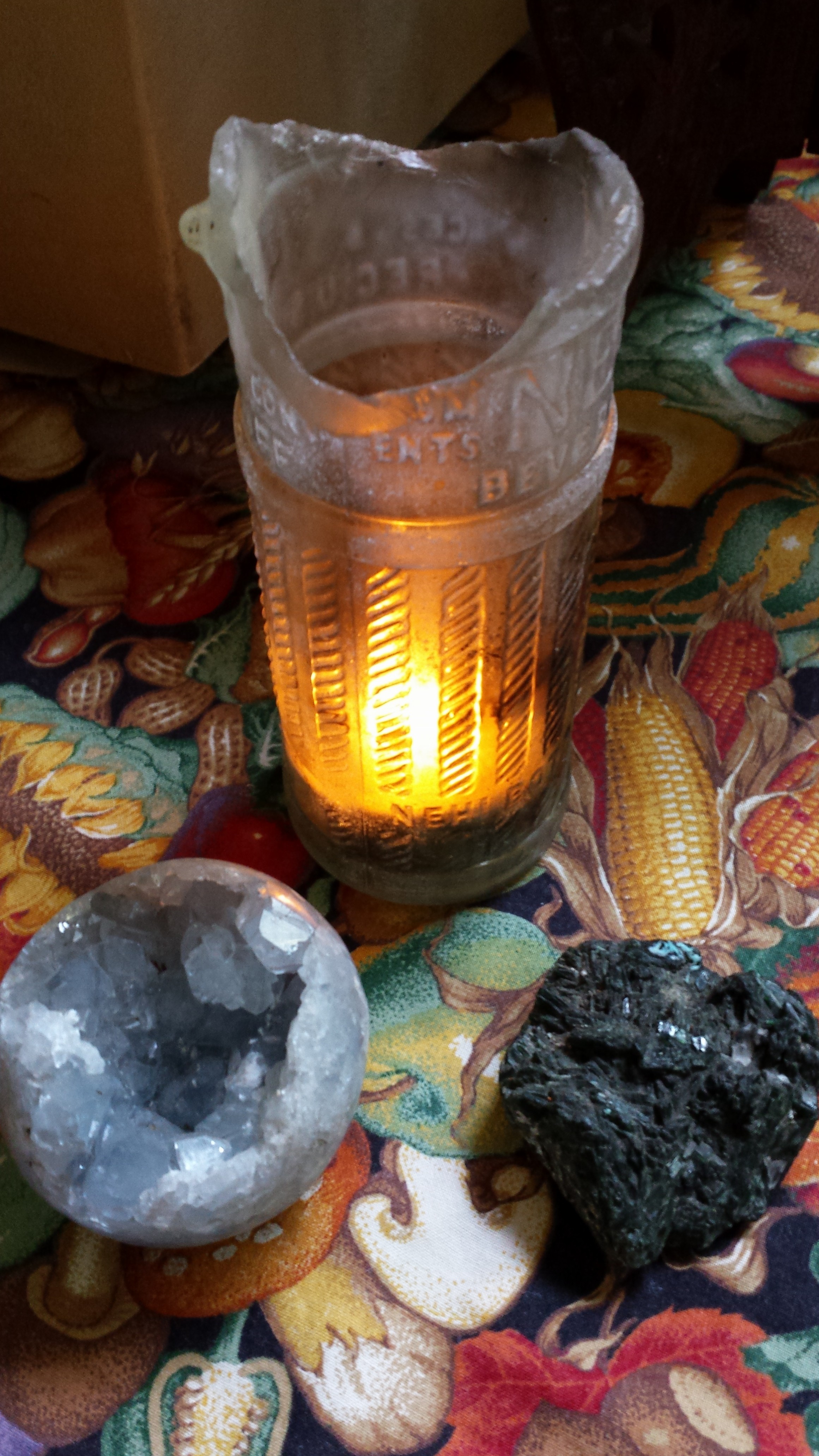 Then we light a candle. We make a small altar with the stone that I found at the headwaters of Jenner Creek when I left my old ‘self-wedding’ band there for the Lord of all Creatures. Matthew places a chalcedony sphere that he’s used for dreamwork. We bless each animal, giving thanks that they feed us. We pray over them, that the molecules of their bodies and spirits open easily apart and go on to their next incarnation with ease and joy.
Then we slaughter them. It goes like this:
Cut open their jugular veins and bleed them out. It’s best if you use a very sharp knife so the cut is clean. Most times the chicken will have some sort of death throes, but sometimes they hardly move at all. Cut off the head. There is a mess of blood.
Then it’s into the pot of very hot water. Swish them up and down a bit to loosen the feathers then sit down to pluck. Have a big trash can there, or some sort of bin. Start with the wings if you can (they’re the hardest feathers to pull), but don’t worry too much about it. The wing-tips will most likely go to make stock since there’s little meat on them. No matter how we do it, there’s a mess of feathers.
Then it’s into the cold water bucket (to rinse), then into the other cold water bucket (to rinse some more). Finally it’s into the cooler full of ice to cool them as fast as possible.
At this point, I take them inside because I am deathly allergic to bee and wasp stings and the Yellow-Jackets just love blood and offal.
In the house, I cut off their feet, up to the yellow. At this point, you can really tell that lizards and birds are related. Chicken feet have scales and talons just like a tiny dinosaur. It’s a carcass now, a once-living thing, no longer full of worm-desire, pecking-order, and get-out-of-my-nest.
Stretch out the neck and slip fingers inside the skin. Disengage the windpipe and pull out the crop. It’s probably full of mashed grain that she wasn’t quite done with. This is the food that was in the process of becoming a chicken. Cut it off and throw it out.
Starting from the tip of the breastbone, cut down to the vent and around it carefully. You need to cut through the skin and muscle but not the guts. Trust me on this. If you smell chicken poo while you are doing this, you will not forget it, even if the meat stays clean. It makes it hard to eat.
Reach your hand inside the cavity and pull out the intestines, liver, heart, gizzard. Throw out the intestine and the vent. Pull the little green bile duct off the liver oh-so-gingerly. If you burst that little sac it will taint the meat and you will finally understand why “bile” used to be considered the source of anger and violence.
You will recognize the heart. It looks like a tiny human heart with valves and all. It beat very quickly when it was in the chicken’s chest, faster when it heard the cry of a hawk, or the bark of a dog. There might still be blood in it; if you squeeze it, you’ll find out.
The gizzard is pretty much a handful of solid muscle. If you look carefully you’ll see it has two lobes with a white tissue between. Slice down through that and open it like a butterfly. Inside will be more grains in various stages of groundedness and hopefully some little stones. If there are no little stones, your chickens need more grit. You can buy mineral grit at the feed store which also includes calcium to help with egg production and shell strength. Or you can let your birds wander around the yard for grit, give them leafy greens, and grind up their eggshells into powder and sprinkle it on their food.
Back to the gizzard which has been butterflied: rinse out the stones and grain. You’ll see on the inside a sheath of yellow. Get your fingernail under the edge of it and peel it off. Pop the gizzard, heart and liver into a pan with lots of butter. One way we honor the birds is to eat these parts right away. It’s not a hunt and we don’t expect to gain the powers of our flock by ingesting them, but it feels like there’s some sort of balance there.
A chicken’s lungs are attached quite well to the ribs. They are a darker solid pink. They used to push air up and through the throat to let everyone know that something was wrong, or right, or simply strange. No air in them anymore. Scraping with fingernails is one way to get them out, but you can also use a ‘lung-scraper’ or a strawberry huller. These are not good to eat. Throw them out.
Cut off the tail (known in some circles as “the parson’s nose”, but also in other countries as “the sultan’s nose” or “the pope’s nose” or any other figure who might be considered to have their “nose in the air”). OR don’t cut off the tail, just the oil glands at the top of the tail, where it connects to the body of the bird. The chicken used to brush that oil through hir feathers, preening.
Rinse the bird well inside and out. If you cut it into pieces it will fit better in a freezer bag or a small crock pot. Freeze it for up to a couple of months. Or cook it right 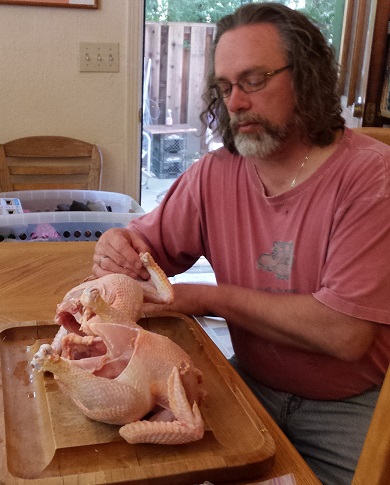 away with any number of amazing chicken recipes, but try at least one that has minimal seasoning and keeps the meat on the bone. Maybe roast it, so it still looks something like the chicken that you raised up from a hatchling. When you eat it, give thanks for the bird, the bugs it ate, the greenery. Give thanks for the brilliant system by which the food we eat becomes our bodies. Give thanks for the hands that refilled the water dish and moved the heat lamp and delivered the feed; that opened the vein and took the life. Give thanks for your own courage.
Blessed Be.
Here is a good (and VERY graphic) photo essay on butchering chickens: http://foodwaterandfire.ludlowsurvivors.com/chickenkill.html
Previous Post

September 4, 2014
Chicken and Truth Sandwich
Next Post

September 16, 2014 Wheel of the Year~Autumn Equinox at the Homestead
Browse Our Archives
Select a Category Air Animal Products Arts and Crafts Author Big Gods Books Buddhism Celebs Chickens Comestibles Deep Well ~ Great Heart Society Dirt-Heart Farmette Drink Earth Elemental Practices Fauna Festivals Fiction? Fire Flora Food Goats Holidays-Holy Days Homework! Invocations Jenya T. Beachy Justice Kitchen Witchery Meat Birds Meditations Moon Magick News Off-Topic Ole Time Good Spell Feri Pagan Tent Revival Poetry Practices Prayers Predators Queer Rant Recovery RIP Rituals Saints and Prophets of Shapeshifter Seasonal Shapeshifter Tradition Small Gods Songs and Chants Spellcraft Stories The Secret Country of Yourself The Village The Witches' Toolkit Travel Turkeys Uncategorized Updates Urban Pagan Homestead Videos Water
Select a Month February 2020 January 2020 November 2019 August 2019 July 2019 June 2019 May 2019 April 2019 February 2019 January 2019 December 2018 October 2018 August 2018 May 2018 April 2018 February 2018 October 2017 September 2017 July 2017 January 2017 April 2016 March 2016 February 2016 January 2016 December 2015 November 2015 October 2015 September 2015 August 2015 July 2015 May 2015 April 2015 March 2015 February 2015 January 2015 December 2014 November 2014 October 2014 September 2014 August 2014 July 2014 June 2014
Follow Us!
TAKE THE
Religious Wisdom Quiz
What valley did David face Goliath in?
Select your answer to see how you score.
Kidron Valley Valley of Elah Valley of Jezreel Valley of Achor
Related posts from Dirt Heart Witch

A Guided Journey to Meet the Elementals: Earth,...

Some Imbolc Advice from One of My Mothers

A Ritual of Personal Cleansing ~ the Untangling...

Come to Hexenfest ~ A Witchy Love-Fest of...
TRENDING AT PATHEOS Pagan

When we talk about Greek religion, we often begin with the dodekatheion—the...

I was recently chatting with someone on Instagram. She asked me what...

While there are many people who share their results, the end of...

On July 23, I saw Christopher Nolan's The Odyssey which is Homer’s...

As I write this two big events have just finished up. One...

Restoring the Watershed of Divine Love
Perhaps cooperation is not something we manufacture through legislation, ideology, or moral...
view all Pagan blogs
Ad-Free & Subscriber Log-In Subscription Support
- About Us
- 2026 Calendar
- Videos
- Podcasts
- Library of World Religions
- Faith In Media Tracker
- Advertise With Us
- Write for Us
- Privacy Policy
- Terms of Service
- Do Not Sell My Data
- Contact Us
- Radiant Digital
- Manage Newsletter Subscriptions
- Unsubscribe From Notifications
- Sitemap
Copyright 2008-2026, Patheos. All rights reserved.
Subscription Support Ad-Free & Subscriber Log-In
Follow Patheos