
BuddhistCatholicContemplativeEvangelicalGeneral ChristianHinduJewishLatter-day SaintMuslimNew VisionsProgressive Christian
Beliefs
- Buddhist
- Catholic
- Contemplative
- Evangelical
- General Christian
- Hindu
- Jewish
- Latter-day Saint
- More Voices
- Muslim
- New Visions
- Pagan
- Progressive Christian
Topics
- Religion News
- Food and Religion
- Sports and Religion
- Religious Art
- Religious Music and Entertainment
- Religious Events
- History and Religion
- Style and Religion
- Politics and Religion
- Women in Religion
- Recreation Outdoors and Religion
- Business Finance and Religion
- Careers Workplace and Religion
- Education and Religion
- Family Parenting and Religion
- Health Fitness and Religion
- Home and Religion
- Relationships and Religion
- Technology and Religion
- Travel and Religion
Columnists
- Buddhist Columnists
- Business Finance and Religion Columnists
- Careers Workplace and Religion Columnists
- Catholic Columnists
- Contemplative Columnists
- Education and Religion Columnists
- Evangelists Columnists
- Family Parenting and Religion Columnists
- General Christian Columnists
- Health Fitness and Religion Columnists
- Hindu Columnists
- History and Religion Columnists
- Home and Religion Columnists
- Jewish Columnists
- More Voices Columnists
- Latter Day Columnists
- Muslim Columnists
- New Visions Columnists
- Nonreligious Columnists
- Pagan Columnists
- Politics and Religion Columnists
- Progressive Columnists
- Recreation Outdoors and Religion Columnists
- Relationships and Religion Columnists
- Religion News Columnists
- Religious Art Columnists
- Religious Events Columnists
- Religious Music and Entertainment Columnists
- Sports and Religion Columnists
- Style and Religion Columnists
- Technology and Religion Columnists
- Travel and Religion Columnists
- Women in Religion Columnists
Resource Library
- 2026 Calendar
- Library of World Religions
- The 100 Most Holy Places on Earth
- Patheos Answers
- Podcasts
- Videos
- Faith Leaders Database
- Anglican Episcopalian
- Bahai
- Baptist
- Buddhism
- Christianity
- Confucianism
- Eastern Orthodoxy
- Hinduism
- Holiness and Pentecostal
- ISKCON
- Islam
- Judaism
- Lutheran
- Methodist
- The Church of Jesus Christ of Latter-day Saints
- New Age
- Paganism
- Presbytarian and Reformed
- Protestantism
- Religion Behind the Scenes
- Roman Catholic
- Scientology
- Shia Islam
- Sikhism
- Sufism
- Sunni Islam
- Taoism
- Zen
- See all religions
Research Tools
 Ad-Free & Subscriber Log-In Subscription Support
Ad-Free & Subscriber Log-In Subscription Support
Follow Patheos 

- Trending:
- Forgiveness
- |
- Marriage
- |
- Consciousness
- |
- Death Penalty
- |
- Election
- |
- Halloween

- Home
- General Christian
- Religious Events
- The Two Kinds of Prayer: One Fast, One Slow
The Two Kinds of Prayer: One Fast, One Slow
Last updated on: May 18, 2025 at 4:09 pm by Clark Elder Morrow
The Two Kinds of Prayer: One Fast, One Slow 2025-05-18T16:09:28-07:00 Clark Elder Morrow
Patheos Explore the world's faith through different perspectives on religion and spirituality! Patheos has the views of the prevalent religions and spiritualities of the world.
Recently I’ve been toying with the idea that in the realm of prayer, there are two vast and ill-defined regions: the occasional prayer and the non-occasional. Allow me to explain (and I certainly hope that my explanation offers some small measure of consolation to those who suffer from what they perceive to be an ineffective prayer life).
In the 18th century composers would often produce works to celebrate or mark a particularly important event in the personal life of a patron, or a local high-ranking person, or the national life of the artist’s homeland. One such piece is known to us now as the “Occasional Oratorio” of George Friedrich Handel, and C. P. E. Bach wrote a composition called the “Occasional Cantata”. These works were tied to a specific occurrence (much as many Te Deums have been throughout the centuries), and, of course, varied in quality according to the inspiration provided by the event in question.
What I am beginning to suspect, or at least to speculate upon, is the proposal that in the Christian sphere (which encompasses all of reality) there are prayers offered up by believers that relate to or involve a specific occasion or need. We all know what these include: prayers for healing, for escape from a dangerous situation, for success in a particular test or challenge, and so forth. My very, very tentative contention is this: these kinds of prayers are more likely to be granted in a noticeable way than prayers that are “non-occasional”. And what are non-occasional prayers?
These are the petitions for more long-term, nebulous, difficult-to-envision things. If, for example, I pray for the sanctification of my daughter, I am not likely to see any results for an extended period of time. This does not mean that God is not working on making her more and more Christlike in the meanwhile; it simply means that I am not noting on a daily basis the advances she is making in this purifying process. I cannot expect myself to see these improvements — the progress is incremental and (viewed from the perspective of a day or a week or even a month) slight. That is how God works. Physical healings may be abrupt and sudden (I suppose such things still happen — I would never deny the Father the freedom to work such miracles), but spiritual advancement is a much more snail-like procedure.
Now if the person I am praying for is myself — if I am desperately praying for my own sanctification — then I am going to be frustrated with the lethargic and slow-moving nature of God’s answer. It’s going to be frustrating and even — on occasion — infuriating (when I notice how revolting I still am!). This is both a good and a poor reaction: good because the Holy Spirit, too, wants me to be perfected as Christ is perfect; poor because my impatience undermines the trust and faith I should have in God’s perfect timing.
There have been innumerable times when I have rejoiced in how God answered an “occasional” prayer of mine. But every other day I am grieved and brought close to despair over God’s tardiness in answering my “non-occasional” prayers — prayers that, to my mind, are even more crucial than the healing of a sciatic knee joint. This is both dispiriting and encouraging: dispiriting because the prayer for the healing of my relationship with my son seems to go unanswered, and encouraging because apparently I won’t give up on demanding an answer from God — just like the persistent widow in Christ’s parable, who seems to be the heroine of that particular little story.
Religious Events
Previous Post

March 17, 2025
Does Hell Drive the Lost Insane?
Next Post

July 19, 2025 The Saint as Revenant: How Homecoming Hones Holy Hunger
Browse Our Archives
Select a Category Basic Theology Christian Poetry Christian Social History Uncategorized
Select a Month October 2026 September 2026 August 2026 October 2025 July 2025 May 2025 March 2025 February 2025 September 2024 August 2024 July 2024 March 2024 February 2024 January 2024 December 2023 November 2023 October 2023 September 2023 August 2023 July 2023
TAKE THE
Religious Wisdom Quiz
True or False: 3 John commends Diotrephes for his hospitality and love for the brethren.
Select your answer to see how you score.
FALSE TRUE
Related posts from The Dinosaur Deliberates
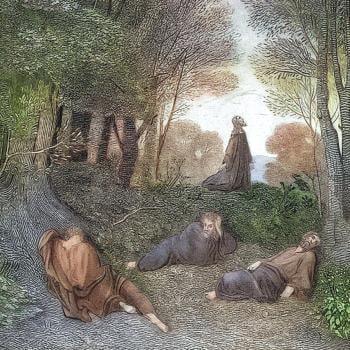
Did Jesus Fear God's Wrath in Gethsemane?

Why Is There An Altar In Heaven?

Why Exodus 23:19b May Be the "Linchpin" of...

Are the Dead in Christ Alive or Dead?
TRENDING AT PATHEOS General Christian

Seventy and Five Years Old: God Still Starts...
There is a small detail tucked into Genesis 12 that I skipped...

A Biblical Vision of Success in Christian Life...
The Concern and Quest Recent trends and tendencies I note around me...

Indigenous Peoples’ Day and the Church
Indigenous' Peoples Day or Columbus Day? Depending on where you live...

When Spiritual Growth Looks Like Losing Ground
Four Passive Spiritual Disciplines: An Introduction When I was a college freshman,...

Faith and Finding Your Current Season
“To everything there is a season,” Ecclesiastes tells us, “and a time...

Did Jesus Fear God's Wrath in Gethsemane?
That Time Jesus Was Terrified Before we begin, let me say at...
view all General Christian blogs
Ad-Free & Subscriber Log-In Subscription Support
- About Us
- 2026 Calendar
- Videos
- Podcasts
- Library of World Religions
- Faith In Media Tracker
- Advertise With Us
- Write for Us
- Privacy Policy
- Terms of Service
- Do Not Sell My Data
- Contact Us
- Radiant Digital
- Manage Newsletter Subscriptions
- Unsubscribe From Notifications
- Sitemap
Copyright 2008-2026, Patheos. All rights reserved.
Subscription Support Ad-Free & Subscriber Log-In
Follow Patheos