
BuddhistCatholicContemplativeEvangelicalGeneral ChristianHinduJewishLatter-day SaintMuslimNew VisionsProgressive Christian
Beliefs
- Buddhist
- Catholic
- Contemplative
- Evangelical
- General Christian
- Hindu
- Jewish
- Latter-day Saint
- More Voices
- Muslim
- New Visions
- Pagan
- Progressive Christian
Topics
- Religion News
- Food and Religion
- Sports and Religion
- Religious Art
- Religious Music and Entertainment
- Religious Events
- History and Religion
- Style and Religion
- Politics and Religion
- Women in Religion
- Recreation Outdoors and Religion
- Business Finance and Religion
- Careers Workplace and Religion
- Education and Religion
- Family Parenting and Religion
- Health Fitness and Religion
- Home and Religion
- Relationships and Religion
- Technology and Religion
- Travel and Religion
Columnists
- Buddhist Columnists
- Business Finance and Religion Columnists
- Careers Workplace and Religion Columnists
- Catholic Columnists
- Contemplative Columnists
- Education and Religion Columnists
- Evangelists Columnists
- Family Parenting and Religion Columnists
- General Christian Columnists
- Health Fitness and Religion Columnists
- Hindu Columnists
- History and Religion Columnists
- Home and Religion Columnists
- Jewish Columnists
- More Voices Columnists
- Latter Day Columnists
- Muslim Columnists
- New Visions Columnists
- Nonreligious Columnists
- Pagan Columnists
- Politics and Religion Columnists
- Progressive Columnists
- Recreation Outdoors and Religion Columnists
- Relationships and Religion Columnists
- Religion News Columnists
- Religious Art Columnists
- Religious Events Columnists
- Religious Music and Entertainment Columnists
- Sports and Religion Columnists
- Style and Religion Columnists
- Technology and Religion Columnists
- Travel and Religion Columnists
- Women in Religion Columnists
Resource Library
- 2026 Calendar
- Library of World Religions
- The 100 Most Holy Places on Earth
- Patheos Answers
- Podcasts
- Videos
- Faith Leaders Database
- Anglican Episcopalian
- Bahai
- Baptist
- Buddhism
- Christianity
- Confucianism
- Eastern Orthodoxy
- Hinduism
- Holiness and Pentecostal
- ISKCON
- Islam
- Judaism
- Lutheran
- Methodist
- The Church of Jesus Christ of Latter-day Saints
- New Age
- Paganism
- Presbytarian and Reformed
- Protestantism
- Religion Behind the Scenes
- Roman Catholic
- Scientology
- Shia Islam
- Sikhism
- Sufism
- Sunni Islam
- Taoism
- Zen
- See all religions
Research Tools
 Ad-Free & Subscriber Log-In Subscription Support
Ad-Free & Subscriber Log-In Subscription Support
Follow Patheos 

- Trending:
- Forgiveness
- |
- Marriage
- |
- Consciousness
- |
- Death Penalty
- |
- Election
- |
- Halloween

- Home
- Evangelical
- Technology and Religion
- Is AI Controlling Us, or Are We Truly Free?
Is AI Controlling Us, or Are We Truly Free?
Last updated on: August 27, 2024 at 3:56 am by Mike Langford
Is AI Controlling Us, or Are We Truly Free? 2024-08-27T03:56:47+00:00 Mike Langford
Patheos Explore the world's faith through different perspectives on religion and spirituality! Patheos has the views of the prevalent religions and spiritualities of the world.
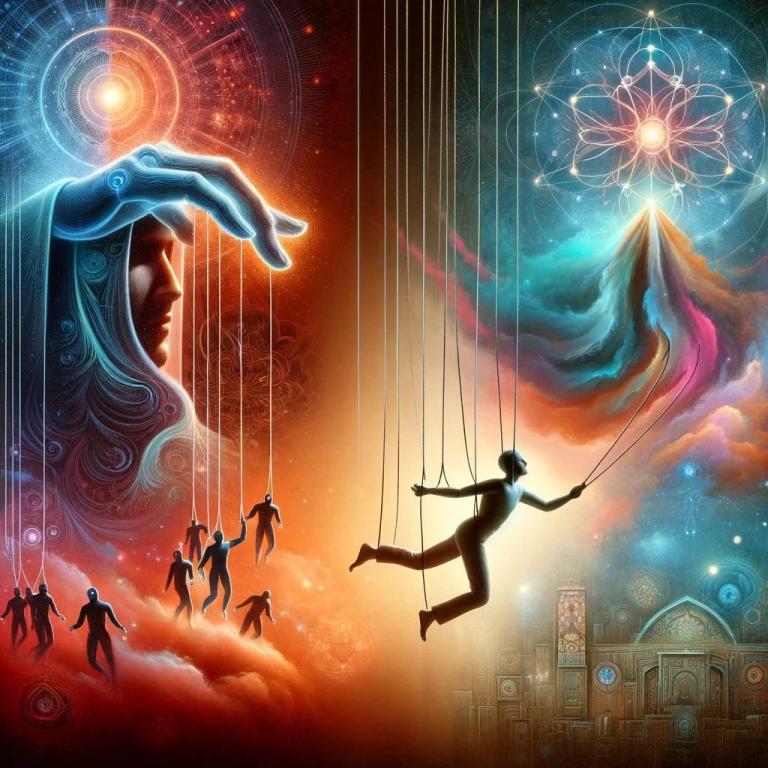
How much does AI already influence in our lifes? Image created with DallE for Patheos.
The Freedom of AI
We often find ourselves concerned with the degree to which AI determines our lives in ways that we see and, perhaps more importantly, in ways that we do not. When there are financial motivations, some parties certainly use AI to bend our behavior in ways that are beneficial to the bottom line. Others use AI to direct our behavior in other ways, perhaps to sway our votes or to attract our attention. But AI also determines our behavior in ways that we do not understand, and perhaps never will.
There is always a complex interplay between our actions and those things that shape our actions. To create some exaggerations for the purpose of discussion, let’s look at the two extremes.
Freedom to choose?
On the one hand, let’s say that our actions are 100% determined by external factors. That would mean you have no freedom to choose anything, but rather choices are made for you upstream. You become a puppet or a cog in a machine. You may think you are making choices, but, in reality, you are not.
On the other hand, let’s say that our actions are 100% determined by you. This would mean that you can perceive the factors that impinge upon you, decide the extent to which they influence you, and then make a choice. You are the master of your own destiny.
Of course, most of us lie somewhere between these two extremes. We believe that there are forces that influence us (we may disagree on how strongly they influence us) but that we also make choices, even in the wake of these influences (we may disagree on how freely we make those choices). The extent to which we think we our behavior is influenced has vast implications in terms of moral culpability, legal restitution, our relationship with external actors, etc.
Determinism vs. Free Will
This is the age-old argument of determinism vs. free will. I won’t get into the philosophical debate – which has yet to be decided, by the way. But I do want to re-frame the question theologically in a way that will perhaps help us to think about our relationship with AI in a different way.
The determinism vs. free will argument in the theological realm is sometimes referred to as the problem of divine will and human freedom. To what extent is God the cause of action vs. us? Christians tend to believe that God has some sort of ultimate authority. If we believe that God is sovereign and God’s will is done, to what extent do we have a say in the matter? Of course, our real-world experience – and, indeed, the structure of our society – is shaped around the idea that we are the ones calling the shots. But this often puts Christians in the uncomfortable position of saying that God does not do what God wills. We have free will, Christians may say, and we can do whatever we want, even if that means frustrating the will of a sovereign and loving God. Especially in this country at this epoch of history, we see God as one who puts choices out on a buffet table, and we are able to choose the options that we want. But we better choose right, or else God will be mad.
Theologically, it is a paradox. We do believe that God is sovereign and has ultimate authority, and we do believe that we are responsible for our own action. Let me suggest three theological ideas that will help here. The first is the Law. The second is the Kingdom of God. And the third is Christology.
The Law
First, the Law. For many of us, when we think of laws, we think of something that hinders our choice. We’d like to be able to do whatever we want, but we have to say within the boundaries of the law if we don’t want to pay a fine or go to jail. In that way, laws play a role in determining our actions. So some would say that laws limit our freedom. But the Jewish people had a different understanding of the law. For the Jews, the religious law, or “Law,” as formalized in the Ten Commandments, was not something that limited their freedom but allowed it. The Jews would say that by living according to the Law, we are freed to be most human. It is when everyone is doing what is right in their own eyes that we are in bondage. But when we live according to the boundaries set out for us by God, we are able to live maximally, abundantly, and freely. And this Law is summed up by Jesus: love God with all that you are, and love your neighbor as yourself. It is living by this Law that maximizes our freedom. To live only for the self or for personal gain and agency is to live a life that is narrowed and enslaved.
The Kingdom of God
Second, the Kingdom of God. The Kingdom of God is Jesus’s favorite thing to talk about. He talks about it more than any other topic. But the words “Kingdom of God” are not always helpful because the Kingdom of God is not a place. The Kingdom of God does not refer to a realm we go to when we die, and it does not refer to a political entity in which all people are of a certain sort. Instead, the Kingdom of God refers to a state of being. The Kingdom of God occurs. It happens. The Kingdom of God occurs when the will of God is done. When the love of God and neighbor happens. In fact, a better translation of the biblical words for “Kingdom of God” is the “Reign of God.” The Kingdom of God or the Reign of God occurs when things happen according to God’s Reign, or God’s Kingship. If we open our eyes and hearts, we can see that God’s Reign occurs all the time, whenever the Holy Spirit actualizes the truth, beauty, and goodness of God. Of course, it is not hard to see when we look around us that the Kingdom of God also does not happen.
So it seems obvious that God is not always determining things exactly according to God’s will, or else there would be no sin. But Christians believe that God is in the business of making God’s liberation will happen, and that one day the Kingdom of God will occur for all people and for all time.
Christology
Third, Christology. One way to solve the theological problem of divine will and human freedom is through what is called “deism.” Deism believes that there is an all-powerful God, but that God chooses to not involve himself in human affairs. We have a cosmos we’ve been given, and perhaps a moral code, but that’s it. We’re on our own. I would argue that many Christians in this part of the world live as functional deists. But the Christian God is not a deistic God. The Christian God is a relational God that involves himself in the happenings of this world. We see that in the person and work of the Holy Spirit who breathes the will of God around us, and we see that in the person and work of Jesus Christ. If Jesus is the incarnated presence of the will of God, how does that will intersect with human freedom? Did Jesus determine the actions of those around him? Very infrequently Jesus would act unilaterally in people’s lives, but, most often, Jesus would live the life that God calls humans to live, injecting grace into the ecosystem, and that grace then goes out into the world by the power of the Spirit, calling to us and shaping us. But this is more of a cooperative thing than a determinative thing. Jesus, even as he obeys and incarnates the will of God, allowing his own action to be determined by God’s Law, implores us to do the same. Jesus is not coercive, but he is no wallflower, either. Jesus enacts God’s will, which is powerful. So powerful that it puts into bondage those things that will keep us from God. In the Resurrection, we see that all that which militates against the Law, against the Kingdom, is itself put to death, so that the only thing that lives is the will of God.
Thus we see that while we may have freedom, ultimately it is God who will have the last word. Our freedom is real, but it lies within the freedom of God, who wants to protect and ensure our true freedom, not some facsimile of bondage.
Freedom and AI
What does any of this have to do with AI? Only this. Rather than ask ourselves the extent to which AI determines our lives or the extent to which our free will is impinged, which is a popular question in cultures that prize autonomous choice, perhaps we should be asking how we might live in the world according to the Law, how we might see and live according to the Reign of God, and how we might answer the call of Jesus in finding true freedom. When we live with God, with each other, with the earth, and with AI in the Law of perfect love, we cooperate with the Reign of God. Perhaps Christians will be at the forefront of discerning how AI might help us live more freely.
General Christian

About Mike Langford
Mike Langford is Professor of Theology, Discipleship, and Ministry at Seattle Pacific University and Seattle Pacific Seminary. He is co-editor of "AI, Faith, and the Future: An Interdisciplinary Approach." You can read more about the author here.
Previous Post

December 15, 2023
AI at Christmastime
Browse Our Archives
Select a Category Uncategorized
Select a Month August 2024 December 2023 September 2023 November 2022 June 2022 March 2022 February 2022 September 2021 August 2021 July 2021 March 2021 February 2021 January 2021 November 2020 October 2020 September 2020 July 2020 June 2020 May 2020 April 2020 March 2020 February 2020 December 2019 November 2019 October 2019 September 2019 August 2019 July 2019 June 2019 May 2019 April 2019 March 2019 February 2019 January 2019 December 2018 November 2018 October 2018 September 2018 August 2018 July 2018 June 2018 May 2018 April 2018 March 2018 February 2018 January 2018
Follow Us!
TAKE THE
Religious Wisdom Quiz
Who said, "Speak, Lord, for your servant is listening"?
Select your answer to see how you score.
Solomon Samuel Eli David
Related posts from Digital Wisdom


AI, Faith, the Future, and the Apocalyptic Imagination
Lecture on AI and the Apocalyptic Imagination
TRENDING AT PATHEOS Evangelical

The REST of Your Life: A Creative Wrestles...
This week I had a conversation with a good friend from church....

How the author of the world's best hymn...
I've been working with John Newton for a while now. This makes...

Long before this Lectio Divina, Psalm 130 - the song - started...

What About the Trees? Another Living Parable
After I finished writing the last article about falling leaves as a...

Why Classical Education Is a Conversation, Not a...
Come and Read: Joy in Classical Education When I was a little...

Cornell University has received a great deal of negative publicity and intense...
view all Evangelical blogs
Ad-Free & Subscriber Log-In Subscription Support
- About Us
- 2026 Calendar
- Videos
- Podcasts
- Library of World Religions
- Faith In Media Tracker
- Advertise With Us
- Write for Us
- Privacy Policy
- Terms of Service
- Do Not Sell My Data
- Contact Us
- Radiant Digital
- Manage Newsletter Subscriptions
- Unsubscribe From Notifications
- Sitemap
Copyright 2008-2026, Patheos. All rights reserved.
Subscription Support Ad-Free & Subscriber Log-In
Follow Patheos