
BuddhistCatholicContemplativeEvangelicalGeneral ChristianHinduJewishLatter-day SaintMuslimNew VisionsProgressive Christian
Beliefs
- Buddhist
- Catholic
- Contemplative
- Evangelical
- General Christian
- Hindu
- Jewish
- Latter-day Saint
- More Voices
- Muslim
- New Visions
- Pagan
- Progressive Christian
Topics
- Religion News
- Food and Religion
- Sports and Religion
- Religious Art
- Religious Music and Entertainment
- Religious Events
- History and Religion
- Style and Religion
- Politics and Religion
- Women in Religion
- Recreation Outdoors and Religion
- Business Finance and Religion
- Careers Workplace and Religion
- Education and Religion
- Family Parenting and Religion
- Health Fitness and Religion
- Home and Religion
- Relationships and Religion
- Technology and Religion
- Travel and Religion
Columnists
- Buddhist Columnists
- Business Finance and Religion Columnists
- Careers Workplace and Religion Columnists
- Catholic Columnists
- Contemplative Columnists
- Education and Religion Columnists
- Evangelists Columnists
- Family Parenting and Religion Columnists
- General Christian Columnists
- Health Fitness and Religion Columnists
- Hindu Columnists
- History and Religion Columnists
- Home and Religion Columnists
- Jewish Columnists
- More Voices Columnists
- Latter Day Columnists
- Muslim Columnists
- New Visions Columnists
- Nonreligious Columnists
- Pagan Columnists
- Politics and Religion Columnists
- Progressive Columnists
- Recreation Outdoors and Religion Columnists
- Relationships and Religion Columnists
- Religion News Columnists
- Religious Art Columnists
- Religious Events Columnists
- Religious Music and Entertainment Columnists
- Sports and Religion Columnists
- Style and Religion Columnists
- Technology and Religion Columnists
- Travel and Religion Columnists
- Women in Religion Columnists
Resource Library
- 2026 Calendar
- Library of World Religions
- The 100 Most Holy Places on Earth
- Patheos Answers
- Podcasts
- Videos
- Faith Leaders Database
- Anglican Episcopalian
- Bahai
- Baptist
- Buddhism
- Christianity
- Confucianism
- Eastern Orthodoxy
- Hinduism
- Holiness and Pentecostal
- ISKCON
- Islam
- Judaism
- Lutheran
- Methodist
- The Church of Jesus Christ of Latter-day Saints
- New Age
- Paganism
- Presbytarian and Reformed
- Protestantism
- Religion Behind the Scenes
- Roman Catholic
- Scientology
- Shia Islam
- Sikhism
- Sufism
- Sunni Islam
- Taoism
- Zen
- See all religions
Research Tools
 Ad-Free & Subscriber Log-In Subscription Support
Ad-Free & Subscriber Log-In Subscription Support
Follow Patheos 

- Trending:
- Forgiveness
- |
- Marriage
- |
- Consciousness
- |
- Death Penalty
- |
- Election
- |
- Halloween

- Home
- Evangelical
- Technology and Religion
- AI and Religion in 2041
AI and Religion in 2041
Last updated on: December 15, 2023 at 7:52 pm by Michael Paulus
AI and Religion in 2041 2023-12-15T19:52:49+00:00 Michael Paulus
Patheos Explore the world's faith through different perspectives on religion and spirituality! Patheos has the views of the prevalent religions and spiritualities of the world.
Next week, at the American Academy of Religion’s Artificial Intelligence and Religion Seminar, I’m leading a roundtable discussion on AI 2041: Ten Visions for Our Future (Currency, 2021). Below are my introductory comments for the session.
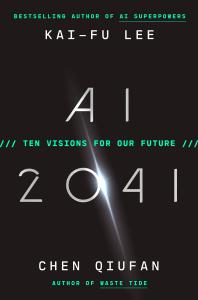
In AI 2041: Ten Visions for Our Future, scientific forecasting and speculative fiction are brought together to imagine the near future of AI. The science fiction writer Chen Qiufan tells ten stories about AI in 2041, which were developed in collaboration with Kai-Fu Lee, an AI expert and entrepreneur, who provides a commentary on each. Overall, these stories explore key AI technologies around the globe—in India, Nigeria, South Korea, China, Japan, Sri Lanka, Germany, the United States, Qatar, and Australia—and highlight major social issues associated with AI in diverse cultural contexts.
Kai-Fu Lee says his intent is to “tell the ‘real’ AI story, in a way that is candid and balanced, but also constructive and hopeful.” He focuses on real and realistic AI, technologies that already exist or can be expected within the next twenty years. Lee’s projected expectations for AI became a map for Chen’s speculative stories of impact, to which Lee adds technological analyses of what each story reveals. Situating himself in a tradition of technological speculation extending back toFrankenstein, Chen points to the continuing challenge for science fiction writers, which he describes as “creating stories that not only reveal hidden truths about our present-day reality, but also, simultaneously, project even wilder imaginative possibilities.” In addition to providing distance for critical reflection, Chen says that, “By imagining the future through science fiction, we may step in, make change, and actively play a role in shaping our reality.”[1]
Lee and Chen share the goal of imagining a desirable future, where the benefits of AI can result in more meaningful and fulfilling lives. They focus on how AI can be good for individuals and society—as well as the challenges that need to be overcome. Lee concludes that AI in 2041 “will open the door to a radiant future for humanity”: “AI will create unbelievable wealth, amplify our capabilities through human-AI symbiosis, improve how we work, play, and communicate, liberate us from routine tasks, and … usher in an age of plentitude.” At the same time, he acknowledges, “AI will bring about myriad challenges and perils: AI biases, security risks, deepfakes, privacy infringements, autonomous weapons, and job displacements.” These challenges are created by humans, Lee points out, and in AI 2041 they are confronted with “human creativity, resourcefulness, tenacity, wisdom, courage, compassion, and love.” In each story, he claims, “our sense of justice, our capacity to learn, our audacity to dream, and our faith in human agency always saved the day.” Lee concludes: “We will not be passive spectators in the story of AI—we are the authors.” And in the future we will author with AI, Lee and Chen imagine we will live comfortable and secure lives, pursue love and self-actualization, and see fear, vanity, and greed decrease. More fundamentally, Lee says, we will “explore what makes us human and what our destiny should be.”[2]
In spite of the clear faith in human agency that runs through AI 2041, religious language, images, practices, and beliefs are conspicuous. This is not surprising, given the spiritual revelation Lee records in his previous book from 2018: AI Superpowers: China, Silicon Valley, and the New World Order. After receiving a severe cancer diagnosis, Lee visited a Buddhist monastery in the south of Taiwan where a monk asked him about his goal in life. Lee answered, “To maximize my impact and change the world.” But he was not very satisfied with his answer. Lee confessed, “This algorithmic way of thinking wasn’t just ‘suboptimal’ at allocating time. It was robing me of my own humanity.” “Seeing my ultimate end point threw my life into sharp focus,” Lee writes, and he began to see that the world “didn’t boil down to inputs, outputs, and optimizations.” He did not want to become an “automaton.” At the end of Superpowers, Lee eloquently pleads for a shared future that synthesizes “AI’s ability to think … coupled with human beings’ ability to love.”[3] Around the same time, Chen began interviewing and shadowing shamans, “in hopes of understanding the rites, rituals, and traditions of China’s Buddhist and Taoist past.” Chen, too, believes much has been lost in our accelerated technological culture—“our relationship to our bodies, to nature, to our roots, to our faiths—and he had set out in search of them.”[4] And so, in AI 2041, Lee and Chen include glimpses of what religion might look like in a world transformed by AI.
[1]Kai-Fu Lee and Chen Qiufan. AI 2041: Ten Visions for Our Future(New York: Currency, 2021), xv, xx–xi. [2]Lee and Chen, AI 2041, 437–38. [3]Kai-Fu Lee, AI Superpowers: China, Silicon Valley, and the New World Order(Boston, MA: Mariner, 2018), 185, 187–88, 190, 193, 196. [4]Yi-Ling Liu, “Sci-Fi Writer or Prophet? The Hyperreal Life of Chen Qiufan,” Wired, March 8, 2021, https://www.wired.com/story/science-fiction-writer-china-chen-qiufan/.
Previous Post

June 23, 2022
AI, Faith, the Future, and the Apocalyptic Imagination
Next Post

September 23, 2023 ChatGPT and Education
Browse Our Archives
Select a Category Uncategorized
Select a Month August 2024 December 2023 September 2023 November 2022 June 2022 March 2022 February 2022 September 2021 August 2021 July 2021 March 2021 February 2021 January 2021 November 2020 October 2020 September 2020 July 2020 June 2020 May 2020 April 2020 March 2020 February 2020 December 2019 November 2019 October 2019 September 2019 August 2019 July 2019 June 2019 May 2019 April 2019 March 2019 February 2019 January 2019 December 2018 November 2018 October 2018 September 2018 August 2018 July 2018 June 2018 May 2018 April 2018 March 2018 February 2018 January 2018
Follow Us!
TAKE THE
Religious Wisdom Quiz
Which prophet saw a vision of a flying scroll?
Select your answer to see how you score.
Jeremiah Ezekiel Zechariah Daniel
Related posts from Digital Wisdom
AI, Faith, the Future, and the Apocalyptic Imagination

Lecture on AI and the Apocalyptic Imagination
TRENDING AT PATHEOS Evangelical

The REST of Your Life: A Creative Wrestles...
This week I had a conversation with a good friend from church....

How the author of the world's best hymn...
I've been working with John Newton for a while now. This makes...

Long before this Lectio Divina, Psalm 130 - the song - started...

What About the Trees? Another Living Parable
After I finished writing the last article about falling leaves as a...

Why Classical Education Is a Conversation, Not a...
Come and Read: Joy in Classical Education When I was a little...

Cornell University has received a great deal of negative publicity and intense...
view all Evangelical blogs
Ad-Free & Subscriber Log-In Subscription Support
- About Us
- 2026 Calendar
- Videos
- Podcasts
- Library of World Religions
- Faith In Media Tracker
- Advertise With Us
- Write for Us
- Privacy Policy
- Terms of Service
- Do Not Sell My Data
- Contact Us
- Radiant Digital
- Manage Newsletter Subscriptions
- Unsubscribe From Notifications
- Sitemap
Copyright 2008-2026, Patheos. All rights reserved.
Subscription Support Ad-Free & Subscriber Log-In
Follow Patheos