
BuddhistCatholicContemplativeEvangelicalGeneral ChristianHinduJewishLatter-day SaintMuslimNew VisionsProgressive Christian
Beliefs
- Buddhist
- Catholic
- Contemplative
- Evangelical
- General Christian
- Hindu
- Jewish
- Latter-day Saint
- More Voices
- Muslim
- New Visions
- Pagan
- Progressive Christian
Topics
- Religion News
- Food and Religion
- Sports and Religion
- Religious Art
- Religious Music and Entertainment
- Religious Events
- History and Religion
- Style and Religion
- Politics and Religion
- Women in Religion
- Recreation Outdoors and Religion
- Business Finance and Religion
- Careers Workplace and Religion
- Education and Religion
- Family Parenting and Religion
- Health Fitness and Religion
- Home and Religion
- Relationships and Religion
- Technology and Religion
- Travel and Religion
Columnists
- Buddhist Columnists
- Business Finance and Religion Columnists
- Careers Workplace and Religion Columnists
- Catholic Columnists
- Contemplative Columnists
- Education and Religion Columnists
- Evangelists Columnists
- Family Parenting and Religion Columnists
- General Christian Columnists
- Health Fitness and Religion Columnists
- Hindu Columnists
- History and Religion Columnists
- Home and Religion Columnists
- Jewish Columnists
- More Voices Columnists
- Latter Day Columnists
- Muslim Columnists
- New Visions Columnists
- Nonreligious Columnists
- Pagan Columnists
- Politics and Religion Columnists
- Progressive Columnists
- Recreation Outdoors and Religion Columnists
- Relationships and Religion Columnists
- Religion News Columnists
- Religious Art Columnists
- Religious Events Columnists
- Religious Music and Entertainment Columnists
- Sports and Religion Columnists
- Style and Religion Columnists
- Technology and Religion Columnists
- Travel and Religion Columnists
- Women in Religion Columnists
Resource Library
- 2026 Calendar
- Library of World Religions
- The 100 Most Holy Places on Earth
- Patheos Answers
- Podcasts
- Videos
- Faith Leaders Database
- Anglican Episcopalian
- Bahai
- Baptist
- Buddhism
- Christianity
- Confucianism
- Eastern Orthodoxy
- Hinduism
- Holiness and Pentecostal
- ISKCON
- Islam
- Judaism
- Lutheran
- Methodist
- The Church of Jesus Christ of Latter-day Saints
- New Age
- Paganism
- Presbytarian and Reformed
- Protestantism
- Religion Behind the Scenes
- Roman Catholic
- Scientology
- Shia Islam
- Sikhism
- Sufism
- Sunni Islam
- Taoism
- Zen
- See all religions
Research Tools
 Ad-Free & Subscriber Log-In Subscription Support
Ad-Free & Subscriber Log-In Subscription Support
Follow Patheos 

- Trending:
- Forgiveness
- |
- Marriage
- |
- Consciousness
- |
- Death Penalty
- |
- Election
- |
- Halloween

- Home
- Evangelical
- Technology and Religion
- Technology after the Pandemic
Technology after the Pandemic
Last updated on: March 26, 2021 at 11:06 pm by Michael Paulus
Technology after the Pandemic 2021-03-26T23:06:02+00:00 Michael Paulus
Patheos Explore the world's faith through different perspectives on religion and spirituality! Patheos has the views of the prevalent religions and spiritualities of the world.
In my last post, I referred to a recent report from the Pew Research Center on expectations about life after the pandemic. The responses captured in the report, gathered during the summer of 2020, are mixed about whether life in 2025 will be mostly worse (47%), better (39%), or about the same (14%). Identifying troubling as well as promising trends, the report points to a “broad and nearly universal view … that people’s relationship with technology will deepen.”
Before the pandemic, especially within the last ten years due to advances in AI, there was broad awareness of the need to critique and integrate digital technologies into our lives and institutions more intentionally. Luciano Floridi’s fourth information revolution and Klaus Schwab’s fourth industrial revolution emphasize the philosophical and practical needs for both digital ethics and digital transformation. The pandemic has accelerated the adoption of digital technologies, from “tele-everything” to automation, and it has revealed opportunities as well as challenges—including the technological dimensions of larger social concerns.
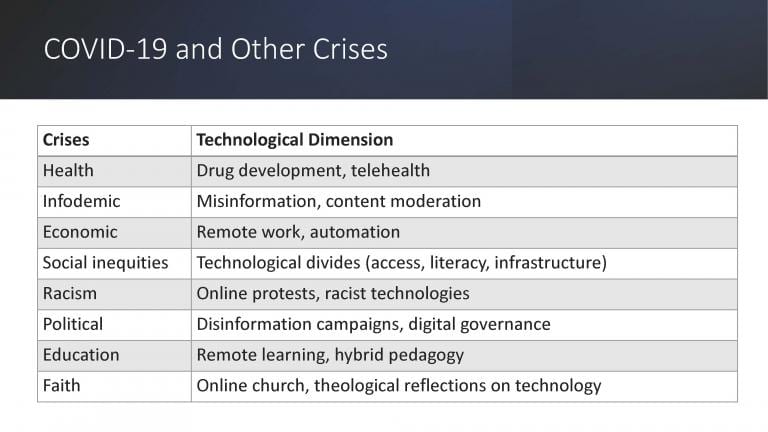
Crises discussed in my Digital Futures class (autumn 2020)
During the pandemic all of us have become much more aware of how online and offline experiences are different but also integrated. In virtual events our sense of place is extended, and sometimes dislocated, but those virtual connections can enrich our local situations—especially when they are connected with ongoing relationships that cross modalities. Most of us, after a year of mostly digitally mediated experiences, are eager for a new balance. As we seek this balance—or, better, integration—it is important we do not return to a simplistic view of online/digital versus offline/physical dualisms.
Digital transformation should be more about digital augmentation than amputation. Over the last year, we have seen new forms of engagement in virtual classrooms, workplaces, and churches. Some of these have not been as fulfilling as their pre-virtual forms, but others were or were simply new possibilities. As we discern how best to avail ourselves of the affordances of different modalities, the more constructive courses of action will focus on how we can collapse the dualities of online/digital and offline/physical modes of experience. How can we integrate digital practices and platforms into our embodied lives wisely? How can we bring pre-digital wisdom into our digitally enhanced lives?
There is a line of technological criticism that sees technology—especially technology created over the last few hundred years—as an ultimately corrupt and inhuman force. Jacques Ellul and Neil Postman, who are among the most prominent critics in this line, speak of technology in terms of a curse, something that is “not part of God’s plan.”
Albert Borgmann, another important critic of modern technology, claims that our pre-industrial condition “calls forth a life of engagement that is oriented within the physical and social world” whereas modern technological culture “induces a life of distraction that is isolated from the environment and from other people.” For 300 hundred years, he claims, “modern technology has been dissolving traditional structures and indulging our weaknesses” (Power Failure, 33, 112). Borgmann’s solution is a call to return to simpler focal things and practices, such as sharing a meal or playing the piano.
As helpful as Borgmann’s criticisms may be, a more constructive line of critique is needed for our technological moment. A return to older forms of technology (tables, pianos, etc.) is not sufficient: while we may retain these, we also need to create new substantial things and practices that include digital technologies. We need to seek and practice wisdom that includes the digital.
I am not bold enough to predict whether or not most people will be better off in 2025; there is still so much suffering and loss to lament, and the pandemic is not over. But there are emerging technological trends that point to a better post-pandemic reality—if we proactively engage with them.
This week the Stanford Institute for Human-Centered Artificial Intelligence (HAI) hosted a conference on intelligence augmentation, which explored ways AI can augment healthcare, art, and education. Given the rapid and widespread adoption and acceptance of healthcare technologies during the pandemic, there seem to be many areas for further digital transformation. In Art, and in our socially disrupted moment, AI presents an opportunity to reconceptualize values associated with creative works as well as introduce alternative narratives about technology. And, following new insights from the science of learning and recent educational experiments, we can develop innovative ways for AI to improve education.
Technological skeptics can help us understand dilemmas and dangers associated with technological change—what we may lose, what we risk, and how we will be changed—but the pandemic has pressed us to graduate from their schools, to pay attention to what has been happening, and to begin creating better technological futures.
Previous Post

February 22, 2021
The Relational Turn in Digital Ethics
Next Post
July 19, 2021 Our Information Apocalypse
Browse Our Archives
Select a Category Uncategorized
Select a Month August 2024 December 2023 September 2023 November 2022 June 2022 March 2022 February 2022 September 2021 August 2021 July 2021 March 2021 February 2021 January 2021 November 2020 October 2020 September 2020 July 2020 June 2020 May 2020 April 2020 March 2020 February 2020 December 2019 November 2019 October 2019 September 2019 August 2019 July 2019 June 2019 May 2019 April 2019 March 2019 February 2019 January 2019 December 2018 November 2018 October 2018 September 2018 August 2018 July 2018 June 2018 May 2018 April 2018 March 2018 February 2018 January 2018
Follow Us!
TAKE THE
Religious Wisdom Quiz
Which Psalm expresses confession: "Against you, you only, have I sinned"?
Select your answer to see how you score.
Psalm 73 Psalm 100 Psalm 24 Psalm 51
Related posts from Digital Wisdom


AI, Faith, the Future, and the Apocalyptic Imagination
Lecture on AI and the Apocalyptic Imagination
TRENDING AT PATHEOS Evangelical

The REST of Your Life: A Creative Wrestles...
This week I had a conversation with a good friend from church....

How the author of the world's best hymn...
I've been working with John Newton for a while now. This makes...

Long before this Lectio Divina, Psalm 130 - the song - started...

What About the Trees? Another Living Parable
After I finished writing the last article about falling leaves as a...

Why Classical Education Is a Conversation, Not a...
Come and Read: Joy in Classical Education When I was a little...

Cornell University has received a great deal of negative publicity and intense...
view all Evangelical blogs
Ad-Free & Subscriber Log-In Subscription Support
- About Us
- 2026 Calendar
- Videos
- Podcasts
- Library of World Religions
- Faith In Media Tracker
- Advertise With Us
- Write for Us
- Privacy Policy
- Terms of Service
- Do Not Sell My Data
- Contact Us
- Radiant Digital
- Manage Newsletter Subscriptions
- Unsubscribe From Notifications
- Sitemap
Copyright 2008-2026, Patheos. All rights reserved.
Subscription Support Ad-Free & Subscriber Log-In
Follow Patheos