
BuddhistCatholicContemplativeEvangelicalGeneral ChristianHinduJewishLatter-day SaintMuslimNew VisionsProgressive Christian
Beliefs
- Buddhist
- Catholic
- Contemplative
- Evangelical
- General Christian
- Hindu
- Jewish
- Latter-day Saint
- More Voices
- Muslim
- New Visions
- Pagan
- Progressive Christian
Topics
- Religion News
- Food and Religion
- Sports and Religion
- Religious Art
- Religious Music and Entertainment
- Religious Events
- History and Religion
- Style and Religion
- Politics and Religion
- Women in Religion
- Recreation Outdoors and Religion
- Business Finance and Religion
- Careers Workplace and Religion
- Education and Religion
- Family Parenting and Religion
- Health Fitness and Religion
- Home and Religion
- Relationships and Religion
- Technology and Religion
- Travel and Religion
Columnists
- Buddhist Columnists
- Business Finance and Religion Columnists
- Careers Workplace and Religion Columnists
- Catholic Columnists
- Contemplative Columnists
- Education and Religion Columnists
- Evangelists Columnists
- Family Parenting and Religion Columnists
- General Christian Columnists
- Health Fitness and Religion Columnists
- Hindu Columnists
- History and Religion Columnists
- Home and Religion Columnists
- Jewish Columnists
- More Voices Columnists
- Latter Day Columnists
- Muslim Columnists
- New Visions Columnists
- Nonreligious Columnists
- Pagan Columnists
- Politics and Religion Columnists
- Progressive Columnists
- Recreation Outdoors and Religion Columnists
- Relationships and Religion Columnists
- Religion News Columnists
- Religious Art Columnists
- Religious Events Columnists
- Religious Music and Entertainment Columnists
- Sports and Religion Columnists
- Style and Religion Columnists
- Technology and Religion Columnists
- Travel and Religion Columnists
- Women in Religion Columnists
Resource Library
- 2026 Calendar
- Library of World Religions
- The 100 Most Holy Places on Earth
- Patheos Answers
- Podcasts
- Videos
- Faith Leaders Database
- Anglican Episcopalian
- Bahai
- Baptist
- Buddhism
- Christianity
- Confucianism
- Eastern Orthodoxy
- Hinduism
- Holiness and Pentecostal
- ISKCON
- Islam
- Judaism
- Lutheran
- Methodist
- The Church of Jesus Christ of Latter-day Saints
- New Age
- Paganism
- Presbytarian and Reformed
- Protestantism
- Religion Behind the Scenes
- Roman Catholic
- Scientology
- Shia Islam
- Sikhism
- Sufism
- Sunni Islam
- Taoism
- Zen
- See all religions
Research Tools
 Ad-Free & Subscriber Log-In Subscription Support
Ad-Free & Subscriber Log-In Subscription Support
Follow Patheos 

- Trending:
- Forgiveness
- |
- Marriage
- |
- Consciousness
- |
- Death Penalty
- |
- Election
- |
- Halloween

- Home
- Evangelical
- Technology and Religion
- The Relational Turn in Digital Ethics
The Relational Turn in Digital Ethics
Last updated on: February 22, 2021 at 9:20 pm by Michael Paulus
The Relational Turn in Digital Ethics 2021-02-22T21:20:42+00:00 Michael Paulus
Patheos Explore the world's faith through different perspectives on religion and spirituality! Patheos has the views of the prevalent religions and spiritualities of the world.
The Pew Research Center recently published a report of what experts think the “new normal” will be in 2025. The unsurprising “broad and nearly universal view is that people’s relationship with technology will deepen as larger segments of the population come to rely more on digital connections for work, education, health care, daily commercial transactions and essential social interactions.” Of those who responded to Pew’s survey, 47% said life will be mostly worse for most people in 2025 than it was before the pandemic; 39% said life would be mostly better for most people.
Major concerns about life in a “tele-everything world” include economic and social inequalities, the asymmetrical power of technology corporations, and the proliferation of misinformation. More specifically, privacy and surveillance concerns are emphasized throughout the report. Digital transformation, accelerated by the pandemic, requires an upgraded ethical orientation to life and the world as well as new rights and laws. One new approach—which is also an ancient approach—in digital ethics and law involves a turn or return toward a focus on relationships.
According to Luciano Floridi, digital ethics (which include computer, information, and data ethics) are “the ethics that we need to develop for our future well-being.” Digital ethics also represent a relational shift in focus for reflecting on the digital dimension of our lives and the digital transformation of our world: “Classical ethics focuses on the agent of an action while modern ethics focuses on the recipient of that action. Digital ethics, instead, focuses on the relationship between the two entities.”
This approach can also be seen in legal scholarship. In a “A Relational Turn for Data Protection?,” Neil Richards and Woodrow Hartzog address the foundational issue of data privacy, which “is about civil rights, free expression, freedom from harassment, collective autonomy interests, and how personal information is leveraged to erode our attention spans, our mental wellbeing, and our public institutions.” They argue that our current focus on informational self-determination, concerned with the collection and use of data, is insufficient: “The goal of data protection law should be to promote trust in the digital environment … [which] requires us to focus directly on power imbalances in relationships rather than indirectly through data rules. It’s time for data protection’s relational turn.”
In addition to ethics and law focusing more on people and their relationships, this relational turn can help us understand how we ourselves are connected with data and digital technologies. In Data Selves, Deborah Lupton describes how people and their data and digital technologies exist in an entangled relationship. Similar to Donna Haraway’s concept of the cyborg—as a blurring of boundaries between a person’s body and the people, places, and technologies one encounters—Lupton speaks of “human-data assemblages.” “Personal data are both private and public … owned by, and part of, the people who have generated them,” she observes; “personal data challenge the ontological boundaries between the binary oppositions of Self/Other, nature/culture, human/nonhuman, and living/dead.” Digital transformation is not just about the creation and use of new technologies: it is about how digital technologies are transforming our relationships with ourselves, others, and everything surrounding us.
Charles Taylor’s concept of porous and buffered selves is helpful here. The buffered self has been characteristic of self-understanding in the modern Western world: “we live with a much firmer sense of the boundary between self and other.” These boundaries change how we understand our relationships with ourselves, other beings and objects, and our environment: “Modern Westerners have a clear boundary between mind and world, even mind and body … the buffered self can form the ambition of disengaging from whatever is beyond the boundary, and of giving its own autonomous order to its life.” A pre-modern, porous sensibility was open to an altogether different experience of reality: “the boundary between agents and forces is fuzzy … the boundary between mind and world is porous.” Digital transformation helps highlight the illusion of the buffered self.
The relational turn recovers ancient understandings about our nature and role in the universe, seeing humans constituted by and flourishing through right relationships. This includes our relationship with technology, as the story of the Tower of Babel reveals.
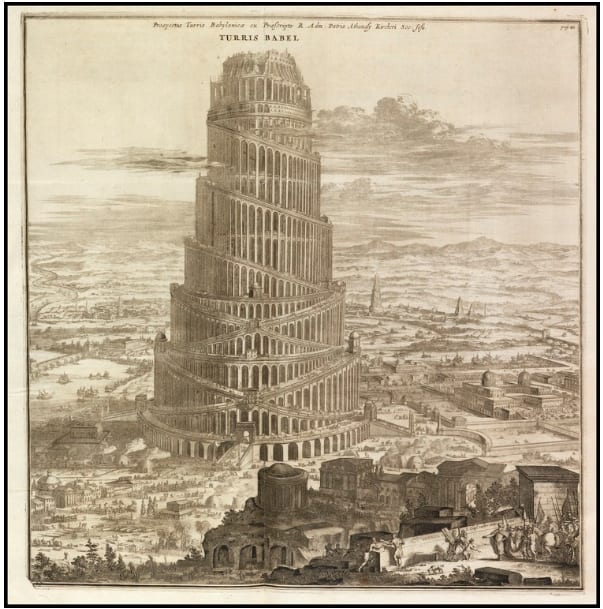
Engraving of the Tower of Babel from Athanasius Kircher’s Turris Babel (1679)
Many see in God’s interruption of the building of the city and tower of Babel a rebuke against technological progress. Jacques Ellul did: He saw the meaning of the city—an image of the technological society—as an impulse and order against God. But in the biblical narrative that runs through Revelation, the last human city (Babylon) is not simply annihilated but rather amplified in the city of God (New Jerusalem). If the technological society can be redeemed and transformed, it can be more productive to focuses on proper relationships in Babel rather than on the proper use of technology.
The first eleven chapters of Genesis trace a trajectory of alienation—from God, creation, others, and even human creations. The story of Babel appears at the climax of this narrative: God’s intervention results in absolute alienation, as people turn away from God, each other, and their artificial creation. After Babel comes God’s covenantal relationship with Abraham and his family, the law to order right relationships with God and others, and the promise that God will establish right relationships for and with all things. All beliefs and behaviors are oriented toward the realization of that promise.
At the end of Revelation and the Christian biblical narrative is the image of New Jerusalem. This city, from God and filled with the glory of God and humans, is the center of new creation. It is an image of perfect and peaceful relationships between all beings and things. Divine, natural, and artificial agency—all forms of creation—flourish together in this ultimate paradisical city.
The large-scale digitization of data, and the complex processing of it by automated and intelligent systems, has elevated the centrality and importance of data and digital technologies in our lives and world. Moreover, we are using these technologies to change our reality radically and they are changing how we think about everything.
As we think about ethics in the context of digital transformation—of what is right and how we socially and technologically realize that rightness—it is helpful to recall that we have ancient frameworks for thinking about proper relationships between ourselves and others. This ancient wisdom can help us discern how we may shape and live into a desirable future.
Previous Post

January 29, 2021
Technological Epiphanies
Next Post
March 26, 2021 Technology after the Pandemic
Browse Our Archives
Select a Category Uncategorized
Select a Month August 2024 December 2023 September 2023 November 2022 June 2022 March 2022 February 2022 September 2021 August 2021 July 2021 March 2021 February 2021 January 2021 November 2020 October 2020 September 2020 July 2020 June 2020 May 2020 April 2020 March 2020 February 2020 December 2019 November 2019 October 2019 September 2019 August 2019 July 2019 June 2019 May 2019 April 2019 March 2019 February 2019 January 2019 December 2018 November 2018 October 2018 September 2018 August 2018 July 2018 June 2018 May 2018 April 2018 March 2018 February 2018 January 2018
Follow Us!
TAKE THE
Religious Wisdom Quiz
By questioning Moses' authority this person became leperous?
Select your answer to see how you score.
Ithamar Miriam Aaron Caleb
Related posts from Digital Wisdom

The Digital Turn and Our Post-Digital Future


The Digital Dimension of Our Lives

TRENDING AT PATHEOS Evangelical

How the author of the world's best hymn...
I've been working with John Newton for a while now. This makes...

Long before this Lectio Divina, Psalm 130 - the song - started...

What About the Trees? Another Living Parable
After I finished writing the last article about falling leaves as a...

Why Classical Education Is a Conversation, Not a...
Come and Read: Joy in Classical Education When I was a little...

Falling Leaves: A Living Parable on Letting Go
I’ve spent the vast majority of my life in the southeast corner...

Cornell University has received a great deal of negative publicity and intense...
view all Evangelical blogs
Ad-Free & Subscriber Log-In Subscription Support
- About Us
- 2026 Calendar
- Videos
- Podcasts
- Library of World Religions
- Faith In Media Tracker
- Advertise With Us
- Write for Us
- Privacy Policy
- Terms of Service
- Do Not Sell My Data
- Contact Us
- Radiant Digital
- Manage Newsletter Subscriptions
- Unsubscribe From Notifications
- Sitemap
Copyright 2008-2026, Patheos. All rights reserved.
Subscription Support Ad-Free & Subscriber Log-In
Follow Patheos