
BuddhistCatholicContemplativeEvangelicalGeneral ChristianHinduJewishLatter-day SaintMuslimNew VisionsProgressive Christian
Beliefs
- Buddhist
- Catholic
- Contemplative
- Evangelical
- General Christian
- Hindu
- Jewish
- Latter-day Saint
- More Voices
- Muslim
- New Visions
- Pagan
- Progressive Christian
Topics
- Religion News
- Food and Religion
- Sports and Religion
- Religious Art
- Religious Music and Entertainment
- Religious Events
- History and Religion
- Style and Religion
- Politics and Religion
- Women in Religion
- Recreation Outdoors and Religion
- Business Finance and Religion
- Careers Workplace and Religion
- Education and Religion
- Family Parenting and Religion
- Health Fitness and Religion
- Home and Religion
- Relationships and Religion
- Technology and Religion
- Travel and Religion
Columnists
- Buddhist Columnists
- Business Finance and Religion Columnists
- Careers Workplace and Religion Columnists
- Catholic Columnists
- Contemplative Columnists
- Education and Religion Columnists
- Evangelists Columnists
- Family Parenting and Religion Columnists
- General Christian Columnists
- Health Fitness and Religion Columnists
- Hindu Columnists
- History and Religion Columnists
- Home and Religion Columnists
- Jewish Columnists
- More Voices Columnists
- Latter Day Columnists
- Muslim Columnists
- New Visions Columnists
- Nonreligious Columnists
- Pagan Columnists
- Politics and Religion Columnists
- Progressive Columnists
- Recreation Outdoors and Religion Columnists
- Relationships and Religion Columnists
- Religion News Columnists
- Religious Art Columnists
- Religious Events Columnists
- Religious Music and Entertainment Columnists
- Sports and Religion Columnists
- Style and Religion Columnists
- Technology and Religion Columnists
- Travel and Religion Columnists
- Women in Religion Columnists
Resource Library
- 2026 Calendar
- Library of World Religions
- The 100 Most Holy Places on Earth
- Patheos Answers
- Podcasts
- Videos
- Faith Leaders Database
- Anglican Episcopalian
- Bahai
- Baptist
- Buddhism
- Christianity
- Confucianism
- Eastern Orthodoxy
- Hinduism
- Holiness and Pentecostal
- ISKCON
- Islam
- Judaism
- Lutheran
- Methodist
- The Church of Jesus Christ of Latter-day Saints
- New Age
- Paganism
- Presbytarian and Reformed
- Protestantism
- Religion Behind the Scenes
- Roman Catholic
- Scientology
- Shia Islam
- Sikhism
- Sufism
- Sunni Islam
- Taoism
- Zen
- See all religions
Research Tools
 Ad-Free & Subscriber Log-In Subscription Support
Ad-Free & Subscriber Log-In Subscription Support
Follow Patheos 

- Trending:
- Forgiveness
- |
- Marriage
- |
- Consciousness
- |
- Death Penalty
- |
- Election
- |
- Halloween

- Home
- Evangelical
- Technology and Religion
- Technological Epiphanies
Technological Epiphanies
Last updated on: January 29, 2021 at 8:50 pm by Michael Paulus
Technological Epiphanies 2021-01-29T20:50:06+00:00 Michael Paulus
Patheos Explore the world's faith through different perspectives on religion and spirituality! Patheos has the views of the prevalent religions and spiritualities of the world.
What a month in the US—an insurrection, another impeachment, an inauguration, and an investment crisis. And all of this following a year that will be remembered for a deadly pandemic, protests for racial justice, and deep political division.
New technologies are at the center of our current disruptions: focusing but also manipulating our attention; providing critical information along with conflicting unintentional misinformation and intentional disinformation and malinformation; empowering both constructive and destructive actions. Our largely polluted and unrestrained information and technological environment has turned a pandemic into an infodemic, given online information wars boots on the ground, and created competing interpretations of reality that physically isolate us from each other (which COVID protocols have exacerbated).
The technological and social disruptions we are facing have a long history. Automated information processing technologies have been changing our lives for decades. The industrial revolution—from steam to electricity and computers—has been restructuring our world for a few hundred years. And centuries of colonization have redistributed wealth and populations violently and inequitably, causing great harm to Black, Indigenous, and other people subjected to trafficking, displacement, and other forms of systemic abuse.
I believe in progress, but I acknowledge that progress generally (and technological progress specifically) is uneven and is used to justify flawed and often evil narratives about the future. One person’s utopia is another person’s dystopia. So I find hope in diverse and alternative narratives from Afrofuturism and Indigenous futures, as well as in the ancient Jewish apocalyptic imagination and early Christian literature inspired by it. In Jewish and Christian biblical texts such as Daniel and Revelation, the apocalyptic imagination is a theological interpretation of reality that opens up deeper dimensions of knowledge, space, time, and agency to reveal narratives about a new and better world.
The early Jewish and Christian apocalyptic imagination is historically and theologically distant from the deformed apocalyptic imagination that was on display at the US Capitol earlier this month. If the book of Revelation, for example, has anything to say about the present reality of the US, a careful reader may find judgments against the imperialistic city of Babylon most relevant. One may look for manifestations of “a city on a hill,” too, but Amanda Gorman’s inaugural poem constructively orients us to “The Hill We Climb.” If we desire to be light in the world, Revelation calls us to turn against the anti-city of Babylon and toward the ultimate city of New Jerusalem. This is a movement of lament, hope, and action. We can use our technologies to participate in the deformation or transformation our cities.
The city itself is one of the most significant technological innovations of our species. It emerged millennia ago—in Asia and Europe, in Africa and in both Americas—and it is certain to figure prominently in the globally networked societies of our shared future. From the beginning, cities have both solved and created problems. They provided security, economies of scale, new opportunities for specialization, and cultural goods. They also created new social hierarchies and inequalities, food insecurity and disease, and more impersonal relationships. And they permanently altered physical environments. A truly apocalyptic assessment of past and present urban dynamics can help us imagine social and technological improvements that can reform and transform our present and future societies.
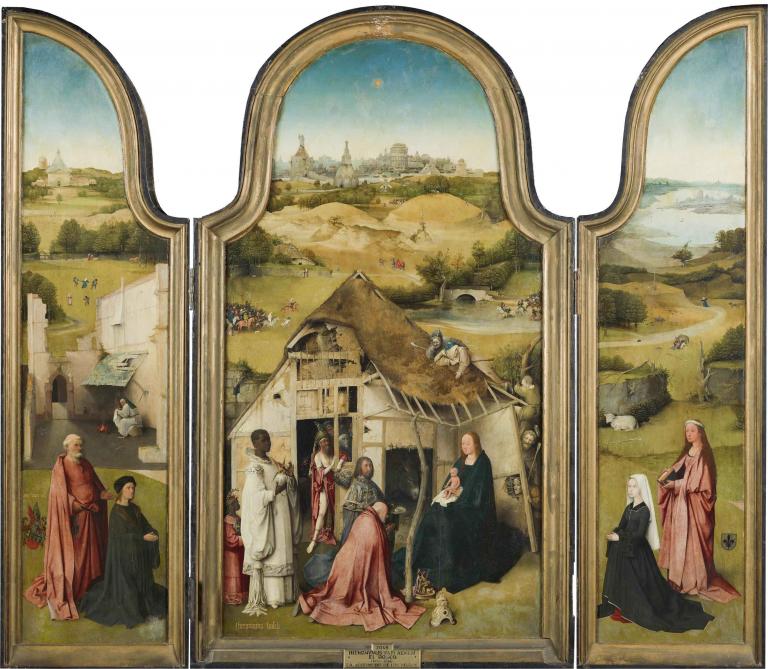
Hieronymus Bosch, The Epiphany (circa 1500)
This last year has revealed much about our technological society. The Capitol was stormed on Epiphany, a day celebrating the revelation of the light, hope, and love of Christ to non-Jewish scientists and technologists and, by extension, all nations. What was revealed on Epiphany this year was more of an anti-Epiphany—a darker set of epiphanies or apocalypses about our unique moment and place in time.
In the key biblical text for Epiphany, Matthew 2:1-12, magi—“wise men” skilled in exploring and applying scientific as well as religious knowledge—arrive in Jerusalem seeking the King of the Jews. King Herod, adding to their knowledge, directs them to another city where they find Jesus and honor him. Then, after receiving a revelation through a dream to not return to Herod, they return to their own country by another way—“no longer at ease [t]here, in the old dispensation,” as T. S. Eliot put it.
The Sunday before Epiphany, my pastor Doug Kelly at Bethany Presbyterian Church in Seattle preached a sermon on this text focusing on the last part of verse 12: “they returned to their own country by another way.” As we look forward to a post-pandemic future, Doug challenged us to think about how we will return to or resume our corporate and individual lives by another way.
The pandemic, which has deeply impacted every dimension of our lives, has revealed many good and terrible things. We must find a way forward that rejects the evils the pandemic has revealed further, such as systemic racism, social inequities, and digital inequities.
We must also find a way forward that leverages the good things we have learned during the pandemic, such as increased access to and improvement of digital content, communication, and communities. Further, as Luciano Floridi and Anna Nobre observe, “this is the first pandemic when a new habitat, the infosphere, has helped overcome the dangers of the biosphere. We have been living ‘onlife’ (both online and offline) for some time, but the pandemic has made the onlife experience a reality of no return.” The pandemic has accelerated the digital transformation of our lives and we have the opportunity to construct—intentionally, proactively, and collaboratively—our postdigital future.
Technology has been a significant force in our lives this last year, both good and bad. By paying attention to what is being revealed to us as well as our desired futures, we may, in the words of Ruha Benjamin, “imagine and craft the worlds [we] cannot live without, just as [we] dismantle the ones [we] cannot live within.”
Previous Post

November 17, 2020
Resources for Imagining the Post-Digital Church
Next Post
February 22, 2021 The Relational Turn in Digital Ethics
Browse Our Archives
Select a Category Uncategorized
Select a Month August 2024 December 2023 September 2023 November 2022 June 2022 March 2022 February 2022 September 2021 August 2021 July 2021 March 2021 February 2021 January 2021 November 2020 October 2020 September 2020 July 2020 June 2020 May 2020 April 2020 March 2020 February 2020 December 2019 November 2019 October 2019 September 2019 August 2019 July 2019 June 2019 May 2019 April 2019 March 2019 February 2019 January 2019 December 2018 November 2018 October 2018 September 2018 August 2018 July 2018 June 2018 May 2018 April 2018 March 2018 February 2018 January 2018
Follow Us!
TAKE THE
Religious Wisdom Quiz
Who follows the rider of the Pale Horse in Revelation?
Select your answer to see how you score.
The Four Winds Hades The Angel Gabriel The Saints
Related posts from Digital Wisdom
AI, Faith, the Future, and the Apocalyptic Imagination
Lecture on AI and the Apocalyptic Imagination

TRENDING AT PATHEOS Evangelical

The REST of Your Life: A Creative Wrestles...
This week I had a conversation with a good friend from church....

How the author of the world's best hymn...
I've been working with John Newton for a while now. This makes...

Long before this Lectio Divina, Psalm 130 - the song - started...

What About the Trees? Another Living Parable
After I finished writing the last article about falling leaves as a...

Why Classical Education Is a Conversation, Not a...
Come and Read: Joy in Classical Education When I was a little...

Cornell University has received a great deal of negative publicity and intense...
view all Evangelical blogs
Ad-Free & Subscriber Log-In Subscription Support
- About Us
- 2026 Calendar
- Videos
- Podcasts
- Library of World Religions
- Faith In Media Tracker
- Advertise With Us
- Write for Us
- Privacy Policy
- Terms of Service
- Do Not Sell My Data
- Contact Us
- Radiant Digital
- Manage Newsletter Subscriptions
- Unsubscribe From Notifications
- Sitemap
Copyright 2008-2026, Patheos. All rights reserved.
Subscription Support Ad-Free & Subscriber Log-In
Follow Patheos