
BuddhistCatholicContemplativeEvangelicalGeneral ChristianHinduJewishLatter-day SaintMuslimNew VisionsProgressive Christian
Beliefs
- Buddhist
- Catholic
- Contemplative
- Evangelical
- General Christian
- Hindu
- Jewish
- Latter-day Saint
- More Voices
- Muslim
- New Visions
- Pagan
- Progressive Christian
Topics
- Religion News
- Food and Religion
- Sports and Religion
- Religious Art
- Religious Music and Entertainment
- Religious Events
- History and Religion
- Style and Religion
- Politics and Religion
- Women in Religion
- Recreation Outdoors and Religion
- Business Finance and Religion
- Careers Workplace and Religion
- Education and Religion
- Family Parenting and Religion
- Health Fitness and Religion
- Home and Religion
- Relationships and Religion
- Technology and Religion
- Travel and Religion
Columnists
- Buddhist Columnists
- Business Finance and Religion Columnists
- Careers Workplace and Religion Columnists
- Catholic Columnists
- Contemplative Columnists
- Education and Religion Columnists
- Evangelists Columnists
- Family Parenting and Religion Columnists
- General Christian Columnists
- Health Fitness and Religion Columnists
- Hindu Columnists
- History and Religion Columnists
- Home and Religion Columnists
- Jewish Columnists
- More Voices Columnists
- Latter Day Columnists
- Muslim Columnists
- New Visions Columnists
- Nonreligious Columnists
- Pagan Columnists
- Politics and Religion Columnists
- Progressive Columnists
- Recreation Outdoors and Religion Columnists
- Relationships and Religion Columnists
- Religion News Columnists
- Religious Art Columnists
- Religious Events Columnists
- Religious Music and Entertainment Columnists
- Sports and Religion Columnists
- Style and Religion Columnists
- Technology and Religion Columnists
- Travel and Religion Columnists
- Women in Religion Columnists
Resource Library
- 2026 Calendar
- Library of World Religions
- The 100 Most Holy Places on Earth
- Patheos Answers
- Podcasts
- Videos
- Faith Leaders Database
- Anglican Episcopalian
- Bahai
- Baptist
- Buddhism
- Christianity
- Confucianism
- Eastern Orthodoxy
- Hinduism
- Holiness and Pentecostal
- ISKCON
- Islam
- Judaism
- Lutheran
- Methodist
- The Church of Jesus Christ of Latter-day Saints
- New Age
- Paganism
- Presbytarian and Reformed
- Protestantism
- Religion Behind the Scenes
- Roman Catholic
- Scientology
- Shia Islam
- Sikhism
- Sufism
- Sunni Islam
- Taoism
- Zen
- See all religions
Research Tools
 Ad-Free & Subscriber Log-In Subscription Support
Ad-Free & Subscriber Log-In Subscription Support
Follow Patheos 

- Trending:
- Forgiveness
- |
- Marriage
- |
- Consciousness
- |
- Death Penalty
- |
- Election
- |
- Halloween

- Home
- Evangelical
- Technology and Religion
- Digital Futures
Digital Futures
Last updated on: September 25, 2020 at 8:57 pm by Michael Paulus
Digital Futures 2020-09-25T20:57:53+00:00 Michael Paulus
Patheos Explore the world's faith through different perspectives on religion and spirituality! Patheos has the views of the prevalent religions and spiritualities of the world.
This quarter I am teaching an undergraduate class called Digital Futures. I developed my proposal for this course, based on my 9.5 working theses about technology, before the pandemic. At that time, I thought the presidential election would be the most relevant event for reflecting on the present and prospective impacts of emerging technologies. Everything that has happened in the last six months—the pandemic, the related infodemic, the accelerated digital transformation of our lives, and the social inequities and divides highlighted by these disruptions—have made the topic of this class overwhelmingly timely.
During the summer, many organizations shifted from planning for the next few months to planning for the coming year—and beyond. While many of us are still in survival mode, a number of significant changes are being made that will become permanent: the deployment of more digital tools (e.g., smart devices for tracking and surveillance), the development of more digital techniques (e.g., the automation of tasks and decisions), and the dawning of a broader recognition of the digital dimension of our reality (i.e., the blending or merging of our online and offline lives). This is not just a time for thinking about the future—it is a time to ask about the future we are creating.
For some time on this site, I have focused on the concept of eschatology—i.e., views of last or ultimate things—as a resource for thinking about technology and the future. This does not mean detailed prophecies about the future. Rather, I am exploring how views of ultimate goals or ends can open up our imagination to what is promised or possible, and then seeking what may be present now of these hoped-for ends.
A year ago, I wrote a post about Neal Stephenson’s latest novel Fall; Or, Dodge in Hell, which imagines a digitally-enabled afterlife. One of the features I highlighted in Fall is how the realization of the transhuman dream of digitally extending consciousness into “Bitworld” requires humans remaining in “Meatspace” to reimagine human futures. This leads to the establishment of an interdisciplinary research center, ONE: The Organization for New Eschatology. Theology is included among the disciplines; one of ONE’s leaders observes that it “can do duty as a cracked mirror or a smudged lens through which we might be able to glimpse things that are informative” (244).
Perhaps theology can contribute more—and we do not need to wait for imagined technological crises, such as simulated lives or artificial superintelligence, to find out. Previously, I shared Tom McLeish’s argument that theology opens up our imagination to something more than natural or human agency: it considers divine agency and ultimate ends (teloi). “Because theology observes and construes stories,” McLeish says, “it is able to discuss purposes and values—it can speak of, and ground, ‘teleology.’” Our theological narratives, McLeish concludes, can help us understand shared goals, common practices, and “shared experiences of creativity and constraints” (Faith and Wisdom in Science [Oxford, 2014], 214, 248).
Technological futurists have already appropriated images and categories from theological eschatologies, but theology has not yet contributed much constructively to imagining futures shaped by transformative digital technologies such as big data, cloud computing, and artificial intelligence. This is curious given the rich eschatological resources of theological traditions and texts, especially those shaped by the apocalyptic imagination. The book of Revelation, in particular, provides rich images—more poetic than prophetic—of two technological and eschatological cities, Babylon and New Jerusalem.
Babylon, the final human city, is destroyed for its imperial corruption. Its fall is celebrated, for its violent injustices are condemned and come to an end. But its fall is also lamented, for there were good practices and things in the city that have been lost. Cultural activities and artifacts that filled daily life—musicians playing instruments, artisans or artificers of every technical trade working with tools, millers grinding grain, and people lighting lamps and celebrating marriages—have been displaced (Rev 18:22f.). The good news is that we can imagine the greatest of these techniques and tools being carried into the divine city, New Jerusalem, after it descends from the new heaven. Technologies, it seems, will be condemned as works of counter-creation or glorified as works of new creation.
At the intersection of the fall of Babylon and the arrival of New Jerusalem, there is a generative space to imagine technologies of hope operative within initial creation and participating in new creation.
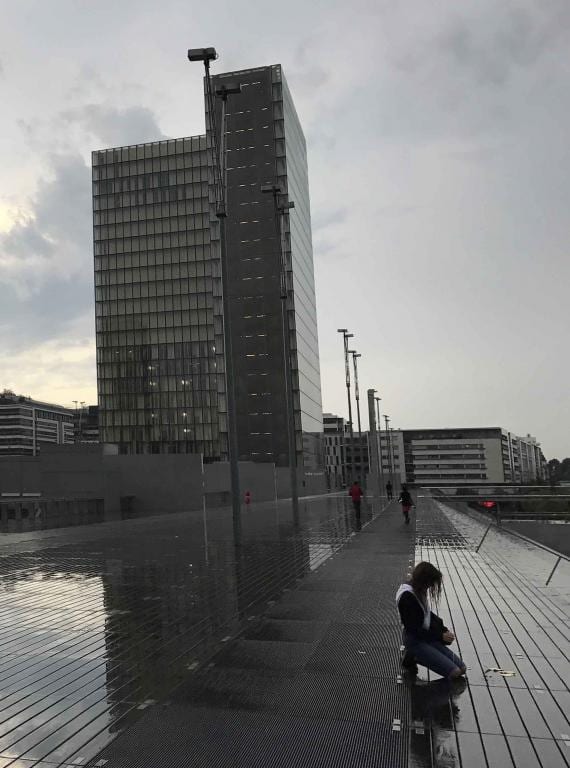
National Library of France (Paris, 2017)
To make that suggestion more concrete, consider the technology of the library. In Between the World and Me, Ta-Nehisi Coates critiques the American “Dream” as the creation of “an empire of humans … built on the destruction of the body.” In his quest for ultimate meaning beyond this version of the Babylonian nightmare, Coates discovers the power of the library to awaken and liberate sleepers from the Dream: “I was made for the library, not the classroom. The classroom was a jail of other people’s interests. The library was open, unending, free” (Spiegel & Grau [2015], 143, 48).
For Coates and many others, the library functions as an eschatological infrastructure enabling the revelation of ultimate meaning and ends. Through the human and technological practices of selection, collection, and mediation of knowledge, the library is oriented to future possibilities as well as past and present realities. Because it projects itself and those who use it into the future, the library can be an agent—and empower human agents—of transformation within and against the imperialistic deformations of the present world. Within Babylon, the library is a power greater than the city and a signpost of better futures that may be realized through the good artificial agents we are capable of creating.
Previous Post

July 15, 2020
Digital Transformation and Ministry
Next Post
October 23, 2020 The Digital Turn and Our Post-Digital Future
Browse Our Archives
Select a Category Uncategorized
Select a Month August 2024 December 2023 September 2023 November 2022 June 2022 March 2022 February 2022 September 2021 August 2021 July 2021 March 2021 February 2021 January 2021 November 2020 October 2020 September 2020 July 2020 June 2020 May 2020 April 2020 March 2020 February 2020 December 2019 November 2019 October 2019 September 2019 August 2019 July 2019 June 2019 May 2019 April 2019 March 2019 February 2019 January 2019 December 2018 November 2018 October 2018 September 2018 August 2018 July 2018 June 2018 May 2018 April 2018 March 2018 February 2018 January 2018
Follow Us!
TAKE THE
Religious Wisdom Quiz
Who was thrown into a den of lions for praying?
Select your answer to see how you score.
Andrew Peter Paul Daniel
Related posts from Digital Wisdom

AI, Faith, the Future, and the Apocalyptic Imagination
Lecture on AI and the Apocalyptic Imagination
TRENDING AT PATHEOS Evangelical

How the author of the world's best hymn...
I've been working with John Newton for a while now. This makes...

Long before this Lectio Divina, Psalm 130 - the song - started...

What About the Trees? Another Living Parable
After I finished writing the last article about falling leaves as a...

Why Classical Education Is a Conversation, Not a...
Come and Read: Joy in Classical Education When I was a little...

Falling Leaves: A Living Parable on Letting Go
I’ve spent the vast majority of my life in the southeast corner...

Cornell University has received a great deal of negative publicity and intense...
view all Evangelical blogs
Ad-Free & Subscriber Log-In Subscription Support
- About Us
- 2026 Calendar
- Videos
- Podcasts
- Library of World Religions
- Faith In Media Tracker
- Advertise With Us
- Write for Us
- Privacy Policy
- Terms of Service
- Do Not Sell My Data
- Contact Us
- Radiant Digital
- Manage Newsletter Subscriptions
- Unsubscribe From Notifications
- Sitemap
Copyright 2008-2026, Patheos. All rights reserved.
Subscription Support Ad-Free & Subscriber Log-In
Follow Patheos