
BuddhistCatholicContemplativeEvangelicalGeneral ChristianHinduJewishLatter-day SaintMuslimNew VisionsProgressive Christian
Beliefs
- Buddhist
- Catholic
- Contemplative
- Evangelical
- General Christian
- Hindu
- Jewish
- Latter-day Saint
- More Voices
- Muslim
- New Visions
- Pagan
- Progressive Christian
Topics
- Religion News
- Food and Religion
- Sports and Religion
- Religious Art
- Religious Music and Entertainment
- Religious Events
- History and Religion
- Style and Religion
- Politics and Religion
- Women in Religion
- Recreation Outdoors and Religion
- Business Finance and Religion
- Careers Workplace and Religion
- Education and Religion
- Family Parenting and Religion
- Health Fitness and Religion
- Home and Religion
- Relationships and Religion
- Technology and Religion
- Travel and Religion
Columnists
- Buddhist Columnists
- Business Finance and Religion Columnists
- Careers Workplace and Religion Columnists
- Catholic Columnists
- Contemplative Columnists
- Education and Religion Columnists
- Evangelists Columnists
- Family Parenting and Religion Columnists
- General Christian Columnists
- Health Fitness and Religion Columnists
- Hindu Columnists
- History and Religion Columnists
- Home and Religion Columnists
- Jewish Columnists
- More Voices Columnists
- Latter Day Columnists
- Muslim Columnists
- New Visions Columnists
- Nonreligious Columnists
- Pagan Columnists
- Politics and Religion Columnists
- Progressive Columnists
- Recreation Outdoors and Religion Columnists
- Relationships and Religion Columnists
- Religion News Columnists
- Religious Art Columnists
- Religious Events Columnists
- Religious Music and Entertainment Columnists
- Sports and Religion Columnists
- Style and Religion Columnists
- Technology and Religion Columnists
- Travel and Religion Columnists
- Women in Religion Columnists
Resource Library
- 2026 Calendar
- Library of World Religions
- The 100 Most Holy Places on Earth
- Patheos Answers
- Podcasts
- Videos
- Faith Leaders Database
- Anglican Episcopalian
- Bahai
- Baptist
- Buddhism
- Christianity
- Confucianism
- Eastern Orthodoxy
- Hinduism
- Holiness and Pentecostal
- ISKCON
- Islam
- Judaism
- Lutheran
- Methodist
- The Church of Jesus Christ of Latter-day Saints
- New Age
- Paganism
- Presbytarian and Reformed
- Protestantism
- Religion Behind the Scenes
- Roman Catholic
- Scientology
- Shia Islam
- Sikhism
- Sufism
- Sunni Islam
- Taoism
- Zen
- See all religions
Research Tools
 Ad-Free & Subscriber Log-In Subscription Support
Ad-Free & Subscriber Log-In Subscription Support
Follow Patheos 

- Trending:
- Forgiveness
- |
- Marriage
- |
- Consciousness
- |
- Death Penalty
- |
- Election
- |
- Halloween

- Home
- Evangelical
- Technology and Religion
- The End and Beginning of Work
The End and Beginning of Work
Last updated on: March 21, 2019 at 3:22 am by Michael Paulus
The End and Beginning of Work 2019-03-21T03:22:46+00:00 Michael Paulus
Patheos Explore the world's faith through different perspectives on religion and spirituality! Patheos has the views of the prevalent religions and spiritualities of the world.
With advances in automation and artificial intelligence, the future of work has become a significant area of interest and concern. In addition to important discussions about the future of various careers and income distribution, we have an opportunity to think about why we work.
Technological disruptions are not new to the workplace. But as more tasks become automated, it’s likely that some jobs will become obsolete, new jobs will be created, and most jobs will change. John Markoff describes this as a tension between artificial intelligence and intelligence augmentation: “Analysts look at the same Bureau of Labor Statistics data and simultaneously predict both the end of work and a new labor renaissance.” “Whether labor is vanquishing or being transformed,” Markoff concludes, “it’s clear that this new automation age is having a profound impact on society.”
The nature and details of this impact are unclear and open to speculation, which range from utopian to dystopian extremes. If you haven’t delved into this literature yet, you can save yourself some time by starting with Jill Lepore’s recent New Yorker essay, “Are Robots Competing for Your Jobs?,” and John Oliver’s recent commentary on automation.
Another good resource is Karel Čapek’s 1921 play R.U.R. (Rossum’s Universal Robots), in which the director of a robot production company has a dream “to transform all of humanity into a worldwide aristocracy. Unrestricted, free, and supreme people. Something ever greater than people.” One character critiques the director’s ideas for sounding “too much like paradise,” and pleads that “there was something good in the act of serving, something great in humility … there was some kind of virtue in work and fatigue.” The dream doesn’t work out: people cease being generative (literally), and then the robots rebel.
A future in which AI increasingly performs tasks previously done by humans requires educational and social support for new workers and workers in transition. As important as these issues are, we also should be asking more fundamental questions about the value and purpose of human work.
Dorothy L. Sayers challenged her generation during the Second World War to think about work not with a view toward compensation (“will it pay?”) but with a view toward value (“is it good?”). One does not work to live; one lives to work. Her answer to the question “why work?” is rooted in the doctrine of creation: humans are created to serve their Creator and others in work—work “is a medium of divine creation.” Sayers’s view of work can seem idealistic, even eschatological. Is the meaning of work found in our beginnings?
Yes, to an extent. In a previous post, I wrote about the technological prehistory of human work. Before we were human, we were technological—a species evolving with the help of tools and techniques. As humans, we have always been augmented by technology. One way to look at the future is as an extension of this evolutionary trajectory.
Miroslav Volf, alternatively, grounds work in the doctrine of new creation that leads “the present world of work toward promised and the hoped-for transformation.” Beginning with new creation means that a clearer meaning of work may be found—apocalyptically—in our end.
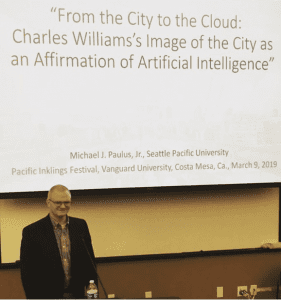
For Christians, the great image of the end is New Jerusalem. Brian Blount points out that this image of a “tangible, measurable, objective city” at the end of the Apocalypse “signals a salvific identity that is neither individualized nor spiritualized but concretized in the communal relationship that exists in an urban environment.” A follower of Christ, he concludes, “works with God to transform the world.”
Humans were, according to Sayers, created to work. According to Volf, we also were created to participate in new creation through our work. T. S. Eliot wrote that we may begin with the understanding that in our beginning is our end. But on the other side of that Friday we call good, we discover that in our end is our beginning.
About the above image: The author presenting on Charles Williams’s image of the city (contra Jacques Ellul’s), Williams’s theology of technological work, and AI (photo taken by Sørina Higgins, March 9, 2019). Presentation slides available here.
Previous Post

March 4, 2019
The Limits of Digital Ethics
Next Post
April 9, 2019 The Possibilities of AI Ethics
Browse Our Archives
Select a Category Uncategorized
Select a Month August 2024 December 2023 September 2023 November 2022 June 2022 March 2022 February 2022 September 2021 August 2021 July 2021 March 2021 February 2021 January 2021 November 2020 October 2020 September 2020 July 2020 June 2020 May 2020 April 2020 March 2020 February 2020 December 2019 November 2019 October 2019 September 2019 August 2019 July 2019 June 2019 May 2019 April 2019 March 2019 February 2019 January 2019 December 2018 November 2018 October 2018 September 2018 August 2018 July 2018 June 2018 May 2018 April 2018 March 2018 February 2018 January 2018
Follow Us!
TAKE THE
Religious Wisdom Quiz
What does "meek" mean in the Beatitudes?
Select your answer to see how you score.
Gentle and humble Angry and harsh Very rich Funny
Related posts from Digital Wisdom


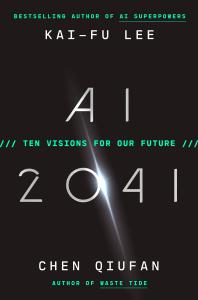
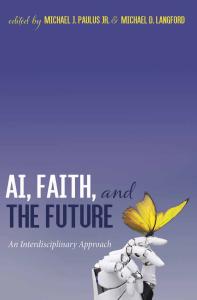
AI, Faith, the Future, and the Apocalyptic Imagination
TRENDING AT PATHEOS Evangelical

The REST of Your Life: A Creative Wrestles...
This week I had a conversation with a good friend from church....

How the author of the world's best hymn...
I've been working with John Newton for a while now. This makes...

Long before this Lectio Divina, Psalm 130 - the song - started...

What About the Trees? Another Living Parable
After I finished writing the last article about falling leaves as a...

Why Classical Education Is a Conversation, Not a...
Come and Read: Joy in Classical Education When I was a little...

Cornell University has received a great deal of negative publicity and intense...
view all Evangelical blogs
Ad-Free & Subscriber Log-In Subscription Support
- About Us
- 2026 Calendar
- Videos
- Podcasts
- Library of World Religions
- Faith In Media Tracker
- Advertise With Us
- Write for Us
- Privacy Policy
- Terms of Service
- Do Not Sell My Data
- Contact Us
- Radiant Digital
- Manage Newsletter Subscriptions
- Unsubscribe From Notifications
- Sitemap
Copyright 2008-2026, Patheos. All rights reserved.
Subscription Support Ad-Free & Subscriber Log-In
Follow Patheos