
BuddhistCatholicContemplativeEvangelicalGeneral ChristianHinduJewishLatter-day SaintMuslimNew VisionsProgressive Christian
Beliefs
- Buddhist
- Catholic
- Contemplative
- Evangelical
- General Christian
- Hindu
- Jewish
- Latter-day Saint
- More Voices
- Muslim
- New Visions
- Pagan
- Progressive Christian
Topics
- Religion News
- Food and Religion
- Sports and Religion
- Religious Art
- Religious Music and Entertainment
- Religious Events
- History and Religion
- Style and Religion
- Politics and Religion
- Women in Religion
- Recreation Outdoors and Religion
- Business Finance and Religion
- Careers Workplace and Religion
- Education and Religion
- Family Parenting and Religion
- Health Fitness and Religion
- Home and Religion
- Relationships and Religion
- Technology and Religion
- Travel and Religion
Columnists
- Buddhist Columnists
- Business Finance and Religion Columnists
- Careers Workplace and Religion Columnists
- Catholic Columnists
- Contemplative Columnists
- Education and Religion Columnists
- Evangelists Columnists
- Family Parenting and Religion Columnists
- General Christian Columnists
- Health Fitness and Religion Columnists
- Hindu Columnists
- History and Religion Columnists
- Home and Religion Columnists
- Jewish Columnists
- More Voices Columnists
- Latter Day Columnists
- Muslim Columnists
- New Visions Columnists
- Nonreligious Columnists
- Pagan Columnists
- Politics and Religion Columnists
- Progressive Columnists
- Recreation Outdoors and Religion Columnists
- Relationships and Religion Columnists
- Religion News Columnists
- Religious Art Columnists
- Religious Events Columnists
- Religious Music and Entertainment Columnists
- Sports and Religion Columnists
- Style and Religion Columnists
- Technology and Religion Columnists
- Travel and Religion Columnists
- Women in Religion Columnists
Resource Library
- 2026 Calendar
- Library of World Religions
- The 100 Most Holy Places on Earth
- Patheos Answers
- Podcasts
- Videos
- Faith Leaders Database
- Anglican Episcopalian
- Bahai
- Baptist
- Buddhism
- Christianity
- Confucianism
- Eastern Orthodoxy
- Hinduism
- Holiness and Pentecostal
- ISKCON
- Islam
- Judaism
- Lutheran
- Methodist
- The Church of Jesus Christ of Latter-day Saints
- New Age
- Paganism
- Presbytarian and Reformed
- Protestantism
- Religion Behind the Scenes
- Roman Catholic
- Scientology
- Shia Islam
- Sikhism
- Sufism
- Sunni Islam
- Taoism
- Zen
- See all religions
Research Tools
 Ad-Free & Subscriber Log-In Subscription Support
Ad-Free & Subscriber Log-In Subscription Support
Follow Patheos 

- Trending:
- Forgiveness
- |
- Marriage
- |
- Consciousness
- |
- Death Penalty
- |
- Election
- |
- Halloween

- Home
- Evangelical
- Technology and Religion
- Right Wrong and Artificial Intelligence
Right Wrong and Artificial Intelligence
Last updated on: March 1, 2018 at 11:18 pm by Bruce Baker
Right Wrong and Artificial Intelligence 2018-03-01T23:18:40+00:00 Bruce Baker
Patheos Explore the world's faith through different perspectives on religion and spirituality! Patheos has the views of the prevalent religions and spiritualities of the world.
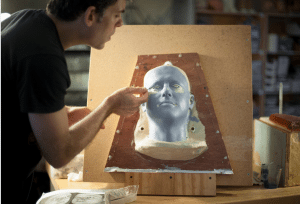
David Hanson making robot face. Credit: Brandon Thibodeaux, NYTimes.
There’s no such thing as artificial ethics.
“The information society is like a tree that has been growing its far-reaching branches much more widely, hastily, and chaotically than its conceptual, ethical, and cultural roots.”
—Luciano Floridi, Information: A Very Short Introduction (Oxford, 2010)
We can imagine the growth of artificial intelligence as a huge tree spreading outward in all directions. Its branches are bearing real fruit: AI is continually finding new ways to cut costs, save energy, cure diseases, drive cars, recognize faces, target shoppers, make money, and sway voters.
These applications represent the branches of the tree. But what about the roots of the tree?
Roots give a tree its food and strength. They keep the tree from falling over. In the case of AI, there is a risk of new technologies growing faster than the “conceptual, ethical, and cultural roots” necessary to sustain its healthy growth.
AI and internet communication technologies (ICTs) in general have become so much a part of daily life that they begin to shape culture and ideas.
Perhaps the biggest ethical risk that might arise from these technologies would come from any false presumptions about the capabilities of AI to make good ethical decisions. AI is capable of amazing feats. It can beat the world’s best professional Go player, for example. But there is a big difference between besting a human at the game of Go, and understanding the moral values that make us human in the first place.
As a start to understanding the moral issues associated with AI and ICTs, I would like to point out three “myths”, or misconceptions, that could influence attitudes in popular culture.
Myth #1: you can live two lives.
We spend more and more time online. We make friends online. We build relationships online. We share more and more bits of ourselves online. It almost seems like we can create a new self, a new identity, by carefully designing our online presence.
But no matter how sophisticated social networks and ICTs become, they do not create a new reality. There’s only one you. Human beings are flesh-and-blood, finite creatures. The challenge is to live an integrated life. This means being real with people, both online and in real life. Real persons have consciousness, free will, and moral agency. We cannot delegate these aspects of our humanity to bots or apps, no matter how much intelligent they become.
So what does this have to do with ethics? First, the pervasive influence of online relationships begins to influence our ideas about what makes a relationship meaningful. Online relational boundaries can be crossed or violated in ways that would never happen in real life. Facebook’s “emotional contagion” experiment, for example, treated people like nameless, faceless bit streams whose emotional states of mind were merely data open for manipulation. The researchers never would have treated people that way if they had been sitting at table together.
Second, the loss of identity in online relationships opens the door to fake news and manipulation. Bad behavior online breaks trust. It eats away at the moral fabric of society. That’s why it makes such an attractive target for bad actors.
Myth #2: organisms are algorithms.
This is a false conclusion of the mindset that places technology, and especially AI, at the apex of human evolution. No question, AI is a powerful force that can do much good. But if this force is treated as an ultimate good, in the absence of God or any transcendent purpose to life, it leads to nihilism, and despair of any meaningful existence.
Yuval Harari, in his best-selling book Homo Deus, argues in favor of this atheistic, ultra-materialism. He argues that technology will ultimately accomplish the goal of the human evolution, which is “to upgrade humans into gods, and turn Homo sapiens into Homo deus.”
The ethical failing here is to deny the existence of any transcendent values in concepts such as virtue, human dignity, and moral law. If AI is all there is, then at the end of the day, there is no such thing as ethics. There is only the relentless advance of technology. We do not have to look far back in history to see where that sort of thinking leads.
Sadly, in my opinion, this sort of thinking, expressed compellingly by Harari, becomes popular when revelatory faith statements are denied as sources of moral authority.
Myth #3: AI can become a source of moral authority.
To see the danger in this myth, we need to recognize the difference between intelligence and wisdom.
AI will get better and better at making smart decisions that employ ethical reasoning. Safety rules programmed into driverless cars are a good example. Our roads will become safer as a result. But this is not the same thing as generalized moral deliberation; it is mere quantitative utilitarianism.
Spiritual growth engages the intellect, but it also seeks to know in deeper ways and to grow in wisdom. This requires reflective, reasonable, responsible, and active belief. “Faith seeking understanding,” as St. Anselm put it.
Here’s a simple example. Write an algorithm for this, please:
For everything there is a season, and a time for every matter under heaven:
a time to be born, and a time to die;
a time to plant, and a time to pluck up what is planted;
a time to kill, and a time to heal;…
a time to embrace, and a time to refrain from embracing;
a time to keep silence, and a time to speak; …
a time to love, and a time to hate;
a time for war, and a time for peace.
That’s the ancient wisdom of Ecclesiastes 3. It’s not reducible to code. It requires a living, breathing, human soul. It’s a faith journey. Which is why you cannot write an algorithm for wisdom.
Wisdom begins with Awe-of-the-Lord.
The lie is to believe we can reduce ethics to code.
The truth is: no soul, no ethics.
In conclusion, we can take a big step in the right direction, toward digital wisdom, by spotting the myths and debunking them.
Previous Post

February 13, 2018
The Information Revelation
Next Post
February 28, 2018 The Robloxian Christians
Browse Our Archives
Select a Category Uncategorized
Select a Month August 2024 December 2023 September 2023 November 2022 June 2022 March 2022 February 2022 September 2021 August 2021 July 2021 March 2021 February 2021 January 2021 November 2020 October 2020 September 2020 July 2020 June 2020 May 2020 April 2020 March 2020 February 2020 December 2019 November 2019 October 2019 September 2019 August 2019 July 2019 June 2019 May 2019 April 2019 March 2019 February 2019 January 2019 December 2018 November 2018 October 2018 September 2018 August 2018 July 2018 June 2018 May 2018 April 2018 March 2018 February 2018 January 2018
Follow Us!
TAKE THE
Religious Wisdom Quiz
What does "Tabernacle" mean?
Select your answer to see how you score.
Sacrifice Dwelling place Holy altar Cupboard
Related posts from Digital Wisdom

Is AI Controlling Us, or Are We Truly...


TRENDING AT PATHEOS Evangelical

The REST of Your Life: A Creative Wrestles...
This week I had a conversation with a good friend from church....

How the author of the world's best hymn...
I've been working with John Newton for a while now. This makes...

Long before this Lectio Divina, Psalm 130 - the song - started...

What About the Trees? Another Living Parable
After I finished writing the last article about falling leaves as a...

Why Classical Education Is a Conversation, Not a...
Come and Read: Joy in Classical Education When I was a little...

Cornell University has received a great deal of negative publicity and intense...
view all Evangelical blogs
Ad-Free & Subscriber Log-In Subscription Support
- About Us
- 2026 Calendar
- Videos
- Podcasts
- Library of World Religions
- Faith In Media Tracker
- Advertise With Us
- Write for Us
- Privacy Policy
- Terms of Service
- Do Not Sell My Data
- Contact Us
- Radiant Digital
- Manage Newsletter Subscriptions
- Unsubscribe From Notifications
- Sitemap
Copyright 2008-2026, Patheos. All rights reserved.
Subscription Support Ad-Free & Subscriber Log-In
Follow Patheos