
BuddhistCatholicContemplativeEvangelicalGeneral ChristianHinduJewishLatter-day SaintMuslimNew VisionsProgressive Christian
Beliefs
- Buddhist
- Catholic
- Contemplative
- Evangelical
- General Christian
- Hindu
- Jewish
- Latter-day Saint
- More Voices
- Muslim
- New Visions
- Pagan
- Progressive Christian
Topics
- Religion News
- Food and Religion
- Sports and Religion
- Religious Art
- Religious Music and Entertainment
- Religious Events
- History and Religion
- Style and Religion
- Politics and Religion
- Women in Religion
- Recreation Outdoors and Religion
- Business Finance and Religion
- Careers Workplace and Religion
- Education and Religion
- Family Parenting and Religion
- Health Fitness and Religion
- Home and Religion
- Relationships and Religion
- Technology and Religion
- Travel and Religion
Columnists
- Buddhist Columnists
- Business Finance and Religion Columnists
- Careers Workplace and Religion Columnists
- Catholic Columnists
- Contemplative Columnists
- Education and Religion Columnists
- Evangelists Columnists
- Family Parenting and Religion Columnists
- General Christian Columnists
- Health Fitness and Religion Columnists
- Hindu Columnists
- History and Religion Columnists
- Home and Religion Columnists
- Jewish Columnists
- More Voices Columnists
- Latter Day Columnists
- Muslim Columnists
- New Visions Columnists
- Nonreligious Columnists
- Pagan Columnists
- Politics and Religion Columnists
- Progressive Columnists
- Recreation Outdoors and Religion Columnists
- Relationships and Religion Columnists
- Religion News Columnists
- Religious Art Columnists
- Religious Events Columnists
- Religious Music and Entertainment Columnists
- Sports and Religion Columnists
- Style and Religion Columnists
- Technology and Religion Columnists
- Travel and Religion Columnists
- Women in Religion Columnists
Resource Library
- 2026 Calendar
- Library of World Religions
- The 100 Most Holy Places on Earth
- Patheos Answers
- Podcasts
- Videos
- Faith Leaders Database
- Anglican Episcopalian
- Bahai
- Baptist
- Buddhism
- Christianity
- Confucianism
- Eastern Orthodoxy
- Hinduism
- Holiness and Pentecostal
- ISKCON
- Islam
- Judaism
- Lutheran
- Methodist
- The Church of Jesus Christ of Latter-day Saints
- New Age
- Paganism
- Presbytarian and Reformed
- Protestantism
- Religion Behind the Scenes
- Roman Catholic
- Scientology
- Shia Islam
- Sikhism
- Sufism
- Sunni Islam
- Taoism
- Zen
- See all religions
Research Tools
 Ad-Free & Subscriber Log-In Subscription Support
Ad-Free & Subscriber Log-In Subscription Support
Follow Patheos 

- Trending:
- Forgiveness
- |
- Marriage
- |
- Consciousness
- |
- Death Penalty
- |
- Election
- |
- Halloween
 Diary of a Wimpy Catholic
- Home
- Catholic
- Bursa Suicide Bombing and the Return of History
Bursa Suicide Bombing and the Return of History
Last updated on: April 29, 2016 at 11:16 pm by Max Lindenman
Bursa Suicide Bombing and the Return of History 2016-04-29T23:16:44-06:00 Max Lindenman
Patheos Explore the world's faith through different perspectives on religion and spirituality! Patheos has the views of the prevalent religions and spiritualities of the world.
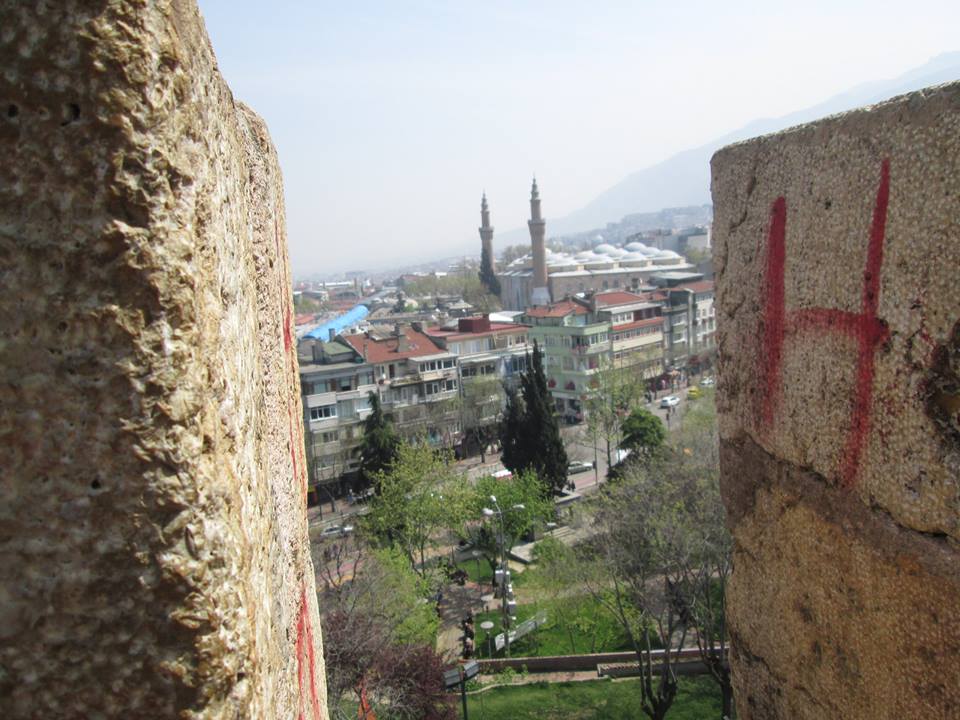
You can’t keep a dog in downtown Bursa. The people are too pious. Or maybe “traditional” is a better word. In either case, they believe dogs are unclean and the enemies of angels. A Colombian friend of mine who has a golden retriever – named “Athena,” after a pagan goddess and a Greek to boot – felt obliged to relocate before his neighbors were able to talk the police into writing him a ticket for violating some zoning law or other.
Bursa on the whole enjoys a reputation for piety – it is known as the City of Saints. Indeed, a stodginess, both comforting and soporific, blankets the entire city. It rests heaviest on the neighborhood known as Fomara, site of the Grand Mosque, a fortress-like structure completed in 1399, when cries of Christe eleison still echoed inside the Hagia Sophia. In its long shadow, you can find boutiques catering to the tastes of observant Muslim women, dealers in muqaddes kitaplar, or holy books, and travel agents who arrange pilgrimages to Mecca.
This is where the suicide bomber struck on Tuesday.
Actually, as suicide bombings go, it wasn’t much. Eight people wounded and some shop windows smashed seems to have been the extent of the damage – chump change compared to the three recent bloodbaths in Ankara, which claimed a total of more than 160 dead and 500 injured. Turkey’s Interior Ministry has detained 15 people for questioning and announced it believes the attack to have been the work of “a group,” but won’t say which one.
The usual suspects would include the Islamic State and the Kurdistan Freedom Falcons – factions that happen, at the moment, to be busily fighting each other in Syria and Iraq. Turkey stands accused of supporting ISIS as a foil to Kurdish militants, but if the accusations are correct, it’s been paid back with attacks on its own soil, including two in Sultanahmet, site of the Hagia Sophia and the Blue Mosque. There was nothing random about the choice. Islamic End Times prophecies foresee a clash between the forces of Islam and “the armies of Rome” taking place in Syria. Some ISIS adherents believe “Rome” refers to Istanbul, once capital of the Byzantine, or eastern Roman, Empire. By attacking its historic cultural and spiritual center, ISIS bombers were poking Rome where they hoped it would hurt most.
Nobody, at this point, can claim to know why a terrorist – a 25-year-old woman, according to Turkish sources – blew herself into carne asada in such a sleepy, straitlaced city as Bursa. But let the record reflect that Bursa served the Ottoman state as its first capital. Directly across the street from the Grand Mosque, atop a soaring promontory, rise the ancient stone walls of the Hisar, or citadel, invested by Osman Gazi, the bey from whom the state took its name. If you were to wander for a few minutes behind those walls, you would come across the tomb where Osman and his son, Orhan Gazi, along with their relatives, lie in felt-covered sarcophagi.
It seems not too farfetched to suppose that the bomber targeted that particular neighborhood because of its historical importance. To a Kurd, the Grand Mosque would represent the origins of Turkish hegemony. To an ISIS devotee, it would symbolize Rome before it became Rome. Either way, by shifting their attention to Bursa from Istanbul or Ankara, the group behind the bombings is marching backward in history. They are digging up dead actors and dragging them back onstage for a curtain call.
By now it’s well known that the “end of history,” first proclaimed by Francis Fukuyama, has been greatly exaggerated. Radical Islam continues to oppose liberal democracy — and so does Turkey’s less radical version. Earlier this week, Ismail Kahraman, a member of the country’s ruling Justice and Development party, called for the formal overthrow of laiklik, or secularism, in favor of an Islamic constitution. Though President Recep Tayyip Erdoğan has distanced himself from the proposal, his ambitions in the Arab world look to many observers like a revival of the Ottoman Empire. (Last year, when I raised the prospect with Akel Bitaji, Mayor of Amman, Jordan, he expressed as much joy as one might expect from the mayor of Athens or Belgrade.) Vladimir Putin’s presidency of Russia has taken on increasingly imperial trappings.
Meanwhile, closer to home, Jonathan Chait, among others, has remarked that the left has adopted ever more illiberal methods when it comes to promoting its radical egalitarian agenda. Last year, after a white supremacist murdered nine African-Americans in Charleston, citizens began demanding that monuments to the South’s antebellum past be removed from the public eye. The removals, which took place in a frenzy, struck Ian Tuttle as “anti-historical” and overtly ideological. Like the suicide bombers’ attacks on historic places, these assaults on history itself suggest that history is very much an ongoing game.
Previous Post

April 24, 2016
Amoris Laetitia and the Family Road Trip
Next Post
April 30, 2016 My First Orthodox Liturgy: A Blast for A Rainy Day
Browse Our Archives
Select a Category Uncategorized
Select a Month August 2016 July 2016 May 2016 April 2016 March 2016 January 2016 December 2015 November 2015 October 2015 September 2015 August 2015 July 2015 June 2015 May 2015 April 2015 February 2015 January 2015 July 2014 April 2014 February 2014 January 2014 December 2013 November 2013 October 2013 September 2013 August 2013 July 2013 May 2013 April 2013 March 2013 February 2013 January 2013 December 2012 November 2012 October 2012 September 2012 August 2012 July 2012 June 2012 May 2012 April 2012 March 2012 February 2012 January 2012 December 2011 November 2011 October 2011 September 2011 August 2011 July 2011 June 2011 May 2011
Follow Us!
TAKE THE
Religious Wisdom Quiz
What did Lamentations describe happening to Jerusalem?
Select your answer to see how you score.
Its blessing and expansion Its prosperity Its rebuilding Its destruction and mourning
Related posts from Diary of a Wimpy Catholic

An Open Letter to the Editor Who Fired...
Lessons from Erdoğan's Victory
Mamma Mia! Emergency Baptism at 30,000 Feet
My First Orthodox Liturgy: A Blast for A...
TRENDING AT PATHEOS Catholic

Rejecting Doom: Christian Hope And Human Action
Christianity is a religion of hope. We are to have hope and...

It’s What Comes From Within Which Matters
One of the most difficult things for us to understand is why...

Why I Choose the Eucharist Over the Sermon
Choose the Eucharist, Not the Sermon What are we supposed to get...

5 Design Elements Found in Spiritually Rooted Homes
Putting Spirituality Into Home Decor Our homes are more than our living...

Credo: A Story of God Told with the...
About 10 years ago, I began to imagine a personal "Credo" that...

The Anatomy of Divine Revelation in Catholic Thought
The claim that God has made Himself known to human beings is...
view all Catholic blogs
Ad-Free & Subscriber Log-In Subscription Support
- About Us
- 2026 Calendar
- Videos
- Podcasts
- Library of World Religions
- Faith In Media Tracker
- Advertise With Us
- Write for Us
- Privacy Policy
- Terms of Service
- Do Not Sell My Data
- Contact Us
- Radiant Digital
- Manage Newsletter Subscriptions
- Unsubscribe From Notifications
- Sitemap
Copyright 2008-2026, Patheos. All rights reserved.
Subscription Support Ad-Free & Subscriber Log-In
Follow Patheos