
BuddhistCatholicContemplativeEvangelicalGeneral ChristianHinduJewishLatter-day SaintMuslimNew VisionsProgressive Christian
Beliefs
- Buddhist
- Catholic
- Contemplative
- Evangelical
- General Christian
- Hindu
- Jewish
- Latter-day Saint
- More Voices
- Muslim
- New Visions
- Pagan
- Progressive Christian
Topics
- Religion News
- Food and Religion
- Sports and Religion
- Religious Art
- Religious Music and Entertainment
- Religious Events
- History and Religion
- Style and Religion
- Politics and Religion
- Women in Religion
- Recreation Outdoors and Religion
- Business Finance and Religion
- Careers Workplace and Religion
- Education and Religion
- Family Parenting and Religion
- Health Fitness and Religion
- Home and Religion
- Relationships and Religion
- Technology and Religion
- Travel and Religion
Columnists
- Buddhist Columnists
- Business Finance and Religion Columnists
- Careers Workplace and Religion Columnists
- Catholic Columnists
- Contemplative Columnists
- Education and Religion Columnists
- Evangelists Columnists
- Family Parenting and Religion Columnists
- General Christian Columnists
- Health Fitness and Religion Columnists
- Hindu Columnists
- History and Religion Columnists
- Home and Religion Columnists
- Jewish Columnists
- More Voices Columnists
- Latter Day Columnists
- Muslim Columnists
- New Visions Columnists
- Nonreligious Columnists
- Pagan Columnists
- Politics and Religion Columnists
- Progressive Columnists
- Recreation Outdoors and Religion Columnists
- Relationships and Religion Columnists
- Religion News Columnists
- Religious Art Columnists
- Religious Events Columnists
- Religious Music and Entertainment Columnists
- Sports and Religion Columnists
- Style and Religion Columnists
- Technology and Religion Columnists
- Travel and Religion Columnists
- Women in Religion Columnists
Resource Library
- 2026 Calendar
- Library of World Religions
- The 100 Most Holy Places on Earth
- Patheos Answers
- Podcasts
- Videos
- Faith Leaders Database
- Anglican Episcopalian
- Bahai
- Baptist
- Buddhism
- Christianity
- Confucianism
- Eastern Orthodoxy
- Hinduism
- Holiness and Pentecostal
- ISKCON
- Islam
- Judaism
- Lutheran
- Methodist
- The Church of Jesus Christ of Latter-day Saints
- New Age
- Paganism
- Presbytarian and Reformed
- Protestantism
- Religion Behind the Scenes
- Roman Catholic
- Scientology
- Shia Islam
- Sikhism
- Sufism
- Sunni Islam
- Taoism
- Zen
- See all religions
Research Tools
 Ad-Free & Subscriber Log-In Subscription Support
Ad-Free & Subscriber Log-In Subscription Support
Follow Patheos 

- Trending:
- Forgiveness
- |
- Marriage
- |
- Consciousness
- |
- Death Penalty
- |
- Election
- |
- Halloween
 Diary of a Wimpy Catholic
- Home
- Catholic
- Muslim Student’s Grounding Proves We’re Getting to Know Each Other
Muslim Student’s Grounding Proves We’re Getting to Know Each Other
Last updated on: April 19, 2016 at 11:56 am by Max Lindenman
Muslim Student’s Grounding Proves We’re Getting to Know Each Other 2016-04-19T11:56:53-06:00 Max Lindenman
Patheos Explore the world's faith through different perspectives on religion and spirituality! Patheos has the views of the prevalent religions and spiritualities of the world.
My friend Khalid’s mother, a native of Karachi, was named “Shaheda.” She stressed the first syllable and pronounced the middle vowel like a schwa. One day while she and her husband were tending the family liquor store, a woman in her early 20s sauntered in wearing a halter top with the same name picked out in big puffy letters.
“Ah!” Exclaimed the husband, beaming. “My wife is also a Shaheda.”
With much rolling of eye and neck, the customer put the foreigner in his place. “You say it like ‘sha-HEE-dah’,” she informed him. “I see,” he deadpanned back.
The name means “witness” and is related to shahid, the Arabic word for “martyr.” At least linguistically, Islam links the two concepts exactly as Christianity does; to boot, the official profession of faith is called the shahada, or “The Testimonial” — the essence of bearing witness.
If all of this sounds impossibly arcane and dull and not worth remembering, well, that might come as a relief to Arabic speakers everywhere who must travel by air. Southwest Airlines employees felt obliged to remove UC Berkeley student Khairuldeen Makhzoomi from a flight after a fellow passenger reported she’d overheard him use the word “shahid,” or “martyr” while talking on his cell phone to his uncle. She also thought she heard him say “inshallah,” or “God willing.”
The jittery traveler seems to been wrong about “shahid” and right about “inshallah,” which Arabic-speakers (and Muslims in general) often tack as a disclaimer onto hopeful predictions. Still, 50% on a spontaneous listening-comprehension exam ain’t bad, considering Americans are often thought to be stumped on any foreign vocabulary items beyond Autobahn, pensione, and pendejo, For good or ill, the Arabic language and culture, along with the tenets of Islam, are working their way into our national consciousness.
A little knowledge is said to be a dangerous thing, and the suspicion cast over the perfectly harmless Makhzoomi by a misheard word tends to validate that old chestnut. But – hell’s bells – we all have to start somewhere, don’t we? And my hunch is that many of us know more than we think we do. How many of the following words and phrases can you recognize, more or less?
Jihad Mujahid Mullah Imam Mufti Shahid Houri
Mukhabarat Intifadah Nakba Fitna Kafir Takfir Sunni
Shi’a Alawi Hijab Abbaya Dar al-Islam Dar al-Harb
As-Salaam aleikum Ahlan wa sahlan Qus ummak
Granted, even those of us who scored 100% would barely qualify, in the event of a Muslim takeover, for jobs as wily, picturesque street urchins. “High-ranking cleric! Security service! Your mother’s ****!” makes a poor sales pitch for pirated DVDs, after all. But it is the beginning of something. Our ignorance of Islam and the Arab Street is far from complete. We are aware, far more than the American Shaheda, that there’s an old and rich culture to get wrong.
I was seven years old when followers of the Ayatollah Khomeini seized our embassy in Teheran, which means I belong to the first generation forced to learn the distinction between Sunni and Shi’a Islam. Many Americans today are even more sophisticated. They have at least a vague idea that there is a strain of Sunni Islamic jurisprudence called Salafism, which finds one expression in Wahhabism. My parents’ generation grew up unaware that any such divisions existed. For my great-grandmother, Islam was Rudolph Valentino.
If our grasp of certain concepts is shaky, well, that very shakiness has led to meaningful dialogue. Consider the #MyJihad hashtag campaign, in which Muslims tweeted about personal spiritual wars, or campaigns against social problems like poverty. In the end, even skeptics had to concede that jihad didn’t necessarily involve slaughtering Greeks at Malazgirt or Parisians in the streets of Paris. That’s a great deal more than the average Buddhist knows about the Most Holy Trinity or the Gifts of the Holy Spirit. Indeed, it’s probably more than most New York Times columnists know about the same subjects.
If we want to learn more, new opportunities present themselves almost every day. At the end of last month, we read of how a Scottish shopkeeper named Asad Shah, a Muslim, was murdered by another Muslim, allegedly for posting too friendly an Easter greeting “to my beloved Christian nation.” Turns out the late Mr. Shah belonged to the Ahmadiyya sect. In The Independent, we can read a complaint from another Ahmadiyya member. Most Muslims, he writes, regard with the sect with suspicion because its members believe its founder and namesake, Ghulam Mirza Ahmad, to have been the messiah. This stuff gets complicated – dizzyingly so. That in itself is a lesson.
Probably this will offer scant comfort to Muslims fearful of having additional pains in the ass heaped onto air travel. As one who’s endured mis-profiling as a Muslim in THREE FREAKING COUNTRIES, I believe I’ve earned the right to offer my sympathies. But I hardly think these episodes, frightening and demeaning as they may be for those affected, represent the final word on Muslims’ position in American social and political life.
Two days after ISIS struck in Belgium, I walked into my local Circle K for my morning Diet Mountain Dew. Standing on line, I overheard the manager quizzing one of the clerks, a woman from Bangladesh, on the dos and don’ts of Ramadan:
“It really lasts for a whole month?”
“Uh-huh. This year from blahblah to blahblah.”
“And you don’t even get to drink water?”
“Nope.”
To borrow a phrase from the French, the manager was Americaine de souche — American to the root. That is to say she was a hearty, milk-fed thing with sideburns like Pushkin’s. We live in a red state, where many voters hold Barry Goldwater in the same regard as the Ahmadiyya faithful hold Ghulam Mirza Ahmad. But there was no trace of hostility or suspicion in the manager’s voice, only admiration tinged with incredulity.
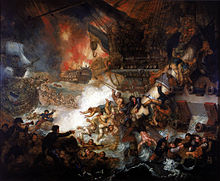
It was Bernard Lewis, I think, who observed that the modern history of Western-Islamic relations began with a bang – the explosion of the massive French three-decker Orient, set ablaze by Nelson’s fleet in Abu Qir Bay. It could be argued that the post-modern chapter began with two other bangs – the hijacked planes hitting the Twin Towers. Given the pretensions of Islam, Christianity, and Western civilization in general, this couldn’t be otherwise. What’s amazing is that, despite all the bangs, many of us are still looking for ways to understand each other and – as the insufferable bumper sticker has it – to co-exist.
Maybe familiarity will breed contempt. But I don’t think that’ll be the sum of its progeny. Christians and Muslims may turn out to have unexpected things in common. We Christians aren’t (yet) subject to widespread profiling, but we are biting our nails over threats to religious liberty. Anyone thinking seriously about the Benedict Option should take a hard look at Molenbeek. That, plus bacon and Easter Bonnets, could be our future, though — inshallah— it won’t come to that.
Previous Post

April 14, 2016
Keeping My Brother -- Exp. Not Nec. but a +
Next Post
April 19, 2016 Je Suis -- I mean, Ich bin ein Jan Böhmermann
Browse Our Archives
Select a Category Uncategorized
Select a Month August 2016 July 2016 May 2016 April 2016 March 2016 January 2016 December 2015 November 2015 October 2015 September 2015 August 2015 July 2015 June 2015 May 2015 April 2015 February 2015 January 2015 July 2014 April 2014 February 2014 January 2014 December 2013 November 2013 October 2013 September 2013 August 2013 July 2013 May 2013 April 2013 March 2013 February 2013 January 2013 December 2012 November 2012 October 2012 September 2012 August 2012 July 2012 June 2012 May 2012 April 2012 March 2012 February 2012 January 2012 December 2011 November 2011 October 2011 September 2011 August 2011 July 2011 June 2011 May 2011
Follow Us!
TAKE THE
Religious Wisdom Quiz
What biblical figure was prepared to sacrifice his son Isaac on an altar?
Select your answer to see how you score.
Moses Noah Isaiah Abraham
Related posts from Diary of a Wimpy Catholic

An Open Letter to the Editor Who Fired...
Lessons from Erdoğan's Victory

Mamma Mia! Emergency Baptism at 30,000 Feet

My First Orthodox Liturgy: A Blast for A...
TRENDING AT PATHEOS Catholic

Rejecting Doom: Christian Hope And Human Action
Christianity is a religion of hope. We are to have hope and...

It’s What Comes From Within Which Matters
One of the most difficult things for us to understand is why...

Why I Choose the Eucharist Over the Sermon
Choose the Eucharist, Not the Sermon What are we supposed to get...

5 Design Elements Found in Spiritually Rooted Homes
Putting Spirituality Into Home Decor Our homes are more than our living...

Credo: A Story of God Told with the...
About 10 years ago, I began to imagine a personal "Credo" that...

The Anatomy of Divine Revelation in Catholic Thought
The claim that God has made Himself known to human beings is...
view all Catholic blogs
Ad-Free & Subscriber Log-In Subscription Support
- About Us
- 2026 Calendar
- Videos
- Podcasts
- Library of World Religions
- Faith In Media Tracker
- Advertise With Us
- Write for Us
- Privacy Policy
- Terms of Service
- Do Not Sell My Data
- Contact Us
- Radiant Digital
- Manage Newsletter Subscriptions
- Unsubscribe From Notifications
- Sitemap
Copyright 2008-2026, Patheos. All rights reserved.
Subscription Support Ad-Free & Subscriber Log-In
Follow Patheos