
BuddhistCatholicContemplativeEvangelicalGeneral ChristianHinduJewishLatter-day SaintMuslimNew VisionsProgressive Christian
Beliefs
- Buddhist
- Catholic
- Contemplative
- Evangelical
- General Christian
- Hindu
- Jewish
- Latter-day Saint
- More Voices
- Muslim
- New Visions
- Pagan
- Progressive Christian
Topics
- Religion News
- Food and Religion
- Sports and Religion
- Religious Art
- Religious Music and Entertainment
- Religious Events
- History and Religion
- Style and Religion
- Politics and Religion
- Women in Religion
- Recreation Outdoors and Religion
- Business Finance and Religion
- Careers Workplace and Religion
- Education and Religion
- Family Parenting and Religion
- Health Fitness and Religion
- Home and Religion
- Relationships and Religion
- Technology and Religion
- Travel and Religion
Columnists
- Buddhist Columnists
- Business Finance and Religion Columnists
- Careers Workplace and Religion Columnists
- Catholic Columnists
- Contemplative Columnists
- Education and Religion Columnists
- Evangelists Columnists
- Family Parenting and Religion Columnists
- General Christian Columnists
- Health Fitness and Religion Columnists
- Hindu Columnists
- History and Religion Columnists
- Home and Religion Columnists
- Jewish Columnists
- More Voices Columnists
- Latter Day Columnists
- Muslim Columnists
- New Visions Columnists
- Nonreligious Columnists
- Pagan Columnists
- Politics and Religion Columnists
- Progressive Columnists
- Recreation Outdoors and Religion Columnists
- Relationships and Religion Columnists
- Religion News Columnists
- Religious Art Columnists
- Religious Events Columnists
- Religious Music and Entertainment Columnists
- Sports and Religion Columnists
- Style and Religion Columnists
- Technology and Religion Columnists
- Travel and Religion Columnists
- Women in Religion Columnists
Resource Library
- 2026 Calendar
- Library of World Religions
- The 100 Most Holy Places on Earth
- Patheos Answers
- Podcasts
- Videos
- Faith Leaders Database
- Anglican Episcopalian
- Bahai
- Baptist
- Buddhism
- Christianity
- Confucianism
- Eastern Orthodoxy
- Hinduism
- Holiness and Pentecostal
- ISKCON
- Islam
- Judaism
- Lutheran
- Methodist
- The Church of Jesus Christ of Latter-day Saints
- New Age
- Paganism
- Presbytarian and Reformed
- Protestantism
- Religion Behind the Scenes
- Roman Catholic
- Scientology
- Shia Islam
- Sikhism
- Sufism
- Sunni Islam
- Taoism
- Zen
- See all religions
Research Tools
 Ad-Free & Subscriber Log-In Subscription Support
Ad-Free & Subscriber Log-In Subscription Support
Follow Patheos 

- Trending:
- Forgiveness
- |
- Marriage
- |
- Consciousness
- |
- Death Penalty
- |
- Election
- |
- Halloween
 Diary of a Wimpy Catholic
- Home
- Catholic
- …Then Someone’s Not Being: A Reply to Elizabeth
…Then Someone’s Not Being: A Reply to Elizabeth
Last updated on: March 13, 2015 at 3:04 pm by Max Lindenman
…Then Someone’s Not Being: A Reply to Elizabeth 2015-03-13T15:04:51-06:00 Max Lindenman
Patheos Explore the world's faith through different perspectives on religion and spirituality! Patheos has the views of the prevalent religions and spiritualities of the world.
Today, in First Things, my mentor, gaffer and friend Elizabeth Scalia does a very gutsy thing. She talks about homosexuality in a way that affirms nobody’s orthodoxy: Wondering whether being born gay might constitute a “call to otherness,” she continues:
I have a theory that our gay brothers and sisters are, in fact, planned, loved-into-being “necessary others,” and that they are meant to show us something of God from a perspective that we cannot otherwise broach. I suspect art is a part of it. I do not presume to guess what attractions Michelangelo felt, but I could not view his stunning work throughout the Vatican and in Rome without recalling a quip someone (I believe Camille Paglia) once made, that when gays were closeted and presumably less active sexually, their energies had been subsumed into creating transcendent, living, time-smashing masterpieces. Now that they were “out”, said the wag, their art was mundane, mostly unmemorable, often lazy and insubstantial.
I know I am entering deep and destructive currents by even daring to swim here, but homosexual questions are all around us—gay marriage, certainly is at the forefront (and there again, we may actually have some instruction from Christ, in Matthew 19) but there is also the issue of recognizing the many homosexuals in our church who are excellent, joyful priests, faithful to their vows and their flocks—and they are questions begging for temperate, reasonable and loving dialogue.
There’s so much good stuff here — where to start? First of all, I really like the idea that eccentricity is no accident. General Patton liked to say that if everybody’s thinking alike, somebody’s not thinking. (Or rather, George C. Scott said that in the biopic; I’m taking it on faith he was quoting the original.) To me, it always seemed self-evidently true that if everyone’s being alike, someone’s not being.
Most Catholic would probably agree. The Public Religion Research Institute reports that “a majority of Catholics supports legal rights for gays and lesbians.” Whatever your own opinion of gay marriage, you’ll allow that those who support it probably believe that gay people: 1) are born gay; and 2) not for no good reason.
But some of the especially devout, I’ve noticed, bind themselves to a much older covenant. Believing homosexuality to be a character flaw, if not a curse, they agree to overlook it until someone wrestles them to the ground and rubs it right in their faces. In this, they believe they’re doing gay people a favor — giving them the benefit of the doubt.
This arrangement produces its comical moments. At my old parish, there was a religious sister who firmly believed that homosexuality was a choice. I’ve never really picked her brain on the subject, but I suppose she believes that gay can be prayed, willed or even married away, the good Lord willing. A friend tells me that one year, a gay parishioner showed up at her birthday party on the arm of, well, a trick — a much younger man, recently acquired, possibly on the street. As the evening wound down, the trick scurried about the room, draining the dregs from everyone’s wine glass while Sister looked on, poleaxed.
Most of her paralysis, I’m sure, came from simple good manners. Few people raised in omes with good china would be able to say, “Hey! Quit minesweeping, you disgusting slob!” with enough force to carry the point. But I’m convinced the imperative to denial, deeply ingrained as it was, played a big part, too. “Leave my glasses alone” would have been one breath away from “Keep your pickups out of my house,” which would have dumped a big jar of nightcrawlers onto the gleaming linoleum of Sister’s worldview.
Call me an unreflective product of my generation, but I think it would have been better for all concerned if Sister had been able to say, “Listen, I know you’re called to be different, but as long as you’re in my house, you’re called to behave like civilized damn human beings!”
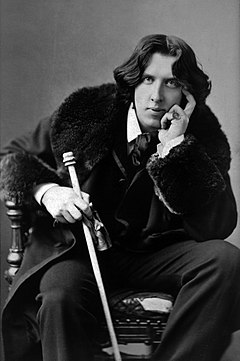
Now onto Elizabeth’s other point, that gays are more productive when most deeply closeted, “and presumably less active sexually” — Oscar Wilde might have agreed. He spoke ruefully of having put his talent into his art and his genius into his life. It’s certainly true that if convention had not obliged him to be a hypocrite, he wouldn’t have been able to speak so profoundly about — and against — hypocrisy, as he did in The Importance of Being Earnest.
But I’m not sure I’m ready to take Wilde completely at his word. He was a vain man, inclined to overlook his own faults — he spends the first part of De Profundis blaming all his misfortunes on Bosie Douglas. Exaggerating the extent to which his work failed to reflect his potential seems to me very much in character.
Even if he were right, would it follow that a sexless life — or a safe one with Constance, Cyril, and Vyvyan at Tite Street– would have provided him more fertile ground for his genius? I doubt it. The mid 1880s, when Wilde’s gay life was at its most dormant — or at any rate, at its tamest — also represented somewhat of a creative doldrums. Wilde’s work took off only later, in tandem with his passions for John Gray and Bosie Douglas. W.H. Auden once wrote that Bosie spurred Wilde’s productivity by presenting him with enormous hotel bills to pay off. Probably. But in The Unmasking of Oscar Wilde, Joseph Pearce points out that Wilde’s work came most to resemble Christian allegory in those times when his life was at its most chaotic. The more he sinned, and courted danger thereby — “feasting with panthers” was his own expression — the better he came to appreciate virtue and redemption, at least in the abstract.
I doubt there’s any single foolproof recipe for creativity — if there is, it would have to include talent, a quality denied even many gay people. But from this one example, it would seem that sex with a sense of sin works at least as well as the sense of sin would by itself.
Previous Post

June 13, 2011
Is Sexual Addiction A Feminist Victory?
Next Post
June 15, 2011 How to REALLY Write for First Things
Browse Our Archives
Select a Category Uncategorized
Select a Month August 2016 July 2016 May 2016 April 2016 March 2016 January 2016 December 2015 November 2015 October 2015 September 2015 August 2015 July 2015 June 2015 May 2015 April 2015 February 2015 January 2015 July 2014 April 2014 February 2014 January 2014 December 2013 November 2013 October 2013 September 2013 August 2013 July 2013 May 2013 April 2013 March 2013 February 2013 January 2013 December 2012 November 2012 October 2012 September 2012 August 2012 July 2012 June 2012 May 2012 April 2012 March 2012 February 2012 January 2012 December 2011 November 2011 October 2011 September 2011 August 2011 July 2011 June 2011 May 2011
Follow Us!
TAKE THE
Religious Wisdom Quiz
True or False: Habakkuk complained to God about injustice and questioned why the wicked prosper.
Select your answer to see how you score.
FALSE TRUE
Related posts from Diary of a Wimpy Catholic

Lent for the Reluctant Ascetic


The Witness of Larycia Hawkins: Too Much Solidarity,...

Why Grow Up When You Can Be Christian?
TRENDING AT PATHEOS Catholic

The Parable Of The Sower And The Word...
One of Christ’s most famous parables is that of the sower who...

Rejecting Doom: Christian Hope And Human Action
Christianity is a religion of hope. We are to have hope and...

Why I Choose the Eucharist Over the Sermon
Choose the Eucharist, Not the Sermon What are we supposed to get...

5 Design Elements Found in Spiritually Rooted Homes
Putting Spirituality Into Home Decor Our homes are more than our living...

Credo: A Story of God Told with the...
About 10 years ago, I began to imagine a personal "Credo" that...

The Anatomy of Divine Revelation in Catholic Thought
The claim that God has made Himself known to human beings is...
view all Catholic blogs
Ad-Free & Subscriber Log-In Subscription Support
- About Us
- 2026 Calendar
- Videos
- Podcasts
- Library of World Religions
- Faith In Media Tracker
- Advertise With Us
- Write for Us
- Privacy Policy
- Terms of Service
- Do Not Sell My Data
- Contact Us
- Radiant Digital
- Manage Newsletter Subscriptions
- Unsubscribe From Notifications
- Sitemap
Copyright 2008-2026, Patheos. All rights reserved.
Subscription Support Ad-Free & Subscriber Log-In
Follow Patheos