
BuddhistCatholicContemplativeEvangelicalGeneral ChristianHinduJewishLatter-day SaintMuslimNew VisionsProgressive Christian
Beliefs
- Buddhist
- Catholic
- Contemplative
- Evangelical
- General Christian
- Hindu
- Jewish
- Latter-day Saint
- More Voices
- Muslim
- New Visions
- Pagan
- Progressive Christian
Topics
- Religion News
- Food and Religion
- Sports and Religion
- Religious Art
- Religious Music and Entertainment
- Religious Events
- History and Religion
- Style and Religion
- Politics and Religion
- Women in Religion
- Recreation Outdoors and Religion
- Business Finance and Religion
- Careers Workplace and Religion
- Education and Religion
- Family Parenting and Religion
- Health Fitness and Religion
- Home and Religion
- Relationships and Religion
- Technology and Religion
- Travel and Religion
Columnists
- Buddhist Columnists
- Business Finance and Religion Columnists
- Careers Workplace and Religion Columnists
- Catholic Columnists
- Contemplative Columnists
- Education and Religion Columnists
- Evangelists Columnists
- Family Parenting and Religion Columnists
- General Christian Columnists
- Health Fitness and Religion Columnists
- Hindu Columnists
- History and Religion Columnists
- Home and Religion Columnists
- Jewish Columnists
- More Voices Columnists
- Latter Day Columnists
- Muslim Columnists
- New Visions Columnists
- Nonreligious Columnists
- Pagan Columnists
- Politics and Religion Columnists
- Progressive Columnists
- Recreation Outdoors and Religion Columnists
- Relationships and Religion Columnists
- Religion News Columnists
- Religious Art Columnists
- Religious Events Columnists
- Religious Music and Entertainment Columnists
- Sports and Religion Columnists
- Style and Religion Columnists
- Technology and Religion Columnists
- Travel and Religion Columnists
- Women in Religion Columnists
Resource Library
- 2026 Calendar
- Library of World Religions
- The 100 Most Holy Places on Earth
- Patheos Answers
- Podcasts
- Videos
- Faith Leaders Database
- Anglican Episcopalian
- Bahai
- Baptist
- Buddhism
- Christianity
- Confucianism
- Eastern Orthodoxy
- Hinduism
- Holiness and Pentecostal
- ISKCON
- Islam
- Judaism
- Lutheran
- Methodist
- The Church of Jesus Christ of Latter-day Saints
- New Age
- Paganism
- Presbytarian and Reformed
- Protestantism
- Religion Behind the Scenes
- Roman Catholic
- Scientology
- Shia Islam
- Sikhism
- Sufism
- Sunni Islam
- Taoism
- Zen
- See all religions
Research Tools
 Ad-Free & Subscriber Log-In Subscription Support
Ad-Free & Subscriber Log-In Subscription Support
Follow Patheos 

- Trending:
- Forgiveness
- |
- Marriage
- |
- Consciousness
- |
- Death Penalty
- |
- Election
- |
- Halloween
 Dharma Lens
- Home
- Hindu
- Politics and Religion
- Faith, Country, Caste! New Survey Highlights American (Mis)Understandings
Faith, Country, Caste! New Survey Highlights American (Mis)Understandings
Last updated on: April 16, 2024 at 10:18 am by Pushpita Prasad
Faith, Country, Caste! New Survey Highlights American (Mis)Understandings 2024-04-16T10:18:42-07:00 Pushpita Prasad
Patheos Explore the world's faith through different perspectives on religion and spirituality! Patheos has the views of the prevalent religions and spiritualities of the world.
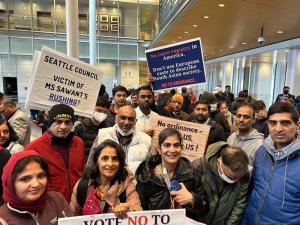
Hindu Americans protest a proposed caste bill
If the media is to be believed, America is being overrun by a new scourge – “caste discrimination” brought to our fair land by “Indians or South Asians” as they flock here in “large numbers”. This is the stated belief of many of the caste equity champions who have been driving the caste narrative from their privileged positions in academia and government – even though data on the ground shows a completely different picture. Over the past two years caste has been added as a protected category, in places far apart as UC Davis, California State University, Brown, Harvard and the City of Seattle and now the state of California. The main “evidence” cited for caste measures has been ONE survey from a private entity and ONE lawsuit against employees at Cisco Systems by the California Civil Rights Department.
Yet, the 2018 Equality Labs survey had earlier been rejected as “admissible evidence by California courts” – Judge Drew Takaichi’s 2/11/21 ruling, and was also called out as unscientific by the 2021 Carnegie survey on Indian Americans (Footnote 29). With the recent withdrawal of the lawsuit against the two Cisco engineers, a rational person might assume there would be a pause in the rush to judgment – but they would be wrong!
So, among all the media chatter, the question arises – how does an average American view caste? The question assumes urgent significance in view of laws like SB403 in California – which means that we can expect to one day have an American individual in the court being judged on caste by a “jury of their peers”.
A new survey conducted recently by CoHNA (Coalition of Hindus of North America) studies this issue and brings pertinent data to the topic and shows caste awareness in the US is low and based on inaccurate or anecdotal information.
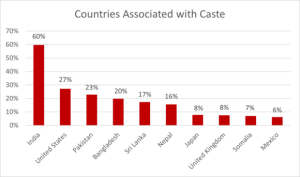
Source CoHNA
A salient finding from the survey – most Americans associate caste with India (and therefore Hinduism) and believe that there are only four castes. Nine out ten Americans had no idea how to tell someone’s caste based on markers such as last name, skin color, educational level, hair texture, etc.; their understanding of caste is already shaped by the time they graduate high school; and, social media and online platforms play a very important role in shaping the understanding and “experiences” of US-based Millennials.
“These findings are significant, since a trial or investigation around caste discrimination would empanel a jury of ordinary Americans or appoint them to conduct the investigation,” said Suresh Krishnamoorthy, Board Member of CoHNA. “Would they be able to identify castes by last names or other markers and reach a fair verdict? Or would they be biased about the origins and nature of caste, which can potentially result in racial profiling, targeting and stereotyping of South Asians and especially people of Indian and Hindu origin, along with government overreach?”
The survey also tests popular claims that discrimination based on caste is ubiquitous in the United States or that Americans can easily identify the numerous castes and sub-castes based on markers such as last name, skin color, food habits, etc. This data is important in light of the claims from caste experts pushing such laws, that is it possible to identify/locate the “caste of a South Asian living in America through such markers.
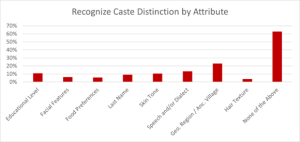
Source CoHNA
The new survey data warns that community specific changes in any civil rights laws should only be taken up after due diligence and consultations with all stakeholders and experts. It also emphasizes the need for a deeper, statistically valid study of the actual prevalence of caste-based systems of discrimination in America before any legislation or policy is passed. Passing laws and policies based on inaccurate or anecdotal information is unethical and can lead to violations of civil rights and the targeting and profiling of Hindu Americans and other micro minorities.
“We undertook this study because we were concerned about claims of mass discrimination within the South-Asian community”, said Nikunj Trivedi, President of CoHNA. “It is important to validate and cross-check claims around caste in the US, especially since these unverified claims have been used to create policy and laws that can have broad and unintended consequences and harm on minorities living in the country. Our data validates what other scientific studies before us have also found.”
The full survey results can be found here. Key findings include:
1) Only 8% of respondents had actual experience with the caste system. Therefore, it is not as widespread as claimed.
2) A majority of those surveyed first learned about caste from school textbooks and had not experienced it.
3) Only a handful of those surveyed knew of the thousands of castes and sub-castes in India. A majority claimed there are only four castes in India.
4) US-based Millennials reporting extensive “personal” experience with caste point to social media and WhatsApp as their sources of knowledge.
5) A majority of those surveyed associated caste with India and Hinduism. It is therefore untenable to associate it across geographies and peoples.
6) Nine out of 10 respondents had no idea how to associate a last name with caste.
7) Over 60% of Americans can’t identify caste distinctions via other attributes such as food preferences, educational level, skin tone, hair texture, etc.
8) An overwhelming majority of those surveyed do not find the caste system important.
The CoHNA survey was based on a YouGov US national sample of 1,500 responses. YouGov is an internationally recognized internet-based polling company that is widely used by major organizations, media houses, political analysts, and others to collect opinions on business, politics, public affairs, social trends, etc.
Previous Post

January 25, 2023
Celebrating Basant Amid A Shrinking Footprint
Next Post

December 4, 2023 Caste - When Words become Weapons
Recent Comments
"There is no occasion for women to consider themselves subordinate or inferior to men. Woman ..."
Representation – A Hindu Take On ..."
"Wonderfully stated Dilip ji. The inherent diversity of Hinduism helps develop an appreciation for different ..."
Earth Week. Dharma. Tree Hugger. Mother ..."
"Excellent article by Pusphita. Some of Hindu practices may be erroneously labeled as idol-worshipping. I ..."
Earth Week. Dharma. Tree Hugger. Mother ..."
"I very much enjoyed this article, thank you!"
Representation – A Hindu Take On ..."
Browse Our Archives
Select a Category civil rights hinduism Uncategorized
Select a Month April 2024 March 2024 December 2023 June 2023 January 2023 December 2022 October 2022 August 2022
TAKE THE
Religious Wisdom Quiz
What Christian group believes in continuing revelation from prophets?
Select your answer to see how you score.
Baptists Latter-day Saints Presbyterians Lutherans
Related posts from Dharma Lens

Representation – A Hindu Take On Women’s Day

Caste - When Words become Weapons

Celebrating Basant Amid A Shrinking Footprint

Not a Diwali Post - Stop Cultural Appropriation
TRENDING AT PATHEOS Hindu

Indian Hindu pilot’s valor in line of duty...
There is a hoary maritime tradition that the captain of the...

Movie on Neem Karoli Baba’s life is a...
Neem Karoli Baba’s life (1900-1973) is associated with miracles he made in...

20 Questions to Ask Before an Interfaith Marriage,...
Four questions every interfaith couple should discuss before marriage: Conversion. Will either...

Avadhānam: The Art of Concentration and Intellectual Mastery
What is Avadhānam? In the summer of 2015, during a three-day Sanskrit...

Jesus in the Dharma: Where Christ Fits in...
Where Does Jesus Fit in Hinduism? That’s a question I get often...

Hormuz: A Shared Hindu and Zoroastrian Heritage
Every evening, somewhere in the world, a newsreader utters the words: "The...
view all Hindu blogs
Ad-Free & Subscriber Log-In Subscription Support
- About Us
- 2026 Calendar
- Videos
- Podcasts
- Library of World Religions
- Faith In Media Tracker
- Advertise With Us
- Write for Us
- Privacy Policy
- Terms of Service
- Do Not Sell My Data
- Contact Us
- Radiant Digital
- Manage Newsletter Subscriptions
- Unsubscribe From Notifications
- Sitemap
Copyright 2008-2026, Patheos. All rights reserved.
Subscription Support Ad-Free & Subscriber Log-In
Follow Patheos