
BuddhistCatholicContemplativeEvangelicalGeneral ChristianHinduJewishLatter-day SaintMuslimNew VisionsProgressive Christian
Beliefs
- Buddhist
- Catholic
- Contemplative
- Evangelical
- General Christian
- Hindu
- Jewish
- Latter-day Saint
- More Voices
- Muslim
- New Visions
- Pagan
- Progressive Christian
Topics
- Religion News
- Food and Religion
- Sports and Religion
- Religious Art
- Religious Music and Entertainment
- Religious Events
- History and Religion
- Style and Religion
- Politics and Religion
- Women in Religion
- Recreation Outdoors and Religion
- Business Finance and Religion
- Careers Workplace and Religion
- Education and Religion
- Family Parenting and Religion
- Health Fitness and Religion
- Home and Religion
- Relationships and Religion
- Technology and Religion
- Travel and Religion
Columnists
- Buddhist Columnists
- Business Finance and Religion Columnists
- Careers Workplace and Religion Columnists
- Catholic Columnists
- Contemplative Columnists
- Education and Religion Columnists
- Evangelists Columnists
- Family Parenting and Religion Columnists
- General Christian Columnists
- Health Fitness and Religion Columnists
- Hindu Columnists
- History and Religion Columnists
- Home and Religion Columnists
- Jewish Columnists
- More Voices Columnists
- Latter Day Columnists
- Muslim Columnists
- New Visions Columnists
- Nonreligious Columnists
- Pagan Columnists
- Politics and Religion Columnists
- Progressive Columnists
- Recreation Outdoors and Religion Columnists
- Relationships and Religion Columnists
- Religion News Columnists
- Religious Art Columnists
- Religious Events Columnists
- Religious Music and Entertainment Columnists
- Sports and Religion Columnists
- Style and Religion Columnists
- Technology and Religion Columnists
- Travel and Religion Columnists
- Women in Religion Columnists
Resource Library
- 2026 Calendar
- Library of World Religions
- The 100 Most Holy Places on Earth
- Patheos Answers
- Podcasts
- Videos
- Faith Leaders Database
- Anglican Episcopalian
- Bahai
- Baptist
- Buddhism
- Christianity
- Confucianism
- Eastern Orthodoxy
- Hinduism
- Holiness and Pentecostal
- ISKCON
- Islam
- Judaism
- Lutheran
- Methodist
- The Church of Jesus Christ of Latter-day Saints
- New Age
- Paganism
- Presbytarian and Reformed
- Protestantism
- Religion Behind the Scenes
- Roman Catholic
- Scientology
- Shia Islam
- Sikhism
- Sufism
- Sunni Islam
- Taoism
- Zen
- See all religions
Research Tools
 Ad-Free & Subscriber Log-In Subscription Support
Ad-Free & Subscriber Log-In Subscription Support
Follow Patheos 

- Trending:
- Forgiveness
- |
- Marriage
- |
- Consciousness
- |
- Death Penalty
- |
- Election
- |
- Halloween
 Dharma Lens
- Home
- Hindu
- Politics and Religion
- Not a Diwali Post – Stop Cultural Appropriation
Not a Diwali Post – Stop Cultural Appropriation
Last updated on: April 16, 2024 at 10:18 am by Pushpita Prasad
Not a Diwali Post – Stop Cultural Appropriation 2024-04-16T10:18:45-07:00 Pushpita Prasad
Patheos Explore the world's faith through different perspectives on religion and spirituality! Patheos has the views of the prevalent religions and spiritualities of the world.

Once upon a time, North America was a stranger to Diwali. Back then, we Hindus made do with what was available- like homemade sweets or off the shelf holiday decor repurposed for Diwali, and a hurried puja since the kids had to go to school just like any other busy weekday. Real festivities with family and friends had to wait for the weekend with most such festivities being private events. Public acknowledgement or large-scale celebration was far too distant an idea to be spared a thought.
Fast forward to 2022 and it seems Diwali is finally having a “mainstream moment” in America. Diwali is an official school holiday in as many as 26 in New Jersey alone, enabling families a chance to celebrate the day meaningfully together. Corporate America has also started catering to an under served need. 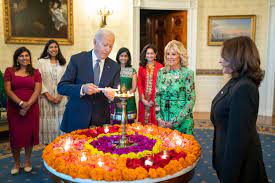 Mainstream retailers like Macy’s have started stocking traditional outfits at select stores. Home Depot puts out ‘Diwali’ decor weeks before Diwali. Amazon, Walmart and other online retailers stock a host of Diwali merchandise. Most importantly in a rare display of consensus, both sides of the political aisle acknowledged and celebrated Diwali.
The South Asia Angle
While these inclusionary changes reflecting the essence of dharma are very welcome, there are some serious concerns as well. Unfortunately and increasingly, Diwali is being co-opted and rebranded as a ‘South Asian’ holiday
At the cost of being accused of narcissism of small differences, there is a need to set the record straight, lest Diwali end up like Yoga. Co-opted and rebranded with some state mandate, Yoga is now been culturally appropriated–cut from its dharmic roots and grand traditions. Yoga is a pale shadow of what it was meant to be. Pranayama is reduced to ‘single nostril breathing’, ado mukha svanasana to ‘downward dog’, vipassana to ‘mindfulness’ and the list goes .
This co-opting and reduction of Yoga to just another commercial fitness routine should serve as a reminder to all of us who watched it happen. One fallout of such grotesque co-option of Diwali is clueless guests dancing to a ‘Bollywood’ song replete with misogynistic innuendos in the name of Diwali. Ironically, traditional Diwali is the exact opposite of this debasement since it is the time to worship and celebrate the divine feminine in the form of Lakshmi, Kali and Gowri.
More seriously, this causal attempt to link Diwali with South Asia as if it was a universal joyous festival celebrated with ease by anyone in the geography, erases the real challenges plaguing communities actually living in the area when it comes to something as simple as celebrating the festival.
The “South Asia” branding deliberately ignores the vast swaths where Diwali barely registers a presence-be it countries like Afghanistan or even several states in India, where Hindus are a small minority.
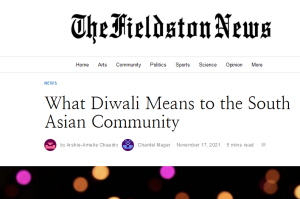 Latest in a long series of violence were reports of violence in Pakistan against Hindus for daring to celebrate Diwali. Many did not celebrate the festival as a protest against state apathy to their woes, because their children were abducted, converted, never to see their families ever again, because institutions failed to protect them and hold the culpable accountable. Last year, after a spate of killings and violence that began during Navratri, Bangladeshi Hindus decided to not observe Deepawali and Kali Puja or light lamps -electric or earthen. This year too temples were vandalized during Diwali in “South Asia.” Sharada peeth, one of the holiest Hindu shrines in the honor of the Goddess of learning, also an erstwhile seat of higher learning has not seen Diwali celebration in the past 75 years. In addition, episodes of rioting and skirmishes are reported each year.
A Global Dharmic Celebration
Facts show that Diwali, at best, is celebrated in only some parts of South Asia, and in some others, with fear under severe conditions. So no, Diwali is not a ‘South Asian holiday’. Not all South Asians celebrate Diwali. Many in South Asia who do want to celebrate Diwali don’t have the liberty to do so.
However, Diwali is observed by all dharmic communities across ethnicities and countries. It is an official holiday in 13 countries-several outside South Asia. Dharmics across the world celebrate Diwali in myriad ways, sometimes call it by different names, eat different foods, follow different customs, worship differ deities, but what binds it all together is the underlying commemoration of the victory of dharma over adharma, of good over evil, symbolized by light over darkness. It is time to set the record straight and ensure that Diwali does not go down the Yoga way.
Diwali is the most popular Hindu festival, just like Eid is the most popular Islamic festival and Christmas the most popular Christian festival. All of these festivals are enjoyed and celebrated by those of other faiths, yet there is no attempt to box them into geographical boxes of being “middle eastern” or “North European” festivals. Diwali and Hindus deserve the same. No more. No less. The cultural appropriation of Hindu traditions needs to stop.
Reprinted with permission from CoHNA’s blog.
History and Religion
Previous Post

October 29, 2022
Chhath - An Ode to the Sun
Next Post

January 25, 2023 Celebrating Basant Amid A Shrinking Footprint
Recent Comments
"There is no occasion for women to consider themselves subordinate or inferior to men. Woman ..."
Representation – A Hindu Take On ..."
"Wonderfully stated Dilip ji. The inherent diversity of Hinduism helps develop an appreciation for different ..."
Earth Week. Dharma. Tree Hugger. Mother ..."
"Excellent article by Pusphita. Some of Hindu practices may be erroneously labeled as idol-worshipping. I ..."
Earth Week. Dharma. Tree Hugger. Mother ..."
"I very much enjoyed this article, thank you!"
Representation – A Hindu Take On ..."
Browse Our Archives
Select a Category civil rights hinduism Uncategorized
Select a Month April 2024 March 2024 December 2023 June 2023 January 2023 December 2022 October 2022 August 2022
TAKE THE
Religious Wisdom Quiz
Who said: "Little children, keep yourselves from idols"?
Select your answer to see how you score.
James Paul John Peter
Related posts from Dharma Lens
Earth Week. Dharma. Tree Hugger. Mother Earth.
Representation – A Hindu Take On Women’s Day

Caste - When Words become Weapons
Faith, Country, Caste! New Survey Highlights American (Mis)Understandings
TRENDING AT PATHEOS Hindu

Indian Hindu pilot’s valor in line of duty...
There is a hoary maritime tradition that the captain of the...

Movie on Neem Karoli Baba’s life is a...
Neem Karoli Baba’s life (1900-1973) is associated with miracles he made in...

20 Questions to Ask Before an Interfaith Marriage,...
Four questions every interfaith couple should discuss before marriage: Conversion. Will either...

Avadhānam: The Art of Concentration and Intellectual Mastery
What is Avadhānam? In the summer of 2015, during a three-day Sanskrit...

Jesus in the Dharma: Where Christ Fits in...
Where Does Jesus Fit in Hinduism? That’s a question I get often...

Hormuz: A Shared Hindu and Zoroastrian Heritage
Every evening, somewhere in the world, a newsreader utters the words: "The...
view all Hindu blogs
Ad-Free & Subscriber Log-In Subscription Support
- About Us
- 2026 Calendar
- Videos
- Podcasts
- Library of World Religions
- Faith In Media Tracker
- Advertise With Us
- Write for Us
- Privacy Policy
- Terms of Service
- Do Not Sell My Data
- Contact Us
- Radiant Digital
- Manage Newsletter Subscriptions
- Unsubscribe From Notifications
- Sitemap
Copyright 2008-2026, Patheos. All rights reserved.
Subscription Support Ad-Free & Subscriber Log-In
Follow Patheos