
BuddhistCatholicContemplativeEvangelicalGeneral ChristianHinduJewishLatter-day SaintMuslimNew VisionsProgressive Christian
Beliefs
- Buddhist
- Catholic
- Contemplative
- Evangelical
- General Christian
- Hindu
- Jewish
- Latter-day Saint
- More Voices
- Muslim
- New Visions
- Pagan
- Progressive Christian
Topics
- Religion News
- Food and Religion
- Sports and Religion
- Religious Art
- Religious Music and Entertainment
- Religious Events
- History and Religion
- Style and Religion
- Politics and Religion
- Women in Religion
- Recreation Outdoors and Religion
- Business Finance and Religion
- Careers Workplace and Religion
- Education and Religion
- Family Parenting and Religion
- Health Fitness and Religion
- Home and Religion
- Relationships and Religion
- Technology and Religion
- Travel and Religion
Columnists
- Buddhist Columnists
- Business Finance and Religion Columnists
- Careers Workplace and Religion Columnists
- Catholic Columnists
- Contemplative Columnists
- Education and Religion Columnists
- Evangelists Columnists
- Family Parenting and Religion Columnists
- General Christian Columnists
- Health Fitness and Religion Columnists
- Hindu Columnists
- History and Religion Columnists
- Home and Religion Columnists
- Jewish Columnists
- More Voices Columnists
- Latter Day Columnists
- Muslim Columnists
- New Visions Columnists
- Nonreligious Columnists
- Pagan Columnists
- Politics and Religion Columnists
- Progressive Columnists
- Recreation Outdoors and Religion Columnists
- Relationships and Religion Columnists
- Religion News Columnists
- Religious Art Columnists
- Religious Events Columnists
- Religious Music and Entertainment Columnists
- Sports and Religion Columnists
- Style and Religion Columnists
- Technology and Religion Columnists
- Travel and Religion Columnists
- Women in Religion Columnists
Resource Library
- 2026 Calendar
- Library of World Religions
- The 100 Most Holy Places on Earth
- Patheos Answers
- Podcasts
- Videos
- Faith Leaders Database
- Anglican Episcopalian
- Bahai
- Baptist
- Buddhism
- Christianity
- Confucianism
- Eastern Orthodoxy
- Hinduism
- Holiness and Pentecostal
- ISKCON
- Islam
- Judaism
- Lutheran
- Methodist
- The Church of Jesus Christ of Latter-day Saints
- New Age
- Paganism
- Presbytarian and Reformed
- Protestantism
- Religion Behind the Scenes
- Roman Catholic
- Scientology
- Shia Islam
- Sikhism
- Sufism
- Sunni Islam
- Taoism
- Zen
- See all religions
Research Tools
 Ad-Free & Subscriber Log-In Subscription Support
Ad-Free & Subscriber Log-In Subscription Support
Follow Patheos 

- Trending:
- Forgiveness
- |
- Marriage
- |
- Consciousness
- |
- Death Penalty
- |
- Election
- |
- Halloween
 Adventures of Dharma Dad
- Home
- Buddhist
- It’s All a State of Mind.
It’s All a State of Mind.
Last updated on: May 24, 2015 at 1:14 pm by Ty Phillips
It’s All a State of Mind. 2015-05-24T13:14:23-04:00 Ty Phillips
Patheos Explore the world's faith through different perspectives on religion and spirituality! Patheos has the views of the prevalent religions and spiritualities of the world.
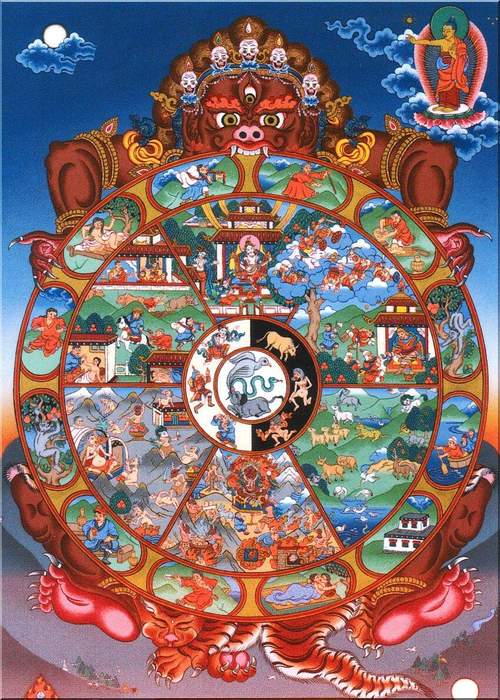
Anyone familiar with Mahayana Buddhism, is probably also familiar with the idea of the six realms of existence. In traditional setting of Buddhism (think Asia) these are easily accepted as literal realms of existence that interplay with the process of samsara and reincarnation. Understanding the western mindset and its lack of acceptance of reincarnation, the famed Tibetan teacher Chogyam Trungpa presented these realms as states of psychological or emotional existence within the human experience.
While I am no Chogyam Trungpa, I think it is necessary to cast the net of this teaching over those unfamiliar with it. I think as science continues to enlighten us on the workings of the world, it behooves us to present these teachings in a way that is consistent with the scientific world. Skirting around reality is never what the Buddha intended, so much like science being a passionate search for truth, I think Buddhism is a passionate search for understanding the mind.
The six realms consist of the following; the hell realms, both hot and cold, the hungry ghost realm, the animal realm, the human realm, the demi god realm, and the god realm. When we look at these through traditional eyes, we see them each as a realm that we can be reborn in, based on our karma and collective merit. But as presented by Trungpa, they were realms of the mind; emotional states that we get stuck in or obsessed with.
The key to our liberation is seeing them for what they are and learning how to remain emotionally unattached to them. We free ourselves by not only accepting the truth of them, but taking a step back from them and loosening our grasp on our fixations.
The Hell Realms
The hell realms are seen as most traditional hells are: burning with flames and freezing with ice. They are places where bad people go to receive punishment and spend time in agony and torment. Unlike western views of hell, in Buddhism, nothing is permanent. Our negative karma is burned away over a period of time and we are then reborn.
Psychologically though, living in a hell realm is akin to emotional torment. We are afraid, in pain, tormented, abused, neglected, and in every way, in a living hell. We cannot see hope or freedom in any direction. We spend our time secluded, hiding and emotionally tortured, afraid to affect the change that will free us. Many of us have probably felt this way at some point.
We see life as something to escape from. We just want the suffering to end and no amount of kindness seems to get through to us. We doubt it, we fear it, we mistrust it. We assume that the helping hand must be laced with poison or further abuse in the end. We can see these as severe emotional illness, abusive relationships, situations of neglect and unless we are truly strong and ready, we often, sadly, succumb to our darkness.
The Hungry Ghost Realms
The hungry ghosts are usually portrayed as thin necked men and women with bloated bellies, sitting around a table of food and drink but unable to consume the nourishment. They can neither feed themselves, nor cooperate enough to feed each other. They lust unceasingly for what is just out of reach. Psychologically, these are people who suffer from emotional and chemical addictions. No matter how much they consume, they cannot create a salve that heals what ails them. No hit is ever enough, no drink strong enough, no relationship consuming enough.
They always want more and even when they have it, they are unable to see it or take care of themselves enough emotionally to handle it when they do see it. They want, and they want, and they want, but apathy prevents them from respecting it when they finally have it.
This emotional state is also connected with greed. It is not the same kind of greed the wealthy have, but the greed that makes them obsessive and bitter, yet unwilling to put in the work. They look at everyone with resentful eye, wanting what other have bitter that they don’t possess it, but again, apathy keeps them bound in a state of emotional starvation.
The Animal Realm
More than any other realm, I have noticed this one looked at and talked about with the most confusion. How can animals be bad? How can we say that our loving dog or cat, the precious baby monkey or tiger is less than us? Is a negative state to be looked down upon? This is actually not at all what is being said, at least not by any teacher with a good understanding of the teaching and the world around them.
Animals are amazing and wonderful creatures. They can be loving and loyal, mysterious and funny. They can be our best friends or like a spider, which is a nightmare to many. What the animal realm represents is an inability to free oneself from suffering. Even a cursory look at any slaughter house would make it clear that this is not a fun or rewarding life.
Animals are largely mistreated, hunted, slaughtered, poached, and live lives filled with kill or be killed, run away or be eaten. It is hardly the life of luxury that many of us experience when we walk to the fridge and make a deli meat sandwich. It is an emotional state too clouded by doubt and fear of the world around them.
We see this in people afraid to act, afraid to take control over their situation and move forward. It is both an unwillingness and lack of understanding on how to change. Many times, even when the change is presented and opened for them, they remain afraid and complacent within their situation, clinging to the suffering they are used to, instead of embracing the uncertainty of the happiness they don’t yet know.
The Human Realm
The human realm is the realm where everything is possible. We are neither too repressed or too distracted by fame and glitter. We have found a balance between work and leisure, reason and emotion. We have stumbled upon the middle path. This emotional state is open to searching for truth and posing the hard questions to ourselves.
We are willing both to work for what we want, contribute from what we have, and still remain relatively unattached to distracting desires that lead to nowhere. We have seen both suffering and distraction for what they are and we want something better for ourselves and those we come in contact with.
This state of equilibrium is not content just sitting back and worrying about ourselves. We have immersed ourselves in compassion and loving kindness and our motivation is now one of liberation for all beings. We reach out a loving hand for all, without expectation for gain or return. We are simply motivated by love. This emotional state makes us prime candidates for pursuing the path of the dharma.
This realm or emotional state is unique and to be cherished. Unlike other states of being, we are neither stuck where we are, or totally comfortable remaining just as is. We embrace willingly, an open experience of all life and work to affect positive change for all. This is the path of true Dharma.
The Demi God Realm
The demi gods live in semi luxury, arguing and competing amongst themselves for better positions and status. They view each other with constant mistrust and jealousy, and they are always keeping up with the proverbial Joneses.
This is a state where we have more than enough but always feel the need to compete and improve our lives, if only to irk those around us. We are often motivated by the basest of feelings and stepping on others to get what we want is not unheard of. We don’t need a new car, but the neighbor just got a Porsche; to counter this, we buy one too, but a better model.
We continue this trend in everything we do; better schools for our kids better colleges, better houses, boats, cars, lawns, pretending to help out those in need, but we do it only for the picture opportunity. Our concern starts and ends with what we see in the mirror and in our wallet. We remain distracted and unhappy even though we have every material comfort in the world.
This realm is very much an exaggeration of the hungry ghost mentality. We are jealous and want to consume, but instead of having a lack of drive, we have a lack of control in knowing that we have more than enough. We have gold digger syndrome.
The God Realm
The god realm is a state of complete physical freedom. We don’t have a care in the world and we are so well off, that we also become devoid of emotional capabilities. Our state is one of apathy to those hurting and those in need. We cannot be bothered by suffering because we have no concept of what it is.
We view human life as something we can possess, mistreat and disregard. We influence political and religious trends with little more than a whim and a check. This emotional position makes us feel, well, godlike. We remain at a complete disconnect from the every encroaching moment of our death and even then, we still can’t be bothered by it.
This is a state of complete apathy where only our entertainment—no matter how vile it may be—is our only concern. We make a show of our disregard for the environment and those within it. We can neither be bothered nor touched by emotion and concern.
When we look at these states, whether we see them as realms of rebirth or realms of emotional health, it is little wonder that the ancient teachers put so much focus on using the human realm for absolute good. They knew that life was fleeting and that concern and compassion only show up in those that are emotionally open to these states of being.
It is easy to get lost in our fixations; too slovenly to care or too wealthy to even notice. Both of these states, like the others, end up at the same finish line. The middle path of the Buddha cannot be overstated in its health in all areas of life. Just like the porridge in the familiar Goldilocks and the Three Bears fable, it is neither too hot, nor too cold. We should reflect on these lessons well and continually watch for where we fall in this spectrum.
Tomorrow or the next life, we never know which will come first.
picture: (source)
Previous Post

May 20, 2015
Don't Force The Moment.
Next Post
May 31, 2015 The Blind Eye of Violence.
Browse Our Archives
Select a Category book review buddhism Buddhism and daily life Buddhism and Parenthood Interfaith Uncategorized
Select a Month February 2016 January 2016 December 2015 November 2015 October 2015 September 2015 August 2015 July 2015 June 2015 May 2015 April 2015
Follow Us!
TAKE THE
Religious Wisdom Quiz
From a whirlwind, God questioned my understanding of creation's mysteries. What did God ask me to consider that I could not control?
Select your answer to see how you score.
Thunder and lightning The stars and moon The depths of the sea The Behemoth and Leviathan
Related posts from Adventures of Dharma Dad

A Buddhist and a Nun Walk into a...


You Left Me: When Their Words Hurt.

TRENDING AT PATHEOS Buddhist

On Taking Refuge in the Dharma
(Here I continue the feature of sharing talks and essays by teachers...

(Continuing my intention to share talks and essays by other members of Empty...
The Subtle Art of Bowing: A Dharma Discourse
(This presentation was first offered by my dear friend Dharma Holder Tom...

Internal Family Systems Can Heal you Mentally &...
How IFS Helped Me Stop Fighting Myself Internal Family Systems (IFS) is...

The Bible No One Spoke About: A Family’s...
A mysterious family Bible, unspoken faith, and a journey from curiosity to...

How Uncertainty Can Transform Your Life in 2025
Embracing Uncertainty: A New Year’s Resolution for the Brave As 2025 approaches,...
view all Buddhist blogs
Ad-Free & Subscriber Log-In Subscription Support
- About Us
- 2026 Calendar
- Videos
- Podcasts
- Library of World Religions
- Faith In Media Tracker
- Advertise With Us
- Write for Us
- Privacy Policy
- Terms of Service
- Do Not Sell My Data
- Contact Us
- Radiant Digital
- Manage Newsletter Subscriptions
- Unsubscribe From Notifications
- Sitemap
Copyright 2008-2026, Patheos. All rights reserved.
Subscription Support Ad-Free & Subscriber Log-In
Follow Patheos