
BuddhistCatholicContemplativeEvangelicalGeneral ChristianHinduJewishLatter-day SaintMuslimNew VisionsProgressive Christian
Beliefs
- Buddhist
- Catholic
- Contemplative
- Evangelical
- General Christian
- Hindu
- Jewish
- Latter-day Saint
- More Voices
- Muslim
- New Visions
- Pagan
- Progressive Christian
Topics
- Religion News
- Food and Religion
- Sports and Religion
- Religious Art
- Religious Music and Entertainment
- Religious Events
- History and Religion
- Style and Religion
- Politics and Religion
- Women in Religion
- Recreation Outdoors and Religion
- Business Finance and Religion
- Careers Workplace and Religion
- Education and Religion
- Family Parenting and Religion
- Health Fitness and Religion
- Home and Religion
- Relationships and Religion
- Technology and Religion
- Travel and Religion
Columnists
- Buddhist Columnists
- Business Finance and Religion Columnists
- Careers Workplace and Religion Columnists
- Catholic Columnists
- Contemplative Columnists
- Education and Religion Columnists
- Evangelists Columnists
- Family Parenting and Religion Columnists
- General Christian Columnists
- Health Fitness and Religion Columnists
- Hindu Columnists
- History and Religion Columnists
- Home and Religion Columnists
- Jewish Columnists
- More Voices Columnists
- Latter Day Columnists
- Muslim Columnists
- New Visions Columnists
- Nonreligious Columnists
- Pagan Columnists
- Politics and Religion Columnists
- Progressive Columnists
- Recreation Outdoors and Religion Columnists
- Relationships and Religion Columnists
- Religion News Columnists
- Religious Art Columnists
- Religious Events Columnists
- Religious Music and Entertainment Columnists
- Sports and Religion Columnists
- Style and Religion Columnists
- Technology and Religion Columnists
- Travel and Religion Columnists
- Women in Religion Columnists
Resource Library
- 2026 Calendar
- Library of World Religions
- The 100 Most Holy Places on Earth
- Patheos Answers
- Podcasts
- Videos
- Faith Leaders Database
- Anglican Episcopalian
- Bahai
- Baptist
- Buddhism
- Christianity
- Confucianism
- Eastern Orthodoxy
- Hinduism
- Holiness and Pentecostal
- ISKCON
- Islam
- Judaism
- Lutheran
- Methodist
- The Church of Jesus Christ of Latter-day Saints
- New Age
- Paganism
- Presbytarian and Reformed
- Protestantism
- Religion Behind the Scenes
- Roman Catholic
- Scientology
- Shia Islam
- Sikhism
- Sufism
- Sunni Islam
- Taoism
- Zen
- See all religions
Research Tools
 Ad-Free & Subscriber Log-In Subscription Support
Follow Patheos 

- Trending:
- Advent
- |
- Forgiveness
- |
- Thanksgiving
- |
- Election
- |
- Seasonal Holidays
- |
- Marriage

-
More
- Home
- Evangelical
- Family, Parenting and Religion
- 1 Peter 3-5: a devotional guide
1 Peter 3-5: a devotional guide
Last updated on: March 24, 2023 at 12:33 am by Rob Dalrymple
1 Peter 3-5: a devotional guide 2023-03-22T09:11:02-08:00 Rob Dalrymple
Patheos Explore the world's faith through different perspectives on religion and spirituality! Patheos has the views of the prevalent religions and spiritualities of the world.
Monday: Read 1 Peter 3:1-7[2]
Today’s reading is a prime example in which understanding the cultural context (in this case, the Greco-Roman context) is critical to a proper understanding of the text. In the Greco-Roman world, a family’s religion was mediated through the father/husband. The conflict for many women in the early church was created when they came to faith in Christ and their husbands did not. The end result is that these women were following a god different from their husbands.
Peter instructs women on how to live in such a situation. His instructions alone affirm the independence and moral capacity of women to determine their own religion. If this wasn’t a problem enough, the situation would have been exacerbated by the wife’s desire for her husband to come to know Jesus as well. If she were to instruct her husband regarding Christianity, it may have been viewed as undermining her husband.
Peter’s exhortation, then, to wives to “be submissive to your own husbands” (1) is at the same time instructing her to assert her independence but to do so with restraint.
This means that though Peter empathizes with a women’s desire to witness to her husband, he exhorts them to not use words, which would be culturally very problematic and potentially dangerous, and might even lead to physical abuse, but, instead, they should attempt to win him over by your “behavior” (1).
1 Peter 3:1-6 not only does not teach the subordination of women, but it actually affirms a woman’s rights. She may choose her own religion, have friends outside her husband’s circle, and receive instruction from a man who was not her husband.
In 3:7, Peter addresses the men. Note that his instructions to the men are brief. This is likely because Peter’s primary concern in this section was to address those who were in culturally vulnerable positions and most men in the Greco-Roman world were not culturally vulnerable.
In addition, contrary to most English translations, Peter is not likely addressing “husbands” but “men” in general. Peter does address them with the general term for husband (aner), which may also mean “men.” But he does not use the standard Greek word for wife (gune) when addressing the women in 3:7. Instead, he employs the more general term for women (gunaikeios).
What about Peter’s reference to women as weaker vessels? Simply put, Peter was not indicating that women were inferior in their roles. As argued above, Peter has already affirmed the independence and equality of women when it comes to choosing their own religion. The fact that they were listening to his advice in this letter is an affirmation of their rights in Christ, which were often not granted to them in the Greco-Roman culture. In light of all this, the best understanding of Peter’s reference to women as “weaker vessels” is in terms of their social status. Peter was informing the men on how to treat the women. In particular, the men must be understanding towards the women who, because of their very act of coming to church were in a much more precarious cultural situation. The women were “weaker” only in the sense of their position within society.
Questions to ponder/discuss:
- The Church today needs to recognize that the NT elevates the role of women. This is evident from Jesus’ inclusion of women as disciples. It is also evident from the pouring out of the Holy Spirit in Acts 2 where it says, “That I will pour forth of My Spirit on all mankind; And your sons and your daughters shall prophesy.” If the New Creation has begun, and if in the New Creation, there is no distinction between “Jew nor Greek, . . . slave nor free . . . male nor female” (Gal 3:28), then should not the people of God be striving towards and implementing this truth in the present?
Tuesday: Read 1 Peter 3:7-12
Peter concludes (“to sum up”: 8) his version of a code of conduct for those who dwell in Roman households and what it means for them to live as “aliens and strangers” (2:11) in the world (8-12).
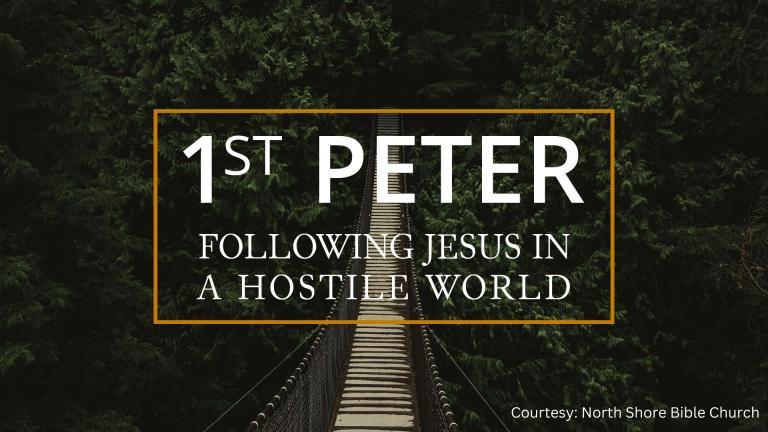
Now Peter begins to address what is the focus of this letter: namely, the relationship of Christians to the hostile world. Peter addresses how they are to live in a world that is hostile to the Church. We should recall that the primary manner of hostility is character attacks and verbal abuse.
His exhortations to each of the subgroups were summarized in the opening of the section when he says that the people of God are called to live “excellent” (2:12) lives in the midst of a hostile pagan culture, even though such behavior will lead to suffering—which in 1 Peter is primarily slander or shaming. For Peter, the result is that unbelievers may be won over to the faith.
Peter first addresses the character of Christians (8). He concludes his list with the command to be “humble in spirit” (8). We must understand that humility was not a virtue in the ancient world. Humility was associated with persons of low status and was a sign of their low social status. To not defend one’s honor, as Peter is encouraging, may have been looked at from the perspective that one was simply unable to defend one’s honor.
Peter’s encouragement to not respond “evil for evil or insult for insult” (8) was also very counter-cultural. His exhortation, however, to give “a blessing instead” (8) would have been even more incredible. But for Peter, this was the very reason why the people of God have been called: “for you were called for the very purpose” (9). Peter then cites the account of David (a righteous sufferer) fleeing from the Philistines (see Ps 34:13-17).
Questions to ponder/discuss:
- We must recognize that Peter is speaking of enemies in the context of social relations and one’s effort to shame another. Peter is not addressing how we are to respond when someone endeavors to bring violent harm to us.
- I think if we are honest with ourselves, the exhortation to give a blessing to our enemies may be the most difficult part of the NT. It is one thing to not hate someone who hates us or to not return evil for evil to them. But to give them a blessing is quite the charge.
- One of the best ways to begin learning to love your enemies is to pray for them. When we pray for them, we are asking God to change them. This is the first step to seeking to bless them.
- Interestingly, blessing your enemies may well be a way to disarm them.
- Do you or anyone in your group have an experience of loving your enemies and eventually the relationship was healed?
Wednesday: Read 1 Peter 3:13-4:11
Peter’s exhortations in the section that began in 2:11 are brought to a climax in 4:11. In this section Peter now interprets their sufferings in light of Christ’s suffering. For Peter, one of the fundamental differences between the life of believers and unbelievers is that the latter is focused on human desires, and the former is focused on doing God’s will.
Peter asks, “who is going to harm you” (13)? Of course, his readers were likely to think of many who would do so. Peter likely has in mind, however, eternal harm. In this case, the answer is “no one.”
Peter then says, “even if you should suffer for the sake of righteousness, you are blessed” (14). In saying this, he is reminding them of God’s eternal perspective. Ultimately, we will both be blessed eternally and our enemies cannot inflict eternal harm on us.
Peter then exhorts them to “sanctify Christ as Lord in your hearts” and to “always being ready to make a defense” (15). Although this verse has been widely used as the ground for Christian apologetics, it seems as though Peter has in mind the call to live a life of holiness which is characterized by suffering and non-violent retaliation. Thus, Peter says that they are to respond with “gentleness” (15) and not a violent outburst in defense of themselves. As a result, we can “keep a good conscience” (16) and put them to shame by our “good behavior” (16).
In 3:18-22, Peter again refers to Jesus as the role model for Christian behavior. Peter notes that Christ suffered for sins “so that He might bring us to God” (18). Then Christ was “made alive in the Spirit” (18). Peter then adds that Jesus “went and made proclamation to the spirits now in prison” (19). What Peter is referring to is highly debated.
Regardless of the difficulty of this passage, Peter’s point is that Jesus only suffered for a little while and was then brought into the presence of God. Since Jesus is a model for Christian suffering, Peter clearly has in mind the goal of encouraging his readers by reminding them that they too will only suffer for a little while.
In 4:1-6, Peter encourages them to stop participating in the things they used to do even though their ceasing such things will lead to their suffering. He begins, “Therefore, since Christ has suffered in the flesh, arm yourselves also with the same purpose” (4:1).
In 4:2-4, he separates the Christian life into two parts. The first part is our life before coming to Christ and the second part is our life after faith in Christ. He argues that even though we are still in the flesh, we should choose to suffer for Christ because this shows that we are no longer motivated by human desires but by the will of God.
Peter concludes this section with a reminder that the end is near (7).
Questions to ponder/discuss:
- It is interesting how much of the message of the NT encourages Christians to be faithful despite suffering. We have addressed this numerous times in our study of the NT. Each time it brings us back to the question of why many Christians in the West do not experience much suffering. I wonder if the answer, at least in part, is found in the fact that we have become so much like the world that the world has no reason to persecute us.
- Many Christians in the West have found an increasing opposition within society primarily centered on certain political and ethical convictions. I wonder here, however, if the “opposition,” which some may choose to label “persecution,” is not so much because of our Christian convictions but because of our failure to present them in love. I am reminded of the title of Eugene Cho’s book Thou Shall Not be a Jerk.
- What are your thoughts on this and how might Christians be able to hold to their convictions and yet present them in love?
Thursday: Read 1 Peter 4:12-19
The final section of this letter extends from 4:12-5:11. Note that Peter begins in 412 with “beloved,” which often marks the beginning of a new section.
In 4:12-19, he begins by putting their suffering in the context of the kingdom of God. There was a popular conviction within Judaism and early Christianity known as the “messianic woes.” This tradition associated the suffering of God’s people with the coming of the Messiah. It is in light of this conviction that Peter notes, they should “not be surprised at the fiery ordeal among you . . . as though something strange were happening to you” (12).
Peter’s concerns are two-fold. First, he wants them to understand that suffering is to be expected. Second, he wants to encourage them to continue to live faithfully as a sign of their trust in God. For Peter, our sufferings are a sharing in “the sufferings of Christ” (13). The idea then is that in our suffering we are not only not to be ashamed (16), but to “glorify God” (16).
Peter also explains that our suffering should be understood in light of the judgment (17). The people of God experience judgment in the present. The rest, however, will have to face judgment later (18).
“Therefore,” Peter concludes, “those also who suffer according to the will of God shall entrust their souls to a faithful Creator in doing what is right” (19).
Questions to ponder/discuss:
- Many Christians might struggle with the idea that we share in “the sufferings of Christ.” For them, Jesus’ sufferings were sufficient and “once for all” (Rom 6:10). And this is certainly true. But what Peter is getting at here is the idea that the people of God suffer as a means of being made perfect (or growing in sanctification as some might prefer to say). Note that Paul says something similar in Col 1:24, “in my flesh I do my share on behalf of His body, which is the church, in filling up what is lacking in Christ’s afflictions.”
- In light of this, what do you think the role of suffering is for you? And how do you see this working out in your situation?
Friday: Read 1 Peter 5:1-14
Peter brings the body of the letter to a close in 5:11. Note the opening, “therefore” (1). Peter addresses three groups in this section. Peter focuses on how they are to use their privileged position within the church and society.
First, he speaks to the “elders” (1-4). They are to be like shepherds and to “shepherd the flock of God” (1). In doing so, the leaders must lead for the benefit of others and not for their own gain (2).
Second, Peter speaks to the “younger men” (5). Peter is concerned that they respect the elders and submit to them (5). We might see how this could be a problem if the elders are encouraging them to follow Christ and this results in shame and troubles within the larger society. One might suspect that many young men might choose to pursue the honor and benefits that Rome has to offer rather than the sufferings brought about by listening to their elders.
Third, Peter speaks to everyone. They are to “clothe yourselves with humility toward one another” (5). There is no doubt that Peter’s exhortation to pursue humility will create tension and anxiety for them as they attempt to navigate the Roman world. Thus, he urges them to cast “all your anxiety on Him, because He cares for you” (7).
In addition, they must be on the alert because the devil “prowls around like a roaring lion [and] seeking someone to devour” (8). The devil attempts to lead the people of God astray by offering ways to alleviate suffering. Consequently, he must be resisted (9).
Finally, once the people of God have completed their suffering, then God “will Himself perfect, confirm, strengthen and establish you” (10). For Peter, as with Paul (see Phil 2:5-11), humility leads to exaltation.
Peter concludes the letter with the customary greetings (12-14). His reference to those in “Babylon” (13) most likely indicates Rome. He refers to Mark as “my son” (13). The relationship between Peter and Mark was well-known in the early church. This has led many to suspect that Peter was the primary source of the Gospel of Mark.
Questions to ponder/discuss:
- How much does humility characterize your relationship with others—especially those in the church?
- What can you do to demonstrate greater humility?
- Note: one of the difficulties of living humbly is that others may take advantage of your love and generosity.
Our goal is to keep these posts free of charge. I do not intend to ever hide them behind a paywall. I can only do this if those of you who have been blessed by them and can afford to give ($5, $10, $25, or more/month) do so. You can give a tax-deductible contribution by following this link.
Please share this post and let others know about determinetruth.
If you wish to view this blog on your smartphone through the Determinetruth app simply download the “tithe.ly church” app on your smartphone and insert “determinetruth” as the church name you wish to follow. Once it is loaded, simply click on the “blog” icon and it will automatically load.
If you would like to have Rob speak at your church or organization in person or via zoom, please let us know by filling out the contact info on the Contact me tab on this site.
[1] This guide is meant to be done either as a group study over the course of 2 or 4 meetings (Day 1-5; 6-10; 11-15; 16-20), or as a private devotion over the course of 4 weeks (or a calendar month—5 lessons per week).
[2] See my blog post from June 11, 2021, for a more detailed discussion of this passage.
General Christian
Family, Parenting and Religion
Education and Religion
About Rob Dalrymple
Rob Dalrymple is married to his wife Toni and is the father of four fabulous children, and two grandchildren. He has been teaching and pastoring for over 33 years at colleges, seminaries, and the local church. He has a PhD in biblical interpretation. He is the author of four books (including Follow the Lamb: A Guide to Reading, Understanding, and Applying the Book of Revelation & Understanding the New Testament and the End Times: Why it Matters) as well as numerous articles and other publications. He is currently completing a commentary on the book of Revelation titled, “Revelation: a Love story” (Cascade Books, pending 2024). You can read more about the author here.
Previous Post

March 20, 2023
Deconstruction/Reconstruction: Jesus is the answer! Worldview #8
Next Post

March 27, 2023 The New Creation has begun: but do we believe it? Worldviews #9
Browse Our Archives
Select a Category 000 1 Cor 11:17-34 1 Corinthians 1 John 1 Peter 1 Thessalonians 1 Timothy 10 Commandments 2 Corinthians 2 John 2 Peter 2 Thessalonians 2 Timothy 3 John 666 Abortion Acts 2:42 Ahmaud Arbery AIPAC All Saints Day America antisemitism BDS Beast Betting Bible Bible study Biblical Interpretation Biden Book of Acts Boycott Campus Protests Catholicism Ceasefire Chavez Ravine Christian Nationalism Christian Zionism Christianity Today Christmas Church Colossians Communion Convict Leasing Covid-19 Craig Blaising creation Crucifixion Daoud Nassar Deception Deconstruction Democracy Devotional guide Discipleship Easter Eden Education Election End-times Ephesians Eschatology Ethnic Cleansing Evangelicalism Evangelicals Evolution Fall Famine Fascism FIFA Freedom of Speech Galatians Gary Burge Gaza Gaza; Genocide; Boycott Genesis Genocide George Floyd Global Warming God's will Gospel Gospel of John Gospel of Luke Gospel of Mark Gospel of Matthew Government Grace Great Prostitute Hamas Harris healthcare Hebrews HeGetsUs Holy Spirit Holy Week Honor Father and Mother ICJ Immigration Indigenous peoples day Iran Israel Israel Palestine Itamar Ben Gvir James Jesus Joel Willits Jude Just war Justice Kamala Harris Kingdom Of God Kings and Queens land of Israel Law (OT) Lazarus Les Miserable LGBTQ+ Love Luke Mahmoud Khalil Man of Lawlessness Mark Mark of the Beast Marriage Martin Luther King Jr Mercy Mexican Repatriation Military-Industrial-Complex Ministry Mission Money NAFTA Nakba Netanyahu New Creation New Testament Nicaragua Nicodemus Non Violence Occupation Pacifism Palestine Parable Paul Peace Pentecost Peonage Philemon Philippians Politics Poor Power Prayer Pride Month Priests Pro-life Propaganda Prophesy Prophet Qatar Queen Elizabeth Racism Reconstruction Redemption Reformation Resurrection Revelation Roe v Wade Romans Romans 13:1-7 Rome Russia Sabbath Samaritan Seals Sermon Settlements Slavery Spiritual gifts Taxes Tent of Nations Terrorism The Beast Theology Titus Torture Trump truth Ukraine Uncategorized Veteran's Day War Warsaw Ghetto wealth Wedding Women World Cup 2022 Worldview Worship Wrath Yemen Zionism
Select a Month September 2026 May 2026 February 2026 November 2025 October 2025 August 2025 July 2025 June 2025 May 2025 April 2025 March 2025 February 2025 January 2025 December 2024 November 2024 October 2024 September 2024 August 2024 July 2024 June 2024 May 2024 April 2024 March 2024 February 2024 January 2024 December 2023 November 2023 October 2023 September 2023 August 2023 July 2023 June 2023 May 2023 April 2023 March 2023 February 2023 January 2023 December 2022 November 2022 October 2022 September 2022 August 2022 July 2022 June 2022 May 2022 April 2022 March 2022 February 2022 January 2022 December 2021 November 2021 October 2021 September 2021 August 2021 July 2021 June 2021 May 2021 April 2021 March 2021 February 2021 January 2021 December 2020 October 2020 September 2020 August 2020 July 2020 June 2020 May 2020 April 2020 March 2020 February 2020 January 2020 December 2019 November 2019 October 2019 August 2019 July 2019 June 2019 May 2019 April 2019 August 2018 June 2018 May 2018 March 2018 September 2017 July 2017 May 2017 November 2016 October 2016 May 2016 April 2016 March 2016 December 2015 November 2015 October 2015 September 2015 August 2015 July 2015
Follow Us!
TAKE THE
Religious Wisdom Quiz
What was the primary inheritance method in biblical times?
Select your answer to see how you score.
Oldest daughter Firstborn son Equal division Youngest child
Support this
Column


Related posts from Determinetruth
Will our Election Change Anything in Gaza or...

What Would You Do? Gaza, Torture, and the...

What can we learn from Bathsheba? Understanding Isr-Pal...

TRENDING AT PATHEOS Evangelical

Happy Thanksgiving! I published this Thanksgiving column back in 2017 in...

More Than a Meal: A Messianic Thanksgiving
A Messianic Thanksgiving What if Thanksgiving became more than a meal to...

The Darkening of the Sun, Moon, and Stars
The darkening of the sun and moon and the falling of stars...

Gratitude as the Parent of All Virtues
Giving thanks stems from gratitude. Cicero said that gratitude is the parent...

Make Thanksgiving Bring Family Closer
Written by Dr. David K. Ewen from Eternal Truth Bible College Start...

Ghosts, Spirits, and Wizards in Post-Puritan New England
As it is Thanksgiving, I have a seasonal post concerned with New...
view all Evangelical blogs
Ad-Free & Subscriber Log-In Subscription Support
- About Us
- 2026 Calendar
- Videos
- Podcasts
- Library of World Religions
- Faith In Media Tracker
- Advertise With Us
- Write for Us
- Privacy Policy
- Terms of Service
- Do Not Sell My Data
- Contact Us
- Radiant Digital
- Manage Newsletter Subscriptions
- Unsubscribe From Notifications
- Sitemap
Copyright 2008-2026, Patheos, part of the Radiant Digital network of media brands. All rights reserved.
Subscription Support Ad-Free & Subscriber Log-In
Follow Patheos