
BuddhistCatholicContemplativeEvangelicalGeneral ChristianHinduJewishLatter-day SaintMuslimNew VisionsProgressive Christian
Beliefs
- Buddhist
- Catholic
- Contemplative
- Evangelical
- General Christian
- Hindu
- Jewish
- Latter-day Saint
- More Voices
- Muslim
- New Visions
- Pagan
- Progressive Christian
Topics
- Religion News
- Food and Religion
- Sports and Religion
- Religious Art
- Religious Music and Entertainment
- Religious Events
- History and Religion
- Style and Religion
- Politics and Religion
- Women in Religion
- Recreation Outdoors and Religion
- Business Finance and Religion
- Careers Workplace and Religion
- Education and Religion
- Family Parenting and Religion
- Health Fitness and Religion
- Home and Religion
- Relationships and Religion
- Technology and Religion
- Travel and Religion
Columnists
- Buddhist Columnists
- Business Finance and Religion Columnists
- Careers Workplace and Religion Columnists
- Catholic Columnists
- Contemplative Columnists
- Education and Religion Columnists
- Evangelists Columnists
- Family Parenting and Religion Columnists
- General Christian Columnists
- Health Fitness and Religion Columnists
- Hindu Columnists
- History and Religion Columnists
- Home and Religion Columnists
- Jewish Columnists
- More Voices Columnists
- Latter Day Columnists
- Muslim Columnists
- New Visions Columnists
- Nonreligious Columnists
- Pagan Columnists
- Politics and Religion Columnists
- Progressive Columnists
- Recreation Outdoors and Religion Columnists
- Relationships and Religion Columnists
- Religion News Columnists
- Religious Art Columnists
- Religious Events Columnists
- Religious Music and Entertainment Columnists
- Sports and Religion Columnists
- Style and Religion Columnists
- Technology and Religion Columnists
- Travel and Religion Columnists
- Women in Religion Columnists
Resource Library
- 2026 Calendar
- Library of World Religions
- The 100 Most Holy Places on Earth
- Patheos Answers
- Podcasts
- Videos
- Faith Leaders Database
- Anglican Episcopalian
- Bahai
- Baptist
- Buddhism
- Christianity
- Confucianism
- Eastern Orthodoxy
- Hinduism
- Holiness and Pentecostal
- ISKCON
- Islam
- Judaism
- Lutheran
- Methodist
- The Church of Jesus Christ of Latter-day Saints
- New Age
- Paganism
- Presbytarian and Reformed
- Protestantism
- Religion Behind the Scenes
- Roman Catholic
- Scientology
- Shia Islam
- Sikhism
- Sufism
- Sunni Islam
- Taoism
- Zen
- See all religions
Research Tools
 Ad-Free & Subscriber Log-In Subscription Support
Ad-Free & Subscriber Log-In Subscription Support
Follow Patheos 

- Trending:
- Forgiveness
- |
- Marriage
- |
- Consciousness
- |
- Death Penalty
- |
- Election
- |
- Halloween

-
More
- Home
- Evangelical
- Devotional Guide 1 Corinthians #1: 1 Cor 1-3
Devotional Guide 1 Corinthians #1: 1 Cor 1-3
Last updated on: August 19, 2022 at 1:38 am by Rob Dalrymple
Devotional Guide 1 Corinthians #1: 1 Cor 1-3 2022-08-07T10:59:14-08:00 Rob Dalrymple
Patheos Explore the world's faith through different perspectives on religion and spirituality! Patheos has the views of the prevalent religions and spiritualities of the world.
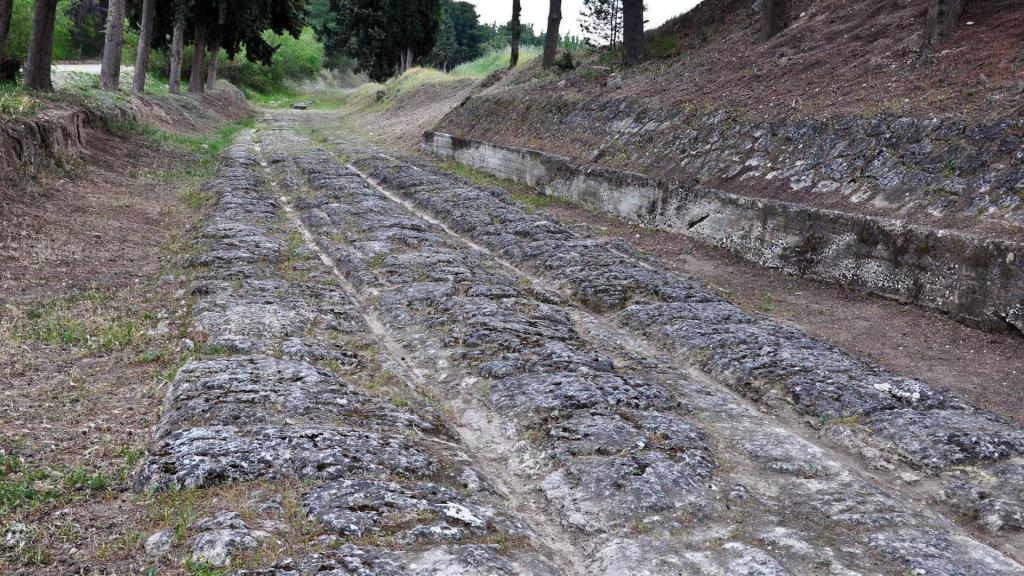
Corinthian road in which cargo was transported from one side of the isthmus to the other
Monday: Read 1 Cor 1:1-9
Paul’s writings customarily begin with a greeting and a thanksgiving. Though we might want to skip them and move on to the body of the letter, we actually need to pay close attention. Some of the key issues in Paul’s letters first appear in the greeting and thanksgivings.
This letter, which we call “1st Corinthians” is actually the second letter that Paul has written to this church (see 5:9). Paul writes to them to address the problems and divisions in the Church. In addition, beginning in 7:1, Paul is responding to a letter that they wrote to him.
There was much contention between Paul and the Corinthians. Much of this letter can be understood as Paul’s argument that he was right and they were wrong. Paul uses phrases like, “do you not know . . .” (10x) and “if anyone thinks that he is . . .” (3x) to show them that they are in error.
Questions to ponder/discuss:
- Read 1:1-8 several times over. Pick out (highlight or underline) as many keywords and repeated words as you can find.
- Did you notice how often “Christ” appears? (64x in the whole letter)
- Why do you think Paul says that he is an apostle “called by the will of God”? This is strong language and not paralleled in Paul’s other letters. Why do you think Paul states in such strong terms not only that he is an apostle, but that he is because of God’s will?
Tuesday: Read 1 Cor 1:10-17
In order to understand 1 Corinthians (and many of Paul’s letters) well we must be reminded of the Roman practice of patronage. The city of Corinth was well known for its ‘patrons’. These were wealthy and powerful people who took on individuals or whole families as ‘clients.’ The Patron would provide the clients with land, jobs, money, and legal protection. The clients would then offer them various services. The clients would be indebted to the Patron. Patrons were very powerful figures and had significant influence within the city. They were the honored ones.
It is quite significant that Paul refused the support of any patrons. If Paul were to receive their support, and it had to be tempting, Paul would be in their debt.
Instead, Paul chose to work as a common laborer. In doing so, he associates himself with the slaves and poor. Though we might think of such an act as a great example of piety, those in the Roman world would not have. In fact, Paul’s actions would have angered many. Ben Witherington summarizes the problem, “Corinth was a city where public boasting and self-promotion had become an art form. The Corinthian people thus lived with an honor-shame culture orientation, where public recognition was often more important than facts. . . . In such a culture a person’s sense of worth is based on recognition by others of one’s accomplishments, hence the self-promoting public inscriptions.”[2]
The church in Corinth was very divided (12). Some followed Paul. Some were following Apollos (Acts 18:21-19:4). He may have been a more eloquent speaker than Paul. Some were following Peter (“Cephas”). These may have been Jewish members of the church who were struggling with Paul’s acceptance of the Gentiles. Others followed Christ. These, perhaps, were the spiritual elites—or so they thought they were.
Questions to ponder/discuss:
- Unity is an essential feature of the Church because it reflects the unity of the Trinity (John 17:21). God is One and his calls his people to be one. What are some reasons why the church today is not unified? (note: some might be valid reasons). What are some things we can do to be more unified?
Wednesday: Read 1 Cor 1:18-2:5
Note that this section is framed with references to “the power of God” (1:18; 2:5).
Paul also caused problems in the city and among some of the wealthy members of the Church because he refused to speak as the professional speakers did. These professional speakers used various performative tactics in order the purpose of gaining praise from the listeners.
Because Paul refused to follow the “rules” on how to speak and to win the audience over, some in the Corinthian congregation were ashamed of Paul (it is as though they were saying, “why can’t you be like the other great speakers who travel the world? Then we would be honored because of your fame.”).
Ironically, Paul notes that the message of the cross was a “stumbling block” (23) to the Jews. This was because Jesus’ death by crucifixion made him cursed according to Deut 21:22-23. The message of the cross was also “foolishness” to the Greeks (18, 21, 23). This was because the Gospel was about a person who died by crucifixion—a death that was reserved for the worst offenders. In other words, the Christians were preaching that their Lord was some low-life who died the most despicable form of death.
Paul responds by noting that even though the world considers the message “foolishness” it still brings salvation to those who believe (21). Thus, the “wisdom” of God—the cross—may be foolishness to the nations but it is “the power of God and the wisdom of God” (24).
In 2:1-4, Paul begins his response to the false teachers who were contending against Paul’s ministry and authority. They were especially saying that Paul did not teach at high a level of wisdom as they did. Paul explains that it was the content of the message (Christ crucified: 2) which was important. For Paul, the truth of the content was confirmed by the Spirit’s power (4).
Questions to ponder/discuss:
- Paul’s explanation as to why he refused to speak with the eloquence that they wanted him to was that he was preaching, “Christ crucified” (23). In other words, the Gospel message that Paul proclaims is about humility and suffering. For him to become an esteemed rhetorician like they wanted him to be would undermine the very message he was presenting. For Paul, the Gospel was about Jesus Christ and Him crucified. Paul’s point is that our lives must match our message. If we preach about a suffering Messiah who dies by crucifixion, then our lives should resemble that message.
- Too often we try to appeal to the wealthy, the powerful, the educated, or any other people or groups that will bring us power, respect, or wealth. Such acts would be strongly condemned by Paul.
- Consider your life and the ways it matches the Gospel message and the ways it doesn’t. Find a close mentor and give them the freedom to speak honestly into your life and to note the things you can improve on so that your life matches your message.
Thursday: Read 1 Cor 2:6-3:4
Paul responds to the accusation that the Corinthians have leveled against him: namely, that he doesn’t speak with “wisdom.”
The talk of wisdom brings us back to Genesis (see tomorrow’s reading for more on Genesis). The wisdom of the world is a “delight to the eyes” and “desirable to make one wise” (Gen 3:6).
Of course, the wisdom of the world is attractive because it is one of power and dominance. This means that the world’s wisdom is only for the powerful and that it comes at the expense of the weak and vulnerable. The world’s wisdom brings chaos and destruction.
The wisdom of God, however, is the way of suffering for the sake of the other. It is the way of love—a sacrificial love that lays down its life for others. This is why the powerful do not like the wisdom of God and think it is foolishness.
It is this clash of kingdoms that Paul has in mind. In the end, Paul did not speak the way the Corinthians wanted him to, but his message was still one of “the Spirit and power” (3:4)
Questions to ponder/discuss:
- Understanding the nature of the Gospel and that it does not appeal to power but to love is lost in much of Christianity today. The rise of the prosperity gospel and the like is the opposite of the Gospel. The world seeks power and wealth. In order to obtain power and wealth, others must suffer. In the kingdom of God, the powerful suffer for the sake of others. The kingdom of God is upside-down (or shall we say the world has it upside-down?)
- What are some ways in which we (as individuals, or as a community) live by the standards of the world? What are some ways in which we make it easy for the rich and powerful to succeed and more difficult for the poor?
- One example that struck me the other day was how some non-profits require their board members to give a certain amount of money in order to serve as board members. The idea is that the board members must show that they believe in the ministry enough to financially support it in order to serve. The problem is that this means that the poor cannot serve on the board of that ministry. As a result, the poor have no power and their voice is not heard.
- Think of our country. It is a democracy. But is it? Does everyone have an equal vote? Is everyone’s voice heard? No, the powerful know that in order to stay in power they must cater to others who have power. Helping the poor is often bad for the rich. In addition, a poor person could never run for a governmental office because they can’t afford to and those in power would make sure they didn’t win. (I wish I had more space to expand on this. But look for the determinetruth blog posts in the coming months and the determinetruth podcast series on 1 Corinthians: https://www.determinetruth.com/)
Friday: Read 1 Cor 3:5-15
1 Corinthians 3:5-4:17 is Paul’s longest discussion on leadership and how the members relate.
As we might recall, some in the congregation have been influenced by the desire for the power and the wisdom of the world. Unfortunately, some of the leaders in the church catered to those who sought power.
This makes Paul’s task very difficult because his conflict is not just with those who have been led astray but with some of the leaders.
Paul compares himself and Apollos. He notes that they are both servants (5) and that neither of them is responsible for the growth of the church (6). They are both God’s fellow workers (9)—that is, they have the same rank. Ultimately, it is God that does the work! (6, 7).
That Paul still has Genesis in mind becomes clear in this passage. Paul uses two metaphors to describe the church that both refer back to Genesis and Eden: a garden and a temple.
First, Paul uses the imagery of a garden—which certainly elicits thoughts of Eden. Both he and Apollos shared the task of attending to the Garden (6-9)—which is the Church: “we are God’s field” (9). Paul’s point is that they share the work of the ministry and that it is God who causes the growth (6, 7).
Second, Paul refers to a building: we are “God’s building” (9). The building that Paul has in view here is the temple (this is made explicit in 3:16-17). This is clear because Paul refers to his own work of laying the foundation as a “wise master builder” (10). This language hints back to the “skilled” workers who were responsible for the construction of the tabernacle (Exod 35:31-32; 31:4).[3]
Paul adds to the metaphor of the temple by noting that the foundation is Jesus (11)! And that each person will be held accountable for the quality of their work (13-15).
By means of these two metaphors, Paul demonstrates that those in leadership in the church share responsibilities and that they will be judged for their work. Paul also shows that it is not in the greatness of the speakers or their presentations that brings the transformation, but God.
Questions to ponder/discuss:
- This passage speaks deeply to the way in which we set up our churches. We usually have a strong hierarchy in our churches. This may work but it often puts too much power in the hands of one person and it often fails to share the responsibilities of the ministry.
- It is also my suspicion that too many churches fail to use volunteers enough. We should construct our churches so that others can fully utilize their gifts and share in the ministry of the church.
- What do you think is the significance of the fact that Paul uses Eden imagery (garden-temple) to describe the church? Note: it is very significant!
NB: our goal is to keep these posts free of charge. I do not intend to ever hide them behind a paywall. I can only do this if those of you who have been blessed by them and can afford to give ($5, $10, $25, or more/month) do so. You can give a tax-deductible contribution by following this link.
Please share this post and let others know about determinetruth.
If you wish to view this blog on your smartphone through the Determinetruth app simply download the “tithe.ly church” app on your smartphone and insert “determinetruth” as the church name you wish to follow. Once it is loaded, simply click on the “blog” icon and it will automatically load.
If you would like to have Rob speak at your church or organization in person or via zoom, please let us know by filling out the contact info on the Contact me tab on this site.
[1] This guide is meant to be done either as a group study over the course of 2 or 4 meetings (Day 1-5; 6-10; 11-15; 16-20), or as a private devotion over the course of 4 weeks (or a calendar month—5 lessons per week).
[2] Witherington, Conflict and Community, 8
[3] Also, the language of gold, silver, precious stones, and wood only occurs together in the description of Solomon’s temple (1 Chronicles 29:2).
About Rob Dalrymple
Rob Dalrymple is married to his wife Toni and is the father of four fabulous children, and two grandchildren. He has been teaching and pastoring for over 32 years at colleges, seminaries, and the local church. He has a PhD (Westminster Theological Seminary) in biblical interpretation. He is the author of four books (including Follow the Lamb: A Guide to Reading, Understanding, and Applying the Book of Revelation & Understanding the New Testament and the End Times: Why it Matters) as well as numerous articles and other publications. You can read more about the author here.
Previous Post

August 16, 2022
The Mark of Beast and “666”: #1
Next Post
August 23, 2022 The Mark of the Beast and 666: #2
Browse Our Archives
Select a Category 000 1 Cor 11:17-34 1 Corinthians 1 John 1 Peter 1 Thessalonians 1 Timothy 10 Commandments 2 Corinthians 2 John 2 Peter 2 Thessalonians 2 Timothy 3 John 666 Abortion Acts 2:42 Ahmaud Arbery AIPAC All Saints Day America antisemitism BDS Beast Betting Bible Bible study Biblical Interpretation Biden Book of Acts Boycott Campus Protests Catholicism Ceasefire Chavez Ravine Christian Nationalism Christian Zionism Christianity Today Christmas Church Colossians Communion Convict Leasing Covid-19 Craig Blaising creation Crucifixion Daoud Nassar Deception Deconstruction Democracy Devotional guide Discipleship Easter Eden Education Election End-times Ephesians Eschatology Ethnic Cleansing Evangelicalism Evangelicals Evolution Fall Famine Fascism FIFA Freedom of Speech Galatians Gary Burge Gaza Gaza; Genocide; Boycott Genesis Genocide George Floyd Global Warming God's will Gospel Gospel of John Gospel of Luke Gospel of Mark Gospel of Matthew Government Grace Great Prostitute Hamas Harris healthcare Hebrews HeGetsUs Holy Spirit Holy Week Honor Father and Mother ICJ Immigration Indigenous peoples day Iran Israel Israel Palestine Itamar Ben Gvir James Jesus Joel Willits Jude Just war Justice Kamala Harris Kingdom Of God Kings and Queens land of Israel Law (OT) Lazarus Les Miserable LGBTQ+ Love Luke Mahmoud Khalil Man of Lawlessness Mark Mark of the Beast Marriage Martin Luther King Jr Mercy Mexican Repatriation Military-Industrial-Complex Ministry Mission Money NAFTA Nakba Netanyahu New Creation New Testament Nicaragua Nicodemus Non Violence Occupation Pacifism Palestine Parable Paul Peace Pentecost Peonage Philemon Philippians Politics Poor Power Prayer Pride Month Priests Pro-life Propaganda Prophesy Prophet Qatar Queen Elizabeth Racism Reconstruction Redemption Reformation Resurrection Revelation Roe v Wade Romans Romans 13:1-7 Rome Russia Sabbath Samaritan Seals Sermon Settlements Slavery Spiritual gifts Taxes Tent of Nations Terrorism The Beast Theology Titus Torture Trump truth Ukraine Uncategorized Veteran's Day War Warsaw Ghetto wealth Wedding Women World Cup 2022 Worldview Worship Wrath Yemen Zionism
Select a Month September 2026 May 2026 February 2026 November 2025 October 2025 August 2025 July 2025 June 2025 May 2025 April 2025 March 2025 February 2025 January 2025 December 2024 November 2024 October 2024 September 2024 August 2024 July 2024 June 2024 May 2024 April 2024 March 2024 February 2024 January 2024 December 2023 November 2023 October 2023 September 2023 August 2023 July 2023 June 2023 May 2023 April 2023 March 2023 February 2023 January 2023 December 2022 November 2022 October 2022 September 2022 August 2022 July 2022 June 2022 May 2022 April 2022 March 2022 February 2022 January 2022 December 2021 November 2021 October 2021 September 2021 August 2021 July 2021 June 2021 May 2021 April 2021 March 2021 February 2021 January 2021 December 2020 October 2020 September 2020 August 2020 July 2020 June 2020 May 2020 April 2020 March 2020 February 2020 January 2020 December 2019 November 2019 October 2019 August 2019 July 2019 June 2019 May 2019 April 2019 August 2018 June 2018 May 2018 March 2018 September 2017 July 2017 May 2017 November 2016 October 2016 May 2016 April 2016 March 2016 December 2015 November 2015 October 2015 September 2015 August 2015 July 2015
Follow Us!
TAKE THE
Religious Wisdom Quiz
True or False: Paul instructed Philemon to receive Onesimus back as more than a slave, as a dear brother.
Select your answer to see how you score.
TRUE FALSE
Support this
Column


Related posts from Determinetruth

The Gospel Above Party: Why I Speak Critically...

A Scholar Weighs In: Why Don't You Listen...

Obey Governments? Not What Paul Said: Reading Rom...

When Trump and MAGA Meet the War Machine
TRENDING AT PATHEOS Evangelical

Letters on Living the Faith by C.S. Lewis
Most of us met C.S. Lewis as a public intellectual. Mere Christianity....

When Halloween Unmasks Married Hearts
Written by Dr. David K. Ewen from Eternal Truth Bible College Behind...

Aristotle. He’s been called the father of logic, the father of the...

Methodist Central Hall and Westminster Abbey
Situated on the same square is Methodist Central Hall and Westminster Abbey. ...

57th Dove Awards Honor Dolly Parton, Crown New...
On gospel music’s biggest night, the 57th annual GMA Dove Awards honored...

The First Eucharistic Controversy: Christ’s Real Presence
For Catholics, the Eucharist is the source and summit of the Christian...
view all Evangelical blogs
Ad-Free & Subscriber Log-In Subscription Support
- About Us
- 2026 Calendar
- Videos
- Podcasts
- Library of World Religions
- Faith In Media Tracker
- Advertise With Us
- Write for Us
- Privacy Policy
- Terms of Service
- Do Not Sell My Data
- Contact Us
- Radiant Digital
- Manage Newsletter Subscriptions
- Unsubscribe From Notifications
- Sitemap
Copyright 2008-2026, Patheos. All rights reserved.
Subscription Support Ad-Free & Subscriber Log-In
Follow Patheos