
BuddhistCatholicContemplativeEvangelicalGeneral ChristianHinduJewishLatter-day SaintMuslimNew VisionsProgressive Christian
Beliefs
- Buddhist
- Catholic
- Contemplative
- Evangelical
- General Christian
- Hindu
- Jewish
- Latter-day Saint
- More Voices
- Muslim
- New Visions
- Pagan
- Progressive Christian
Topics
- Religion News
- Food and Religion
- Sports and Religion
- Religious Art
- Religious Music and Entertainment
- Religious Events
- History and Religion
- Style and Religion
- Politics and Religion
- Women in Religion
- Recreation Outdoors and Religion
- Business Finance and Religion
- Careers Workplace and Religion
- Education and Religion
- Family Parenting and Religion
- Health Fitness and Religion
- Home and Religion
- Relationships and Religion
- Technology and Religion
- Travel and Religion
Columnists
- Buddhist Columnists
- Business Finance and Religion Columnists
- Careers Workplace and Religion Columnists
- Catholic Columnists
- Contemplative Columnists
- Education and Religion Columnists
- Evangelists Columnists
- Family Parenting and Religion Columnists
- General Christian Columnists
- Health Fitness and Religion Columnists
- Hindu Columnists
- History and Religion Columnists
- Home and Religion Columnists
- Jewish Columnists
- More Voices Columnists
- Latter Day Columnists
- Muslim Columnists
- New Visions Columnists
- Nonreligious Columnists
- Pagan Columnists
- Politics and Religion Columnists
- Progressive Columnists
- Recreation Outdoors and Religion Columnists
- Relationships and Religion Columnists
- Religion News Columnists
- Religious Art Columnists
- Religious Events Columnists
- Religious Music and Entertainment Columnists
- Sports and Religion Columnists
- Style and Religion Columnists
- Technology and Religion Columnists
- Travel and Religion Columnists
- Women in Religion Columnists
Resource Library
- 2026 Calendar
- Library of World Religions
- The 100 Most Holy Places on Earth
- Patheos Answers
- Podcasts
- Videos
- Faith Leaders Database
- Anglican Episcopalian
- Bahai
- Baptist
- Buddhism
- Christianity
- Confucianism
- Eastern Orthodoxy
- Hinduism
- Holiness and Pentecostal
- ISKCON
- Islam
- Judaism
- Lutheran
- Methodist
- The Church of Jesus Christ of Latter-day Saints
- New Age
- Paganism
- Presbytarian and Reformed
- Protestantism
- Religion Behind the Scenes
- Roman Catholic
- Scientology
- Shia Islam
- Sikhism
- Sufism
- Sunni Islam
- Taoism
- Zen
- See all religions
Research Tools
 Ad-Free & Subscriber Log-In Subscription Support
Ad-Free & Subscriber Log-In Subscription Support
Follow Patheos 

- Trending:
- Forgiveness
- |
- Marriage
- |
- Consciousness
- |
- Death Penalty
- |
- Election
- |
- Halloween
 Denison Forum
- Home
- Evangelical
- Religion News
- Why this Auschwitz survivor never had children
Why this Auschwitz survivor never had children
Last updated on: January 28, 2025 at 6:16 am by Jim Denison
Why this Auschwitz survivor never had children 2025-01-28T06:16:51-06:00 Jim Denison
Patheos Explore the world's faith through different perspectives on religion and spirituality! Patheos has the views of the prevalent religions and spiritualities of the world.
Teresa Regula arrived at Auschwitz as a sixteen-year-old. Once a healthy child, she contracted chickenpox, measles, and scarlet fever in the horrific Nazi concentration camp.
Speaking ahead of yesterday’s eightieth anniversary of Auschwitz’s liberation by Soviet troops, she said: “When I returned (from the camp), I thought, ‘I’m never going to have children—ever.’ If they had to go through even a fraction of what I went through, I didn’t want that.”
Though she later married, she has remained childless all her life.
Having visited the Holocaust museum in Israel and several in US cities over the years, I know that I cannot begin to understand the horror of the atrocities inflicted on the Jewish people by the Nazis. A million of them were murdered in Auschwitz, six million in total. A fourth of the victims were children.
“I cry by day, but you do not answer”
I would imagine that many of Hitler’s Jewish victims knew Psalm 22, David’s famous prayer of lament. They of all people would have the right to pray its opening words:
My God, my God, why have you forsaken me? Why are you so far from saving me, from the words of my groaning? O my God, I cry by day, but you do not answer, and by night, but I find no rest (vv. 1–2).
David goes on to describe his suffering in detail:
- “All who see me mock me; they make mouths at me; they wag their heads; ‘He trusts in the Lᴏʀᴅ; let him deliver him; let him rescue him, for he delights in him!’” (vv. 7–8).
- “They have pierced my hands and feet” (v. 16).
- “I can count all my bones—they stare and gloat over me” (v. 17).
- “They divide my garments among them, and for my clothing, they cast lots” (v. 18).
And yet, he refuses to abandon his belief in the goodness of his God: “You are holy, enthroned on the praises of Israel. In you our fathers trusted; they trusted, and you delivered them” (vv. 3–4).
Now comes the hard question: What do we do when God does not deliver us?
What would David say to the victims of Auschwitz?
Psalm 22 on the cross
One Jew in particular especially had the right to ask our question.
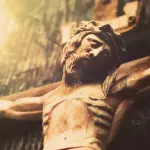
Jesus made David’s initial lament his own cry from the cross: “My God, my God, why have you forsaken me?” (Matthew 27:46). His death on Calvary fulfilled Psalm 22’s descriptions in stunning detail:
- His enemies mocked him with the exact words of Psalm 22:8 (Matthew 27:43).
- “They have pierced my hands and feet” (Psalm 22:16) is a graphic depiction of crucifixion, though the Persians did not invent this horrific form of execution until four centuries after the time of David.
- “I can count all my bones” (Psalm 22:17): before Jesus’ executioners could break his legs to hasten his death, as was typical, he “gave up his spirit” (John 19:30, 33).
- “They divide my garments among them, and for my clothing they cast lots” (Psalm 22:18): this was precisely how Jesus’ executioners stole his clothing (John 19:23–24).
Crucifixion was one of the worst forms of torture ever devised. And yet Jesus refused to drink even wine mixed with gall to dull his senses, choosing to experience the cross in all its excruciating pain (Matthew 27:34).
What’s more, his sinless soul was made to bear the sins of all of humanity across all time (Isaiah 53:6; 2 Corinthians 5:21). You and I have no possible way to imagine the horror, disgust, and grief this must have caused him. Even worse, the holy Father was forced in that moment to turn from his sin-bearing Son, causing Jesus to cry out in agony at having been “forsaken” by him.
In total, Jesus suffered physical, emotional, mental, and spiritual pain on a level no other human has ever experienced. And yet, somehow, he found the faith to pray at the end, “Father, into your hands I commit my spirit” (Luke 23:46).
How can we do the same?
I have no simple formulas to offer Holocaust survivors, or those devastated by the wildfires and now the floods and mudslides in California, or Ukrainians continuing to suffer from Russia’s immoral and illegal invasion, or anyone else facing the tragedy and pain of our fallen world.
However, I’ve made two discoveries over the years that I find deeply encouraging in my hardest days.
One: Faith in God is most needed when it is hardest.
When all is well, it is easy to trust in the God we credit for our success. When he answers our prayers in the ways we want him to, it’s easy to have faith in him. But when our days are painful beyond despair, when our suffering knows no release and our grieved questions have no answers, those are the times when we need an omnipotent Father the most.
But he cannot give what we do not have faith to receive. And so, it is when we find it hardest to trust him that we most need to trust him. It is when we are sickest that we most need a doctor.
Of course, it is in such times that faith can be hardest to choose, which leads to my second observation.
Two: My lack of faith is God’s invitation to seek the faith he alone can give.
One reason God allows us to come to the end of ourselves is so we can turn to him for the faith we cannot muster up ourselves, a faith that our circumstances can neither warrant nor produce. Then we can cry with the demoniac’s desperate father, “I believe; help my unbelief!” (Mark 9:24).
I once heard a pastor say, “When you don’t have faith, pray for the faith to have faith.”
We can ask our Lord to help us believe that his omniscient ways are higher and better than ours (Isaiah 55:9); that the God who “is” love can only want our best (1 John 4:8); that the Father who redeems all he allows will redeem even this, whether we understand his redemption in this life or the next (cf. 1 Corinthians 13:12).
Carolyn Custis James observed,
“Joy isn’t grounded in our circumstances; it is grounded in the unchanging character of God.”
Will you choose joy today?
Our latest website articles:
- “Why did Emilia Peréz actually receive 13 Oscar nominations? What the film about a transgender cartel leader could reveal about our culture”
- “Court rules that elephants are not persons: A reflection on your deepest purpose and highest joy”
- “Did China damage Taiwan’s internet service? Undersea cables and gray zone conflict”
- “Four reflections on Bishop Budde’s message to Donald Trump”
- “First hostages released in Hamas–Israel ceasefire: Can there ever be peace between Jews and Arabs?”
Quote for the day:
“You don’t really know Jesus is all you need until Jesus is all you have.” —Tim Keller
Previous Post
January 27, 2025
Hamas releases four hostages, but what about the others?
Next Post

January 29, 2025 Why DeepSeek “turned tech and Wall Street upside down”
Browse Our Archives
Select a Category america biblical-living Uncategorized
Select a Month March 2025 February 2025 January 2025 December 2024 November 2024 October 2024 September 2024 August 2024 July 2024 June 2024 May 2024 April 2024 March 2024 February 2024 January 2024 December 2023 November 2023 October 2023 September 2023 August 2023 July 2023 June 2023 May 2023 April 2023 March 2023 February 2023 January 2023 December 2022 November 2022 October 2022 September 2022 August 2022 July 2022 June 2022 May 2022 April 2022 March 2022 February 2022 January 2022 August 2021 July 2021 June 2021 May 2021 April 2021 March 2021 February 2021 January 2021 December 2020 November 2020 October 2020 September 2020 August 2020 July 2020
Follow Us!
TAKE THE
Religious Wisdom Quiz
Who does the Bible say is Lord of the Sabbath?
Select your answer to see how you score.
Jesus Moses Man Satan
Related posts from Denison Forum

Five ways “Covid changed everything around us”

Father of thirteen-year-old cancer survivor responds to Rachel...

Will Trump dismantle the Department of Education today?

Is Trump wrong to negotiate with Russia?
TRENDING AT PATHEOS Evangelical

How the author of the world's best hymn...
I've been working with John Newton for a while now. This makes...

Long before this Lectio Divina, Psalm 130 - the song - started...

What About the Trees? Another Living Parable
After I finished writing the last article about falling leaves as a...

Why Classical Education Is a Conversation, Not a...
Come and Read: Joy in Classical Education When I was a little...

Falling Leaves: A Living Parable on Letting Go
I’ve spent the vast majority of my life in the southeast corner...

Cornell University has received a great deal of negative publicity and intense...
view all Evangelical blogs
Ad-Free & Subscriber Log-In Subscription Support
- About Us
- 2026 Calendar
- Videos
- Podcasts
- Library of World Religions
- Faith In Media Tracker
- Advertise With Us
- Write for Us
- Privacy Policy
- Terms of Service
- Do Not Sell My Data
- Contact Us
- Radiant Digital
- Manage Newsletter Subscriptions
- Unsubscribe From Notifications
- Sitemap
Copyright 2008-2026, Patheos. All rights reserved.
Subscription Support Ad-Free & Subscriber Log-In
Follow Patheos