
BuddhistCatholicContemplativeEvangelicalGeneral ChristianHinduJewishLatter-day SaintMuslimNew VisionsProgressive Christian
Beliefs
- Buddhist
- Catholic
- Contemplative
- Evangelical
- General Christian
- Hindu
- Jewish
- Latter-day Saint
- More Voices
- Muslim
- New Visions
- Pagan
- Progressive Christian
Topics
- Religion News
- Food and Religion
- Sports and Religion
- Religious Art
- Religious Music and Entertainment
- Religious Events
- History and Religion
- Style and Religion
- Politics and Religion
- Women in Religion
- Recreation Outdoors and Religion
- Business Finance and Religion
- Careers Workplace and Religion
- Education and Religion
- Family Parenting and Religion
- Health Fitness and Religion
- Home and Religion
- Relationships and Religion
- Technology and Religion
- Travel and Religion
Columnists
- Buddhist Columnists
- Business Finance and Religion Columnists
- Careers Workplace and Religion Columnists
- Catholic Columnists
- Contemplative Columnists
- Education and Religion Columnists
- Evangelists Columnists
- Family Parenting and Religion Columnists
- General Christian Columnists
- Health Fitness and Religion Columnists
- Hindu Columnists
- History and Religion Columnists
- Home and Religion Columnists
- Jewish Columnists
- More Voices Columnists
- Latter Day Columnists
- Muslim Columnists
- New Visions Columnists
- Nonreligious Columnists
- Pagan Columnists
- Politics and Religion Columnists
- Progressive Columnists
- Recreation Outdoors and Religion Columnists
- Relationships and Religion Columnists
- Religion News Columnists
- Religious Art Columnists
- Religious Events Columnists
- Religious Music and Entertainment Columnists
- Sports and Religion Columnists
- Style and Religion Columnists
- Technology and Religion Columnists
- Travel and Religion Columnists
- Women in Religion Columnists
Resource Library
- 2026 Calendar
- Library of World Religions
- The 100 Most Holy Places on Earth
- Patheos Answers
- Podcasts
- Videos
- Faith Leaders Database
- Anglican Episcopalian
- Bahai
- Baptist
- Buddhism
- Christianity
- Confucianism
- Eastern Orthodoxy
- Hinduism
- Holiness and Pentecostal
- ISKCON
- Islam
- Judaism
- Lutheran
- Methodist
- The Church of Jesus Christ of Latter-day Saints
- New Age
- Paganism
- Presbytarian and Reformed
- Protestantism
- Religion Behind the Scenes
- Roman Catholic
- Scientology
- Shia Islam
- Sikhism
- Sufism
- Sunni Islam
- Taoism
- Zen
- See all religions
Research Tools
 Ad-Free & Subscriber Log-In Subscription Support
Ad-Free & Subscriber Log-In Subscription Support
Follow Patheos 

- Trending:
- Forgiveness
- |
- Marriage
- |
- Consciousness
- |
- Death Penalty
- |
- Election
- |
- Halloween

- Home
- Latter-day Saint
- History and Religion
- How the Old Testament Tax Collector Adoram Typifies Christ
How the Old Testament Tax Collector Adoram Typifies Christ
Last updated on: July 6, 2026 at 7:19 am by Delisa Hargrove
How the Old Testament Tax Collector Adoram Typifies Christ 2026-07-06T07:19:14-10:00 Delisa Hargrove
Patheos Explore the world's faith through different perspectives on religion and spirituality! Patheos has the views of the prevalent religions and spiritualities of the world.
I decided to look for direct references to Jesus Christ’s ministry as I read through the Old Testament this time. Some examples include the well-known ways prophets and miracles are a type of Christ—such as the sacrifice of Isaac representing Jesus’ sacrifice.
As I read about David’s kingdom splintering after Solomon’s death, two verses caught my attention.
When Solomon’s son Rehoboam promised to increase his subjects’ taxation and burdens, all of his people except for the tribes of Judah and Benjamin revolted from Rehoboam’s reign. Here are the verses:
Then king Rehoboam sent Adoram, who was over the tribute; and all Israel stoned him with stones, that he died. Therefore king Rehoboam made speed to get him up to his chariot, to flee to Jerusalem.
So Israel rebelled against the house of David unto this day.
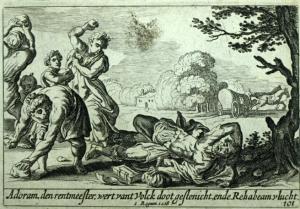
1700 engraving from The Bible Antique Testament of Adoram being stoned by the people
This reminded me of a parable of Jesus recorded in Matthew, Mark, and Luke.
Matthew 21:33-39
33 ¶ Hear another parable: There was a certain householder, which planted a vineyard, and hedged it round about, and digged a winepress in it, and built a tower, and let it out to husbandmen, and went into a far country:
34 And when the time of the fruit drew near, he sent his servants to the husbandmen, that they might receive the fruits of it.
35 And the husbandmen took his servants, and beat one, and killed another, and stoned another.
36 Again, he sent other servants more than the first: and they did unto them likewise.
37 But last of all he sent unto them his son, saying, They will reverence my son.
38 But when the husbandmen saw the son, they said among themselves, This is the heir; come, let us kill him, and let us seize on his inheritance.
39 And they caught him, and cast him out of the vineyard, and slew him.
Luke 20:9-16 relates the same parable!
Here are the key points relating to the verses in 1 Kings.
13 Then said the lord of the vineyard, What shall I do? I will send my beloved son: it may be they will reverence him when they see him.
14 But when the husbandmen saw him, they reasoned among themselves, saying, This is the heir: come, let us kill him, that the inheritance may be ours.
15 So they cast him out of the vineyard, and killed him. What therefore shall the lord of the vineyard do unto them?
Mark 12:6:12 relates the same parable!
I started in the middle of Mark’s account and continued through the end of this episode.
6 Having yet therefore one son, his wellbeloved, he sent him also last unto them, saying, They will reverence my son.
7 But those husbandmen said among themselves, This is the heir; come, let us kill him, and the inheritance shall be ours.
8 And they took him, and killed him, and cast him out of the vineyard.
9 What shall therefore the lord of the vineyard do? he will come and destroy the husbandmen, and will give the vineyard unto others.
10 And have ye not read this scripture; The stone which the builders rejected is become the head of the corner:
11 This was the Lord’s doing, and it is marvellous in our eyes?
12 And they sought to lay hold on him, but feared the people: for they knew that he had spoken the parable against them: and they left him, and went their way.
Hopefully, the connection I made with Adoram’s death as the king’s emmissary is clear. But can he be considered a type of Jesus Christ?
Beginning the Deep Dive
There are quite a few applications to David-Solomon-Rehoboam’s kingdoms to this parable—also stark differences to the true Lord and King, like Rehoboam running away—but I really focused on
Then king Rehoboam sent Adoram, who was over the tribute; and all Israel stoned him with stones, that he died.
David appointed Adoram as the kingdom’s tribute collector in 2 Samuel 20:24, so this wasn’t his first rodeo.
The name Adoram means “my lord is exalted or noble exaltation.” Of course, that name relates to Jesus Christ.
That definition reminded me of Abram, which means “exalted father.” The -ram portion of those names means “exalted, high, lofty.” “Ram” catapulted me to Abraham and Isaac’s ram in the thicket. I found that the Hebrew word for a ram is אַיִל (ayil.) That word also means: mighty (man), lintel, oak, post, ram, tree!
I compared the words R-W-M and A-Y-L.
AI helped me format my findings into a readable list form.
1. רוּם / רוֹם (R-W-M)
-
Meaning: Height, high up, elevation, or exaltation. [1]
-
Linguistic Root: The root is ר-ו-ם, a primitive Semitic root meaning “to rise,” “to lift up,” or “to be high”. [1, 2]
-
Refers to vertical height and elevation.
-
Common Derivatives:
- להרים (leharim) – to lift / raise.
- תרומה (terumah) – a donation or offering (literally, something “lifted up”).
- מרום (marom) – heights or heaven.
- רם (ram) – high or loud
2. אַיִל (A-Y-L)
-
-
Meaning: A ram (male sheep); historically, it also metaphorically referred to a chief, leader, prominent pillar, or a strong oak tree. In modern slang, it can mean a tycoon or mogul. [1, 2, 3, 4]
-
Linguistic Root: The root is א-י-ל, which historically carries the core concept of “strength,” “power,” or “preeminence”. [1, 2, 3]
-
Refers to physical power and nobility.
-
Common Derivatives:
-
After learning all of these meanings, the similar verbiage in Genesis 22:13 really struck me.
And Abraham lifted up his eyes, and looked, and behold behind him a ram caught in a thicket by his horns: and Abraham went and took the ram, and offered him up for a burnt offering in the stead of his son.
Three links from Adoram to Abraham and Isaac’s sacrifice—how Adoram typifies Christ:
1. The Action: “Lifted Up” (וַיִּשָּׂא – Vayyissa)
The verse starts with Abraham physically looking up. In Hebrew, the phrase “lifted up his eyes” uses the verb nasa (נשׂא). However, when he actually performs the sacrifice at the end of the verse, the text says: וַיַּעֲלֵהוּ לְעֹלָה (Vay’alehu l’olah—”and he lifted it up as an ascending offering”). [1, 2]
- The connection: This physical concept of elevating an offering high onto an altar is the exact definition of the root רום (R-W-M) found in Ado-ram (meaning “exalted/high”). [1, 2]
2. The Substitute: “A Ram” (אַיִל – Ayil)
The animal caught in the thicket is explicitly called an אַיִל (ayil). [1]
- The connection: As a noun, it means “ram,” but its root letters denote strength and leadership. In ancient Near Eastern culture, the ayil was a symbol of political and spiritual power—a “mighty one” or “lord.” [1, 2, 3, 4]
3. The Structural Echo: “Instead of” (תַּחַת – Tachat)
The verse concludes with the ram being sacrificed תַּחַת בְּנֽוֹ (tachat b’no—”in place of/underneath his son”). [1, 2]
Putting these pieces together reveals symmetry between the name Adoram and the mechanics of Genesis 22:13:
-
- Adon (Lord/Ruler) → Mirrored by the אַיִל (Ayil / Ram), which symbolically represents the chief, ruler, or strong substitute.
- Ram (Exalted/Lifted high) → Mirrored by the action וַיַּעֲלֵהוּ (Vay’alehu), as the substitute is lifted up onto Mount Moriah to be sacrificed to the Exalted God. [1, 2, 3, 4, 5]
Adoram Typifies Christ
Through the lens of Hebrew wordplay, Genesis 22:13 is a living illustration of the name Adoram: the “mighty lord” (ayil) is physically “lifted high” (ram) on the altar.
I worship THE Mighty Lord physically lifted high on a crucificial altar. I’m grateful for seemingly random Old Testament verses that teach me so much about Jesus Christ’s mission and purpose.
History and Religion
Previous Post

June 23, 2026
Vow for Healing
Next Post
July 20, 2026 Could Abinadi Have Been a Young Adult?
Recent Comments
"Nice analogy Daylen"
Staying on the Covenant Trail | ..."
"Thanks for being there for me. You were part of the miracle"
Waiting on the Lord | Desirée ..."
"Great article."
Waiting on the Lord | Desirée ..."
"I see all this concerns the religion ABOUT Jesus, but, as we come to Christmas, ..."
A Latter-day Call to Gather to ..."
Browse Our Archives
Select a Category Discovery How Tos Realization Uncategorized
Select a Month September 2026 August 2026 July 2026 June 2026 May 2026 March 2026 February 2026 January 2026 November 2025 October 2025 August 2025 July 2025 June 2025 May 2025 March 2025 February 2025 January 2025 December 2024 November 2024 October 2024 September 2024 August 2024 June 2024 May 2024 March 2024 February 2024 January 2024 December 2023 November 2023 October 2023 September 2023 August 2023 July 2023 June 2023 April 2023 March 2023 February 2023 January 2023 December 2022 November 2022 October 2022 August 2022 July 2022 June 2022 May 2022 April 2022 March 2022 February 2022 January 2022 November 2021 October 2021 September 2021 August 2021 June 2021 May 2021 April 2021 March 2021 February 2021 December 2020 November 2020 October 2020 September 2020 August 2020 July 2020 June 2020 May 2020 April 2020 March 2020 February 2020 December 2019 November 2019 October 2019 September 2019 August 2019 July 2019 June 2019 May 2019 April 2019 March 2019 February 2019 January 2019 December 2018 November 2018 October 2018 September 2018 August 2018 July 2018 June 2018 May 2018 April 2018 March 2018 February 2018 January 2018 December 2017 November 2017
Follow Us!
TAKE THE
Religious Wisdom Quiz
Who saw a vision of a ladder reaching heaven?
Select your answer to see how you score.
Joseph Isaac Adam Jacob
Related posts from Spiritual Truth Seeker - My Tesserae

The Character of God, Enos, & The Family...
Spiritual Truth Seeker – My Tesserae

Spiritual Truth Seeker – My Tesserae
Could Abinadi Have Been a Young Adult?
Spiritual Truth Seeker – My Tesserae

The Author of Salvation or Destruction
Spiritual Truth Seeker – My Tesserae
TRENDING AT PATHEOS Latter-day Saint

Did Prayer Cure His Cancer? Or Was It...
At 4 AM one morning, Joshua W. Brown’s wife awoke to a...

8 Ways a Near-Death Experience Rewires the Soul
Does Consciousness Survive Physical Death? After 50 Years of Research, Dr. Raymond...

Holy Longing: What Our Restlessness Is Telling Us
“One can find so many pains when the rain is falling.” -John...

What this is NOT about. This blog is definitely not about...

Who said the Israelites were God’s chosen? That’s right, they did. Who...

The Spirit World Is the Real World: God...
A Monk’s Wisdom on Body and Spirit I sit with Brother Martin...
view all Latter-day Saint blogs
What Are Your Thoughts?leave a comment
Ad-Free & Subscriber Log-In Subscription Support
- About Us
- 2026 Calendar
- Videos
- Podcasts
- Library of World Religions
- Faith In Media Tracker
- Advertise With Us
- Write for Us
- Privacy Policy
- Terms of Service
- Do Not Sell My Data
- Contact Us
- Radiant Digital
- Manage Newsletter Subscriptions
- Unsubscribe From Notifications
- Sitemap
Copyright 2008-2026, Patheos. All rights reserved.
Subscription Support Ad-Free & Subscriber Log-In
Follow Patheos