
BuddhistCatholicContemplativeEvangelicalGeneral ChristianHinduJewishLatter-day SaintMuslimNew VisionsProgressive Christian
Beliefs
- Buddhist
- Catholic
- Contemplative
- Evangelical
- General Christian
- Hindu
- Jewish
- Latter-day Saint
- More Voices
- Muslim
- New Visions
- Pagan
- Progressive Christian
Topics
- Religion News
- Food and Religion
- Sports and Religion
- Religious Art
- Religious Music and Entertainment
- Religious Events
- History and Religion
- Style and Religion
- Politics and Religion
- Women in Religion
- Recreation Outdoors and Religion
- Business Finance and Religion
- Careers Workplace and Religion
- Education and Religion
- Family Parenting and Religion
- Health Fitness and Religion
- Home and Religion
- Relationships and Religion
- Technology and Religion
- Travel and Religion
Columnists
- Buddhist Columnists
- Business Finance and Religion Columnists
- Careers Workplace and Religion Columnists
- Catholic Columnists
- Contemplative Columnists
- Education and Religion Columnists
- Evangelists Columnists
- Family Parenting and Religion Columnists
- General Christian Columnists
- Health Fitness and Religion Columnists
- Hindu Columnists
- History and Religion Columnists
- Home and Religion Columnists
- Jewish Columnists
- More Voices Columnists
- Latter Day Columnists
- Muslim Columnists
- New Visions Columnists
- Nonreligious Columnists
- Pagan Columnists
- Politics and Religion Columnists
- Progressive Columnists
- Recreation Outdoors and Religion Columnists
- Relationships and Religion Columnists
- Religion News Columnists
- Religious Art Columnists
- Religious Events Columnists
- Religious Music and Entertainment Columnists
- Sports and Religion Columnists
- Style and Religion Columnists
- Technology and Religion Columnists
- Travel and Religion Columnists
- Women in Religion Columnists
Resource Library
- 2026 Calendar
- Library of World Religions
- The 100 Most Holy Places on Earth
- Patheos Answers
- Podcasts
- Videos
- Faith Leaders Database
- Anglican Episcopalian
- Bahai
- Baptist
- Buddhism
- Christianity
- Confucianism
- Eastern Orthodoxy
- Hinduism
- Holiness and Pentecostal
- ISKCON
- Islam
- Judaism
- Lutheran
- Methodist
- The Church of Jesus Christ of Latter-day Saints
- New Age
- Paganism
- Presbytarian and Reformed
- Protestantism
- Religion Behind the Scenes
- Roman Catholic
- Scientology
- Shia Islam
- Sikhism
- Sufism
- Sunni Islam
- Taoism
- Zen
- See all religions
Research Tools
 Ad-Free & Subscriber Log-In Subscription Support
Ad-Free & Subscriber Log-In Subscription Support
Follow Patheos 

- Trending:
- Forgiveness
- |
- Marriage
- |
- Consciousness
- |
- Death Penalty
- |
- Election
- |
- Halloween

- Home
- Latter-day Saint
- History and Religion
- Theophilus in Luke’s Gospel
Theophilus in Luke’s Gospel
Last updated on: January 6, 2023 at 10:59 am by Delisa Hargrove
Theophilus in Luke’s Gospel 2023-01-06T10:59:55-10:00 Delisa Hargrove
Patheos Explore the world's faith through different perspectives on religion and spirituality! Patheos has the views of the prevalent religions and spiritualities of the world.
In the preface of his gospel, Luke addressed “most excellent Theophilus.” Theophilus seemed like a pretty Greek name to me. I glossed over it assuming I couldn’t know who Theophilus was because he isn’t found in the scriptures beyond Luke’s mention in Luke and Acts. But as I began a new reading of Luke 1, I found some clues about Theophilus.
Several theories exist about who Theophilus is. Two, in particular, fascinated me.
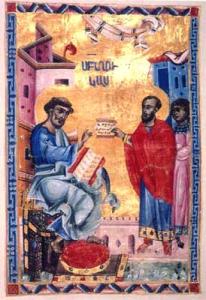
Luke the Evangelist, a medieval Armenian illumination by Toros Roslin
Theophilus ben Ananus
Theophilus ben Ananus served as “the High Priest in the Second Temple in Jerusalem from 37 to 41 CE according to Josephus‘s Antiquities of the Jews. He was a member of one of the wealthiest and most influential Jewish families in Iudaea Province during the 1st century.”
In this tradition, Theophilus would have been both a kohen and a Sadducee. That would make him the son of Annas and brother-in-law of Caiaphas, raised in the Jewish Temple. Adherents claim that Luke’s Gospel was targeted at Sadducee readers. This might explain a few features of Luke. He begins the story with an account of Zacharias the righteous priest who had a Temple vision of an angel (1:5–25). Luke quickly moves to account Mary‘s purification (niddah), Jesus‘ Temple redemption (pidyon ha-ben) rituals (2:21–39), and then to Jesus’ pilgrimage to the Temple when he was twelve (2:46), possibly implying his bar mitzvah. He makes no mention of Caiaphas’ role in Jesus’ crucifixion and emphasizes Jesus’ literal resurrection (24:39), including an ascension into heaven as a realm of spiritual existence (24:52; Acts 1:1). Luke also seems to stress Jesus’ arguments with the Sadducees on points like legal grounds for divorce, the existence of angels, spirits, and an afterlife (Sadducees did not believe in the resurrection of the dead). If this was the case then Luke is trying to use Jesus’ rebuttals and teachings to break down Theophilus’ Sadducean philosophy, maybe with the hope that Theophilus would use his influence to get the Sadducees to cease their persecution of the Christians. One could also look at Luke’s Gospel as an allegorical (רֶמֶז remez) reference to Jesus as “the man called the Branch” prophesied in Zechariah 3:8; 6:12–13, who is the ultimate high priest foreshadowed by the Levitical priesthood. …
All of the New Testament passages concerning alms and almsgiving, except one in Matthew, are in Luke-Acts. Therefore, these parables may be about alms, almsgiving, and the proper use of the wealth controlled by the temple authorities. Luke’s criticism focuses on the use of these temple resources by the religious aristocracy for their own selfish purposes. This means that the religious authorities controlled tremendous wealth that had been in times past properly distributed to the people as part of the institutional form of almsgiving. The priests in these parables are unfaithful, dishonest, and disobedient because, inter alia, they have not invited the poor, the maimed, the lame, and the blind to the banquet table. Once the office of the High Priest became non-hereditary, and available to the highest bidder, the institutional role of almsgiving was abandoned or reduced as the purchaser had to recoup his purchase price.
This Theophilus had four brothers who all served as High Priests. That his brother-in-law, Joseph Caiaphas, condemned Jesus Christ reminds me of the Apostle’s fierce boldness in declaring God’s Word, even when it quite probably won’t be received.
Mattathias ben Theophilus
Theophilus’s son Mattathias ben Theophilus is another option for Luke’s Theophilus. Mattathias ben Theophilus served as the High Priest from 65-66 AD, and
was in office in 65 C.E., when the war against the Romans broke out (Josephus, “Ant.” xx. 9, § 7). During the troubles in Jerusalem which preceded the siege by Titus (“B. J.” iv. 3, § 7) he was deposed, since he, like the other aristocrats, belonged to the peace party, one of his sons having even sought refuge with the Romans. Matthias was put to death as a dangerous character by the very Simon ben Gioras whom he had invited to Jerusalem to subdue the revolutionists (“B. J.” vi. 2, § 2). According to Grätz, it is he who is referred to in a Talmudic story which relates that once, on a Day of Atonement, a high priest remained in the Holy of Holies a longer time than usual praying for the Sanctuary, which was in danger of destruction by the Zealots (Tosef., Yoma, ii. 5; Yoma 53b; Yer. Yoma 42c).
Only one High Priest succeeded Mattathias before Rome toppled the temple in 70 AD.
Out of curiosity, I traced their genealogy and found, as expected, that through their patriarchal line, High Priests Theophilus and Mattathias descend from Levi through Aaron.
A Catalyst for Luke’s Gospel
Forasmuch as many have taken in hand to set forth in order a declaration of those things which are most surely believed among us,
Even as they delivered them unto us, which from the beginning were eyewitnesses, and ministers of the word;
That thou mightest know the certainty of those things, wherein thou hast been instructed.
Whoever Theophilus was, I am eternally grateful for him. Because “it seemed good” to Luke to write his letter to Theophilus, we have another witness of Jesus Christ told through Luke’s unique perspective and experience.
History and Religion
Previous Post

December 30, 2022
An Expectation Gone Awry
Next Post

January 7, 2023 Growing Your Testimony in Christ
Recent Comments
"Nice analogy Daylen"
Staying on the Covenant Trail | ..."
"Thanks for being there for me. You were part of the miracle"
Waiting on the Lord | Desirée ..."
"Great article."
Waiting on the Lord | Desirée ..."
"I see all this concerns the religion ABOUT Jesus, but, as we come to Christmas, ..."
A Latter-day Call to Gather to ..."
Browse Our Archives
Select a Category Discovery How Tos Realization Uncategorized
Select a Month September 2026 August 2026 July 2026 June 2026 May 2026 March 2026 February 2026 January 2026 November 2025 October 2025 August 2025 July 2025 June 2025 May 2025 March 2025 February 2025 January 2025 December 2024 November 2024 October 2024 September 2024 August 2024 June 2024 May 2024 March 2024 February 2024 January 2024 December 2023 November 2023 October 2023 September 2023 August 2023 July 2023 June 2023 April 2023 March 2023 February 2023 January 2023 December 2022 November 2022 October 2022 August 2022 July 2022 June 2022 May 2022 April 2022 March 2022 February 2022 January 2022 November 2021 October 2021 September 2021 August 2021 June 2021 May 2021 April 2021 March 2021 February 2021 December 2020 November 2020 October 2020 September 2020 August 2020 July 2020 June 2020 May 2020 April 2020 March 2020 February 2020 December 2019 November 2019 October 2019 September 2019 August 2019 July 2019 June 2019 May 2019 April 2019 March 2019 February 2019 January 2019 December 2018 November 2018 October 2018 September 2018 August 2018 July 2018 June 2018 May 2018 April 2018 March 2018 February 2018 January 2018 December 2017 November 2017
Follow Us!
TAKE THE
Religious Wisdom Quiz
What does "Christ" mean in Greek?
Select your answer to see how you score.
Lord of Lords Savior Anointed One Chosen One
Related posts from Spiritual Truth Seeker - My Tesserae

The Character of God, Enos, & The Family...
Spiritual Truth Seeker – My Tesserae

Spiritual Truth Seeker – My Tesserae
Could Abinadi Have Been a Young Adult?
Spiritual Truth Seeker – My Tesserae

How the Old Testament Tax Collector Adoram Typifies...
Spiritual Truth Seeker – My Tesserae
TRENDING AT PATHEOS Latter-day Saint

Did Prayer Cure His Cancer? Or Was It...
At 4 AM one morning, Joshua W. Brown’s wife awoke to a...

8 Ways a Near-Death Experience Rewires the Soul
Does Consciousness Survive Physical Death? After 50 Years of Research, Dr. Raymond...

Holy Longing: What Our Restlessness Is Telling Us
“One can find so many pains when the rain is falling.” -John...

What this is NOT about. This blog is definitely not about...

Who said the Israelites were God’s chosen? That’s right, they did. Who...

The Spirit World Is the Real World: God...
A Monk’s Wisdom on Body and Spirit I sit with Brother Martin...
view all Latter-day Saint blogs
What Are Your Thoughts?leave a comment
Ad-Free & Subscriber Log-In Subscription Support
- About Us
- 2026 Calendar
- Videos
- Podcasts
- Library of World Religions
- Faith In Media Tracker
- Advertise With Us
- Write for Us
- Privacy Policy
- Terms of Service
- Do Not Sell My Data
- Contact Us
- Radiant Digital
- Manage Newsletter Subscriptions
- Unsubscribe From Notifications
- Sitemap
Copyright 2008-2026, Patheos. All rights reserved.
Subscription Support Ad-Free & Subscriber Log-In
Follow Patheos