
BuddhistCatholicContemplativeEvangelicalGeneral ChristianHinduJewishLatter-day SaintMuslimNew VisionsProgressive Christian
Beliefs
- Buddhist
- Catholic
- Contemplative
- Evangelical
- General Christian
- Hindu
- Jewish
- Latter-day Saint
- More Voices
- Muslim
- New Visions
- Pagan
- Progressive Christian
Topics
- Religion News
- Food and Religion
- Sports and Religion
- Religious Art
- Religious Music and Entertainment
- Religious Events
- History and Religion
- Style and Religion
- Politics and Religion
- Women in Religion
- Recreation Outdoors and Religion
- Business Finance and Religion
- Careers Workplace and Religion
- Education and Religion
- Family Parenting and Religion
- Health Fitness and Religion
- Home and Religion
- Relationships and Religion
- Technology and Religion
- Travel and Religion
Columnists
- Buddhist Columnists
- Business Finance and Religion Columnists
- Careers Workplace and Religion Columnists
- Catholic Columnists
- Contemplative Columnists
- Education and Religion Columnists
- Evangelists Columnists
- Family Parenting and Religion Columnists
- General Christian Columnists
- Health Fitness and Religion Columnists
- Hindu Columnists
- History and Religion Columnists
- Home and Religion Columnists
- Jewish Columnists
- More Voices Columnists
- Latter Day Columnists
- Muslim Columnists
- New Visions Columnists
- Nonreligious Columnists
- Pagan Columnists
- Politics and Religion Columnists
- Progressive Columnists
- Recreation Outdoors and Religion Columnists
- Relationships and Religion Columnists
- Religion News Columnists
- Religious Art Columnists
- Religious Events Columnists
- Religious Music and Entertainment Columnists
- Sports and Religion Columnists
- Style and Religion Columnists
- Technology and Religion Columnists
- Travel and Religion Columnists
- Women in Religion Columnists
Resource Library
- 2026 Calendar
- Library of World Religions
- The 100 Most Holy Places on Earth
- Patheos Answers
- Podcasts
- Videos
- Faith Leaders Database
- Anglican Episcopalian
- Bahai
- Baptist
- Buddhism
- Christianity
- Confucianism
- Eastern Orthodoxy
- Hinduism
- Holiness and Pentecostal
- ISKCON
- Islam
- Judaism
- Lutheran
- Methodist
- The Church of Jesus Christ of Latter-day Saints
- New Age
- Paganism
- Presbytarian and Reformed
- Protestantism
- Religion Behind the Scenes
- Roman Catholic
- Scientology
- Shia Islam
- Sikhism
- Sufism
- Sunni Islam
- Taoism
- Zen
- See all religions
Research Tools
 Ad-Free & Subscriber Log-In Subscription Support
Ad-Free & Subscriber Log-In Subscription Support
Follow Patheos 

- Trending:
- Forgiveness
- |
- Marriage
- |
- Consciousness
- |
- Death Penalty
- |
- Election
- |
- Halloween

- Home
- Latter-day Saint
- History and Religion
- Zion Camp’s Cholera Outbreak at Rush Creek
Zion Camp’s Cholera Outbreak at Rush Creek
Last updated on: August 6, 2022 at 11:40 am by Delisa Hargrove
Zion Camp’s Cholera Outbreak at Rush Creek 2022-08-06T11:40:57-10:00 Delisa Hargrove
Patheos Explore the world's faith through different perspectives on religion and spirituality! Patheos has the views of the prevalent religions and spiritualities of the world.
My parents, siblings, families, and I made a pilgrimage to Missouri, Illinois, and Iowa to walk in our ancestor’s footsteps and learn more about their lives. Rush Creek in Clay County, Missouri was our first ancestral stop. A deadly cholera outbreak wreaked havoc on Zion’s Camp at Rush Creek and Sidney Gilbert’s adjacent farm. The healthy moved the sick into the Gilbert’s home. When the men died, they were carried back to Rush Creek and buried. Ultimately, cholera claimed 13 lives, including Sidney Gilbert’s.
Joseph Bates Noble, mom’s 2nd great-grandfather, participated in Zion’s Camp and experienced the cholera outbreak at Rush Creek.

Along the path to the burial site at Rush Creek
Our cousin Jenni Clark Andersen compiled the following general details about the cholera outbreak at Rush Creek.
Cholera Outbreak at Rush Creek
Tuesday, June 3. Encamped on the bank of the Illinois River.
Prophecy of a Scourge. Joseph Smith: While we were refreshing ourselves and teams about the middle of the day, I got up on a wagon wheel, called the people together, and said that I would deliver a prophecy. I said the Lord had revealed to me that a scourge would come upon the camp in consequence of the fractious and unruly spirits that appeared among them, and they should die like sheep with the rot; still, if they would repent and humble themselves before the Lord, the scourge, in a great measure, might be turned away; but, as the Lord lives, the members of this camp will suffer for giving way to their unruly temper.
Saturday, June 21 Encamped at Cooper’s Farm near current-day Excelsior Springs.
Cholera Breaks out in the Camp. Joseph Smith: Brother Ezra Thayre and Joseph Hancock are sick with the cholera. Thomas Heyes was taken today. Previous to crossing the Mississippi river I had called the camp together and told them that in consequence of the disobedience of some who had been unwilling to listen to my words, but had rebelled, God had decreed that sickness should come upon the camp, and if they did not repent and humble themselves before God they should die like sheep with the rot; that I was sorry, but could not help it. The scourge must come; repentance and humility may mitigate the chastisement but cannot altogether avert it. But there were some who would not give heed to my words.
Tuesday, June 24. Rush Creek.
Prophecy Fulfilled. Joseph Smith: This night the cholera burst forth among us, and about midnight it was manifested in its most virulent form. Our ears were saluted with cries and moanings and lamentations on every hand; even those on guard fell to the earth with their guns in their hands, so sudden and powerful was the attack of this terrible disease. At the commencement, I attempted to lay on hands for their recovery, but I quickly learned by painful experience, that when the great Jehovah decrees destruction upon any people, and makes known His determination, man must not attempt to stay His hand. The moment I attempted to rebuke the disease I was attacked, and had I not desisted in my attempt to save the life of a brother, I would have sacrificed my own. The disease seized upon me like the talons of a hawk, and I said to the brethren: “If my work were done, you would have to put me in the ground without a coffin.”
Of these sorrowful scenes Elder Heber C. Kimball in his journal, gives the following description: “When the cholera first broke out in the camp, Brother John S. Carter was the first who went forth to rebuke it, but [he] himself, was immediately seized by it, and as before stated, was the first who was slain. In about thirty minutes after his death, Seth Hitchcock followed him; and it appeared as though we must sink under the destroyer with them. We were not able to obtain boards to make coffins, [for those who died], but were under the necessity of rolling them up in their blankets and burying them in that manner. So, we placed them on a sled, which was drawn by a horse about half a mile, where we buried them in a little bluff by the side of a small stream that emptied into Rush creek. This we accomplished by dark and returned.

Zion’s Camp members buried cholera victims in this mound at Rush Creek.
Our hopes were that no more would die, but while we were uniting in a covenant to pray once more with uplifted hands to God, we looked at our beloved brother, Elder Wilcox, and he was gasping his last. At this scene my feelings were beyond expression. Those only who witnessed it, can realize anything of the nature of our sufferings, and 50 felt to weep, and pray to the Lord that He would spare my life that I might behold my dear family again.
I felt to covenant with my brethren, and I felt in my heart never to commit another sin while I lived. We felt to sit and weep over our brethren, and so great was our sorrow that we could have washed them with our tears, to realize that they had traveled one thousand miles through so much fatigue to lay down their lives for our brethren—and who hath greater love than he who is willing to lay down his life for his brethren? This increased our love to them.
About 12 o’clock at night we placed Brother Wilcox on a small sled, which we drew to the place of interment, with one hand hold of the rope, and in the other we bore our firelocks for our defense. While one or two were digging the grave, the rest stood with their arms to defend them. This was our situation, the enemies around us, and the destroyer in our midst.
Soon after we returned another brother was taken away from our little band; thus it continued until five out of ten [attacked] were taken away. It was truly affecting to see the love manifested among the brethren for one another, during the affliction; Brother Joseph, seeing the sufferings of his brethren, stepped forward to rebuke the destroyer, but was immediately seized with the disease himself; and I assisted him a short distance from the place when it was with difficulty he could walk.
All that kept our enemies from us was the fear of the destroyer which the Lord so sent among us. After burying these five brethren, or about this time, I was seized by the hand of the destroyer, as I had gone in the woods to pray. I was instantly struck blind and saw no way whereby I could free myself from the disease, only to exert myself by jumping and thrashing myself about, until my sight returned to me, and my blood began to circulate in my veins. I started and ran some distance, and by this means, through the help of God, I was enabled to extricate myself from the grasp of death. This circumstance took place in a piece of woods just behind Brother Sidney Gilbert’s house.
Two other brethren died at Brother Gilbert’s house about this same time. One of these was a cousin to Brother Joseph Smith, the Prophet.”
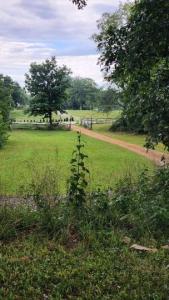
Along the path to the burial site looking back towards Sidney Gilbert’s farm
Wednesday, June 25. Rush Creek
Fear of the Cholera. Joseph Smith: While traveling, we called at the house of a Mr. Moss for a drink of water. The woman of the house shouted from the door, that they had “no water for Mormons,” that they were “afraid of the cholera,” etc., at the same time throwing out her arms as if defending herself from the cholera in the form of a personage. We turned and departed, according to the commandment, and before a week had passed, the cholera entered that house, and that woman and three others of the family were dead.
Joseph Smith: I have seen those men who died of the cholera in our camp; and the Lord knows, if I get a mansion as bright as theirs, I ask no more,” said Joseph Smith of those who served in Zion’s Camp. Then he wept and continued: “I wish you to notify all the brethren living in the branches, within a reasonable distance from this place, to meet at a general conference on Saturday next [February 14, 1835]. I shall then and there appoint twelve Special Witnesses, to open the door of the Gospel to foreign nations, and you [Brigham Young] will be one of them. (History of the Church, 2:181.)
Joseph Bates Noble Experienced the Cholera Outbreak at Rush Creek
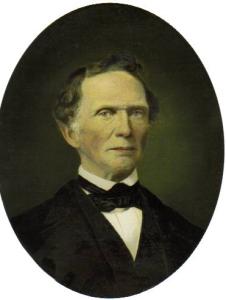
Joseph Bates Noble
Joseph Bates Noble, at age 24, marched in Zion’s Camp. He was encamped on Rush Creek when cholera broke out. The following story is from his personal accounts.
When the cholera broke out in the camp, Joseph Bates Noble was appointed to take care of four of the sufferers. He remained with them in a small room until they were all dead, after which he accompanied Elders Brigham Young and Heber C. Kimball to Liberty, about two miles from the camp. There he was violently seized with the dreadful malady himself. For 48 hours he suffered the most severe pains with vomiting and purging, while a burning fever in the bowels and distressing cramps, such as are peculiar to cholera, threatened him with momentary death. His voice also failed and his hearing nearly left him. While laying in this painful condition, Elders Brigham and Joseph Young, Heber C. Kimball, Orson Hyde, Peter Whitmer, and some two or three others came in and formed a ring around him and then administered to him.
While they were praying for him, Joseph Bates Noble was blessed with a glorious vision, in which he saw, among other things, the Holy City (New Jerusalem), and while gazing upon its glory and admiring its beauty, he heard a voice saying, “Behold, the blessed abode of the Saints.” The power of God rested upon him in a most marvelous manner; he was almost instantly healed from his sickness, and while the brethren were yet with him he arose and dressed himself. Two days later he started on his return trip to Ohio, in company with Lyman E. And Luke S. Johnson, Sylvester Smith, Zebedee Coltrin, Zerubbabel Snow, and others. They arrived in Kirtland about the 1st of August.
In his journal, Joseph Noble wrote:
Never had I experienced such manifestations of the blessings of God as at this time. I continued to gain strength very fast so that in six or seven days I could do my portion of the walking as we had but one baggage wagon.
In the paper Times and Seasons, there was printed this quote about Joseph’s illness. “It was with great exertions that his life was preserved and that by the application of cold water being drawn out of a well and poured upon him daily and hourly.”
The Company continued their march traveling from twenty-five to thirty miles a day arriving in Kirtland the first day of August. President Joseph Smith had arrived a few days before. Joseph Noble said, “We were all in fairly good health through some of us were weak from fatigue and exposure.”
From his journal, Joseph Bates Noble wrote:
The excitement was so great that we always lay with our armor on, so we were ready in a moment’s warning. One thing I am assured of, the God of our Fathers was our defense. When our enemies gathered thick around us and ready seemingly to destroy us, the heavens gathered blackness and poured forth their thunderings and lightnings and hailstones, so that a little way from our camp the trees were stripped of many leaves and branches to the size of a man’s finger. How plain we could see the hand of the Lord in our preservation.
To all those who made the trek with Zion’s Camp in 1834, President Joseph Smith issued a call for them to assemble on February 14, 1835. This meeting resulted in the organization of the Quorum of the Twelve Apostles. Joseph Bates Noble was a witness to the event of that meeting. On February 28, 1835, Joseph Bates Noble was chosen and ordained a member of the First Council of Seventy in Kirtland.
Latter-day Saint
History and Religion
Previous Post
July 27, 2022
Do Mormons Believe in Jesus?
Next Post

August 6, 2022 Far West from Our Ancestors' Perspectives
Browse Our Archives
Select a Category Discovery How Tos Realization Uncategorized
Select a Month September 2026 August 2026 July 2026 June 2026 May 2026 March 2026 February 2026 January 2026 November 2025 October 2025 August 2025 July 2025 June 2025 May 2025 March 2025 February 2025 January 2025 December 2024 November 2024 October 2024 September 2024 August 2024 June 2024 May 2024 March 2024 February 2024 January 2024 December 2023 November 2023 October 2023 September 2023 August 2023 July 2023 June 2023 April 2023 March 2023 February 2023 January 2023 December 2022 November 2022 October 2022 August 2022 July 2022 June 2022 May 2022 April 2022 March 2022 February 2022 January 2022 November 2021 October 2021 September 2021 August 2021 June 2021 May 2021 April 2021 March 2021 February 2021 December 2020 November 2020 October 2020 September 2020 August 2020 July 2020 June 2020 May 2020 April 2020 March 2020 February 2020 December 2019 November 2019 October 2019 September 2019 August 2019 July 2019 June 2019 May 2019 April 2019 March 2019 February 2019 January 2019 December 2018 November 2018 October 2018 September 2018 August 2018 July 2018 June 2018 May 2018 April 2018 March 2018 February 2018 January 2018 December 2017 November 2017
Follow Us!
TAKE THE
Religious Wisdom Quiz
What did Jesus say to the storm on the Sea of Galilee?
Select your answer to see how you score.
"Be gone!" "Depart from me!" "Peace, be still!" "Let there be light!"
Related posts from Spiritual Truth Seeker - My Tesserae

The Character of God, Enos, & The Family...
Spiritual Truth Seeker – My Tesserae

Spiritual Truth Seeker – My Tesserae
Could Abinadi Have Been a Young Adult?
Spiritual Truth Seeker – My Tesserae
How the Old Testament Tax Collector Adoram Typifies...
Spiritual Truth Seeker – My Tesserae
TRENDING AT PATHEOS Latter-day Saint

Did Prayer Cure His Cancer? Or Was It...
At 4 AM one morning, Joshua W. Brown’s wife awoke to a...

8 Ways a Near-Death Experience Rewires the Soul
Does Consciousness Survive Physical Death? After 50 Years of Research, Dr. Raymond...

Holy Longing: What Our Restlessness Is Telling Us
“One can find so many pains when the rain is falling.” -John...

What this is NOT about. This blog is definitely not about...

Who said the Israelites were God’s chosen? That’s right, they did. Who...

The Spirit World Is the Real World: God...
A Monk’s Wisdom on Body and Spirit I sit with Brother Martin...
view all Latter-day Saint blogs
Ad-Free & Subscriber Log-In Subscription Support
- About Us
- 2026 Calendar
- Videos
- Podcasts
- Library of World Religions
- Faith In Media Tracker
- Advertise With Us
- Write for Us
- Privacy Policy
- Terms of Service
- Do Not Sell My Data
- Contact Us
- Radiant Digital
- Manage Newsletter Subscriptions
- Unsubscribe From Notifications
- Sitemap
Copyright 2008-2026, Patheos. All rights reserved.
Subscription Support Ad-Free & Subscriber Log-In
Follow Patheos