
BuddhistCatholicContemplativeEvangelicalGeneral ChristianHinduJewishLatter-day SaintMuslimNew VisionsProgressive Christian
Beliefs
- Buddhist
- Catholic
- Contemplative
- Evangelical
- General Christian
- Hindu
- Jewish
- Latter-day Saint
- More Voices
- Muslim
- New Visions
- Pagan
- Progressive Christian
Topics
- Religion News
- Food and Religion
- Sports and Religion
- Religious Art
- Religious Music and Entertainment
- Religious Events
- History and Religion
- Style and Religion
- Politics and Religion
- Women in Religion
- Recreation Outdoors and Religion
- Business Finance and Religion
- Careers Workplace and Religion
- Education and Religion
- Family Parenting and Religion
- Health Fitness and Religion
- Home and Religion
- Relationships and Religion
- Technology and Religion
- Travel and Religion
Columnists
- Buddhist Columnists
- Business Finance and Religion Columnists
- Careers Workplace and Religion Columnists
- Catholic Columnists
- Contemplative Columnists
- Education and Religion Columnists
- Evangelists Columnists
- Family Parenting and Religion Columnists
- General Christian Columnists
- Health Fitness and Religion Columnists
- Hindu Columnists
- History and Religion Columnists
- Home and Religion Columnists
- Jewish Columnists
- More Voices Columnists
- Latter Day Columnists
- Muslim Columnists
- New Visions Columnists
- Nonreligious Columnists
- Pagan Columnists
- Politics and Religion Columnists
- Progressive Columnists
- Recreation Outdoors and Religion Columnists
- Relationships and Religion Columnists
- Religion News Columnists
- Religious Art Columnists
- Religious Events Columnists
- Religious Music and Entertainment Columnists
- Sports and Religion Columnists
- Style and Religion Columnists
- Technology and Religion Columnists
- Travel and Religion Columnists
- Women in Religion Columnists
Resource Library
- 2026 Calendar
- Library of World Religions
- The 100 Most Holy Places on Earth
- Patheos Answers
- Podcasts
- Videos
- Faith Leaders Database
- Anglican Episcopalian
- Bahai
- Baptist
- Buddhism
- Christianity
- Confucianism
- Eastern Orthodoxy
- Hinduism
- Holiness and Pentecostal
- ISKCON
- Islam
- Judaism
- Lutheran
- Methodist
- The Church of Jesus Christ of Latter-day Saints
- New Age
- Paganism
- Presbytarian and Reformed
- Protestantism
- Religion Behind the Scenes
- Roman Catholic
- Scientology
- Shia Islam
- Sikhism
- Sufism
- Sunni Islam
- Taoism
- Zen
- See all religions
Research Tools
 Ad-Free & Subscriber Log-In Subscription Support
Ad-Free & Subscriber Log-In Subscription Support
Follow Patheos 

- Trending:
- Forgiveness
- |
- Marriage
- |
- Consciousness
- |
- Death Penalty
- |
- Election
- |
- Halloween

- Home
- Latter-day Saint
- Food and Religion
- Finding That Something the Soul Needs in the Wilderness
Finding That Something the Soul Needs in the Wilderness
Last updated on: August 27, 2022 at 9:08 am by Delisa Hargrove
Finding That Something the Soul Needs in the Wilderness 2022-08-27T09:08:06-10:00 Delisa Hargrove
Patheos Explore the world's faith through different perspectives on religion and spirituality! Patheos has the views of the prevalent religions and spiritualities of the world.
After an epic showdown with idolatrous priests, the prophet Elijah learned that Queen Jezebel intended to kill him. Finding that something the soul needs in the wilderness.
But he himself went a day’s journey into the wilderness, and came and sat down under a juniper tree: and he requested for himself that he might die; and said, It is enough; now, O Lord, take away my life; for I am not better than my fathers.
And as he lay and slept under a juniper tree, behold, then an angel touched him, and said unto him, Arise and eat.
And he looked, and, behold, there was a cake baken on the coals, and a cruse of water at his head. And he did eat and drink, and laid him down again.
And the angel of the Lord came again the second time, and touched him, and said, Arise and eat; because the journey is too great for thee.
And he arose, and did eat and drink, and went in the strength of that meat forty days and forty nights unto Horeb the mount of God.
And he came thither unto a cave, and lodged there;
Juniper Tree, Arise, Eat
I’ve loved this story for as long as I’ve seen the value in taking naps to restore and refresh. But this story speaks much more to me than deep, restorative sleep.
Elijah’s story also speaks of devastating loss, trauma, and unfettered grief.

“Junper Berries” by Sébastien Noël on Unsplash
Mark Matousek’s When You’re Falling Dive: Lessons in the Art of Living details how tragedies impact persons. Without even sharing Matousek’s story preceding the following summation, most people have enough life experience to resonate on some level with this description of these desperate, determined women.
[They] seemed to be digging for their own lives in the desert, the parts of themselves that had been stolen, the layers of their own severed past, lost somewhere in the vast expanse. Without finding these relics, they could not grieve; without grieving, they could never feel whole. Quixotic as their plight might appear to the eye of reason, it made perfect sense to the soul. Souls seek retrieval and restitution; to the soul’s eye, all of our pieces are valuable, especially the broken ones (page 246.)
I see Elijah’s sitting in the wilderness as taking a moment to find the layers, grieving the losses, seeking restitution.
Elijah sat under a juniper tree—a tree that thrives in environments where other trees can’t survive. Elijah slept under a juniper tree—the tree anciently symbolizing the Mother goddess.
An angel laid hand(s) on him, adjuring Elijah to arise (Hebrew word meaning abide, make sure, uphold, accomplish, get up, ordain, raise up, establish, strengthen, be uprising, be made to stand) and eat (Hebrew word meaning burn up, consume, devour, dine, eat—literally or figuratively.)
The image of Elijah’s contest with priests of Ba’al penetrates this scene in my mind as I remember Elijah stood, declaring
Lord God of Abraham, Isaac, and of Israel, let it be known this day that thou art God in Israel, and that I am thy servant …
Then the fire of the Lord fell, and consumed the burnt sacrifice, and the wood, and the stones, and the dust, and licked up the water that was in the trench.
Those Elijah served acknowledged “The Lord, he is the God; the Lord, he is the God.”
And then, Elijah fled for his life into the wilderness.

Photo by Chris Rhoads on Unsplash
We must accept heartbreak to be fully human. We cannot love without tasting some blood, nor connect without braving some chink in our armor. Those who are most spiritually naked, most transparent, are also those who see most fully. “Let the scar of the heart be seen,” said the prophet Mohammad. “For by their scars are known the men who are in the way of Love. Holy books encourage us to strip ourselves bare—to allow ourselves to be burned all the way through by our passionate quest if we wish to be whole. Avoiding life’s shadows makes the heart shallow.
In his play Orpheus Descending, Tennessee Williams describes the opposite of such surrender through the invention of a mythic white bird whose entire life is spent in the air—soaring, unsullied, shadowless—touching earth only once, to die. While the desire to avoid pain may be normal, denial as a long-term strategy is a cold, narrow way to live. We may be dodging bullets through extreme self-protection yet find ourselves withering in our distant aeries, too—safe yet only half engaged—armorming our unbroken hearts while remaining secretly loveless, invulnerable, and dry. (Mark Matousek, When You’re Falling Dive: Lessons in the Art of Living, page 249.)
Finding That Something the Soul Needs in the Wilderness
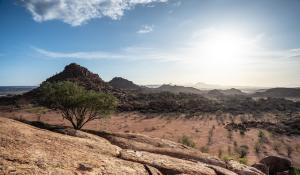
Photo by Eelco Böhtlingk on Unsplash
In a similar era where the love of many waxes cold with men’s hearts failing them for fear, Elijah’s soul-exhaustion feels so familiar. I’ve been in the wilderness clinging to a single, green tree, willing, in the exhaustion of the conflict, to die, to escape, to do something else, to get a different answer, to follow my own path, to feel completely safe, to rest in the arms of Jesus, even in darkness.
I am Jesus Christ, the Son of God. I am the same that came unto mine own … I am the light which shineth in darkness ….
Among the many favorite takeaways that I’ve taken away from this story is that Elijah gets up.
And he arose, and did eat and drink, and went in the strength of that meat forty days and forty nights unto Horeb the mount of God.
There is something that soothes souls, that brings restitution, that allows us to strengthen our spines while keeping our hearts open and softened. We have the capacity to find that something that our soul needs.
Elijah’s story shows me that even during emotional and spiritual drought, and while resting in barren wildernesses, I can find that something my soul needs, even when my soul isn’t entirely whole yet.
Food and Religion
History and Religion
Previous Post

June 28, 2022
Some Whys and Hows of Scripture Study and Revelation
Next Post

July 8, 2022 Optimizing the To-Do List
Browse Our Archives
Select a Category Discovery How Tos Realization Uncategorized
Select a Month September 2026 August 2026 July 2026 June 2026 May 2026 March 2026 February 2026 January 2026 November 2025 October 2025 August 2025 July 2025 June 2025 May 2025 March 2025 February 2025 January 2025 December 2024 November 2024 October 2024 September 2024 August 2024 June 2024 May 2024 March 2024 February 2024 January 2024 December 2023 November 2023 October 2023 September 2023 August 2023 July 2023 June 2023 April 2023 March 2023 February 2023 January 2023 December 2022 November 2022 October 2022 August 2022 July 2022 June 2022 May 2022 April 2022 March 2022 February 2022 January 2022 November 2021 October 2021 September 2021 August 2021 June 2021 May 2021 April 2021 March 2021 February 2021 December 2020 November 2020 October 2020 September 2020 August 2020 July 2020 June 2020 May 2020 April 2020 March 2020 February 2020 December 2019 November 2019 October 2019 September 2019 August 2019 July 2019 June 2019 May 2019 April 2019 March 2019 February 2019 January 2019 December 2018 November 2018 October 2018 September 2018 August 2018 July 2018 June 2018 May 2018 April 2018 March 2018 February 2018 January 2018 December 2017 November 2017
Follow Us!
TAKE THE
Religious Wisdom Quiz
What did Daniel's three friends refuse to worship, resulting in their persecution?
Select your answer to see how you score.
A bronze snake A golden image A cedar pole A Persian king
Related posts from Spiritual Truth Seeker - My Tesserae
God, I'm for You | Valeska M. Bushman
Spiritual Truth Seeker – My Tesserae
How the Old Testament Tax Collector Adoram Typifies...
Spiritual Truth Seeker – My Tesserae

The Author of Salvation or Destruction
Spiritual Truth Seeker – My Tesserae

Spiritual Truth Seeker – My Tesserae
TRENDING AT PATHEOS Latter-day Saint

Did Prayer Cure His Cancer? Or Was It...
At 4 AM one morning, Joshua W. Brown’s wife awoke to a...

8 Ways a Near-Death Experience Rewires the Soul
Does Consciousness Survive Physical Death? After 50 Years of Research, Dr. Raymond...

Holy Longing: What Our Restlessness Is Telling Us
“One can find so many pains when the rain is falling.” -John...

What this is NOT about. This blog is definitely not about...

Who said the Israelites were God’s chosen? That’s right, they did. Who...

The Spirit World Is the Real World: God...
A Monk’s Wisdom on Body and Spirit I sit with Brother Martin...
view all Latter-day Saint blogs
Ad-Free & Subscriber Log-In Subscription Support
- About Us
- 2026 Calendar
- Videos
- Podcasts
- Library of World Religions
- Faith In Media Tracker
- Advertise With Us
- Write for Us
- Privacy Policy
- Terms of Service
- Do Not Sell My Data
- Contact Us
- Radiant Digital
- Manage Newsletter Subscriptions
- Unsubscribe From Notifications
- Sitemap
Copyright 2008-2026, Patheos. All rights reserved.
Subscription Support Ad-Free & Subscriber Log-In
Follow Patheos