
BuddhistCatholicContemplativeEvangelicalGeneral ChristianHinduJewishLatter-day SaintMuslimNew VisionsProgressive Christian
Beliefs
- Buddhist
- Catholic
- Contemplative
- Evangelical
- General Christian
- Hindu
- Jewish
- Latter-day Saint
- More Voices
- Muslim
- New Visions
- Pagan
- Progressive Christian
Topics
- Religion News
- Food and Religion
- Sports and Religion
- Religious Art
- Religious Music and Entertainment
- Religious Events
- History and Religion
- Style and Religion
- Politics and Religion
- Women in Religion
- Recreation Outdoors and Religion
- Business Finance and Religion
- Careers Workplace and Religion
- Education and Religion
- Family Parenting and Religion
- Health Fitness and Religion
- Home and Religion
- Relationships and Religion
- Technology and Religion
- Travel and Religion
Columnists
- Buddhist Columnists
- Business Finance and Religion Columnists
- Careers Workplace and Religion Columnists
- Catholic Columnists
- Contemplative Columnists
- Education and Religion Columnists
- Evangelists Columnists
- Family Parenting and Religion Columnists
- General Christian Columnists
- Health Fitness and Religion Columnists
- Hindu Columnists
- History and Religion Columnists
- Home and Religion Columnists
- Jewish Columnists
- More Voices Columnists
- Latter Day Columnists
- Muslim Columnists
- New Visions Columnists
- Nonreligious Columnists
- Pagan Columnists
- Politics and Religion Columnists
- Progressive Columnists
- Recreation Outdoors and Religion Columnists
- Relationships and Religion Columnists
- Religion News Columnists
- Religious Art Columnists
- Religious Events Columnists
- Religious Music and Entertainment Columnists
- Sports and Religion Columnists
- Style and Religion Columnists
- Technology and Religion Columnists
- Travel and Religion Columnists
- Women in Religion Columnists
Resource Library
- 2026 Calendar
- Library of World Religions
- The 100 Most Holy Places on Earth
- Patheos Answers
- Podcasts
- Videos
- Faith Leaders Database
- Anglican Episcopalian
- Bahai
- Baptist
- Buddhism
- Christianity
- Confucianism
- Eastern Orthodoxy
- Hinduism
- Holiness and Pentecostal
- ISKCON
- Islam
- Judaism
- Lutheran
- Methodist
- The Church of Jesus Christ of Latter-day Saints
- New Age
- Paganism
- Presbytarian and Reformed
- Protestantism
- Religion Behind the Scenes
- Roman Catholic
- Scientology
- Shia Islam
- Sikhism
- Sufism
- Sunni Islam
- Taoism
- Zen
- See all religions
Research Tools
 Ad-Free & Subscriber Log-In Subscription Support
Ad-Free & Subscriber Log-In Subscription Support
Follow Patheos 

- Trending:
- Forgiveness
- |
- Marriage
- |
- Consciousness
- |
- Death Penalty
- |
- Election
- |
- Halloween

- Home
- Latter-day Saint
- Putting Off the Natural Man
Putting Off the Natural Man
Last updated on: October 22, 2021 at 12:35 pm by Delisa Hargrove
Putting Off the Natural Man 2021-10-22T12:35:07-10:00 Delisa Hargrove
Patheos Explore the world's faith through different perspectives on religion and spirituality! Patheos has the views of the prevalent religions and spiritualities of the world.
On a recent morning walk, while listening to an inspiring audiobook about being a true disciple of Jesus Christ, a new thought trickled through my mind and heart:
The Savior’s atonement heals sins, weaknesses, sorrows, and every wound of mortality. Sins, weaknesses, sorrows, and wounds of mortality are all part of the natural man. Cast off all of them.
I literally stopped in my tracks and turned off my audiobook. “What?” I asked. Startled, I needed more information.
Mosiah 3:19 then came to mind.
For the natural man is an enemy to God, and has been from the fall of Adam, and will be, forever and ever, unless he yields to the enticings of the Holy Spirit, and putteth off the natural man and becometh a saint through the atonement of Christ the Lord, and becometh as a child, submissive, meek, humble, patient, full of love, willing to submit to all things which the Lord seeth fit to inflict upon him, even as a child doth submit to his father.
Totally engrossed in my thoughts, I walked slowly home considering ways I could cast off weaknesses, sorrows, and wounds like I have cast off sin (and continue to need to cast off sin.)
I’ve pondered the concept for days and realized I had a complete paradigm shift on the subject. I felt compelled to give place for this experiment upon the word here.
Putting Off the Natural Man
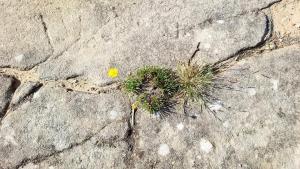
I did a hardcore analysis of how I categorize, purge and/or convey to long-term storage sin, weakness, sorrows, and wounds.
For me, casting off sin is an obvious purge. Scriptures and prophets clearly prescribe the removal of sin’s blot, and I try to repent as quickly as I recognize the need.
I considered weakness the fallout of the Fall, something to be overcome, but not necessarily prohibiting my progress in the same way as sin. The Savior promised that
if men come unto me I will show unto them their weakness. I give unto men weakness that they may be humble; and my grace is sufficient for all men that humble themselves before me; for if they humble themselves before me, and have faith in me, then will I make weak things become strong unto them.
So weakness can and should be cast off and changed by Jesus Christ.
In many ways, I’ve worn my wounds like a badge of honor. “Life did this to me and I’ve survived and you can, too!” As I’ve clung to the iron rod with one hand, I’ve used my free hand to drag my sorrows along behind me in some kind of indestructible burlap bag.
While I’ve fallen at the Savior’s feet pleading for grace and healing, and He has mercifully healed the wounds and sorrows I’ve brought Him and I know I’m a different person, I realized I’ve subconsciously felt like the spirit of the wounds and sorrows would somehow be perpetually near me so I could testify of Christ’s healing or perhaps I kept it near to rationalize relapses of old thinking and behavior.
On my next early morning walk, while still mentally sifting and sorting, I wondered about the options for dealing with healed/healing sorrows and wounds. What other ways existed besides how I dealt with them?
Suddenly my mind’s eye saw an image discarding sorrow’s indestructible burlap bag, leaving it by the wayside. Instead of walking forward, the image moved upward and I saw wound’s “shadow self” fall to the ground. They were cast off!
Words are inadequate to fully express what I learned, but in that moment I could sense that while the image experienced mortality in a telestial way, she could experience and then move through the experiences rather than perpetually dragging the experience with her. As she “putteth off” all the remnants—sins, weakness, wounds, and sorrows—of this world, her natural man, she retained the experiences’ purifying and educative impacts without the baggage weighing her down.
Kintsukuroi = Golden Repair
Same lesson, different metaphor.
Kintsukuroi is
the Japanese art of repairing broken pottery by mending the areas of breakage with lacquer dusted or mixed with powdered gold, silver, or platinum … As a philosophy, it treats breakage and repair as part of the history of an object, rather than something to disguise.
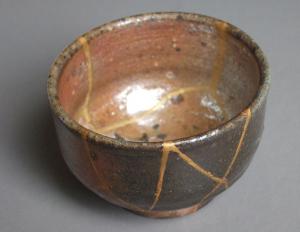
wikicommons image by Haragayato, “Kintugi”
I’ve enjoyed the metaphor of kintsukuroi because I love gold work, but felt some subtle discordance with the metaphor’s complete application. When still trying to understand my lesson, a gold-repaired piece of pottery crossed my mind. Then in an instant, the golden wounds disappeared and the pottery stood complete, whole, and perfect.
Becoming a New Creature
It was a perfect bowl. Then it was broken. Then it was repaired. Then it was perfect, reborn, a new creature.
Therefore if any man be in Christ, he is a new creature: old things are passed away; behold, all things are become new (2 Corinthians 5:17.)
And the Lord said unto me: Marvel not that all mankind, yea, men and women, all nations, kindreds, tongues and people, must be born again; yea, born of God, changed from their carnal and fallen state, to a state of righteousness, being redeemed of God, becoming his sons and daughters; And thus they become new creatures; and unless they do this, they can in nowise inherit the kingdom of God (Mosiah 27:25, 26.)
A new creature … without baggage or visible history but with gained intelligence. And “whatever principle of intelligence we attain unto in this life, it will rise with us in the resurrection.”
A new creature who used this mortal journey to turn to Christ who promised, “Know thou, my [child], that all these things shall give thee experience, and shall be for thy good.”
And it came to pass that when Jesus had said these words he perceived that there were some among them who marveled, and wondered…for they understood not the saying that old things had passed away, and that all things had become new.
And he said unto them: Marvel not that I said unto you that old things had passed away, and that all things had become new (3 Nephi 15:2,3.)
I marveled. And then I learned that as I put off all remnants of the natural man, I can be completely and totally made new in the Healer’s purifying atonement.
Better Choices Through Knowledge
Previous Post

October 4, 2021
Accessing the Power of God During Unprecedented Times
Next Post

October 27, 2021 In the Attitude Of
Browse Our Archives
Select a Category Discovery How Tos Realization Uncategorized
Select a Month September 2026 August 2026 July 2026 June 2026 May 2026 March 2026 February 2026 January 2026 November 2025 October 2025 August 2025 July 2025 June 2025 May 2025 March 2025 February 2025 January 2025 December 2024 November 2024 October 2024 September 2024 August 2024 June 2024 May 2024 March 2024 February 2024 January 2024 December 2023 November 2023 October 2023 September 2023 August 2023 July 2023 June 2023 April 2023 March 2023 February 2023 January 2023 December 2022 November 2022 October 2022 August 2022 July 2022 June 2022 May 2022 April 2022 March 2022 February 2022 January 2022 November 2021 October 2021 September 2021 August 2021 June 2021 May 2021 April 2021 March 2021 February 2021 December 2020 November 2020 October 2020 September 2020 August 2020 July 2020 June 2020 May 2020 April 2020 March 2020 February 2020 December 2019 November 2019 October 2019 September 2019 August 2019 July 2019 June 2019 May 2019 April 2019 March 2019 February 2019 January 2019 December 2018 November 2018 October 2018 September 2018 August 2018 July 2018 June 2018 May 2018 April 2018 March 2018 February 2018 January 2018 December 2017 November 2017
Follow Us!
TAKE THE
Religious Wisdom Quiz
What was the primary form of greeting in Biblical times?
Select your answer to see how you score.
Bow Handshake Kiss Wave
Related posts from Spiritual Truth Seeker - My Tesserae
God, I'm for You | Valeska M. Bushman
Spiritual Truth Seeker – My Tesserae

The Character of God, Enos, & The Family...
Spiritual Truth Seeker – My Tesserae

Spiritual Truth Seeker – My Tesserae
Could Abinadi Have Been a Young Adult?
Spiritual Truth Seeker – My Tesserae
TRENDING AT PATHEOS Latter-day Saint

Did Prayer Cure His Cancer? Or Was It...
At 4 AM one morning, Joshua W. Brown’s wife awoke to a...

8 Ways a Near-Death Experience Rewires the Soul
Does Consciousness Survive Physical Death? After 50 Years of Research, Dr. Raymond...

Holy Longing: What Our Restlessness Is Telling Us
“One can find so many pains when the rain is falling.” -John...

What this is NOT about. This blog is definitely not about...

Who said the Israelites were God’s chosen? That’s right, they did. Who...

The Spirit World Is the Real World: God...
A Monk’s Wisdom on Body and Spirit I sit with Brother Martin...
view all Latter-day Saint blogs
Ad-Free & Subscriber Log-In Subscription Support
- About Us
- 2026 Calendar
- Videos
- Podcasts
- Library of World Religions
- Faith In Media Tracker
- Advertise With Us
- Write for Us
- Privacy Policy
- Terms of Service
- Do Not Sell My Data
- Contact Us
- Radiant Digital
- Manage Newsletter Subscriptions
- Unsubscribe From Notifications
- Sitemap
Copyright 2008-2026, Patheos. All rights reserved.
Subscription Support Ad-Free & Subscriber Log-In
Follow Patheos